


Israel Will Soon Slow or Halt Aid into Parts of Northern Gaza as it Ramps up Offensive

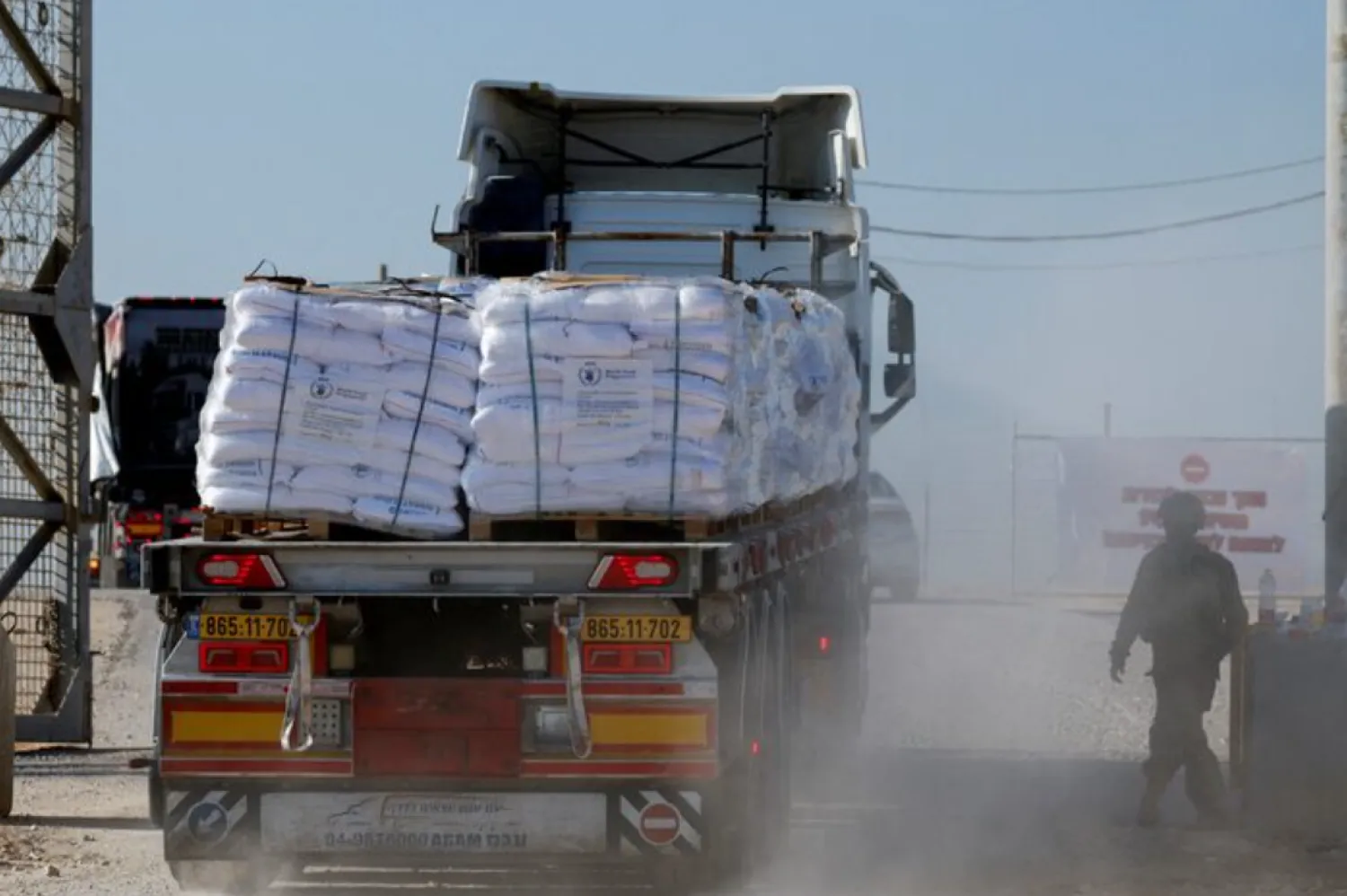
A truck carries humanitarian aid destined for the Gaza Strip, amid the ongoing conflict in Gaza between Israel and Hamas, at the Kerem Shalom crossing in southern Israel, November 11, 2024. REUTERS/Amir Cohen/File Photo
TT

Israel Will Soon Slow or Halt Aid into Parts of Northern Gaza as it Ramps up Offensive

A truck carries humanitarian aid destined for the Gaza Strip, amid the ongoing conflict in Gaza between Israel and Hamas, at the Kerem Shalom crossing in southern Israel, November 11, 2024. REUTERS/Amir Cohen/File Photo

Israel will soon slow or halt humanitarian aid into parts of northern Gaza as it expands its offensive attempting to cripple Hamas, an official said on Saturday.

The official who spoke on condition of anonymity because they were not authorized to speak to the media, told The Associated Press that Israel will stop airdrops over Gaza City in the coming days and reduce the arrival of aid trucks into the northern part of the strip as it prepares to evacuate hundreds of thousands of residents south.

Israel on Friday declared Gaza City a combat zone, calling it a Hamas stronghold and alleging that a network of tunnels remains in use despite several previous large-scale raids on the area throughout the nearly 23-month-long war.

The shift comes weeks after Israel first announced plans to widen its offensive in the city, where hundreds of thousands are sheltering while enduring famine. In recent days, the military has ramped up strikes on the city’s outskirts. AP video footage overnight Friday showed several large explosions across Gaza.

The military's announcement to resume fighting came as the death toll in Gaza rose to more than 63,000 people. On Saturday, four people were killed by Israeli gunfire while trying to get aid in central Gaza, according to health officials at Awda hospital, were the bodies were brought.

It was unclear when the pause in aid would begin and when the airdrops would fully stop. By Saturday there had been no airdrops for several days across Gaza, a break from the almost daily drops for the past few weeks.

Israel's army didn't respond to a request for comment about the airdrops or how it would provide aid to Palestinians as Israel ramped up its offensive.

On Friday, Israeli army spokesperson Avichay Adraee urged Palestinians to flee south, calling evacuation “inevitable.”

Aid groups warn that a largescale evacuation of Gaza City would exacerbate the dire humanitarian crisis.

Earlier this month the leading authority on food crises said that Gaza City was in famine and that half a million people across the strip were facing catastrophic levels of hunger. On Saturday the health ministry in Gaza said 10 people died as a result of starvation and malnutrition over the past 24 hours, among them three children.

“Such an evacuation would trigger a massive population movement that no area in the Gaza Strip can absorb, given the widespread destruction of civilian infrastructure and the extreme shortages of food, water, shelter and medical care,” said Mirjana Spoljaric, president of the International Committee of the Red Cross, in a statement Saturday.

It's impossible that a mass evacuation of Gaza City could be done in a safe and dignified way, she said.

Hundreds of residents have begun leaving Gaza City, piling their few remaining possessions onto pickup trucks or donkey carts. Many have been forced to leave their homes more than once.

The UN said Thursday that 23,000 people had evacuated this past week, but many in Gaza City say there is nowhere safe to go. Others who have been displaced south worry that the area can't support an influx of people.

“There is no food and even water is not available. When it is available, it is not safe to drink," said Amer Zayed as he waited for food from a charity kitchen in the southern city of Deir Al-Balah.

“What exacerbates the situation is the displacement of residents ... The suffering gets worse when there are more displaced people,” he said.



Israel Launches Wave of Fresh Strikes on Lebanon

Smoke and sparks ascend from the site of an Israeli airstrike that targeted a building in the southern Lebanese village of Kfour on January 21, 2026. (AFP)
TT

Israel Launches Wave of Fresh Strikes on Lebanon

Smoke and sparks ascend from the site of an Israeli airstrike that targeted a building in the southern Lebanese village of Kfour on January 21, 2026. (AFP)

Israel launched fresh strikes on what it said were Hezbollah targets in south Lebanon after raids earlier Wednesday killed two people, the latest violence despite a year-old ceasefire with the group.

The state-run National News Agency said Israeli warplanes launched raids on buildings in several south Lebanon towns including Qanarit and Kfour, after the Israeli army issued evacuation warnings to residents identifying sites it intended to strike there.

An AFP photographer was slightly wounded along with two other journalists who were working near the site of a heavy strike in Qanarit.

The Israeli army said it was striking Hezbollah targets in response to the group's "repeated violations of the ceasefire understandings".

Under heavy US pressure and fears of expanded Israeli strikes, Lebanon has committed to disarming Hezbollah.

But Israel has criticized the Lebanese army's progress as insufficient and has kept up regular strikes, usually saying it is targeting members of the Iran-backed group or its infrastructure.

Earlier Wednesday, the health ministry said an Israeli strike on a vehicle in the town of Zahrani, in the Sidon district, killed one person.

An AFP correspondent saw a charred car on a main road with debris strewn across the area and emergency workers in attendance.

Later, the ministry said another strike targeting a vehicle in the town of Bazuriyeh in the Tyre district killed one person.

Israel said it struck Hezbollah operatives in both areas.

A Lebanese army statement decried the Israeli targeting of "civilian buildings and homes" in a "blatant violation of Lebanon's sovereignty" and the ceasefire deal.

It also said such attacks "hinder the army's efforts" to complete the disarmament plan.

This month, the army said it had completed the first phase of its plan to disarm Hezbollah, covering the area south of the Litani river, around 30 kilometers (20 miles) from the Israeli border.

Most of Wednesday's strikes were north of the river.

More than 350 people have been killed by Israeli fire in Lebanon since the ceasefire, according to an AFP tally of health ministry reports.

The November 2024 truce sought to end more than a year of hostilities, but Israel accuses Hezbollah of rearming, while the group has rejected calls to surrender its weapons.


Syria’s Rifaat Al-Assad, ‘Butcher of Hama’, Dies Aged 88, Say Sources

Rifaat al-Assad, uncle of deposed Syrian ruler Bashar al-Assad. (AP file)
TT

Syria’s Rifaat Al-Assad, ‘Butcher of Hama’, Dies Aged 88, Say Sources

Rifaat al-Assad, uncle of deposed Syrian ruler Bashar al-Assad. (AP file)

Rifaat al-Assad, uncle of deposed Syrian ruler Bashar al-Assad and dubbed the "Butcher of Hama" for suppressing an uprising in the 1980s, has died aged 88, two sources close to the family said Wednesday.

Once a pillar of the Assad family's dynastic rule, Rifaat "died after suffering from influenza for around a week", one source who worked in Syria's presidential palace for over three decades told AFP.

A second source, an ex-officer of Syria's army in the Assad era, confirmed the death, saying Rifaat had moved to the United Arab Emirates after his nephew's government was toppled by opposition factions in December 2024, without specifying if he died there.

Rifaat's role in a February 1982 massacre as part of a crackdown on an armed revolt by the Muslim Brotherhood earned him the nickname "the Butcher of Hama", referring to the central Syrian city.

His brother Hafez al-Assad, who ruled Syria at the time, launched the campaign, which government forces carried out under the command of Rifaat, who was the head of the elite "Defense Brigades".

The death toll from 27 days of violence, which took place under a media blackout, has never been formally established, though estimates range from 10,000 to 40,000.

Swiss prosecutors had accused Rifaat of a long list of crimes, including ordering "murders, acts of torture, inhumane treatment and illegal detentions" while an officer in the Syrian army.

He also served as vice president under his brother Hafez but went into exile in 1984 after a failed attempt to overthrow him, moving to Switzerland then France.

He later presented himself as an opponent of his nephew Bashar, who succeeded Hafez in 2000.

In 2021, he returned to Syria from France to escape a four-year prison sentence for money laundering and misappropriation of Syrian public funds.

Two years later, he appeared in a family photo alongside Bashar, the ruler's wife Asma and other relatives.

Shortly after Bashar's ouster, Rifaat crossed into Lebanon and then flew out of Beirut airport, a Lebanese security source said at the time, without specifying his final destination.


Palestinian PM to Asharq Al-Awsat: Gaza Rebuilding Delays Aid Displacement Plans

Palestinian Prime Minister Mohammad Mustafa (Asharq Al-Awsat)
TT

Palestinian PM to Asharq Al-Awsat: Gaza Rebuilding Delays Aid Displacement Plans

Palestinian Prime Minister Mohammad Mustafa (Asharq Al-Awsat)

With a fragile ceasefire holding in the Gaza Strip amid continued Israeli violations and overlapping political and security pressures, Palestinian Prime Minister Mohammad Mustafa has set out a roadmap for the next phase, beginning with urgent humanitarian needs and extending to reconstruction, institution-building, and the reunification of Gaza and the West Bank.


Speaking to Asharq Al-Awsat on the sidelines of the World Economic Forum in Davos, Mustafa tied the provision of “decent housing, even if temporary,” to the launch of reconstruction efforts, the opening of border crossings, the restoration of security, and the prevention of displacement.


Any delay in these steps, he warned, would undermine recovery prospects and advance what he described as Israel’s aim of pushing Gaza’s population to leave.


Delaying these steps, he warned, threatens recovery prospects and serves what he described as Israel’s objective of pushing Gaza’s population to leave.


Decent living basics are a top priority


Mustafa said the progress achieved so far on the Gaza ceasefire “deserves thanks to all international and Arab parties” that helped secure it and set the process toward subsequent steps.


But he stressed that the next phase still requires extensive work and that “everything must start with the basics.”


“People are still dying and suffering under these conditions,” he said. “There is indeed no famine today, but decent housing is not available, even temporarily, at least.” He said Israel “continues to impose restrictions” on this front, calling housing “an absolute priority.”


“We do not want to talk about big things. Let us simplify matters,” Mustafa added. “After food and water, the most basic need is for people to live in a dignified place. We are not asking for apartment buildings or villas, just temporary housing, a ready place, a room of 70 or 100 square meters for a family to live with dignity.”


Two conditions for economic recovery


The Palestinian prime minister said the second step after providing temporary housing was “seriously thinking about launching economic recovery and reconstruction, even in their initial stages.”


While acknowledging that arrangements are complex, he said they hinge on two essential conditions: opening the crossings and restoring security.


“Without opening the crossings, construction materials will not enter, and without security, there will be no reconstruction, no economy, nothing at all,” he said.


He added that the next step must be to allow crossings to open for the entry of construction materials and to begin repairing infrastructure to restore basic services, stressing that this “necessarily requires improving the security situation.”


Security and institution-building


Mustafa said improving security must be based on recognizing that the current situation is temporary and that, “ultimately, after around two years, full authority must return to the Palestinian Authority.”


“We want to build all institutions, including the security institution, and we are taking this into account,” he said.


In this context, he said efforts were underway to accelerate work with partners, particularly Egypt, Europeans, and Jordan, to reestablish or strengthen the Palestinian security force, especially the Palestinian police, so that it can maintain security in Gaza.


He added that an international military peace force, if deployed, could provide additional support and help preserve calm with Israel.


Unifying institutions between Gaza and the West Bank


Mustafa said the government is working to develop the performance of institutions in Gaza so they can carry out their duties in delivering services to citizens, but within unified institutional and legal frameworks linking Gaza and the West Bank.


He said the ultimate goal is the unity of Gaza and the West Bank as a step toward establishing a Palestinian state, as agreed at the New York conference led by Saudi Arabia and France, and as outlined in President Donald Trump’s plan and UN Security Council Resolution 2803.


That resolution, he said, stipulates that the process begins with a ceasefire and ends with self-determination and the establishment of a Palestinian state.


Asked whether displacement plans still pose a real threat, Mustafa said: “We hope displacement will not be real and will not succeed. But to ensure its failure, we must achieve what we talked about: reconstruction, relief, housing, and security.”


“How can people live?” he asked, warning that the absence of these fundamentals would push people to look for any opportunity to leave, which he said is what Israel wants.