

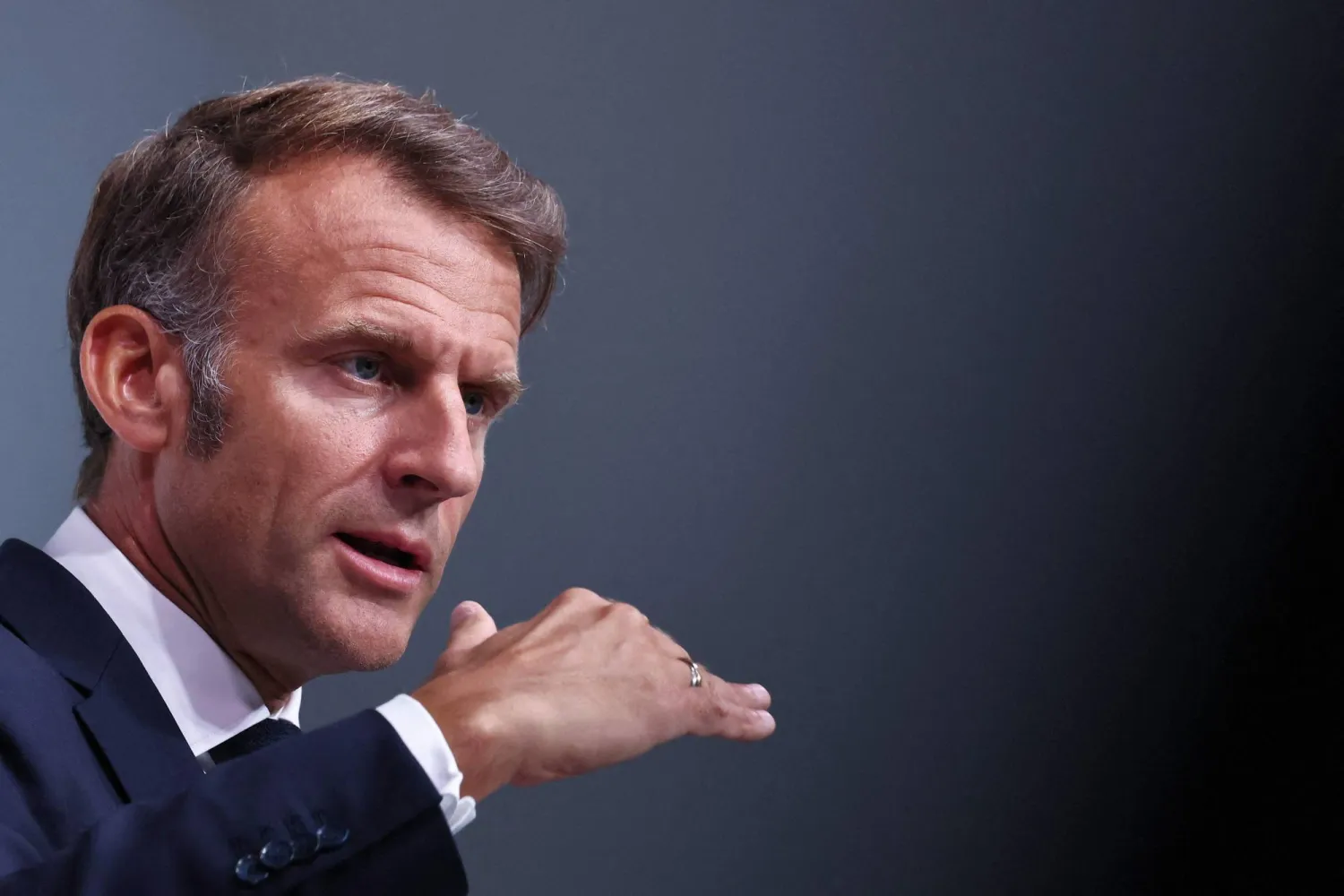

Macron's Decision to Recognize a Palestinian State in September Angers Israel and the US

File: France's President Emmanuel Macron attends a joint press conference with German Chancellor as part of the 25th Franco-German cabinet meeting and a meeting of the Franco-German Defense and Security Council (CFADS) in Toulon, south-eastern France, on August 29, 2025. (Photo by Manon Cruz / POOL / AFP)
TT

Macron's Decision to Recognize a Palestinian State in September Angers Israel and the US

File: France's President Emmanuel Macron attends a joint press conference with German Chancellor as part of the 25th Franco-German cabinet meeting and a meeting of the Franco-German Defense and Security Council (CFADS) in Toulon, south-eastern France, on August 29, 2025. (Photo by Manon Cruz / POOL / AFP)

French President Emmanuel Macron’s decision to recognize a Palestinian state, prompting similar moves from other Western nations, angered Israel and its US ally by putting a two-state solution back at the heart of diplomatic efforts to end the devastating war in Gaza.

In a letter to Israeli Prime Minister Benjamin Netanyahu last week, Macron wrote that “our determination to see the Palestinian people have their own state is rooted in our conviction that lasting peace is essential to the security of the state of Israel.”

France’s diplomatic efforts “stem from our outrage at the appalling humanitarian disaster in Gaza, for which there can be no justification,” Macron added. Israel on Friday declared Gaza’s largest city a combat zone as the death toll surpassed 63,000 Palestinians, according to the territory's Health Ministry, since the war started on Oct. 7, 2023, with a Hamas-led attack on Israel.

France, the UK, Canada, Australia and Malta have said they would formalize their pledge during the annual gathering of world leaders at the UN General Assembly, which starts Sept. 23. Some others, including New Zealand, Finland and Portugal, are considering a similar move.

Netanyahu rejects Palestinian statehood and plans to expand the military offensive in Gaza.

Israel and US say recognizing a Palestinian state emboldens militants

Macron’s letter comes after Netanyahu accused him of “fueling” the “antisemitism fire” with his call for a Palestinian state, remarks Macron denounced as “abject.”

Last week, US Ambassador to France Charles Kushner also wrote a letter arguing that "gestures toward recognition of a Palestinian state embolden extremists, fuel violence and endanger Jewish life in France.” Kushner was summoned by the French foreign ministry and represented in his absence by his deputy.

Such angry reaction “shows that symbols matter,” said geopolitics expert Pascal Boniface, director of the Paris-based Institute for International and Strategic Relations. “There is some kind of race against time between the diplomatic path, with the two-state solution back at the heart of the debate, and the situation on the ground (in Gaza), which is every day making this two-state solution a little more complicated or impossible.”

Boniface said some supporters of a two-state solution showed disappointment at leaders' decision to wait until September to officially recognize a Palestinian state, because they "fear that recognition will come when Gaza has even more become a graveyard.”

Calls on Israel to stop the Gaza offensive Macron and other international leaders have urged Israel to stop its offensive in the besieged territory, where most of its over 2 million residents are displaced, neighborhoods lie in ruins and a famine has been declared in Gaza City.

“The occupation of Gaza, the forced displacement of Palestinians, their reduction to starvation ... will never bring victory to Israel," Macron wrote in his letter to Netanyahu. "On the contrary, they will reinforce the isolation of your country, fuel those who find pretext for antisemitism, and endanger Jewish communities around the world.”

More than 140 countries already recognize a Palestinian state in what is a mostly symbolic move.

“The world will be the same the day after,” said Muhammad Shehada, a Gaza political analyst and visiting fellow at the European Council on Foreign Relations think tank.

Still, it adds diplomatic pressure on Israel, he stressed. Heavyweight Western nations demonstrating strong support for a two-state solution “shatters the illusion that Netanyahu is trying to sell to the Israelis and to the international community that mass population transfer or depopulation is the only way to solve the Palestinian issue,” Shehada said.

Strengthening moderate Palestinians

French Foreign Minister Jean-Noël Barrot insisted this week that diplomatic efforts resulted, for the first time, in highly significant condemnation of the Hamas attacks against civilians by all 22 members of the Arab League.

During a July conference co-hosted by France and Saudi Arabia at the UN, Arab League nations agreed in their New York Declaration that “Hamas must end its rule in Gaza and hand over its weapons to the Palestinian Authority.”

Shehada expects the move to strengthen the camp of moderate Palestinians, including by demonstrating to the public that the Palestinian Authority is gaining weight in negotiations.

He said it may weaken the most violent leadership in Hamas by “creating a diplomatic track that provides Palestinians with an alternative to violence, sending a message that diplomatic engagement will pay off and will lead to a Palestinian state, whereas violence will not take you anywhere.”

The Palestinian Authority hopes to establish an independent state in the West Bank, east Jerusalem and Gaza — areas captured by Israel in the 1967 Mideast war. Hamas drove out the PA when it seized Gaza in 2007, a year after winning Palestinian parliamentary elections. After the Hamas takeover of Gaza, the PA was left with administering semiautonomous pockets of the Israeli-occupied West Bank



Mladenov Shuttle Talks between Israel and Ramallah Hasten Gaza Administration Committee

A general view shows the destruction in the Bureij refugee camp in central Gaza (AFP)
TT

Mladenov Shuttle Talks between Israel and Ramallah Hasten Gaza Administration Committee

A general view shows the destruction in the Bureij refugee camp in central Gaza (AFP)

Nickolay Mladenov, the man chosen to serve as the director-general for US President Donald Trump's Board of Peace in Gaza, discussed arrangements for the second phase of the ceasefire agreement with Palestinian Vice President Hussein al-Sheikh.

The meeting, which took place a day after Mladenov met with Israeli Prime Minister Benjamin Netanyahu, was viewed by experts speaking to Asharq Al-Awsat as increasing the chances of launching the second phase and announcing the formation of a body to administer Gaza.

Netanyahu had announced the selection of Bulgarian diplomat Mladenov, the former United Nations Middle East envoy from early 2015 until the end of 2020, to serve as director general of the Board of Peace, chaired by US President Donald Trump and tasked with overseeing the peace process in Gaza.

Al-Sheikh received Mladenov and his accompanying delegation on Friday at his office in the West Bank city of Ramallah, in the presence of Maj. Gen. Majed Faraj, head of the General Intelligence Service, according to the Palestinian News Agency, which did not describe Mladenov by his new American-appointed title.

The meeting discussed “the role of the Palestinian administrative committee and Palestinian police and security forces in assuming their duties and linking them to the Palestinian Authority, the holder of sovereignty and legitimacy, as well as ways to implement the second phase of President Trump’s plan as the announcement of the Board of Peace approaches.”

Al-Sheikh stressed the need to begin implementing the second phase, underlining the importance of a full Israeli withdrawal from the Gaza Strip as part of that phase, which includes ending Hamas rule, handing over its weapons, and moving toward reconstruction under President Trump’s plan.

He also stressed that the Gaza Strip is an integral part of the State of Palestine, highlighting the importance of political, administrative, and legal linkage between Palestinian institutions in Gaza and the Palestinian National Authority in the West Bank, and respect for the principle of one authority, one law, and one legitimate weapon.

Al-Sheikh said that while a transitional plan is being implemented in Gaza, there must be an urgent plan to halt all unilateral actions that violate international law, foremost among them settlement expansion, settler violence, and the release of withheld Palestinian funds.

On Thursday evening, the Israeli prime minister’s office said in a statement that Netanyahu insisted on the need to disarm Hamas and demilitarize Gaza, describing both as conditions under the Trump administration’s 20-point ceasefire plan.

Tarek Fahmy, a professor of political science specializing in Palestinian and Israeli affairs, said Mladenov is a professional diplomat with a good reputation and will be the board’s appointed director, despite being ranked second after former British Prime Minister Tony Blair, who did not enjoy widespread Arab acceptance.

Fahmy said Mladenov is “preparing the ground and accelerating steps toward announcing a technocratic committee under Palestinian leadership.”

Palestinian political analyst Abdul Mahdi Moutawe said Mladenov is not new to Gaza, noting his previous role at the UN in the Middle East.

He said Mladenov met Netanyahu and al-Sheikh to gauge positions and narrow differences in order to reach understandings leading to partial Palestinian administration of Gaza, which would expand as progress is made in the second phase, and depending on the ability to resolve obstacles, particularly those related to disarming Hamas and the enclave.

Under Trump’s 20-point peace plan for Gaza, the territory would be governed by a temporary Palestinian transitional committee composed of nonpartisan technocrats, under the supervision and oversight of the Board of Peace.

The US website Axios cited American officials and informed sources as saying Trump is expected to announce the Board of Peace this week as part of the second phase of the ceasefire agreement reached between Israel and Hamas, which took effect on Oct. 10.

Egyptian Foreign Minister Badr Abdelatty, in a phone call with UN Secretary-General Antonio Guterres on Thursday evening, stressed the importance of an Israeli withdrawal from Gaza, the announcement of a temporary Palestinian technocratic committee to administer the enclave, and the formation of an international stabilization force.

Fahmy expects the Board of Peace to be announced in the coming days, alongside pressure to announce the committee and avoid objections to proposed names, in order to begin implementing the second phase in earnest and away from any Israeli maneuvering or obstruction.

Moutawe believes the board and the administrative committee will be announced this week, allowing them to move forward with the second phase and begin its actual implementation.


Southern Transitional Council Dissolution Paves Way for Calm South Yemen Talks

A member of Yemeni government forces mans a machine gun on a pick-up truck while on patrol outside the headquarters of the Central Bank of Yemen in the southern port city of Aden, Yemen, 08 January 2026. (EPA)
TT

Southern Transitional Council Dissolution Paves Way for Calm South Yemen Talks

A member of Yemeni government forces mans a machine gun on a pick-up truck while on patrol outside the headquarters of the Central Bank of Yemen in the southern port city of Aden, Yemen, 08 January 2026. (EPA)

As Yemen’s government, led by the Presidential Leadership Council, moves to consolidate military and security authority in the south under the defense and interior ministries, it is seeking to contain the fallout from recent turmoil, prevent a return to rebellion, and avert a slide back into violence.

At the same time, political and social forces across the south face mounting pressure to revive a stalled political process capable of delivering practical and equitable solutions to crises, foremost among them the southern issue.

Recent developments, foremost among them the dissolution of the Southern Transitional Council itself, which occurred days after its head, Aidrous al-Zubaidi, fled Yemen have brought about a shift in the political and security power balances.

They have opened the way for a phase marked by the absence of major divisions, allowing space for calm arrangements and dialogue, with focus on the southern issue, amid fears of renewed unrest.

While Zubaidi’s exit and the folding of the Southern Transitional Council mark the end of a project that lasted more than eight years before sliding into chaos and violence in recent weeks, the legitimate government and the Saudi-led Arab coalition have shown significant flexibility toward its leaders.

Atiq Bahuqayba, a leader in the Socialist Party in Hadhramaut, has called for the implementation of what Rashad al-Alimi, chairman of the Presidential Leadership Council, stated during his visit to Hadhramaut in mid-2023, when he promised that the province would manage its own affairs fully.

Flexible governance

No southern settlement can pass without Hadhramaut playing an active role and having the most prominent voice in shaping it, especially in light of the events and developments it has witnessed, which explains the intensified political and security activity there in recent weeks.

Bahuqayba told Asharq Al-Awsat that the Hadhramaut Tribes Alliance remains committed to self-rule for the province, describing it as one of the core demands of its residents and its various political and social forces.

He said recent events involving forces from outside the province nearly dragged it into security and military chaos, were it not for the firmness of presidential decisions and Saudi intervention.

He added that the southern dialogue conference called for by Riyadh carries major importance for Hadhramaut and the south at this sensitive juncture, requiring all Hadhrami forces to participate effectively, while aligning with the local authority led by Governor Salem al-Khanbashi and the commander of the Nation Shield Forces in the province.

Once again, following the dissolution of the Southern Transitional Council, the southern issue has been returned to the fore. It opens the door to tangible gains on the ground, provided there is southern leadership capable of managing reality rather than retreating into violent rhetoric.

Developments over the years in Yemen have shown that engaging seriously with southern demands is more effective than ignoring or confronting them. Flexible governance enables stability and prevents the opening of new fronts, without undermining calls for justice and fairness.

Ali al-Khawlani, a Yemeni academic and political researcher, told Asharq Al-Awsat that the opportunity is now available for political action away from unilateral actions, after recent events demonstrated that there would be no tolerance for attempts to divide Yemen or for practices that harm the national security of neighboring countries, particularly those resembling the behavior of the Houthi group, which required a forceful response.

Al-Khawlani, who heads the Independent Yemeni Center for Strategic Studies, said that the dissolution of the Southern Transitional Council, following its leaders' agreement to participate in a south-to-south dialogue, places all southern forces under the responsibility of participating in decision-making.

He warned against any adventurism that could harm regional security or involve cooperation with forces seeking to sow chaos and instability.

Promoting a model

Political and social forces in Hadhramaut have pushed toward formulating solutions that are more sustainable, rejecting both the dismantling of the Yemeni state and a full return to pre-war centralization.

This has been prompted by calls for self-administration in southern provinces, led by the country’s largest province.

Hadhramaut plays a pivotal role in the country’s future, both generally and in the south in particular, as the province that has seen more stability than others during the war, despite complex circumstances. It is also the most attractive to governance models that move away from rigid centralization.

Ahlam Jaber, a political activist in the city of Mukalla, expects the upcoming dialogue conference in Riyadh to lead to a reordering of the southern political landscape on fair foundations that recognize realities on the ground, with Hadhramaut playing an effective role.

Jaber told Asharq Al-Awsat that Hadhramaut represents a model that could extend to other provinces, not only in the south, but across Yemen.

This, she said, would help untangle long-standing challenges and adjust approaches to managing crises. She pointed to the presence of a local authority that represents the province, a tribal alliance with significant social and security influence, as well as social, economic, academic, and administrative figures capable of shaping visions and setting strategies.

The post-Southern Transitional Council phase does not represent a political vacuum, but a repositioning. Backed by the firmness of the legitimate authority and support from the Saudi-led coalition, the south is moving toward a phase of stability that awaits a political resolution and a comprehensive settlement without renewed security tensions.


Syria Urges Kurdish Fighters to Surrender after Ramping Up Aleppo Operation

TOPSHOT - Residents of Aleppo's Sheikh Maqsud area evacuate their neighborhood after warnings from the Syrian army that called on civilians to get out of harms way, following the refusal of Kurdish fighter forces to leave Aleppo, on January 9, 2026. (Photo by OMAR HAJ KADOUR / AFP)
TT

Syria Urges Kurdish Fighters to Surrender after Ramping Up Aleppo Operation

TOPSHOT - Residents of Aleppo's Sheikh Maqsud area evacuate their neighborhood after warnings from the Syrian army that called on civilians to get out of harms way, following the refusal of Kurdish fighter forces to leave Aleppo, on January 9, 2026. (Photo by OMAR HAJ KADOUR / AFP)

Syria's army said its operation in a Kurdish neighborhood of Aleppo was nearing completion early Saturday and urged fighters from the minority to surrender themselves and their weapons.

Government forces began striking the Sheikh Maqsud district overnight after the Kurdish fighters defied a deadline to withdraw during a temporary ceasefire.

A military source told the official SANA news agency that the combing operation in Sheikh Maqsud was "more than 90 percent" complete, and that "a number of SDF members" had been arrested.

In a statement posted by the Ministry of Defense, Syria's army said "the only remaining option for the armed elements in the Sheikh Maqsud area of Aleppo is to surrender themselves and their weapons immediately".

The violence in Syria's second city erupted after efforts to integrate the Kurds' de facto autonomous administration and military into the country's new government stalled.

Since the start of the fighting on Tuesday, at least 21 civilians have been killed, according to figures from both sides, and tens of thousands have fled Aleppo.

The clashes, some of the most intense since Syria's new authorities took power, present yet another challenge as the country struggles to reunify after ousting longtime ruler Bashar al-Assad in December 2024.

Both sides blame the other for starting the violence.

Early Friday, Syrian authorities announced a six-hour window for the Kurdish fighters to leave, but they instead refused to "surrender" and vowed to defend their districts.

In response, Syria's army warned it would renew strikes on military targets in Sheikh Maqsud and urged civilians to get out ahead of the district's takeover by security forces.

An AFP correspondent saw residents laden with belongings fleeing before the two-hour humanitarian corridor closed.

Kurdish forces reported coming under artillery and drone attacks and claimed in a post on social media to be mounting a "fierce and ongoing resistance".

The army said three soldiers had been killed by Kurdish forces, while state television accused them of launching drones on residential areas of Aleppo.

A flight suspension at Aleppo airport was extended until late Saturday.

The SDF controls swathes of Syria's oil-rich north and northeast, and was key to the defeat of the ISIS group in 2019.

But Ankara views its main component as an extension of the Kurdistan Workers' Party (PKK), which agreed last year to end its four-decade armed struggle against Türkiye.

Elham Ahmad, a senior official in the Kurdish administration in Syria's northeast, accused Syria's authorities of "choosing the path of war" by attacking Kurdish districts and of "seeking to put an end to the agreements that have been reached".

"We are committed to them and we are seeking to implement them," she told AFP.

The March integration agreement was meant to be implemented last year, but differences, including Kurdish demands for decentralized rule, have stymied progress.

Ahmad said that "the United States is playing a mediating role... we hope they will apply pressure to reach an agreement".

A diplomatic source told AFP that US envoy Tom Barrack was headed to Damascus.

Türkiye, which shares a 900-kilometer (550-mile) border with Syria, has launched successive offensives to push Kurdish forces from the frontier.

Syrian President Ahmed al-Sharaa discussed the situation in a call with Turkish leader Recep Tayyip Erdogan and said he was determined to "end the illegal armed presence" in the city, a Syrian presidency statement said.

UN spokesperson Stephane Dujarric expressed alarm over the impact of the fighting on civilians and called on all parties "to swiftly return to negotiations to ensure the full implementation of the 10 March agreement".

Nanar Hawach, senior Syria analyst at the International Crisis Group, said the renewed clashes cast doubt on the government's ability to gain the trust of minority factions and sow the country back together after 14 years of civil war.

"If the fighting escalates, international actors will wonder about Damascus's capacity to govern Syria's heterogeneous society," he added.

Syria's authorities have committed to protecting minorities, but sectarian bloodshed rocked the Alawite and Druze communities last year.