
The Lebanese Army has finalized a comprehensive plan, mandated by the Cabinet on August 5, to ensure that all weapons are brought under state authority by the end of this year. The strategy, completed more than two weeks ago, will be presented on Friday by Army Commander General Rodolphe Haykal.
The proposal has drawn significant domestic, regional, and international interest, and the army has kept its contents tightly guarded. However, sources told Asharq Al-Awsat that the plan is structured in stages, each with its own deadline. The Cabinet had explicitly requested that the disarmament process be completed by year’s end, but any delay in approving or launching the plan will inevitably affect the timeline.
Senior political sources did not rule out abandoning the deadlines altogether to ease “growing tensions within the Shiite community.” They suggested that Friday’s Cabinet session could mirror the standoffs of August 5 and 7, when ministers from the Shiite bloc refused to discuss the plan, citing continued Israeli attacks and occupation of Lebanese territory. In such a scenario, the ministers could withdraw, allowing the government to adopt the plan in their absence.
Designed for Implementation
According to the same sources, the army’s proposal assumes cooperation and coordination with Hezbollah to ensure smooth implementation, similar to arrangements south of the Litani River. This does not mean conceding to the status quo, they stressed; rather, the plan was drafted with the intention of being carried out, incorporating multiple scenarios to secure its success. It is built on the premise that Lebanon’s sole enemy is Israel.
Officials involved in the process acknowledge that the final word is political, not military. Without Israel’s engagement in the “step-for-step” approach outlined in the US proposal - whose objectives Lebanon has accepted - the plan risks remaining “ready but on hold” until Tel Aviv makes a reciprocal move.
Counting on US Mediation
Beirut continues to pin its hopes on US envoys Tom Barrack and Morgan Ortagus to secure concessions from Israel, which would make it easier to persuade Hezbollah to cooperate with the army’s plan.
Despite the hardline stance shown by the American delegation during its recent visit to Beirut, Barrack made notable comments afterward, saying he had urged Israeli Prime Minister Benjamin Netanyahu to give Lebanon “a chance, with some tolerance and understanding.”
Political Coordination
For now, direct coordination between the army and Hezbollah is limited to the area south of the Litani, where most operational tasks have already been completed. Hezbollah was not directly involved in drafting the plan, with the political leadership - particularly the presidency - handling this track, which has recently been reactivated.
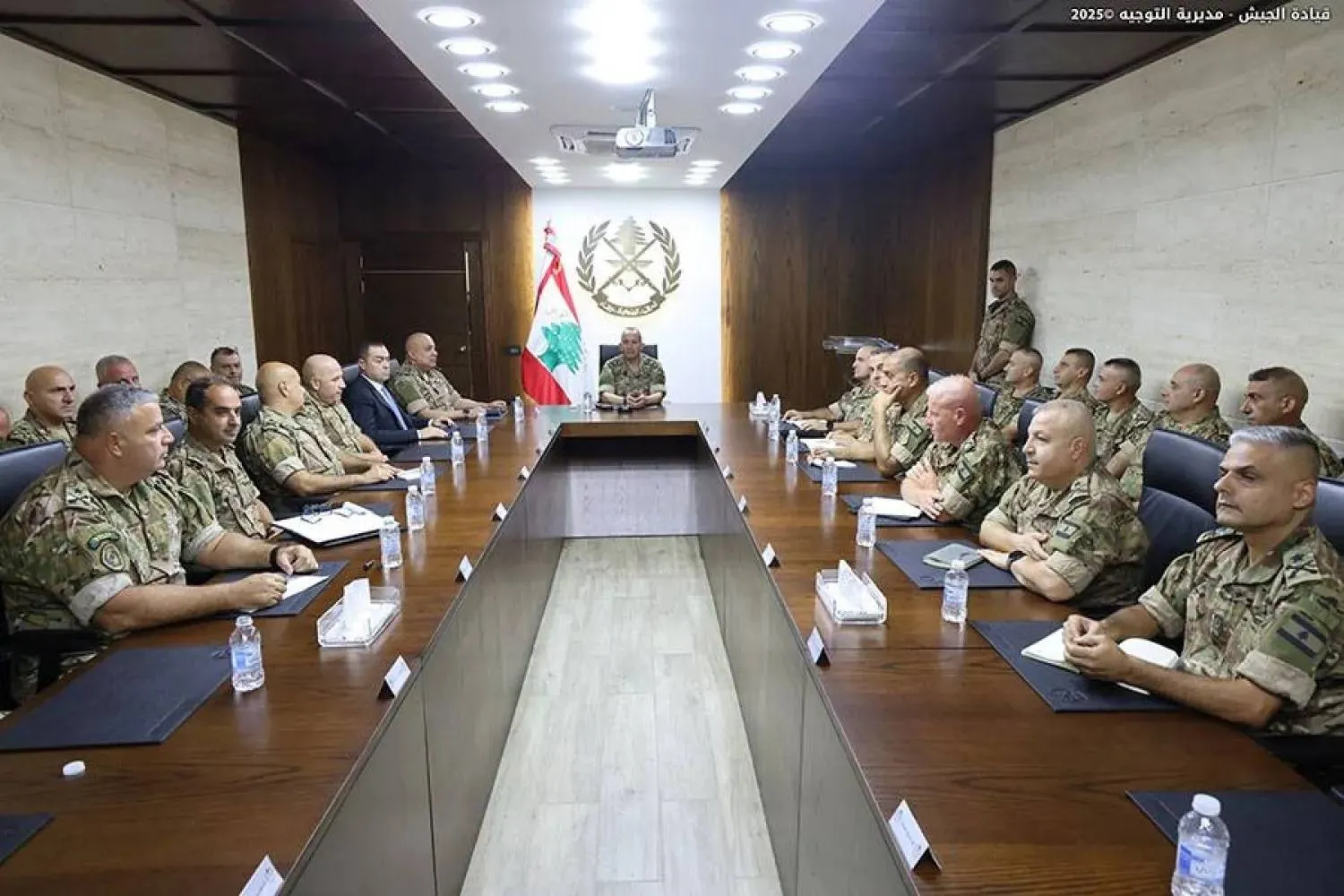
At a special meeting with senior officers, Haykal acknowledged that the army is “entering a delicate phase, entrusted with sensitive missions,” and pledged to take the necessary steps to ensure success while preserving civil peace and domestic stability.
A Gradual Approach
Retired Brigadier General George Nader told Asharq Al-Awsat that the plan is designed for gradual implementation, beginning south of the Litani, as stipulated in the ceasefire resolution, and extending to all Lebanese territory. “Each phase comes with its own timetable, making the plan both geographically and temporally structured,” he explained.
Nader added that successful implementation requires Hezbollah’s prior approval to cooperate, along with intelligence data on weapons stockpiles, which would make the process “smooth and feasible.”