


UNIFIL Slams Israeli Drone Attack on Peacekeepers in South Lebanon

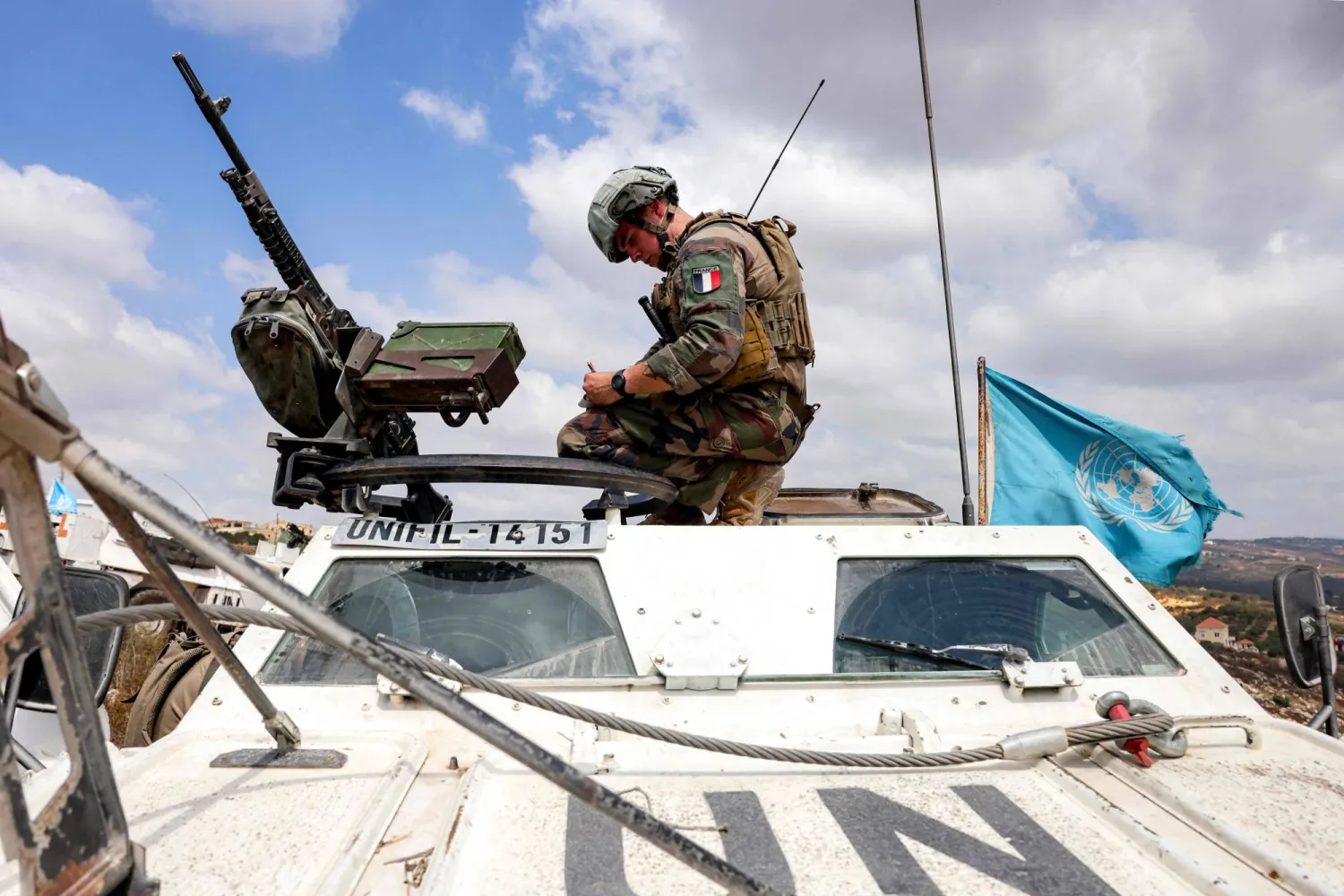
A French peacekeeper of the United Nations Interim Force in Lebanon (UNIFIL) sits atop a stopped armored vehicle during a patrol in the village of Kfar Kila in southern Lebanon near the border with northern Israel on August 27, 2025. (Photo by ANWAR AMRO / AFP)
TT

UNIFIL Slams Israeli Drone Attack on Peacekeepers in South Lebanon

A French peacekeeper of the United Nations Interim Force in Lebanon (UNIFIL) sits atop a stopped armored vehicle during a patrol in the village of Kfar Kila in southern Lebanon near the border with northern Israel on August 27, 2025. (Photo by ANWAR AMRO / AFP)

Israeli drones dropped four grenades close to UN peacekeepers in southern Lebanon near the border with Israel as they were working to clear roadblocks, the force said Wednesday. No one was hurt in the attack. 

The UN Interim Force in Lebanon (UNIFIL) described the Tuesday morning incident as “one of the most serious attacks on UNIFIL personnel and assets” since the cessation of hostilities in November that ended the 14-month Israel-Hezbollah war. 

The Israeli military said later Wednesday that it did not intentionally target the peacekeepers but dropped several sonic bombs near a suspect in a border area. It added that contact was made with the peacekeeping force and explained the details of what happened. 

UNIFIL said one grenade hit within 20 meters (65 feet) and three others within approximately 100 meters (330 feet) of UN personnel and vehicles, adding the drones were observed returning toward Israel. 

UNIFIL said the Israeli military had been informed in advance of the peacekeeping force’s road clearance work in the area, southeast of the village of Marwahin and less than a kilometer (mile) from the border line. 

“Out of concern for the safety of peacekeepers following the incident, yesterday’s work was suspended,” UNIFIL said. 

France, which has a large force within UNIFIL, condemned the attack, saying that the “respect of its members applies to all parties without exception.” 

Qatar called it a “grave violation of international humanitarian law” and the UN Security Council resolution that ended the Israel-Hezbollah war. 

The attack came after the UN Security Council voted unanimously last week to terminate the UN peacekeeping force in southern Lebanon at the end of next year after nearly five decades, bowing to demands from the United States and Israel. 

The multinational peacekeeping force has played a significant role in monitoring the security situation in southern Lebanon for decades, including during the Israel-Hezbollah conflict. It has also drawn criticism from both sides and from officials in US President Donald Trump’s administration, which has moved to slash US funding for the operation as Trump remakes America’s approach to foreign policy. 

The Israel-Hezbollah war killed over 4,000 people in Lebanon, including hundreds of civilians, and caused destruction worth $11 billion, according to the World Bank. In Israel, 127 people died, including 80 soldiers. 

UNIFIL said any actions that endanger peacekeepers and assets or interfere with their tasks are unacceptable and a serious violation of international law and the resolution that ended the war. It added it is the Israeli military's responsibility to ensure the safety and security of the peacekeepers performing Security Council-mandated tasks. 

The Israeli military said its troops carried out an operation inside Lebanon on the edge of the disputed Shebaa Farms, where they detonated artillery pieces that were used by Hezbollah members during the war.  

Shebaa Farms was captured by Israel from Syria during the 1967 Mideast war, but Lebanon considers it and the nearby Kfar Shouba hills as Lebanese territories. 



Syria Restructures Security Authority in Response to Pressure

12 July 2026, Syria, Damascus: Syrian President Ahmed al-Sharaa attends the inaugural session of Syria's newly formed People's Assembly in Damascus. (Syrian Presidency)
TT

Syria Restructures Security Authority in Response to Pressure

12 July 2026, Syria, Damascus: Syrian President Ahmed al-Sharaa attends the inaugural session of Syria's newly formed People's Assembly in Damascus. (Syrian Presidency)

A sweeping round of senior security appointments announced Sunday by Syrian President Ahmed al-Sharaa amounts to a fundamental restructuring of the country’s security apparatus, driven by both domestic security concerns and mounting political and economic pressure from abroad, according to Syrian security and strategic affairs analyst Ismat al-Absi.

Speaking to Asharq Al-Awsat, al-Absi said the appointments reflect a clear effort to consolidate security authority in the hands of al-Sharaa and Interior Minister Anas Khattab by placing both Public Security, including policing and internal security, and National Security under a single command.

The move effectively ends the institutional divide and potential rivalry between the Interior Ministry and the intelligence services, making Khattab the sole authority overseeing both strategic and operational security decision-making, al-Absi said.

Hussein al-Salama will assume an executive role reporting directly to Khattab on national security affairs, while the General Intelligence Directorate will be headed by Abdul Qader Tahan within the unified structure.

Al-Absi said the appointments also mark a broader institutional overhaul, noting that the changes are intended to bring the transitional phase to a close by establishing a unified centralized security structure after concerns over overlapping authorities among agencies with different backgrounds, including Hayat Tahrir al-Sham (HTS) and the Syrian Democratic Forces (SDF).

According to al-Absi, the immediate catalysts were recent security pressures, including bombings in Damascus and the interception of weapons allegedly being smuggled from Iraq to Hezbollah in Lebanon.

He said the attacks and the foiled smuggling operations exposed gaps in interagency coordination, border security, and urban surveillance.

The Damascus bombings occurred during French President Emmanuel Macron’s July 6-7 visit - the first by a major Western head of state since al-Sharaa took office in late 2024 - when two explosive devices detonated a few hundred meters from the Four Seasons Hotel, where Macron was staying.

Syrian authorities later announced the arrest of the cell responsible, with preliminary investigations indicating it was affiliated with ISIS.

Economic researcher Firas Shaabo said the security restructuring is also intended to create a safe and stable environment for investment.

He explained that unifying the country’s top security leadership would reduce institutional fragmentation and strengthen coordination, making the changes an integral part of Syria’s broader economic vision.

Given the National Security Office broad oversight powers, the restructuring could reinforce stability, remove obstacles to development and reconstruction, attract foreign investment, stimulate the domestic economy, and reassure the international community and regional partners of the state’s ability to maintain internal stability, he added.


Al-Zaidi Hails Washington Visit as Iran Distances Itself from Criticism

President Donald Trump, gestures as he greets Iraq's Prime Minister Ali al-Zaidi at the White House, Tuesday, July 14, 2026, in Washington. (AP)
TT

Al-Zaidi Hails Washington Visit as Iran Distances Itself from Criticism

President Donald Trump, gestures as he greets Iraq's Prime Minister Ali al-Zaidi at the White House, Tuesday, July 14, 2026, in Washington. (AP)

Iraqi Prime Minister Ali al-Zaidi praised the outcome of his Washington visit amid broad public support but political divisions at home. Iran, meanwhile, officially distanced itself from critical remarks of the visit made by Ali Akbar Velayati, an adviser to its supreme leader.

Velayati had described al-Zaidi as “inexperienced” and also slammed the timing of the visit as it took place shortly after the days-long funeral of slain Iranian Supreme Leader Ali Khamenei, who was killed at the beginning of the US-Israel war on Iran.

Tehran sought to distance itself from his comments with Foreign Minister Abbas Araghchi informing his Iraqi counterpart Fuad Hussein on Sunday that bilateral ties should not be affected by “personal and unofficial” remarks.

He described Iranian-Iraqi ties as deep-rooted and strategic, underpinned by historical, cultural and religious ties and shared interests.

Concluding his five-day US trip, al-Zaidi thanked President Donald Trump’s administration and the American people for their warm reception.

“Our government remains determined to translate the strategic economic partnership between the two friendly countries into reality,” he wrote on X, citing the agreements and memorandums of understanding signed during the visit.

He said they could usher in a new phase of bilateral relations based on shared interests, while strengthening coordination to promote stability and prosperity in Iraq and the wider region.

Iraq and the United States signed 48 agreements during the visit that require parliamentary approval. Memorandums of understanding signed alongside them can take effect without ratification.

Opponents of the visit, particularly Iran-aligned armed factions, viewed the outcome with suspicion. They fear that implementing even some of the deals could elevate Baghdad’s relationship with Washington, while diminishing cooperation with Tehran, particularly following an agreement between Iraq’s central bank and the US Treasury aimed at curbing the smuggling of funds to Iran.

Al-Zaidi described the banking agreement as an important step toward reforming the financial sector and integrating it into the global system.

He said seven Iraqi banks had been cleared to resume foreign correspondent banking in currencies other than the dollar, paving the way for restoring their eligibility to conduct US dollar transactions once compliance and governance requirements are met.

Abdulrahman al-Jubouri, head of the Academy for Political Development and Good Governance, told Asharq Al-Awsat implementing the visit’s agenda would signal that Iraq had abandoned its traditional balanced policy in favor of closer alignment with the West.

Talib Mohammed Karim, a professor of political thought at Mustansiriyah University, was more cautious. In remarks to Asharq Al-Awsat, he said it was too early to speak of a fundamental shift in Iraqi-US relations, but the visit represented an attempt to “redefine” them by moving beyond security and military issues toward economic, investment and energy cooperation.


Iraqi PM to Visit Tehran This Week

Iraqi Prime Minister Ali al-Zaidi attends a meeting with US President Donald Trump (not pictured) in the Oval Office of the White House in Washington, DC, USA, 14 July 2026. (EPA)
TT

Iraqi PM to Visit Tehran This Week

Iraqi Prime Minister Ali al-Zaidi attends a meeting with US President Donald Trump (not pictured) in the Oval Office of the White House in Washington, DC, USA, 14 July 2026. (EPA)

Iraqi Prime Minister Ali al-Zaidi will visit Tehran ‌within ‌the coming ‌week, ⁠the Iraqi state ⁠news agency reported on ⁠Sunday.

During ‌the visit, ‌the prime minister will ‌sign memoranda of ⁠understanding in ⁠Tehran in areas of cooperation.

Al-Zaidi had visited the United States earlier this week where he met with President Donald Trump.

Trump praised the new PM, saying the US is “going to have a long-term relationship with Iraq. We're going to have a long-term relationship with a man that will be a great leader.”

“It's a great honor to have the Prime Minister of Iraq with us. He's been a great fighter, and he's been a great fan of America,” he went on to say.

Iraq signed 48 agreements and partnerships with American companies, many in the oil sector, during al-Zaidi's visit.

Al-Zaidi, a businessman, came to power this year with US blessing after Trump vetoed another candidate.

He has vowed to boost Iraq's fragile economy and disarm pro-Iran armed groups in Iraq that have targeted US facilities.

Iraq has long walked a tightrope between the competing influences of allies the United States and neighboring Iran.