
Tripoli Militia Buildup Heightens Libyans’ Fears of Imminent Clash

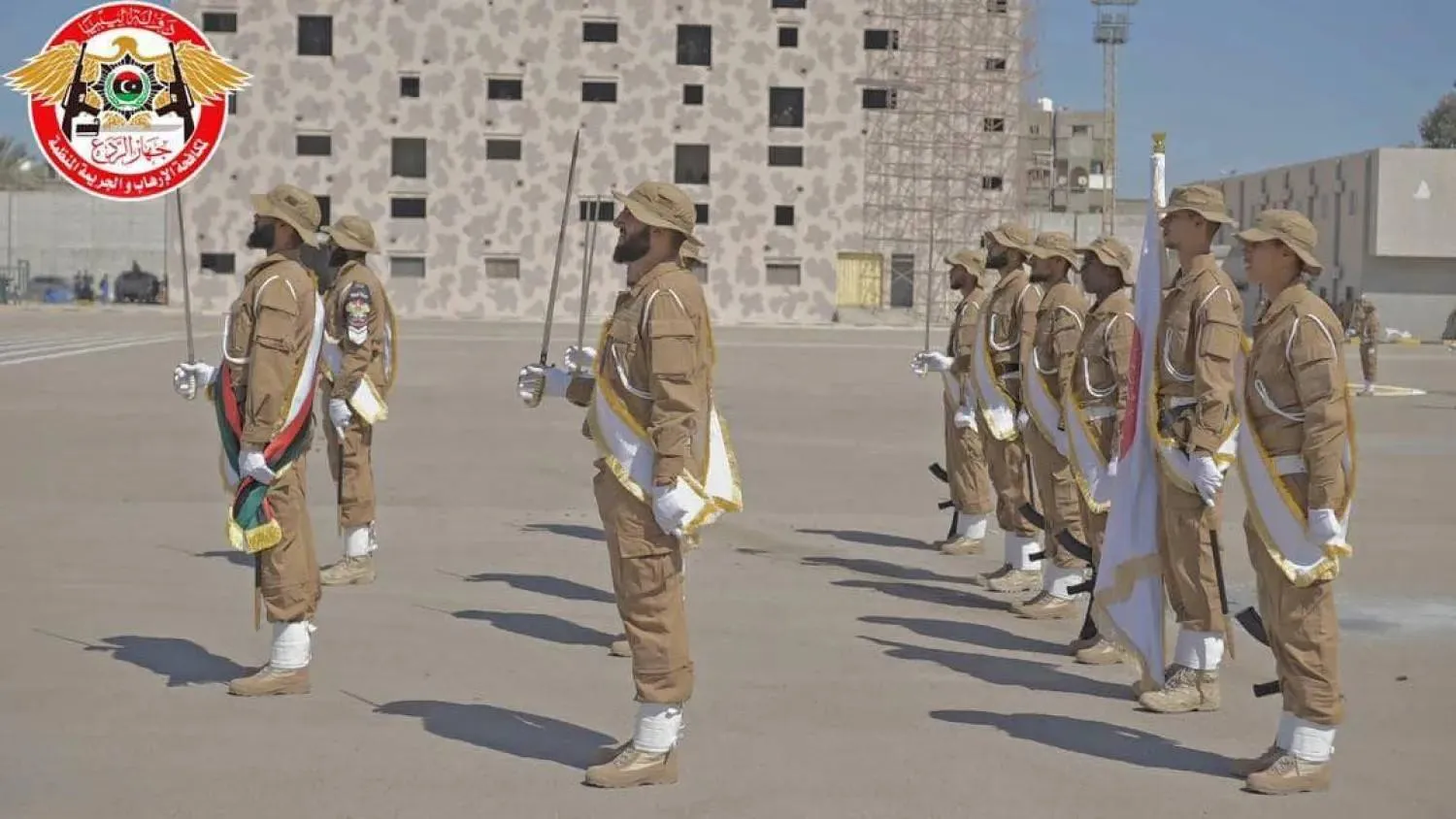
Members of the Special Deterrence Force (al-Radaa) during a military parade in Tripoli. (Official Force page)
TT

Tripoli Militia Buildup Heightens Libyans’ Fears of Imminent Clash

Members of the Special Deterrence Force (al-Radaa) during a military parade in Tripoli. (Official Force page)

Rival militias are massing in the Libyan capital, Tripoli, exposing sharp ideological rifts and a scramble for influence inside state institutions, fueling public fears that the city could soon descend into another round of fighting.

Armed groups aligned with the defense and interior ministries of interim Prime Minister Abdulhamid Dbeibah’s Government of National Unity (GNU) dominate western and southern districts of Tripoli. Eastern parts are held by their adversaries, mainly the Special Deterrence Force, known as al-Radaa. Between them, militias from the coastal city of Misrata control the tense buffer zones.

Analysts and local reports say the confrontation is not only about territory but also about ideology and control of strategic assets. Dbeibah has aligned himself with former grand mufti Sadiq al-Ghariani, a figure closely associated with political Islam in Libya. Ghariani, who has long voiced support for the Muslim Brotherhood, has backed Dbeibah against al-Radaa through a media campaign.

Mohamed al-Tarhouni, a Libyan military analyst, told Asharq Al-Awsat that fighters linked to the former Benghazi and Derna rebel councils are now embedded in two GNU-backed brigades: the 444 Brigade, commanded by Mahmoud Hamza, and the 111 Brigade, led by Abdel Salam al-Zoubi. Both groups fought against Libyan National Army (LNA) in the country’s east during the war on “terrorism” years ago.

Dbeibah also relies on the General Security Force led by Abdullah al-Trabelsi, brother of Interior Minister Imad al-Trabelsi. Though not ideologically driven, analysts describe this alliance as part of Libya’s growing pattern of “family rule.”

On the opposing side, al-Radaa, commanded by Abdelraouf Kara, follows the hardline Madkhali Salafi current, which regards Islamist groups as its ideological enemies. Other factions, such as the “Shield Battalion” in Tajoura, have a history of shifting alliances – at times clashing with al-Radaa, while at other moments aligning against common threats.

The fragile balance was jolted in May when forces loyal to Dbeibah stormed the headquarters of the Stability Support Apparatus after its leader Abdelghani al-Kikli, known as Ghneiwa, was killed. His group, once powerful, has since waned.

The struggle also centers on sovereign and economic assets. Dbeibah, analysts say, wants to consolidate his grip over government institutions, the central bank and state companies.

According to Washington’s Middle East Institute, militias have entrenched themselves into Tripoli’s economy, operating as a cartel that profits from smuggling, subsidized goods and state contracts – a hallmark of Libya’s “war economy.”

Though no official figures exist, international estimates suggest Tripoli’s armed groups can rapidly mobilize thousands of fighters with armored vehicles, air defenses and heavy weapons. Dbeibah’s brigades, especially the 444 and 111, are seen as the best equipped, benefiting from billions in defense funding. Reports that his forces deployed drones in May – possibly imported from Ukraine – have raised questions about whether such weapons will feature in future battles.

By contrast, al-Radaa is viewed as more disciplined, with thousands of fighters, light and medium weapons, and special intervention units inside the capital.

Reinforcements from Misrata and other western towns have bolstered Dbeibah’s camp. Non-official estimates put their strength at more than 17,000 fighters, including the Joint Operations Force led by Omar Bogdada.

Meanwhile, the LNA of eastern commander Khalifa Haftar is watching from afar. Analysts at the Libyan Center for Security and Military Studies say Haftar is unlikely to intervene directly, given how the balance of power has shifted since his failed 2019 assault on Tripoli.

There are growing reports of a possible reconciliation initiative brokered by the Presidential Council. But political analyst Mohamed al-Ameen warned that without concrete steps to demilitarize the capital and impose the rule of law, any deal would be “cosmetic and doomed to collapse.”



Germany Moves Troops Out of Iraq, Citing Mideast 'Tensions'

FILE PHOTO: German Defense Minister Ursula von der Leyen visits the Transport Helicopter Regiment 30 (Transporthubschrauberregiment 30) at the Hermann-Koehl-Kaserne in Niederstetten, Germany, August 20, 2018. REUTERS/Ralph Orlowski
TT

Germany Moves Troops Out of Iraq, Citing Mideast 'Tensions'

FILE PHOTO: German Defense Minister Ursula von der Leyen visits the Transport Helicopter Regiment 30 (Transporthubschrauberregiment 30) at the Hermann-Koehl-Kaserne in Niederstetten, Germany, August 20, 2018. REUTERS/Ralph Orlowski

Germany's military has "temporarily" moved some troops out of Erbil in northern Iraq because of "escalating tensions in the Middle East," a German defense ministry spokesman told AFP on Thursday.

Dozens of German soldiers had been relocated away from the base in Erbil, capital of Iraq's autonomous Kurdistan region.

"Only the personnel necessary to maintain the operational capability of the camp in Erbil remain on site," the spokesman said.

The spokesman did not specify the source of the tensions, but US President Donald Trump has ordered a major build-up of US warships, aircraft and other weaponry in the region and threatened action against Iran.

German troops are deployed to Erbil as part of an international mission to train local Iraqi forces.

The spokesman said the German redeployment away from Erbil was "closely coordinated with our multinational partners".


UN: At Least 15 Children Killed in Sudan Drone Strike

The war in Sudan, ongoing since mid-April 2023, has caused extensive destruction across the country (AFP)
TT

UN: At Least 15 Children Killed in Sudan Drone Strike

The war in Sudan, ongoing since mid-April 2023, has caused extensive destruction across the country (AFP)

A drone strike on a displacement camp in Sudan killed at least 15 children earlier this week, the United Nations reported late on Wednesday.

"On Monday 16 February, at least 15 children were reportedly killed and 10 wounded after a drone strike on a displacement camp in Al Sunut, West Kordofan," the UN children's agency said in a statement.

Across the Kordofan region, currently the Sudan war's fiercest battlefield, "we are seeing the same disturbing patterns from Darfur -- children killed, injured, displaced and cut off from the services they need to survive," UNICEF's Executive Director Catherine Russell said.


MSF Will Keep Operating in Gaza 'as Long as We Can'

(FILES) A Palestinian man walks on his crutches to the Doctors Without Borders or Medecins Sans Frontieres (MSF) clinic, in the al-Rimal neighborhood of Gaza City on new year's Eve, December 31, 2025. (Photo by Omar AL-QATTAA / AFP)
TT

MSF Will Keep Operating in Gaza 'as Long as We Can'

(FILES) A Palestinian man walks on his crutches to the Doctors Without Borders or Medecins Sans Frontieres (MSF) clinic, in the al-Rimal neighborhood of Gaza City on new year's Eve, December 31, 2025. (Photo by Omar AL-QATTAA / AFP)

The head of Doctors Without Borders in the Palestinian territories told AFP the charity would continue working in Gaza for as long as possible, following an Israeli decision to end its activities there.

In early February, Israel announced it was terminating all the activities in Gaza by the medical charity, known by its French acronym MSF, after it failed to provide a list of its Palestinian staff.

MSF has slammed the move, which takes effect on March 1, as a "pretext" to obstruct aid.

"For the time being, we are still working in Gaza, and we plan to keep running our operations as long as we can," Filipe Ribeiro told AFP in Amman, but said operations were already facing challenges.

"Since the beginning of January, we are not anymore in the capacity to get international staff inside Gaza. The Israeli authorities actually denied any entry to Gaza, but also to the West Bank," he said.

Ribeiro added that MSF's ability to bring medical supplies into Gaza had also been impacted.

"They're not allowed for now, but we have some stocks in our pharmacies that will allow us to keep running operations for the time being," he said.

"We do have teams in Gaza that are still working, both national and international, and we have stocks."

In December, Israel announced it would prevent 37 aid organizations, including MSF, from working in Gaza from March 1 for failing to submit detailed information about their Palestinian employees, drawing widespread condemnation from NGOs and the United Nations.

It had alleged that two MSF employees had links with Palestinian militant groups Hamas and Islamic Jihad, which the medical charity has repeatedly and vehemently denied.

MSF says it did not provide the names of its Palestinian staff because Israeli authorities offered no assurances regarding their safety.

Ribeiro warned of the massive impact the termination of MSF's operations would have for healthcare in war-shattered Gaza.

"MSF is one of the biggest actors when it comes to the health provision in Gaza and the West Bank, and if we are obliged to leave, then we will create a huge void in Gaza," he said.

The charity says it currently provides at least 20 percent of hospital beds in the territory and operates around 20 health centers.

In 2025 alone, it carried out more than 800,000 medical consultations, treated more than 100,000 trauma cases and assisted more than 10,000 infant deliveries.