


Lebanon Faces Crunch Point on Hezbollah Arms

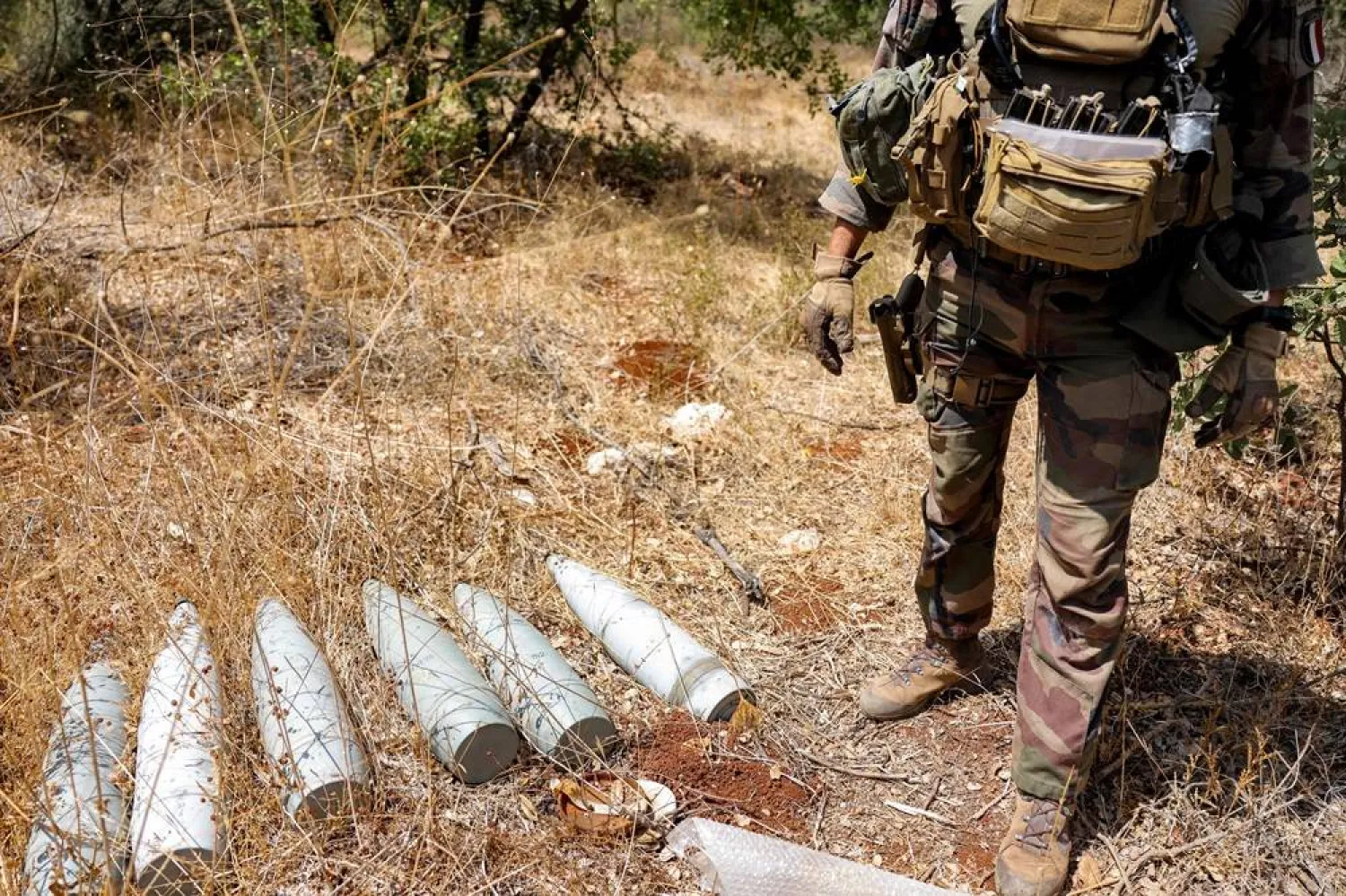
 A French peacekeeper of the United Nations Interim Force in Lebanon (UNIFIL) stands by munitions formerly used by Iran-backed Hezbollah at a position that was held by the group in the Khraibeh Valley in al-Meri in south Lebanon on August 27, 2025. (AFP)
A French peacekeeper of the United Nations Interim Force in Lebanon (UNIFIL) stands by munitions formerly used by Iran-backed Hezbollah at a position that was held by the group in the Khraibeh Valley in al-Meri in south Lebanon on August 27, 2025. (AFP)
TT

Lebanon Faces Crunch Point on Hezbollah Arms

 A French peacekeeper of the United Nations Interim Force in Lebanon (UNIFIL) stands by munitions formerly used by Iran-backed Hezbollah at a position that was held by the group in the Khraibeh Valley in al-Meri in south Lebanon on August 27, 2025. (AFP)
A French peacekeeper of the United Nations Interim Force in Lebanon (UNIFIL) stands by munitions formerly used by Iran-backed Hezbollah at a position that was held by the group in the Khraibeh Valley in al-Meri in south Lebanon on August 27, 2025. (AFP)

Lebanon's government is set to discuss a plan on Friday for disarming Hezbollah, a critical juncture in a standoff between the Iran-backed group which is refusing to give up its weapons and rivals who want it to disarm in line with US demands.

Calls for Hezbollah's disarmament have taken center stage in Lebanon since last year's devastating war with Israel, which upended a power balance long dominated by the Shiite group.

Despite mounting pressure, Hezbollah has rejected any move to dismantle its arsenal, leaving a deep divide between the group and its Shiite ally Amal on the one hand, and other Lebanese, among them leading Christian and Sunni politicians.

Friday's cabinet session takes place against a backdrop of an escalation in Israeli strikes in southern Lebanon, which killed four people on Wednesday, adding to fears in Lebanon of further attacks if Hezbollah does not disarm. The Israeli military said it targeted a site where Hezbollah stored engineering tools being used for "the organization's recovery".

Longstanding tensions in Lebanon over Hezbollah's arms have sharpened since the administration led by President Joseph Aoun and Prime Minister Nawaf Salam tasked the US-backed army on August 5 with devising a plan to establish a state monopoly on arms by the end of the year.

It is not yet clear how Friday's session will pan out. With the army keen to avoid confrontation with Hezbollah, the plan could avoid any disarmament timeline, a diplomat and a Lebanese source said.

Any cabinet decision opposed by Hezbollah is likely to prompt a walk-out by Shiite ministers loyal to the group and Amal, stripping the government of sectarian consensus. One possibility could be to delay a vote on the plan.

The army, drawn from Lebanon's mosaic of religious groups, split along sectarian lines at the start of the 1975-90 civil war, and has been widely regarded as the guarantor of civil peace since being rebuilt after that conflict.

Israel last week signaled it would scale back its military presence in southern Lebanon if the army took action to disarm Hezbollah.

But Hezbollah has ruled out disarming, saying its weapons protect Lebanon from Israeli attack. Senior Iranian official Ali Akbar Velayati last month criticized Beirut's moves on disarmament.

Hezbollah politician Mohammed Raad said on Wednesday it was "imperative" for Lebanese authorities to refrain from agreeing on any plans regarding Hezbollah's arms.

A US proposal discussed by Beirut last month foresaw Hezbollah's disarmament by the end of the year, along with Israel's withdrawal and an end to its military operations in Lebanon. It also held out the prospect of economic support.

A source close to Hezbollah said Lebanon faced mounting US pressure to implement the proposal, but that the group continued to communicate, including to the army, that it would neither hand in its arms nor allow anyone to take them.

'BALL OF FIRE'

Amal leader and Parliament Speaker Nabih Berri had been insisting that any discussion happen without a deadline, the source said.

Berri, in an August 31 speech, indicated that the Shiite parties were ready to discuss the fate of Hezbollah's arms, but "within the framework of a calm and consensual dialogue".

He said it was "nationally unacceptable to throw the ball of fire into the lap of the Lebanese army" by requiring it to tackle the long taboo issue of Hezbollah arms too abruptly.

A US-backed ceasefire agreed in November 2024 required Hezbollah's disarmament, beginning in areas south of the Litani River, the area adjacent to Israel.

Hezbollah says the deal only applies to that region and that it has handed over weapons to Lebanese troops in that area. Israeli forces continue to occupy five hilltops in the south and to carry out airstrikes on Hezbollah fighters and arms depots.



Israel Begins Demolitions Inside UNRWA Headquarters in East Jerusalem

A photograph shows a demolished structure inside the headquarters of the United Nations Relief and Works Agency (UNRWA) in the Sheikh Jarrah neighborhood of Israeli-annexed east Jerusalem on January 20, 2026. (AFP)
TT

Israel Begins Demolitions Inside UNRWA Headquarters in East Jerusalem

A photograph shows a demolished structure inside the headquarters of the United Nations Relief and Works Agency (UNRWA) in the Sheikh Jarrah neighborhood of Israeli-annexed east Jerusalem on January 20, 2026. (AFP)

Israeli bulldozers began demolishing structures inside the headquarters of the UN agency for Palestinian refugees (UNRWA) in east Jerusalem on Tuesday, an AFP photographer saw, with the Israeli foreign ministry defending the move.

"UNRWA-Hamas had already ceased its operations at this site and no longer had any UN personnel or UN activity there. The compound does not enjoy any immunity and the seizure of this compound by Israeli authorities was carried out in accordance with both Israeli and international law," the foreign ministry said in a statement.

Israel has repeatedly accused UNRWA of providing cover for Hamas, claiming that some of its employees took part in the group's October 7, 2023 attack on Israel, which sparked the war in Gaza.


Hamas Leaders Prepare for 'Safe Exit' from Gaza, Amid Doubts Over Return

A Palestinian child is seen as fighters from Hamas’ Qassam Brigades search for the bodies of Israeli hostages in the Jabalia refugee camp in northern Gaza, last December. (EPA)
TT

Hamas Leaders Prepare for 'Safe Exit' from Gaza, Amid Doubts Over Return

A Palestinian child is seen as fighters from Hamas’ Qassam Brigades search for the bodies of Israeli hostages in the Jabalia refugee camp in northern Gaza, last December. (EPA)

Sources within Hamas in Gaza revealed that senior figures in the movement are preparing for a “safe exit” from the enclave following arrangements related to Gaza’s future under the second phase of the ceasefire agreement, which the United States announced had begun last week.

Three Hamas sources told Asharq Al-Awsat that several prominent political and military leaders who survived the war are preparing to leave the territory. One source said the departure would be voluntary and carried out under specific arrangements, with full coordination with the Hamas leadership abroad. Another source noted that other leaders, particularly military figures, categorically reject leaving Gaza under any circumstances.

Throughout nearly two years of war, Hamas officials have repeatedly stated their rejection of removing the movement’s leadership from the Strip.

The sources separately provided Asharq Al-Awsat with the names of several leaders believed likely to depart, though it is refraining from publishing them due to the inability to contact them promptly. Some of these figures were recently appointed to leadership positions in Hamas’ political bureau in Gaza as part of new organizational arrangements aimed at rebuilding and restructuring the movement.

According to the same sources, a number of former prisoners released in the 2011 exchange deal for Israeli soldier Gilad Shalit — who now oversee key portfolios within Hamas leadership — are expected to be among those traveling to Türkiye.

However, a senior Hamas leader based outside Gaza denied the reports, telling Asharq Al-Awsat that the issue of leaders leaving the Strip “has not been raised.”

Another source inside Gaza declined to comment, saying only that he had no knowledge of the matter.

Sources in Gaza said the exit would likely be “without return, at least for several years,” with those leaders likely to end up residing in several countries. Other sources said some leaders would leave temporarily to hold meetings in Egypt with security officials on critical issues related to Gaza’s governmental security forces and other key files, before returning to the Strip.

In September, Israeli Prime Minister Benjamin Netanyahu said in an interview with Fox News that Israel was considering providing safe passage for Hamas leaders to leave Gaza under certain conditions, as part of a plan being prepared by US President Donald Trump, which entered into force in October.

Israel’s public broadcaster reported that Hamas leaders would most likely head to Qatar or Türkiye if they left Gaza. Israel’s Channel 12 previously reported that Hamas officials told US officials they were prepared to accept a limited relocation of military leaders and some operatives from Gaza.

On Jan. 14, US envoy Steve Witkoff officially announced the launch of the second phase of the ceasefire, which includes Hamas relinquishing control of Gaza, establishing a Palestinian technocratic committee to administer the enclave, initiating a comprehensive disarmament process, and launching large-scale reconstruction projects.

Hamas welcomed the announcement, saying it had fulfilled all requirements for completing the first phase and moving to the second, while continuing discussions with mediators over options regarding its weapons and those of other Palestinian factions.


China Confirms Invited to Join Trump’s ‘Board of Peace’

 Displaced Palestinians shelter in a tent camp in Deir al-Balah, central Gaza Strip, January 19, 2026. (Reuters)
Displaced Palestinians shelter in a tent camp in Deir al-Balah, central Gaza Strip, January 19, 2026. (Reuters)
TT

China Confirms Invited to Join Trump’s ‘Board of Peace’

 Displaced Palestinians shelter in a tent camp in Deir al-Balah, central Gaza Strip, January 19, 2026. (Reuters)
Displaced Palestinians shelter in a tent camp in Deir al-Balah, central Gaza Strip, January 19, 2026. (Reuters)

Beijing confirmed on Tuesday that China had been invited to join US President Donald Trump's "Board of Peace".

"China has received the United States' invitation," foreign ministry spokesman Guo Jiakun told a regular news briefing, without specifying whether Beijing would accept the invitation.

The board was originally conceived to oversee the rebuilding of war-torn Gaza, but the charter does not appear to limit its role to the occupied Palestinian territory.

Washington has asked various leaders to sit on the board, chaired by Trump, including Russian President Vladimir Putin, Hungarian premier Viktor Orban and Canadian Prime Minister Mark Carney.

Guo said China-US relations had achieved overall stability in the past year, despite a trade war that saw both countries impose tit-for-tat tariffs on each others' products.

"Over the past year, China-US relations have experienced ups and downs, but have maintained overall dynamic stability," Guo told reporters.

"Cooperation between China and the US benefits both sides, while confrontation harms both," he added.