

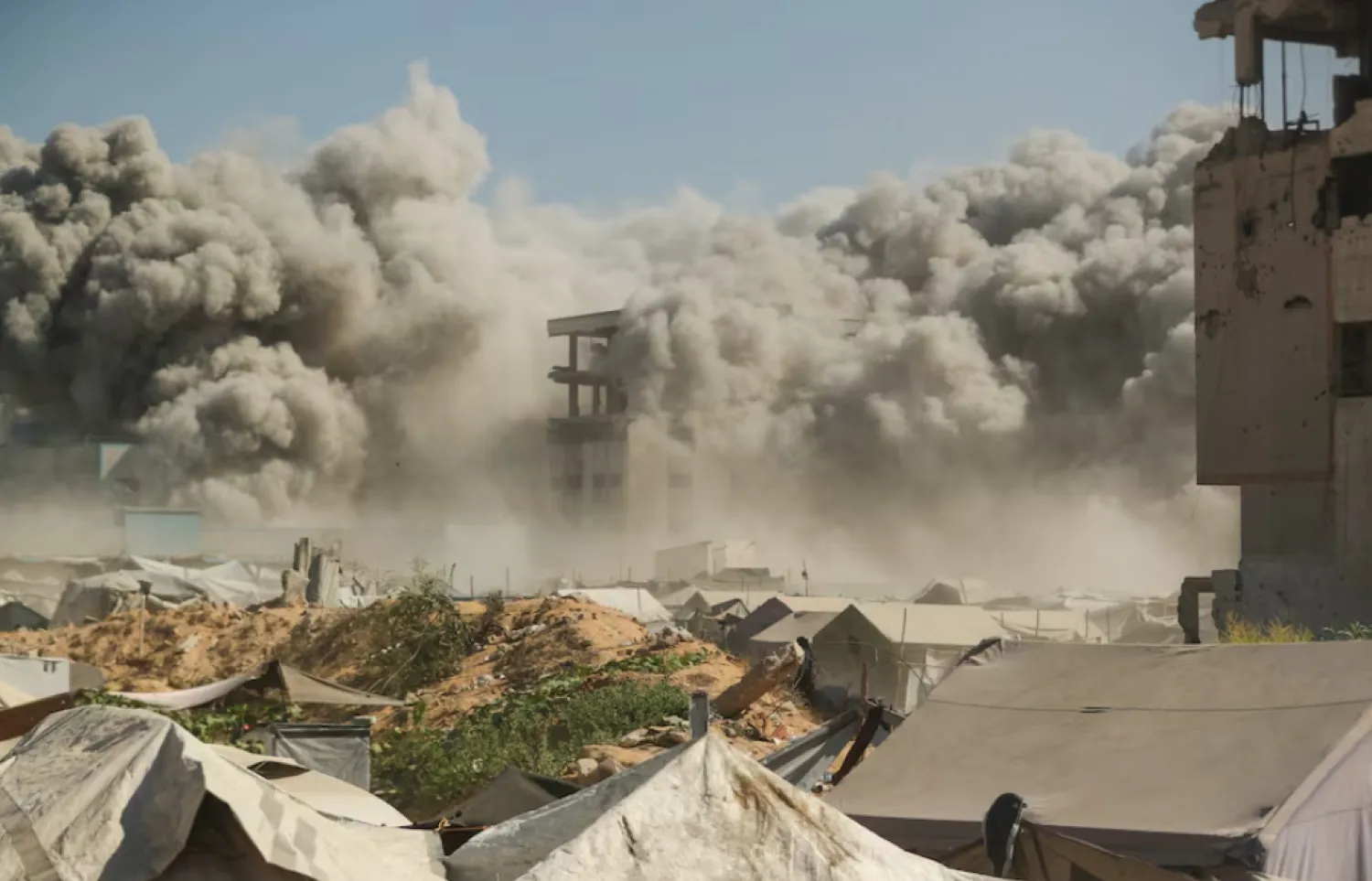

Israel Bombs Another Gaza City High-Rise as US Advances a New Ceasefire Proposal

Smoke and flames rise as a residential building collapses after an Israeli air strike, in Gaza City, September 8, 2025. REUTERS/Mahmoud Issa
TT

Israel Bombs Another Gaza City High-Rise as US Advances a New Ceasefire Proposal

Smoke and flames rise as a residential building collapses after an Israeli air strike, in Gaza City, September 8, 2025. REUTERS/Mahmoud Issa

Israel struck and destroyed another high-rise building in Gaza City on Monday after warning residents to evacuate, part of an offensive aimed at taking over the largest Palestinian city. The military said it was targeting Hamas observation posts and bombs placed around the 12-story office building. 

Over the past several days, Israel has destroyed multiple high-rise buildings in Gaza City, accusing Hamas of putting surveillance infrastructure in them. It has ordered people to flee ahead of its ground offensive into the city of some 1 million residents, which experts say is experiencing famine. 

US President Donald Trump said that he was giving his “last warning” to Hamas regarding a possible ceasefire, as Arab officials described a new US proposal for the immediate release of all the remaining hostages in exchange for 3,000 Palestinians and a temporary ceasefire. 

In Jerusalem, meanwhile, two Palestinian gunmen opened fire at a bus station, killing six people and wounding 12 in the worst such attack on Israelis in nearly a year. Tensions have soared across Israel and the occupied West Bank in the two years since Hamas' Oct. 7 attack out of Gaza ignited the war. 

Gaza's Health Ministry said hospitals received the bodies of 65 people killed by Israeli fire over the past 24 hours, with another 320 people wounded. 

‘Last warning’ proposal  

Israeli Foreign Minister Gideon Saar confirmed that Israel had accepted the latest US proposal during a news conference in Hungary and expressed hope it would succeed. 

Hamas said in a statement late Sunday that it was “ready to sit at the negotiating table” regarding the proposal from US Mideast envoy Steve Witkoff. The smaller Islamic Jihad armed group, which also holds hostages, said it too would consider the proposal. 

The “last warning” proposal, presented by Witkoff, calls for a negotiated end of the war and the withdrawal of Israeli forces from Gaza once the hostages are released and a ceasefire is established, according to officials familiar with the talks. 

The prisoner exchange would include hundreds of Palestinians serving life sentences, added the officials from Hamas, Islamic Jihad and Egypt, who all spoke on the condition of anonymity to discuss closed-door talks. Details of the proposal were first reported by Axios. 

A Hamas official said the group was studying the proposal with other Palestinian factions and would respond within days. He said they will demand a “clear commitment” that the war will end before releasing the hostages. 

An Egyptian official said the new proposal, which Arab mediators received from the US, was broader than previous ones and would require negotiations over ending the war, the withdrawal of Israeli forces and Israel’s demand that Hamas disarm. 

Hamas-led fighters abducted 251 people in the Oct. 7 attack and killed some 1,200, mostly civilians. Forty-eight hostages are still inside Gaza, around 20 of them believed to be alive. 

Israel's retaliatory offensive has killed at least 64,522 Palestinians, according to Gaza's Health Ministry, which does not say how many were civilians or combatants. It says around half of those killed were women and children. Large parts of major cities have been completely destroyed, and around 90% of the population of some 2 million Palestinians have been displaced. 

Hamas has said it will only return the remaining hostages — its only bargaining chip — in exchange for Palestinian prisoners, a lasting ceasefire and a full Israeli withdrawal from Gaza. It says it is willing to hand over power to politically independent Palestinians. 

Israeli Prime Minister Benjamin Netanyahu has rejected those terms, saying the war will continue until all the hostages are returned and Hamas has been disarmed. He says Israel will maintain open-ended security control over Gaza and facilitate what he describes as the voluntary emigration of much of its population, which the Palestinians and many others see as a plan for forcible expulsion. 

Mediators had previously focused on brokering a temporary ceasefire and the release of some hostages, with the two sides then holding talks on a more permanent truce. Witkoff walked away from those talks in July, after which Hamas accepted a proposal that the mediators said was almost identical to an earlier one that Israel had approved 


Macron Meets Pope Leo to Talk Lebanon, Middle East War

 French President Emmanuel Macron and his wife Brigitte Macron are welcomed as they arrive at the San Damaso courtyard to meet Pope Leo XIV at the Vatican, April 10, 2026. (Reuters)
French President Emmanuel Macron and his wife Brigitte Macron are welcomed as they arrive at the San Damaso courtyard to meet Pope Leo XIV at the Vatican, April 10, 2026. (Reuters)
TT

Macron Meets Pope Leo to Talk Lebanon, Middle East War

 French President Emmanuel Macron and his wife Brigitte Macron are welcomed as they arrive at the San Damaso courtyard to meet Pope Leo XIV at the Vatican, April 10, 2026. (Reuters)
French President Emmanuel Macron and his wife Brigitte Macron are welcomed as they arrive at the San Damaso courtyard to meet Pope Leo XIV at the Vatican, April 10, 2026. (Reuters)

French President Emmanuel Macron arrived Friday at the Vatican for his first meeting with Pope Leo XIV, a private audience expected to be dominated by the Iran war.

The French leader, who arrived with his wife Brigitte after flying to Rome on Thursday, will meet the US pontiff and the Vatican's secretary of state, Pietro Parolin.

Macron and the leader of the world's 1.4 billion Catholics were due above all to discuss "the resolution of the crisis in the Middle East", a spokesman for Macron's office told reporters.

They are particularly focused on Lebanon, where deadly Israeli strikes threatened this week's temporary truce between the US and Iran.

Leo XIV visited Lebanon late last year as part of his first trip abroad, which also included Türkiye, and has repeatedly prayed for the victims of conflict there.

Macron has also made numerous appeals for Lebanon to be included in the ceasefire.

He discussed the conflict on Thursday evening with representatives of the Catholic community of Sant'Egidio, an informal diplomatic channel of the Holy See that is very active on Middle Eastern and humanitarian issues.

"Macron is a man of peace," and "can do a lot" to "support" the Lebanese authorities, the community's founder, Andrea Riccardi, told reporters, adding that Lebanon "must not be left alone".

In recent days, both Macron and the Chicago-born pontiff have spoken out against US President Donald Trump over the war, which began with Israel-US attacks on Iran.

Leo condemned as "unacceptable" threats to civilian targets -- while not citing Trump by name -- while Macron said there was "too much talk, and it's all over the place".

Both welcomed the truce and have urged a diplomatic solution to the war, which has expanded across the Middle East and roiled the global economy.

The US government on Thursday denied a report that the Vatican's US envoy was summoned in January for a "bitter" dressing down over a speech by the pope condemning "diplomacy based on force", in remarks widely viewed as aimed at the Trump administration.

Macron is expected to invite Leo, a more reserved character than his predecessor, to visit France soon.

Friday's meeting at the Vatican comes three days before the pope's visit to the former French colony of Algeria, the first ever by a pontiff.


World Food Program Warns Lebanon Facing Food Security Crisis Due to Iran War

Volunteers carry World Food Program (WFP) boxes of aid supplies in a school-turned-shelter in Beirut, following an escalation between Hezbollah and Israel amid the US-Israeli conflict with Iran, Lebanon, March 12, 2026. REUTERS/Mohamed Azakir
TT

World Food Program Warns Lebanon Facing Food Security Crisis Due to Iran War

Volunteers carry World Food Program (WFP) boxes of aid supplies in a school-turned-shelter in Beirut, following an escalation between Hezbollah and Israel amid the US-Israeli conflict with Iran, Lebanon, March 12, 2026. REUTERS/Mohamed Azakir

Lebanon is facing a food security crisis as the Iran war disrupts supplies of goods inside the ‌country, the ‌United Nations ‌World ⁠Food Program said on ⁠Friday.

"What we're witnessing is not just a displacement ⁠crisis, it is rapidly ‌becoming ‌a food ‌security crisis," ‌said World Food Program country director Allison Oman, speaking ‌via video link from Beirut.

She warned ⁠that ⁠food was becoming increasingly unaffordable due to rising food prices and rising demand among displaced families.


Egypt-Pakistan Military Drill Underscores Closer Ties

Launch of the joint Egyptian-Pakistani “Raad 2” exercise in Pakistan on Thursday (Egyptian military spokesman)
TT

Egypt-Pakistan Military Drill Underscores Closer Ties

Launch of the joint Egyptian-Pakistani “Raad 2” exercise in Pakistan on Thursday (Egyptian military spokesman)

A joint military exercise between Egypt and Pakistan has underscored growing ties between the two countries, which became increasingly evident during the recent Iran war.

The joint drill, dubbed “Raad 2,” began Thursday with the participation of Egyptian paratroopers and Pakistani special forces and is set to run for several days at special forces training grounds in Pakistan.

Egypt’s military spokesman said the exercise includes a range of joint training activities focused on special operations and counterterrorism, aimed at exchanging tactical expertise, aligning operational concepts and enhancing coordination and combat readiness among participating units.

Pakistan, Egypt and Türkiye emerged as key mediators in the Iran war, which began on Feb. 28.

Egyptian President Abdel Fattah al-Sisi on Wednesday welcomed the ceasefire announced this week between the US and Iran and urged all parties to engage seriously in talks “to achieve lasting peace and peaceful coexistence among the peoples of the region and the world.”

Cairo also reiterated its support for initiatives aimed at achieving peace and security, stressing its continued efforts with Pakistan and Türkiye to work with regional and international partners to enhance stability.

Pakistan, which maintains good relations with both the administration of US President Donald Trump and neighboring Iran, played a mediating role between Washington and Tehran.

Pakistani Prime Minister Shehbaz Sharif said Wednesday in a post on X that China, Saudi Arabia, Türkiye, Egypt and Qatar had all provided support to help secure a ceasefire and give diplomacy a chance.

A four-way meeting involving Saudi Arabia, Egypt, Türkiye and Pakistan held in Islamabad in late March discussed ways to enhance coordination in response to rapid developments and escalating military tensions in the region.

Participants also exchanged assessments of the severe economic repercussions of the escalation, including its impact on international shipping, supply chains, food security and energy security amid rising oil prices.

Rakha Ahmed Hassan, a member of the Egyptian Council for Foreign Affairs and a former assistant foreign minister, said Egyptian-Pakistani cooperation dates back many years and includes joint exercises and exchanges of expertise.

He told Asharq Al-Awsat the drill aims to strengthen ties and benefit from evolving military experience, particularly in light of new weapons and technologies introduced in both countries.

He added the exercise is not directly linked to the Iran war but comes within the broader context of addressing various challenges. “The training is military support and is not directed against anyone,” he stated.

In recent days, Egyptian Foreign Minister Badr Abdelatty held daily contacts with his Pakistani counterpart, Ishaq Dar, and Turkish Foreign Minister Hakan Fidan to discuss efforts to launch direct negotiations between the US and Iran and to promote diplomacy over military escalation.

Hassan said Egypt, Pakistan and Türkiye played a significant role in reaching a truce, noting that the three countries helped bridge differences between the sides thanks to their strong relations with all parties and their interest in ending a war that caused heavy damage to all sides, including the US and Israel.
