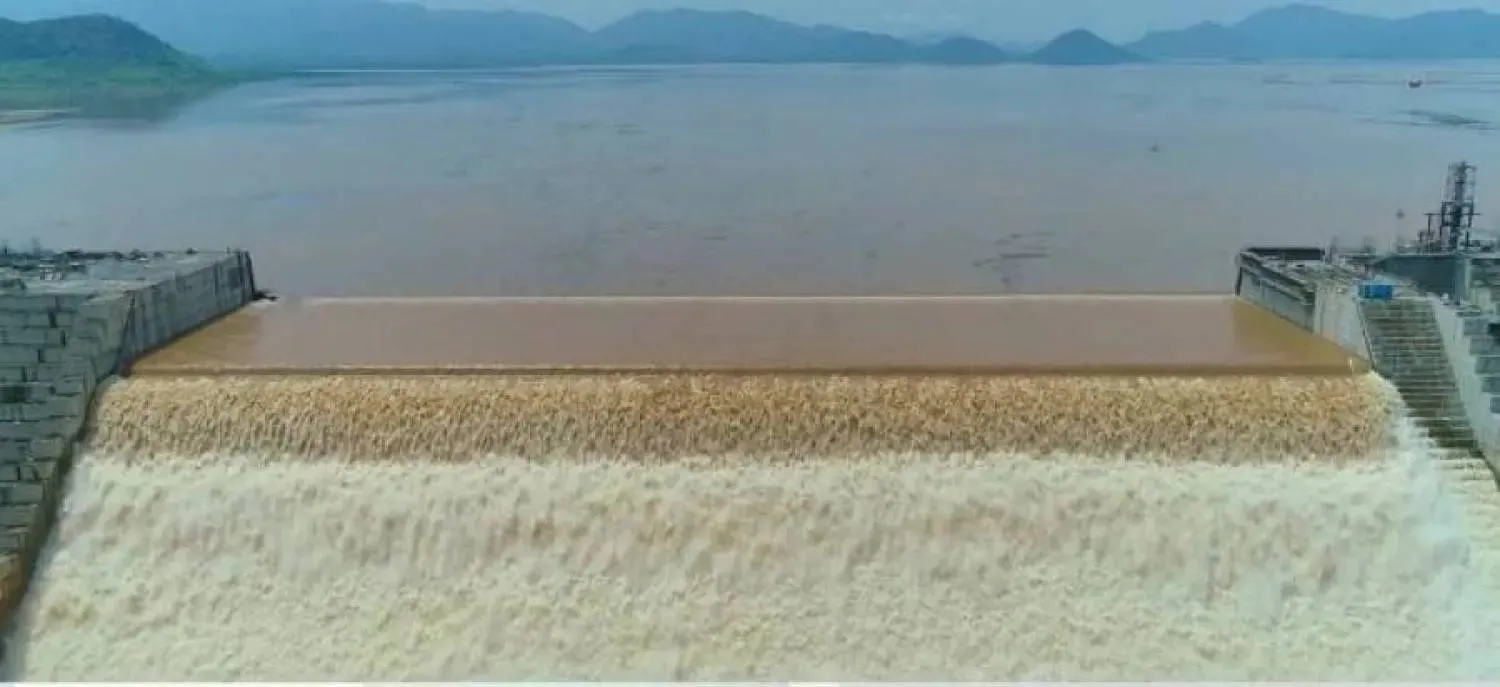

Ethiopia will inaugurate its Grand Renaissance Dam on the Blue Nile 14 years after construction began, despite the absence of an agreement with downstream countries Egypt and Sudan and amid repeated warnings from Cairo over mounting water scarcity.
Prime Minister Abiy Ahmed is scheduled to preside over the ceremony for the $4.2 billion hydropower project, built on the Nile’s main tributary to generate electricity, according to Agence France-Presse.
“The dam is proof of Ethiopia’s strength. It is not only a national project but a historic achievement for the whole of Africa,” Abiy told delegates at the African Climate Summit in Addis Ababa on Monday, the Ethiopian News Agency reported.
Egypt, which depends on the Nile for nearly all its freshwater needs, says the dam threatens its already scarce supplies. Water Resources and Irrigation Minister Hani Sewilam said Egypt ranks among the world’s most water-stressed countries, with annual per capita availability of just 560 cubic meters, far below the global water poverty threshold of 1,000 cubic meters.
Ahead of Cairo’s Eighth Water Week conference in October, Sewilam said his ministry had introduced measures to cushion shortages, including upgrading irrigation systems, using smart technologies, and expanding the treatment and reuse of agricultural drainage water.
Ethiopia denies the dam poses any danger. Abiy said last week it would not threaten downstream states, but hinted at further projects. “Ethiopia has started with one project, but it can build more dams in the Nile basin,” he said.
Egypt’s Options
Cairo sees three possible courses of action, according to Salah Halima, a former ambassador and member of the Egyptian Council for Foreign Affairs: intensify pressure on Addis Ababa to sign a legally binding agreement on the dam’s operation; accept international mediation, possibly from the United States; or take the dispute to the UN Security Council.
Under Chapter VI of the UN Charter, the Council can recommend peaceful settlement through negotiation and mediation but cannot impose binding measures. Chapter VII authorizes coercive steps, including sanctions or military action, to preserve international peace and security.
Halima told Asharq al-Awsat newspaper that Cairo could turn to the Council to test the dam’s safety standards, highlight geological studies, and argue that unilateral operation without a legal deal endangers both downstream states.
The Security Council urged Egypt, Ethiopia and Sudan in 2021 to resume African Union-led talks to reach a binding agreement within a reasonable timeframe, but the process stalled.
Egypt’s then-foreign minister wrote to the Council in September last year, rejecting what he called Ethiopia’s unilateral actions in violation of international law and the 2015 Declaration of Principles signed by the three states.
Risk of Confrontation
Former Egyptian deputy foreign minister for Sudan affairs Hossam Issa warned Ethiopia’s refusal to compromise could fuel regional tensions.
“Addis Ababa’s unilateral measures on the Nile and its escalation with neighbors, whether Somalia, Eritrea or Sudan, could eventually lead to confrontation,” he said. “There is no justification for storing this amount of water when Ethiopia already enjoys abundant rainfall. The real aim is to control the Nile and provoke the downstream states.”
He said Cairo was coordinating diplomatic pressure with Sudan and neighboring countries to force a policy shift in Addis Ababa.
Egypt and Sudan last week held a joint “2+2” meeting of their foreign and water ministers in Cairo, where they reiterated opposition to unilateral moves in the eastern Nile basin. A joint statement said the Renaissance Dam “poses a real threat to regional stability.”