
Israel Intensifies Gaza City Strikes as Many Residents Refuse Evacuation

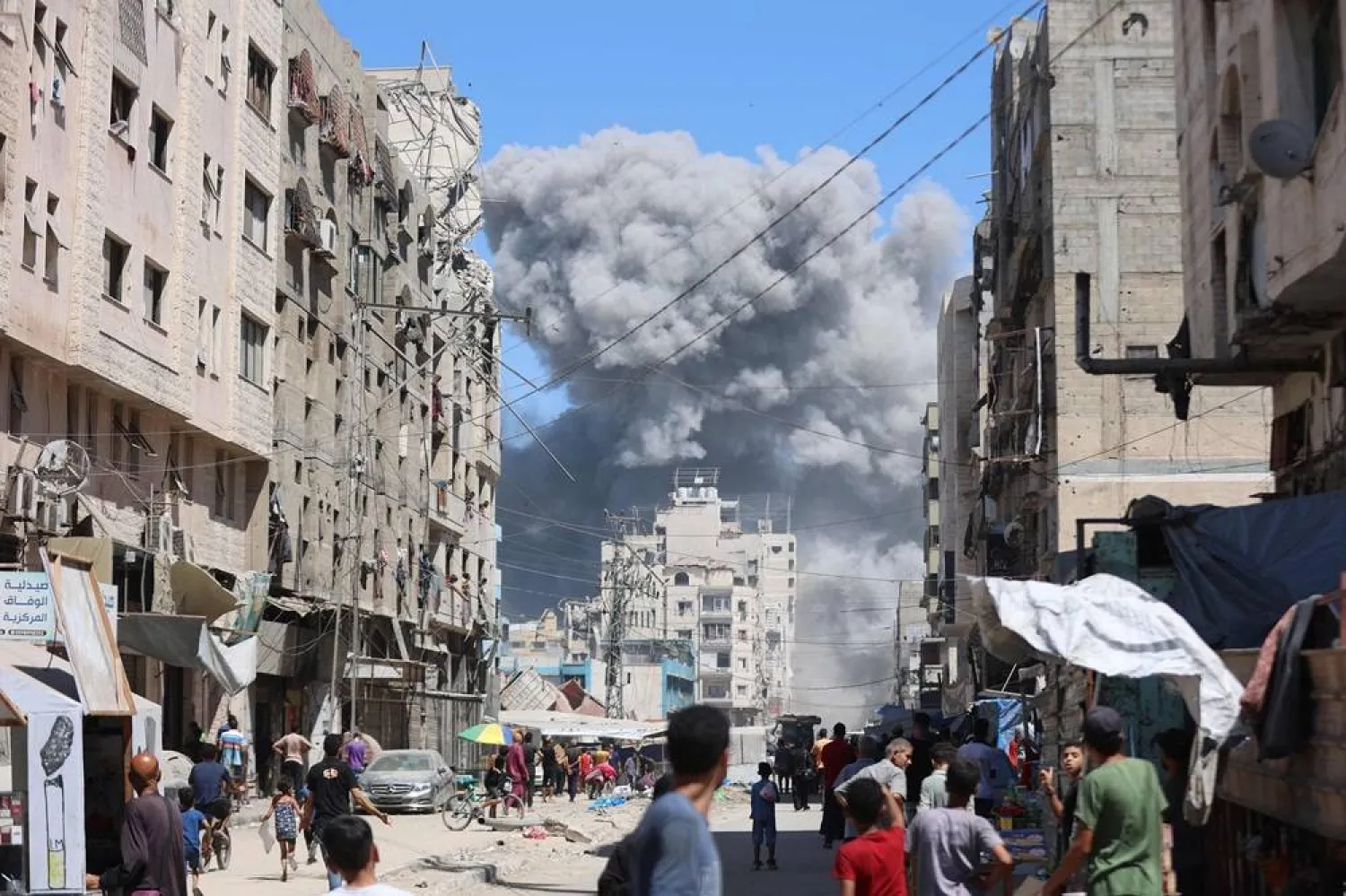
Smoke billows after an Israeli strike on Al-Nassr Street in Gaza City on September 12, 2025. (AFP)
TT

Israel Intensifies Gaza City Strikes as Many Residents Refuse Evacuation

Smoke billows after an Israeli strike on Al-Nassr Street in Gaza City on September 12, 2025. (AFP)

Israeli strikes killed at least 40 Palestinians in the Gaza Strip on Friday, local health authorities said, most of them in Gaza City, where many residents are staying put despite Israeli evacuation orders because they have nowhere safe to go.

Israel has stated its intention to take full control of the ruined city, where about a million people are sheltering, as part of its plan to wipe out the group Hamas, and has been intensifying its attacks.

"The explosions never stopped since yesterday," said father-of-two Adel, 60, who lives in Gaza City close to Beach refugee camp. He did not wish to give his full name for safety reasons.

"Many families left their homes and that is what the occupation wants," he told Reuters via a chat app. "By these bombardments they are telling people 'You either leave your area or die there'."

The army said it had completed five waves of air strikes on Gaza City this week, targeting more than 500 sites, and that it had destroyed reconnaissance and sniper sites, buildings containing tunnel openings and weapons depots.

In a statement, it said it would "continue to intensify the pace of strikes in a focused manner, based on precise intelligence, with the aim of hitting Hamas' infrastructure".

Palestinian health authorities said several deadly strikes had hit targets in the south of the territory, where some of those fleeing the bombardment of Gaza City have been heading.

Amjad Al-Shawa, head of the Palestinian NGOs Network, which liaises with the UN and international aid groups, told Reuters an estimated 10% of people in Gaza City had left since Israel announced its plan to take control a month ago.

ISRAEL EXPANDS CROSSING TO ALLOW IN MORE AID TRUCKS

The Israeli army said it had started expanding an area of the southern Gaza Strip it calls "Crossing 147" in order to increase the volume of aid entering a designated humanitarian zone. This was in preparation to receive the population leaving the northern area, it said.

"It should be emphasized that upon completion, the crossing's intake capacity will rise to 150 trucks per day - triple the current level, thereby enabling increased entry of aid, with an emphasis on food," the army said in a statement.

The UN and many foreign governments, including those of countries traditionally allied with Israel, have condemned the Gaza City evacuation order, called for a ceasefire, and sharply criticized conditions in the humanitarian zone.

Israel's military assault on Gaza has killed more than 64,000 people, mostly civilians, according to local health authorities, caused a hunger crisis and wider humanitarian disaster, and reduced much of the enclave to rubble.

The territory's health ministry has said at least 411 people, including 142 children, have died of malnutrition and starvation in the enclave.

The war was triggered by Hamas-led attacks launched from Gaza on southern Israel on October 7, 2023, in which 1,200 people, mostly civilians, were killed, and 251 taken hostage, according to Israeli tallies.

On Friday, Israeli police said an attacker from a Palestinian area of the West Bank had been arrested after carrying out a stabbing attack on guests of a hotel at a kibbutz near Jerusalem.

Israel's ambulance service said two people had been taken to hospital.


Lebanon Says France to Host Conference to Support Army

French Special Presidential Envoy to Lebanon, Jean-Yves Le Drian looks on during a meeting with Lebanese Prime Minister Nawaf Salam (not pictured) at the Government Palace in Beirut, Lebanon, 14 January 2026. (EPA)
TT

Lebanon Says France to Host Conference to Support Army

French Special Presidential Envoy to Lebanon, Jean-Yves Le Drian looks on during a meeting with Lebanese Prime Minister Nawaf Salam (not pictured) at the Government Palace in Beirut, Lebanon, 14 January 2026. (EPA)

Lebanon said Wednesday that a conference in support of the country's army as it seeks to disarm Hezbollah would take place in Paris on March 5.

The announcement follows recent promises of support to the military, which lacks funds, equipment and technical expertise.

Presidency spokeswoman Najat Charafeddine said President Joseph Aoun met French envoy Jean-Yves Le Drian, Saudi envoy Yazid bin Farhan and ambassadors including from the US, Egypt and Qatar, discussing preparations for "a conference to support the Lebanese army and internal security forces".

"It was decided to hold the conference in Paris on March 5, to be opened by French President Emmanuel Macron," she said at the presidential palace.

Under US pressure and fearing expanded Israeli strikes, Lebanon has committed to disarming the Iran-backed Hezbollah, which was badly weakened in more than a year of hostilities with Israel that largely ended in late 2024.

Last week, Lebanon's army said it had completed the first phase of its plan to disarm the group, covering the area south of the Litani river, around 30 kilometers (20 miles) from the Israeli border.

A plan for the disarmament north of the Litani is to be presented to cabinet next month.
Israel, which accuses Hezbollah or rearming, has criticized the army's progress as insufficient, while Hezbollah has rejected calls to surrender its weapons.

Lebanon's army has dismantled tunnels and other military infrastructure belonging to Hezbollah near the Israeli border in recent months, seizing weapons and ammunition, despite its limited capacities.

Despite the ceasefire, Israel has kept up regular strikes on Lebanon, usually saying it is targeting Hezbollah, and has maintained troops in five south Lebanon areas it deems strategic.

Last month, talks with international envoys in Paris touched on the Lebanese army's needs, while its chief agreed to document its progress in disarming Hezbollah.


Iraqi Officials Arrest Man Wanted by Australian Police as 'Number One Priority'

Australian Federal Police Commissioner Krissy Barrett said the arrested man, Kazem Hamad, was a threat to national security. (Getty Images file)
TT

Iraqi Officials Arrest Man Wanted by Australian Police as 'Number One Priority'

Australian Federal Police Commissioner Krissy Barrett said the arrested man, Kazem Hamad, was a threat to national security. (Getty Images file)

Iraqi officials have arrested a man wanted by Australian Federal Police as a person of interest in ​the investigation into a spate of firebombings, including an antisemitic attack on a Melbourne synagogue, police said on Wednesday.

Australian Federal Police Commissioner Krissy Barrett said the arrested man, Kazem Hamad, was a threat to national security and that she had identified ‌him as her "Number ‌One priority".

Iraq's National ‌Center ⁠for ​International ‌Judicial Cooperation said in a statement that Kadhim Malik Hamad Rabah al-Hajami had been arrested as part of a drugs investigation, after a request from Australia.

Barrett said Iraqi officials had made an independent decision to arrest the man ⁠in their own criminal investigation, after Australian Federal Police provided ‌information to Iraqi law enforcement ‍late last year.

"This ‍arrest is a significant disruption to an ‍alleged serious criminal and his alleged criminal enterprise in Australia," she said in a statement.

In October, Barrett said that in addition to being a ​suspect in arson attacks in Australia linked to the tobacco trade, the man ⁠was "a person of interest in the investigation into the alleged politically-motivated arson attack on the Adass Israel Synagogue" in Melbourne.

Australia expelled Iran's ambassador in August after the Australian Security Intelligence Organization traced the funding of hooded criminals who allegedly set fire to the Melbourne synagogue in December 2024 to Iran's Revolutionary Guard Corps.

Hamad, previously convicted in Australia for drug trafficking ‌offences, was deported from Australia to Iraq in 2023.


Syria Asks Lebanon to Hand Over Assad-Era Officers

A drone view shows the port of the coastal city of Latakia, Syria, March 11, 2025. (Reuters)
TT

Syria Asks Lebanon to Hand Over Assad-Era Officers

A drone view shows the port of the coastal city of Latakia, Syria, March 11, 2025. (Reuters)

Syrian authorities have asked Lebanese security forces to hand over more than 200 senior officers who fled to Lebanon after the fall of Bashar al-Assad, following a Reuters investigation that showed how the neighboring country was a hub for insurgent plotting.

On December 18, a ​top Syrian security official, Brig. Abdul Rahman al-Dabbagh, met with his Lebanese counterparts in Beirut to discuss the exiled Assad-era officers, according to three senior Syrian sources, two Lebanese security officials, and a diplomat with knowledge of the visit.

The meetings came days after a Reuters investigation detailed rival plots being pursued by Rami Makhlouf, the billionaire cousin of the ousted president, and Maj. Gen. Kamal Hassan, former head of military intelligence, both living in exile in Moscow, to finance potential Alawite militant groups in Lebanon and along the Syrian coast. Syria and Lebanon share a 375-kilometer border.

The two rival camps aim to undermine the new Syrian government under President Ahmed al-Sharaa. Reuters found they are sending money to intermediaries in Lebanon to try and stir uprisings that would divide Syria and allow the plotters to regain control over the coastal areas. The population of those areas is dominated ‌by Alawites, the minority ‌sect associated with the Assad family and the dictatorship’s ruling elite.

Al-Dabbagh, an aide to the ‌head ⁠of ​internal security ‌in Syria’s Latakia province, an Alawite stronghold, met with Lebanese intelligence chief Tony Kahwaji and Major General Hassan Choucair, head of the General Security Directorate, and presented them with the list of senior officers wanted by Syria.

The visit focused on gathering information about the whereabouts and legal status of the officers, as well as trying to find ways to prosecute or extradite them to Syria, according to the Syrian sources.

They described it as a direct request from one security agency to another, rather than a demand for extradition.

Three senior Lebanese security officials confirmed the meetings. One of the Lebanese officials denied receiving any demands from the Syrians to hand over the officers. Two others acknowledged receiving a list of names but said none were senior officers.

One of the Lebanese security ⁠officials said there is no evidence of any insurgency being planned, despite the threats against Syria’s new government detailed in the Reuters reporting.

All the officials spoke on condition of anonymity to reveal details of ‌a highly sensitive cross-border issue.

Among the names handed over by Syrian officials to ‍Lebanon were several high-ranking figures acting as intermediaries for Makhlouf or Hassan in ‍Lebanon, according to a Syrian source who saw the list.

A Lebanese judicial official said Syria had not made a formal extradition request to ‍Lebanon, typically done through the two countries’ justice and foreign ministries.

Accompanying Dabbagh on his Beirut visit was Khaled al-Ahmad, a former Assad advisor and childhood friend of Sharaa, who is leading the government’s efforts to win over the Alawite community through development projects and aid, according to two witnesses who saw the men together on that mid-December day.

According to the two witnesses, who are both ex-Assad officers, al-Ahmad and Dabbagh went together to an upscale Beirut restaurant that is popular among Assad’s ​men. The two witnesses said they and others interpreted the outing as a warning to those trying to influence Alawites to rise up against Syria’s new leaders that Lebanon is no longer a haven.

In a January 2 post on X, Lebanese Deputy Prime Minister Tarek Mitri called on his government’s security agencies to verify the information circulating in the media and take action against the Lebanon-based agents for Assad’s former insiders, Makhlouf and Hassan.

“It is incumbent upon them, and upon all of us, to avert the dangers of any actions that undermine Syria’s unity or threaten its security and stability, whether in Lebanon or originating from it,” the tweet read.

In response to questions from Reuters, Lebanon’s General Security referred to January 11 remarks by Lebanese President Joseph Aoun, who said Lebanon’s military intelligence and other security agencies had carried out raids in several areas of the country’s north and east.

Aoun said the raids did not produce evidence of the presence of officers linked to the Assad dictatorship and said Lebanon was continuing to coordinate with Syria on the issue.

Syrian government officials did not respond to requests for comment.

From January 3 to January 6, Lebanese soldiers raided locations and shelters housing displaced Syrians. The Lebanese Army said 38 Syrians were arrested during the raids on different charges such as possession of drugs or weapons, or entering the country illegally.

A senior Lebanese security official told Reuters those ‌raids were linked to the exiles’ plots.

Another senior Lebanese security official emphasized that there was no arrest warrant for the Syrian officers in Lebanon, nor Interpol requests for them.

“We can't do anything against them,” the official added.