


Human Rights Experts Join Rising Chorus That Accuses Israel of Genocide in Gaza 

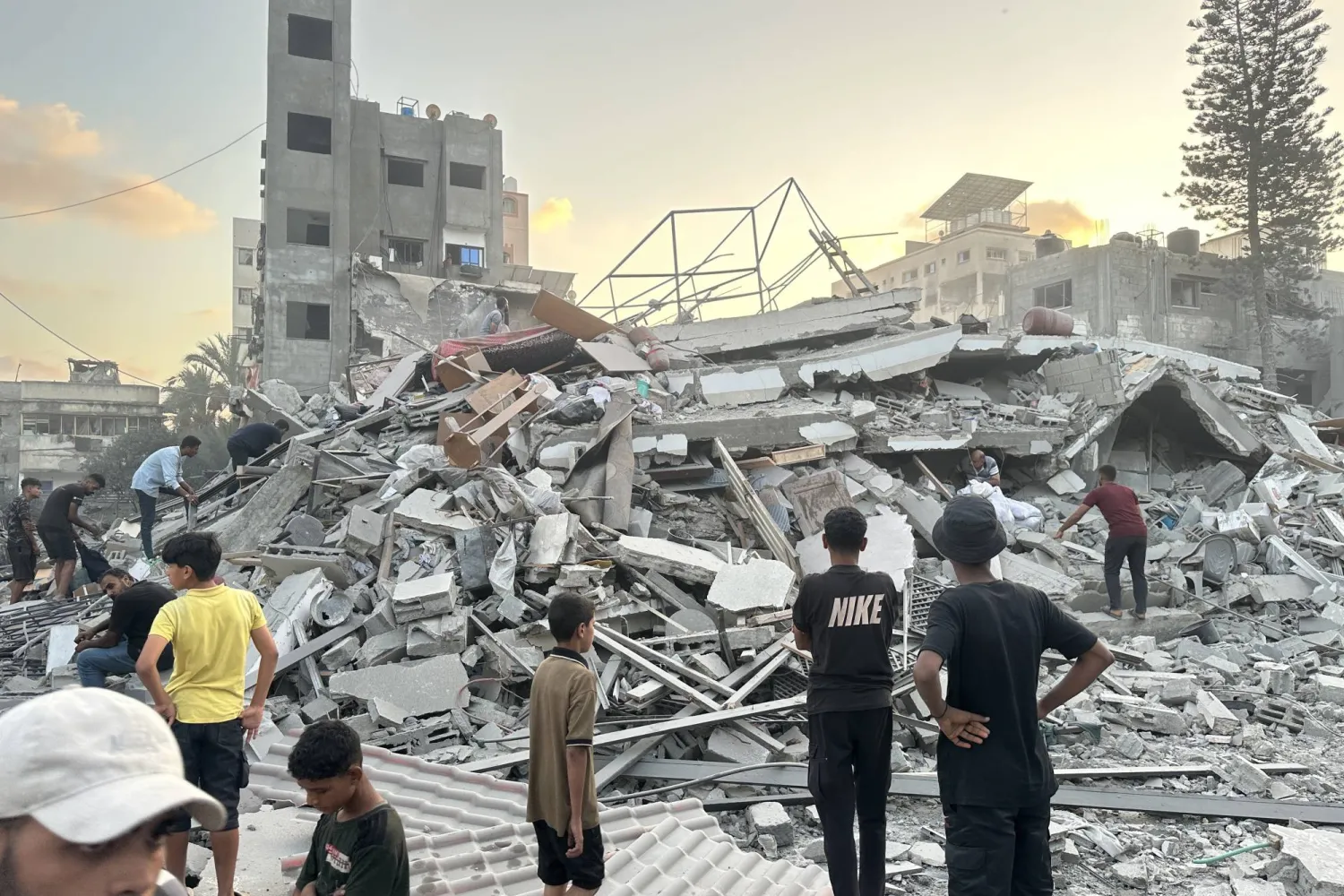
15 September 2025, Palestinian Territories, Gaza: People gather outside a building damaged in an Israeli airstrike west of Gaza City. (dpa)
TT

Human Rights Experts Join Rising Chorus That Accuses Israel of Genocide in Gaza 

15 September 2025, Palestinian Territories, Gaza: People gather outside a building damaged in an Israeli airstrike west of Gaza City. (dpa)

A team of independent experts commissioned by the United Nations' Human Rights Council has concluded that Israel is committing genocide in Gaza, issuing a report Tuesday that calls on the international community to end the genocide and take steps to punish those responsible for it.

The deeply-documented findings by the three-member team are the latest accusations of genocide against Prime Minister Benjamin Netanyahu's government by rights advocates as Israeli carries on with its war against Hamas in Gaza that has killed tens of thousands of people. Israel rejected what it called a “distorted and false” report.

The Commission of Inquiry on the Occupied Palestinian Territory and Israel, which was created four years ago, has repeatedly documented alleged human rights abuses and violations both in Gaza since the deadly Oct. 7, 2023, attacks in Israel led by Hamas, and other Palestinian areas.

While neither the commission nor the 47-member-country council that it works for within the UN system can take action against a country, the findings could be used by prosecutors at the International Criminal Court or the UN's International Court of Justice.

The report also amounts to a final message from the team headed by former UN rights chief Navi Pillay. All three of its members announced in July that they would resign, citing personal reasons and a need for change.

The team was commissioned by the Human Rights Council, the UN’s top human rights body, but it does not speak for the United Nations.

Israel has refused to cooperate with the commission and has accused it and the HRC of anti-Israel bias. Earlier this year, the Trump administration, a key Israeli ally, pulled the United States out of the council.

After a painstaking legal analysis, the commission said Israel had committed four of the five “genocidal acts” defined under an international convention adopted in 1948 known colloquially as the “Genocide Convention,” three years after the end of World War II and the Holocaust.

“The Commission finds that Israel is responsible for the commission of genocide in Gaza,” said Pillay, the commission chair. “It is clear that there is an intent to destroy the Palestinians in Gaza through acts that meet the criteria set forth in the Genocide Convention.”

Pillay, a former UN human rights chief, said “responsibility for the atrocity crimes lies with Israeli authorities at the highest echelons” over the nearly two-year war.

Her commission concluded that Netanyahu, as well as Israeli President Isaac Herzog and former Defense Minister Yoav Gallant, had incited the commission of genocide. It hasn't assessed whether other Israeli leaders had done so too.

Israel, which was founded in the aftermath of the Holocaust, has adamantly rejected genocide allegations against it as an antisemitic “blood libel.”

Israel's Foreign Ministry issued an angry response Tuesday, saying it “categorically rejects this distorted and false report.”

“Three individuals serving as Hamas proxies, notorious for their openly antisemitic positions — and whose horrific statements about Jews have been condemned worldwide — released today another fake ‘report’ about Gaza,” it said.

Genocide accusations are especially sensitive in Israel, which was founded as a haven for Jews in the wake of the Holocaust and where memories of the Holocaust still play an important role in the country’s national identity.

In coming to its conclusion of genocide, the commission said it pored over the conduct of Israeli security forces and “explicit statements” by Israeli civilian and military authorities, among other criteria.

In particular, the experts cited as factors the death toll, Israel's “total siege” of Gaza and blockade of humanitarian aid that has led to starvation, a policy of “systematically destroying” the health care system, and direct targeting of children.

The commission urged other countries to halt weapons transfers to Israel and block individuals or companies from actions that could contribute to genocide in Gaza.

“The international community cannot stay silent on the genocidal campaign launched by Israel against the Palestinian people in Gaza,” said Pillay, who is a South African jurist. “When clear signs and evidence of genocide emerge, the absence of action to stop it amounts to complicity.”

The current UN high commissioner for human rights, Volker Türk, has decried Israel’s conduct of the war in Gaza and spoken out forcefully against alleged crimes, but has not accused Israel of carrying out genocide.

His office, alluding to international law, has argued that only an international court can make a final, formal determination of genocide. Critics counter that could take years and insist that thousands of people, many of them civilians, are being systematically killed in Gaza in the meantime.

The International Court of Justice is hearing a genocide case filed by South Africa against Israel.



Growing US Role in Gaza Raises Israeli Alarm 

US soldiers listen to Vice President JD Vance as he delivers remarks at the Civilian Military Coordination Center in southern Israel on Friday. (EPA)
TT

Growing US Role in Gaza Raises Israeli Alarm 

US soldiers listen to Vice President JD Vance as he delivers remarks at the Civilian Military Coordination Center in southern Israel on Friday. (EPA)

Growing US involvement in the Gaza Strip is stirring growing concern in Israel, where security sources have voiced alarm over Washington’s reported plan to build a large military base in the enclave, a move they say signals “an unprecedented insistence on intervening in Gaza, and in the Israeli and Palestinian conflict.”

According to the sources cited by the Israeli daily Yedioth Ahronoth, the plan “reshapes the map of influence after Israel did everything it could since the 1967 war to limit international intervention in the Palestinian territories.”

Until recently, US military presence in Israel was extremely limited. After the ceasefire agreement was signed, the United States sent about 200 troops to Israel. They are currently operating from an American command center in Kiryat Gat in southern Israel.

The United States also deployed a THAAD missile defense battery during the Israel-Iran war in June to help intercept Iranian missiles.

Yedioth said the planned base forms part of US measures that have already reduced Israel’s freedom of action inside the enclave, particularly with regard to allowing humanitarian aid into Gaza, which Israel had used as a pressure tool on Hamas.

Israeli sources said the US command center in Kiryat Gat is expected to assume full control over the distribution of humanitarian aid, leaving Israel only a marginal role in coordinating government activity in the territories.

Michael Milstein, a Hamas expert at the Moshe Dayan Center for Middle Eastern and African Studies at Tel Aviv University, told The Guardian that the military coordination center in Kiryat Gat will be responsible for most of the activity in Gaza, and Israel’s status as the main player in the enclave will change.

All of this has fed rising accusations in Israel against Prime Minister Benjamin Netanyahu since the ceasefire brokered by Washington.

Critics argue the Americans have taken the initiative in Gaza out of Israel’s hands.

Netanyahu has been forced to defend himself and his relationship with the United States repeatedly in recent weeks, following Israeli claims that Washington has entrenched its dominance over Israel through a political airlift of senior officials, a military headquarters in the south monitoring Gaza minute by minute, and American drones operating over the enclave.

They say the Americans have prevented Netanyahu and his government from taking action against Hamas or carrying out attacks or even imposing sanctions, have intervened in the search for bodies, brought in foreign teams despite initial Israeli objections, want Hamas members extracted alive from Rafah, and are effectively deciding the nature of the next phase, who will govern the enclave, and who will participate in any international force.

Many Israelis, including politicians, writers, and analysts, say the United States has taken the initiative in the Gaza Strip and is now openly determining Israeli security and political affairs in a way that has turned Israel into a de facto American “protectorate.”

Israeli commentators have written about “Bibi’s guardianship,” “a single deciding party,” the internationalization of the conflict, and “tight American supervision.”

These sentiments intensified with a report about US plans to build a 500-million-dollar military base near the Gaza border to support the ceasefire.

Yedioth Ahronoth reported Tuesday, citing Israeli officials, that the planned US base along the Gaza boundary would host several thousand troops tasked with maintaining the ceasefire.

In recent weeks, US officials have raised the proposal in discussions with the Israeli government and the Israeli army and have begun surveying potential sites around Gaza.

After the ceasefire agreement was signed in the Egyptian city of Sharm el-Sheikh in October, about 200 American troops were deployed in Israel from the central US military coordination center in Kiryat Gat, although Washington stressed it would not send soldiers into the enclave.


Israel Says Hezbollah Trying to Rebuild, Smuggle in Arms from Syria

Smoke rises after an Israeli airstrike on Tayr Debba town in southern Lebanon, 06 November 2025. (EPA)
TT

Israel Says Hezbollah Trying to Rebuild, Smuggle in Arms from Syria

Smoke rises after an Israeli airstrike on Tayr Debba town in southern Lebanon, 06 November 2025. (EPA)

The Israeli military accused Lebanese armed group Hezbollah on Tuesday of seeking to rebuild its combat abilities in south Lebanon to the point of threatening Israel's security and undoing last year's ceasefire deal.

Military spokesman Nadav Shoshani said Iranian-backed Hezbollah was operating south of the Litani River in violation of the truce accord and that Israeli forces were conducting strikes on Hezbollah targets in that area. Hezbollah says it is committed to the ceasefire deal.

Lebanon's President Joseph Aoun and Prime Minister Nawaf Salam say Israel is violating the truce deal, pointing to the occupation of five hilltop positions in southern Lebanon by Israeli troops as well as Israeli air strikes and deadly ground incursions into Lebanese territory.

TENSION OVER DISARMAMENT PUSH

Shoshani told a news briefing that Hezbollah was also trying to smuggle in weapons from Syria and via other routes to Lebanon. "We are working to prevent that from happening and to block the ground routes from Syria into Lebanon to a high level of success, but they still pose a threat to us," Shoshani said.

"We are committed to the agreement but it must be held. We will not return to the reality of October 7 (2023) with a threat of thousands of terrorists on our border within walking distance of our civilians."

Hezbollah denies it is rebuilding its military capabilities in south Lebanon. It has not fired at Israel since the ceasefire came into force, and Lebanese security officials told Reuters that Hezbollah has not obstructed Lebanese army operations to find and confiscate the group's weapons in the country's south.

In a televised speech on Tuesday, Hezbollah head Sheikh Naim Qassem said Hezbollah remained committed to the 2024 ceasefire and that there was "no alternative" to that deal.

He said if Israel withdrew, stopped its attacks on Lebanon and released Lebanese nationals detained in Israel, then northern Israeli towns would have "no problem" with security.

But he reiterated Hezbollah's rejection of full disarmament and said Israel's destructive and deadly strikes "cannot continue", adding: "There is a limit to everything."

Israel has been pressing Lebanon's army to be more aggressive in disarming Hezbollah by searching private homes in the south for weaponry, according to Lebanese and Israeli officials.

The army is confident it can declare Lebanon's south free of Hezbollah arms by the end of 2025, but has refused to search private dwellings for fear of reigniting civil strife and derailing a disarmament strategy seen by the army as cautious but effective, Lebanese security officials told Reuters.

Hezbollah was severely weakened in a year-long war that saw an Israeli incursion into south Lebanon backed by heavy air strikes, but still wields considerable power among Shiites in Lebanon's fragile sectarian-based system of governance.


For Many Syrians, Sharaa's US Visit Marks New Beginning

 A Syrian flag is displayed outside the White House following the meeting of US President Donald Trump and Syrian President Ahmed al-Sharaa in the Oval Office of the White House in Washington, DC, US, November 10, 2025. (Reuters)
A Syrian flag is displayed outside the White House following the meeting of US President Donald Trump and Syrian President Ahmed al-Sharaa in the Oval Office of the White House in Washington, DC, US, November 10, 2025. (Reuters)
TT

For Many Syrians, Sharaa's US Visit Marks New Beginning

 A Syrian flag is displayed outside the White House following the meeting of US President Donald Trump and Syrian President Ahmed al-Sharaa in the Oval Office of the White House in Washington, DC, US, November 10, 2025. (Reuters)
A Syrian flag is displayed outside the White House following the meeting of US President Donald Trump and Syrian President Ahmed al-Sharaa in the Oval Office of the White House in Washington, DC, US, November 10, 2025. (Reuters)

On the streets of Damascus on Tuesday, Syrians viewed their leader's visit to Washington as a shift towards the West that could pave the way to reviving the country's war-battered economy.

On Monday, Donald Trump received Ahmed al-Sharaa, a first for a Syrian head of state since independence in 1946.

"God willing, this visit will be a new beginning for Syria and an opening to the world after years of isolation," law student Boushra Abdel Bari said.

"We hope that this visit... will facilitate the reconstruction of Syria with the United States and the rest of the world."

As Sharaa made his historic visit to Washington, the State Department announced a pause of US sanctions under the Caesar Act, pending their possible permanent lifting by Congress.

The law imposed wide-ranging sanctions on investment in Syria in an effort to ensure accountability over abuses under Assad, banning the country from the global banking system.

Historically, Syria has been in the orbit of first the Soviet Union then Russia, which was autocratic leader Bashar al-Assad's main ally during more than 13 years of civil war.

But since overthrowing Assad in December 2024, the interim Syrian president has made numerous overtures to the West and Gulf, while being careful not to burn his bridges with Moscow.

For Abdel Bari, Assad's ally Russia "has brought us nothing but ruin and destruction."

Omar Nassar, a 36-year-old printer, also welcomed Syria's move towards the Western camp.

"Syria paid the price for aligning itself with the socialist camp in the past... and was isolated from its Arab and international environment," he said.

"We are very optimistic after this visit. We expect positive repercussions in the economic and diplomatic spheres."

Saddam Hajjar, who runs a coffee kiosk in the Syrian capital, also believed that "things are getting better".

"We hope to be part of the new Middle East in the future," he said. "The Syrian people deserve a better life after making so many sacrifices."

Assad's fall ended a civil war that lasted more than 13 years, which broke out after the government cracked down on a peaceful uprising in 2011.

The war killed more than half a million people, displaced or forced millions of Syrians into exile, and brought the economy to its knees.

Layal Kaddour, a 25-year-old NGO worker, thought the visit to Washington was "a bold political move" that broke years of isolation.

"The possible repercussions are an easing of sanctions and the opening up of economic prospects," she said.

But she wondered if her country will now be "subject to international pressure that would influence independent political decision-making," alluding to concerns about US pressure on Syria to make peace with Israel, which has long been an enemy.