

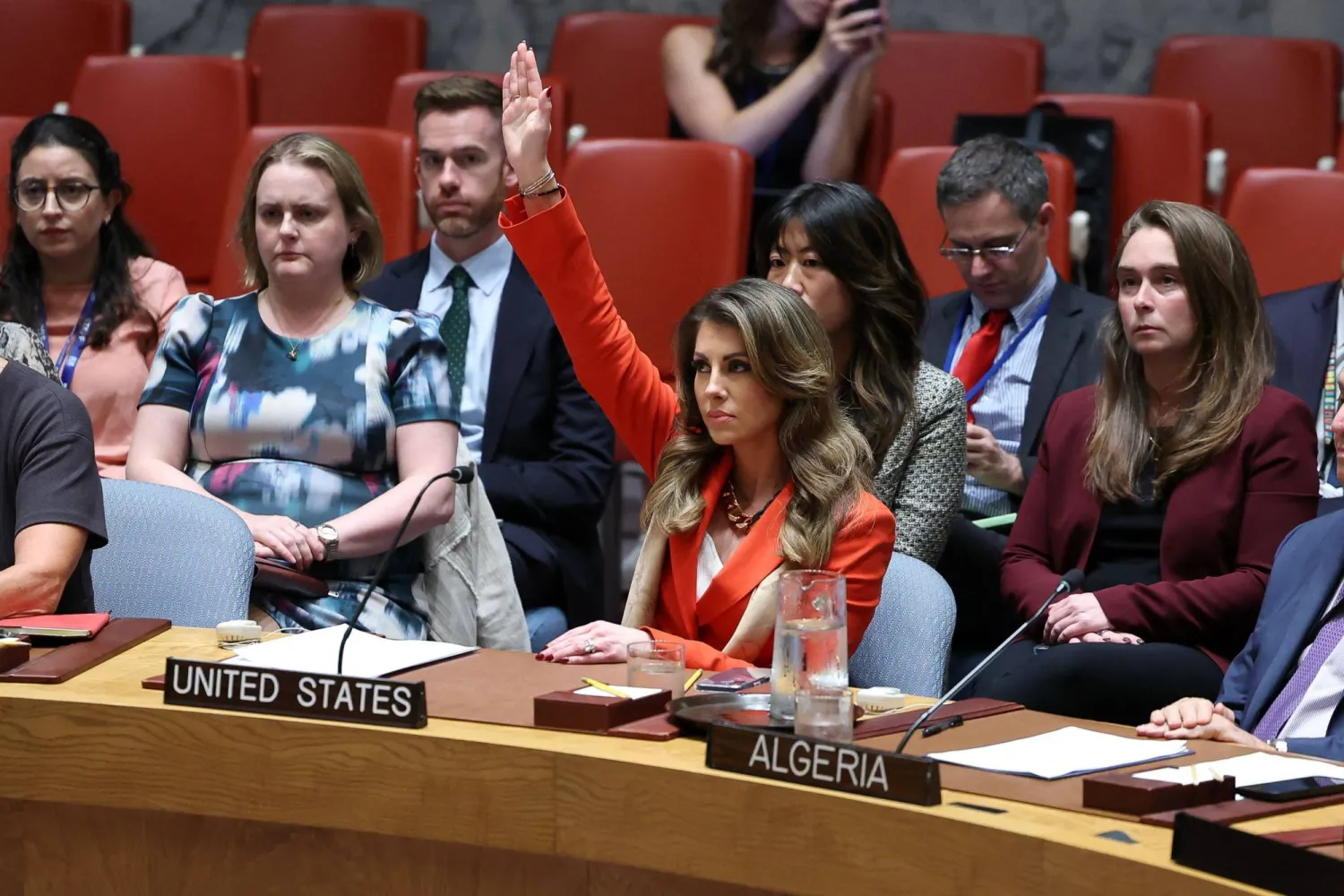

US Vetoes UN Security Council Resolution Demanding Immediate Gaza Ceasefire and Hostage Release 

US deputy Middle East envoy Morgan Ortagus (C) raises her hand to veto a draft resolution during a United Nations Security Council meeting on the situation in Gaza, at UN headquarters in New York on September 18, 2025. (AFP)
TT

US Vetoes UN Security Council Resolution Demanding Immediate Gaza Ceasefire and Hostage Release 

US deputy Middle East envoy Morgan Ortagus (C) raises her hand to veto a draft resolution during a United Nations Security Council meeting on the situation in Gaza, at UN headquarters in New York on September 18, 2025. (AFP)

The United States once again vetoed a UN Security Council resolution Thursday that had demanded an immediate and permanent ceasefire in Gaza and the release of hostages, saying that the effort did not go far enough in condemning Hamas.

The 14 other members of the United Nations’ most powerful body voted in favor of the resolution, which described the humanitarian situation in Gaza as “catastrophic” and called on Israel to lift all restrictions on the delivery of aid to the 2.1 million Palestinians in the territory.

“US opposition to this resolution will come as no surprise,” Morgan Ortagus, a senior US policy adviser, said before the vote. “It fails to condemn Hamas or recognize Israel’s right to defend itself, and it wrongly legitimizes the false narratives benefiting Hamas, which have sadly found currency in this council.”

She added that other council members “ignored” US warnings about the “unacceptable” language and instead adopted “performative action designed to draw a veto.”

The outcome further highlights US and Israeli isolation on the world stage over the nearly two-year war in Gaza. The vote came just days before the annual gathering of world leaders at the UN General Assembly, where Gaza will be a major topic and major US allies are expected to recognize an independent Palestinian state. It is a largely symbolic move vehemently opposed by Israel and the US, dividing the Trump administration from allies including the UK and France.

The latest resolution tied a ceasefire to the release of hostages The resolution, drafted by the council’s 10 elected members who serve two-year terms, goes further than previous drafts to highlight what it calls the “deepening of suffering” of Palestinian civilians.

“I can understand the anger and frustration and disappointment of the Palestinian people who might be watching this session of the Security Council, hoping that there is some help in the pipeline, and this nightmare could be brought to an end,” said Riyad Mansour, the Palestinian ambassador to the UN “I can imagine the anger and frustration that it did not happen.”

Algeria, one of the leaders of the resolution, also expressed dismay at another failed council action for Gaza, apologizing to Palestinians for not doing enough to save civilians’ lives.

Despite the effort failing to pass, Algeria’s UN ambassador, Amar Bendjama, said: “14 courageous members of this Security Council raised their voice. They have acted with conscience and in the cause of the international public opinion.”

Pakistan's ambassador called the vote, which took place during the 10,000th meeting of the Security Council, “a dark moment.”

Danny Danon, Israel’s ambassador to the UN, blasted the new effort, saying it would “not release the hostages and will not bring security to the region.”

“Israel will continue to fight Hamas and protect its citizens, even if the Security Council prefers to turn a blind eye to terrorism,” he said in a statement.

What the UN resolution called for

The effort reiterated demands from previous versions, including the release of all hostages held by Hamas and other armed groups following their Oct. 7, 2023, surprise attack in southern Israel that launched the war in Gaza.

In opposing similar resolutions since November, the US had complained that the demands, including a ceasefire, were not directly linked to the unconditional release of hostages and would only embolden Hamas.

The new resolution expressed “deep alarm” after a report released last month by the world’s leading authority on food crises said Gaza City has become gripped by famine, and that it’s likely to spread across the territory without a ceasefire and an end to restrictions on humanitarian aid.

Israeli forces have pressed on with a new ground offensive in Gaza City. The latest Israeli operation, which started Tuesday, further escalates a conflict that has roiled the Middle East and likely pushes any ceasefire further out of reach.

The Israeli military, which says it wants to “destroy Hamas’ military infrastructure,” hasn’t given a timeline for the offensive, but there were indications it could take months.

That same day, a team of independent experts commissioned by the UN Human Rights Council concluded that Israel is committing genocide in Gaza, issuing a report that called on the international community to end it and take steps to punish those responsible for it.

Last week, the UN General Assembly voted overwhelmingly to support a two-state solution to the Israel-Palestinian conflict and urged Israel to commit to a Palestinian state.

The US veto of the resolution comes as about half of Americans say the Israeli military response in the Gaza Strip has “gone too far,” according to the survey from The Associated Press-NORC Center for Public Affairs Research. That’s up from November 2023, when 40% said Israel’s military action had gone too far.

But at the same time, Americans overall, particularly Republicans, are less likely to say that negotiating a ceasefire should be a high priority for the US government than they were just a few months ago when the US was holding ceasefire talks with Hamas.

Lebanon Charges Ex-Central Bank Governor Salameh Over Alleged $44.8 Mln Embezzlement

The Lebanese Central Bank in Beirut (NNA) 
TT

Lebanon Charges Ex-Central Bank Governor Salameh Over Alleged $44.8 Mln Embezzlement

The Lebanese Central Bank in Beirut (NNA) 

Lebanese prosecutors have indicted former central bank governor Riad Salameh and two lawyers on charges including embezzlement of public funds, forgery and illicit enrichment, judicial authorities said on Tuesday. 

Salameh, who headed the Lebanese Central Bank for three decades, was detained for about 13 months over alleged financial crimes committed during his tenure and was released in September after paying record bail of more than $14 million. The banker, who remains in Lebanon and is subject to a travel ban, has denied any ‌wrongdoing. 

According to ‌a copy of the indictment issued by Beirut's indictment ‌chamber ⁠seen by ‌Reuters, the panel accused Salameh alongside lawyers Marwan Issa el-Khoury and Michel John Tueni of embezzling $44.8 million from what it described as a central bank "consultancy account". 

It said the chamber also approved a request by the financial public prosecutor to widen investigations into how funds were moved into and out of banks without senior bank managers notifying the central bank's Special Investigation Commission. 

KHOURY SAYS HE HAS NO KNOWLEDGE OF 'CONSULTANCY ⁠ACCOUNT' 

In a statement to Reuters, Khoury said he had no knowledge of the "consultancy account" referenced in ‌the charge, had not been involved in the central ‍bank's financial transactions and had never received ‍funds from the institution. 

He said the indictment itself called for a ‍continuation of the inquiry and that there should not have been an accusation against him before the investigation was complete. 

Khoury said the inquiry had already proved that he had not received any funds from the central bank or any fees in relation to its financial transactions. 

Tueni could not be reached for comment. 

The indictment follows earlier moves by the central bank to file a criminal ⁠complaint against a former senior bank official at the central bank, a former banker and a lawyer over alleged illicit enrichment through misuse of public funds, the bank's acting governor Wassim Mansouri has said. 

Salameh, whose 30-year term ended amid a cascade of domestic and international investigations, has been under scrutiny over allegations that more than $300 million was siphoned off between 2002 and 2015. 

The central bank has said it will act as a principal plaintiff in a state investigation into Forry Associates, a company suspected of receiving commissions from commercial banks and transferring them abroad. The company is controlled by Salameh's brother Raja, who also denies wrongdoing. 

The Salameh ‌brothers are under investigation in France, Germany, Switzerland and other countries over alleged embezzlement. 


Howling Winds Collapse Walls on Gaza Tent Camps, Killing 4, Child Dies of Hypothermia

Palestinians walk past tents used by displaced people, during a windy winter day, in Gaza City, January 13, 2026. (Reuters)
TT

Howling Winds Collapse Walls on Gaza Tent Camps, Killing 4, Child Dies of Hypothermia

Palestinians walk past tents used by displaced people, during a windy winter day, in Gaza City, January 13, 2026. (Reuters)

At least four people died overnight in Gaza from walls collapsing onto their tents as strong winds lashed the Palestinian coastal territory, hospital authorities said Tuesday. 

Dangerous living conditions persist in Gaza after more than two years of devastating Israeli bombardment and aid shortfalls. A ceasefire has been in effect since Oct. 10. But aid groups say that Palestinians broadly lack the shelter necessary to withstand frequent winter storms. 

The dead include two women, a girl and a man, according to Shifa hospital, Gaza City’s largest hospital, which received the bodies. 

Meanwhile, the child death toll in Gaza ticked up. The Gaza Health Ministry said Tuesday a 1-year-old boy died of hypothermia overnight, while the spokesman for the UN’s children agency said over 100 children and teenagers have been killed in the territory by “military means" since the ceasefire began. 

Family mourns 

Three members of the same family — 72-year-old Mohamed Hamouda, his 15-year-old granddaughter and his daughter-in-law — were killed when an 8-meter-high (26-foot-high) wall collapsed onto their tent in a coastal area along the Mediterranean shore of Gaza City, Shifa hospital said. At least five others were injured in that collapse. 

Their relatives on Tuesday began removing the rubble that had buried their loved ones and rebuilding the tent shelters for survivors. 

“The world has allowed us to witness death in all its forms,” Bassel Hamouda said after the funeral. “It’s true the bombing may have temporarily stopped, but we have witnessed every conceivable cause of death in the world in the Gaza Strip.” 

A second woman was killed when a wall fell on her tent in the western part of the city, Shifa hospital said. 

The majority of Palestinians live in makeshift tents since their homes were reduced to rubble during the war. When storms now strike the territory, Palestinian rescue workers warn people against seeking shelter inside damaged buildings, saying they could fall down on top of them. Aid groups say not enough shelter materials are entering Gaza during the truce. 

In the central town of Zawaida, Associated Press footage showed inundated tents Tuesday morning, with people trying to rebuild their shelters. 

Yasmin Shalha, a displaced woman from the northern town of Beit Lahiya, stood against winds that lifted the tarps of tents around her as she stitched hers back together with needle and thread. She said it had fallen on top of her family the night before, as they slept. 

“The winds were very, very strong. The tent collapsed over us,” the mother of five told the AP. “As you can see, our situation is dire.” 

Mohamed al-Sawalha, a 72-year-old man from the northern refugee camp of Jabaliya, criticized the conditions that most Palestinians in Gaza endure. 

“It doesn’t work neither in summer nor in winter,” he said of the tent. “We left behind houses and buildings (with) doors that could be opened and closed. Now we live in a tent. Even sheep don’t live like we do.” 

Israel’s bombing campaign has reduced entire neighborhoods to rubble and half-standing structures. Residents aren’t able to return to their homes in Israeli-controlled areas of the Gaza Strip. 

Child death toll in Gaza rises  

The Gaza Health Ministry said Tuesday a 1-year-old boy died of hypothermia in the central town of Deir al-Balah, the seventh fatality due to the cold conditions since winter started, including a baby just seven days old and a 4-year-old girl whose deaths were announced the day before. 

The ministry, part of the Hamas-run government, says more than 440 people were killed by Israeli fire and their bodies brought to hospitals since the ceasefire went into effect just over three months ago. The ministry maintains detailed casualty records that are seen as generally reliable by UN agencies and independent experts. 

Meanwhile, UNICEF spokesman James Elder said Tuesday at least 100 children under the age of 18 — 60 boys and 40 girls — have been killed in Gaza since the truce began due to military operations, including drone strikes, airstrikes, tank shelling and use of live ammunition.  

Those figures, he said, reflect incidents where enough details have been compiled to warrant recording, but the total toll is expected to be higher. He also said hundreds of children have been wounded. 

While “bombings and shootings have slowed” during the ceasefire, they have not stopped, Elder told reporters at a UN briefing in Geneva by video from Gaza City. 

“So what the world now calls calm would be considered a crisis anywhere else,” he told 

The Palestinian territory's population of more than 2 million people has been struggling to keep the cold weather and storms at bay, amid shortages of humanitarian aid and a lack of more substantial temporary housing, which is badly needed during the winter months.  

It's the third winter since the war between Israel and Hamas started on Oct. 7, 2023, when gunmen stormed into southern Israel and killed around 1,200 people and abducted 251 others into Gaza. 

Gaza’s Health Ministry says more than 71,400 Palestinians have been killed since Israel's retaliatory offensive began in the territory. 


Syrian Army Tells Kurdish Forces to Withdraw from Area East of Aleppo City

Buses carrying displaced residents drive past a building in ruins as they return to the Achrafieh neighborhood after days of fighting between government forces and Kurdish fighters in the northern city of Aleppo, Syria, Monday, Jan. 12, 2026. (AP)
TT

Syrian Army Tells Kurdish Forces to Withdraw from Area East of Aleppo City

Buses carrying displaced residents drive past a building in ruins as they return to the Achrafieh neighborhood after days of fighting between government forces and Kurdish fighters in the northern city of Aleppo, Syria, Monday, Jan. 12, 2026. (AP)

Syria's army told Kurdish forces on Tuesday to withdraw from an area east of Aleppo after deadly clashes in the city last week, as a senior Kurdish official accused Damascus of preparing a new attack. 

Syria's government is seeking to extend its authority across the country, and progress has stalled on integrating the Kurds' de facto autonomous administration and forces into the central government under a deal reached last March. 

In Qamishli, the main Kurdish city in the country's northeast, thousands of people demonstrated against the Aleppo violence. 

Syrian state television published an army statement with a map declaring a large area east of Aleppo city a "closed military zone" and said "all armed groups in this area must withdraw to east of the Euphrates" River. 

The area, controlled by Kurdish forces, extends from near Deir Hafer, around 50 kilometers (30 miles) from Aleppo, to the Euphrates about 30 kilometers further east, as well as towards the south. 

On Monday, Syria accused the US-backed, Kurdish-led Syrian Democratic Forces (SDF) of sending reinforcements to Deir Hafer and said it sent its own personnel there in response. 

The SDF is the de facto army of the Kurds' semi-autonomous administration and controls swathes of the country's oil-rich north and northeast, much of which it captured during Syria's civil war and the fight against the ISIS group. 

An AFP correspondent saw government forces transporting reinforcements including air defense batteries and artillery towards Deir Hafer on Tuesday. 

Kurdish forces denied any build-up of their personnel around Deir Hafer and accused the government of attacking the town, while state television said SDF sniper fire there killed one person. 

- 'Bloodshed' - 

Elham Ahmad, a senior official in the Kurdish administration, said government forces were "preparing themselves for another attack". 

"The real intention is a full-scale attack" against Kurdish-held areas, she told an online press conference, accusing the government of having made a "declaration of war" and breaking the March agreement on integrating Kurdish forces. 

"These assaults should stop," she said, adding that if guarantees were provided "for the security of the civilian population, we are ready to continue the negotiation and dialogue", suggesting the United Nations or other international organizations also take part. 

But, she added, "We will defend ourselves." 

Syria's government took full control of Aleppo city over the weekend after capturing its Kurdish-majority Sheikh Maqsud and Achrafieh neighborhoods and evacuating fighters there to Kurdish-controlled areas in the northeast. 

Both sides traded blame over who started the violence last Tuesday that ultimately killed dozens of people and displaced tens of thousands. 

In Qamishli, shops were shut in a general strike and thousands protested to voice their anger at the Aleppo fighting, some carrying Kurdish flags and banners in support of the SDF and its chief Mazloum Abdi. 

- PKK, Türkiye - 

Other protesters burned portraits of Turkish Foreign Minister Hakan Fidan, whose country has lauded the Syrian government's Aleppo operation "against terrorist organizations". 

Türkiye has long been hostile to the SDF, seeing it as an extension of the Kurdistan Workers' Party (PKK) and a major threat along its southern border. 

Last year, the PKK announced an end to its long-running armed struggle against the Turkish state and began destroying its weapons, but Ankara has insisted that the move include armed Kurdish groups in Syria. 

On Tuesday, the PKK called the "attack on the Kurdish neighborhoods in Aleppo" an attempt to sabotage peace efforts between it and Ankara. 

A day earlier, Ankara's ruling party levelled the same accusation against Kurdish fighters. 

The Britain-based Syrian Observatory for Human Rights reported 45 civilians and 60 soldiers and fighters from both sides killed in the Aleppo violence. 

Aleppo civil defense official Faysal Mohammad told AFP on Tuesday that emergency workers had pulled 50 bodies from the two Kurdish-majority neighborhoods since the end of fighting, without saying whether they were combatants or civilians.
