

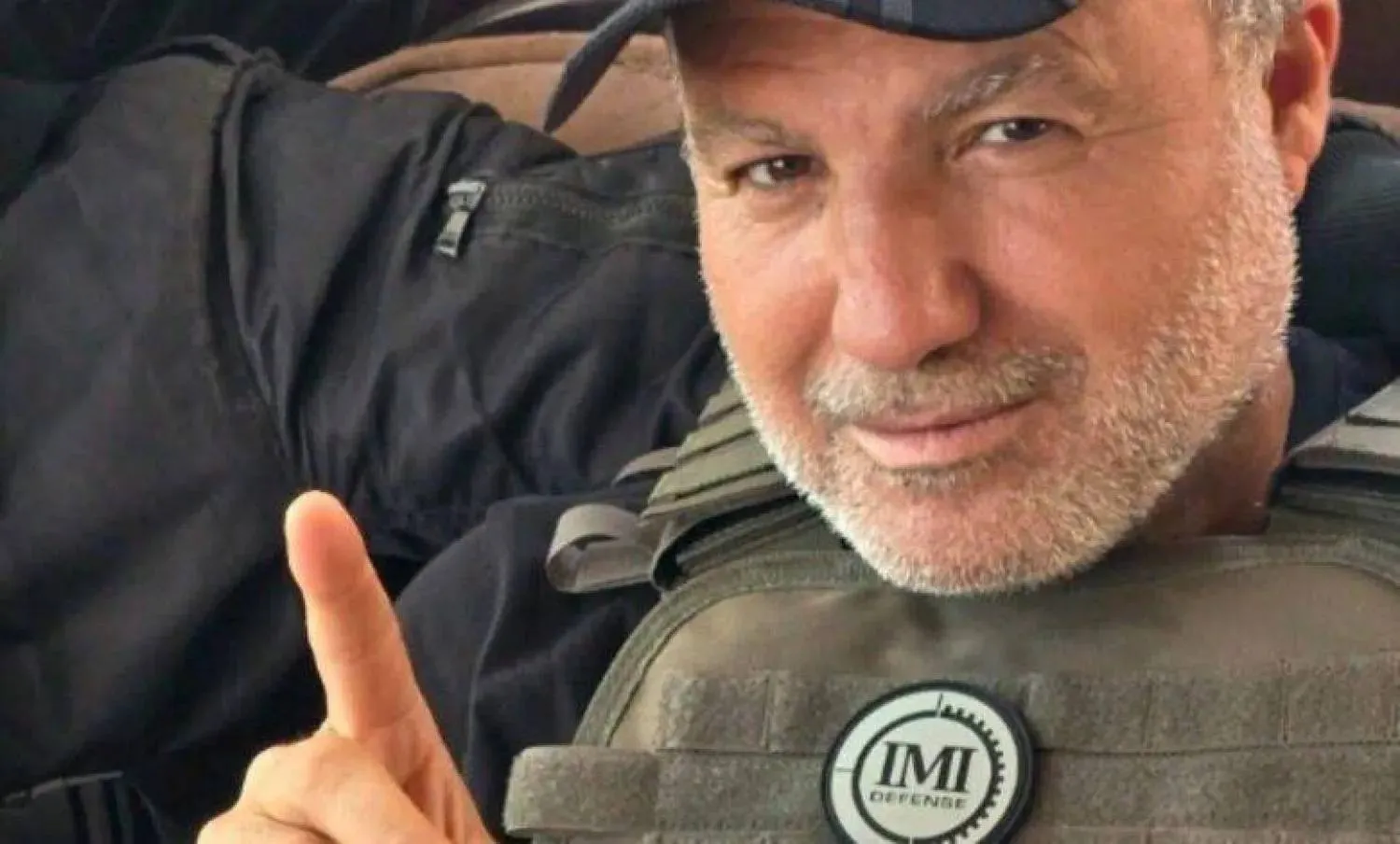

Former Security Official Forms Anti-Hamas Group in Gaza’s Khan Younis

Hussam al-Astal. (Palestinian press)
TT

Former Security Official Forms Anti-Hamas Group in Gaza’s Khan Younis

Hussam al-Astal. (Palestinian press)

Hussam al-Astal, a former member of the Palestinian Authority’s security agency, announced the formation of an armed group that operated against Hamas in Gaza’s Khan Younis.

He called on the residents of Khan Younis to move to areas under his control where they can find food, water and shelter.

He told The Times of Israel that his group will take in “whoever lives under Hamas’s oppression,” and that there is enough food, water and shelter for all.

“In the coming days, we will bring in another 300-400 people,” he added, revealing that the group carries out security screenings to make sure those joining have no ties to Hamas.

Al-Astal’s group has established itself around the village of Kizan al-Najjar, just south of Khan Younis, which was emptied of its residents during the war. The location is about a kilometer from al-Mawasi, where Israel has directed Palestinians displaced from Gaza City, reported the outlet.

“I am responsible for the (new) humanitarian zone in Khan Younis,” he explained, comparing his efforts to those of Yasser Abu Shabab, whose armed gang has set up security structures and civilian infrastructure as an alternative to Hamas rule in Israeli-controlled parts of Rafah in recent months.

Al-Astal said he was in contact with Shahab, but that he was working independently of him.

He told the daily that he had worked for several years in Israel before joining the PA’s security forces when it was still in control of Gaza.

Moreover, he revealed that his group was coordinating with Israel, saying soon “we will rely on Israel to bring us electricity and water.”

Al-Astal said his group has weapons to defend themselves and that they received funding from multiple sources, including the US, Europe, and unspecified Arab states.

“People here don’t want Hamas, they want peace with Israel,” he stressed. “I’m 50 years old; I remember when the army and Israel were in Gaza, and we lived in peace,” he reflected. “Children played, children went to school, and there were no problems. But today, Hamas’s terror has destroyed Gaza and its people.”

Al-Astal was held by the Hamas government security agency for years. He was lured into Gaza through one of his brothers who worked for the agency.

He was investigated for cooperating with Israel, Palestinian sources inside Hamas told Asharq Al-Awsat.

The probe accused him of the assassination of a Hamas engineer, Fadi al-Batsh, in Malaysia in 2018. He was sentenced to death by the Hamas-affiliated permanent military court in Gaza in 2022.

The sources said al-Astal is involved in facilitating the entry of suspicious vehicles from Israel to Gaza to assist collaborators with Israel’s Shabak agency.

Al-Astal escaped from jail in Gaza after the eruption of the Gaza war in October 2023. He tried to flee towards Israel but with the emergence of Abu Shahab’s group, he joined it to fight against Hamas. He later formed his own group along with other gunmen, some of whom are accused of collaborating with Israel or were held in Hamas jails.



Incubator Shortages, Premature Births Strain Gaza's Hospitals

The war in Gaza has devastated the territory's healthcare system, leaving premature babies even more vulnerable. BASHAR TALEB / AFP
TT

Incubator Shortages, Premature Births Strain Gaza's Hospitals

The war in Gaza has devastated the territory's healthcare system, leaving premature babies even more vulnerable. BASHAR TALEB / AFP

As monitors beep and doctors consult near them, two tiny newborns lie silently side-by-side, sharing a single incubator in a southern Gaza hospital running short on space and supplies.

Gaza's youngest already face an extremely precarious entry into the world, given the dire humanitarian situation in the war-shattered territory that borders Israel and Egypt, reported AFP.

But for babies needing specialist care, such as those born prematurely, the road ahead is even more perilous.

"The situation is dire: there is no oxygen available for them, nor is there any spare incubators in the hospital," said Hatem Dhahir, head of the neonatal department at Nasser hospital in the southern city of Khan Yunis.

"We're trying to transfer them to other hospitals, but they're always full and the situation is very bad. Most of the children need oxygen and are very underweight, and things are going from bad to worse," he told AFP.

The war between Israel and Hamas has devastated the Palestinian territory's healthcare system, with many medical facilities rendered completely or partially unusable.

Ongoing Israeli restrictions on goods entering the Gaza Strip mean medical supplies and specialist equipment are also running low.

Israel says it is preventing the entry of items that could also have military use as it accuses Hamas -- which carried out the worst-ever attack against Israel on October 7, 2023 -- of plotting further violence.

Dhahir said Nasser hospital had seen a significant increase in the number of premature births in recent months, as well as twins and triplets.

The influx was forcing staff to place two or even three babies in each incubator, he said.

In March, the UN's humanitarian agency OCHA said that one in three pregnancies in Gaza were high-risk and 70 percent of newborns were premature or underweight.

Incubator sharing significantly increased mortality risks, it said.

- 'No room' -

Nearly the entirety of Gaza's population was displaced at least once during the devastating war, sparked by Hamas's October 7, 2023 attack on Israel.

The fighting flattened swathes of the territory, left hundreds of thousands of people living in tents and temporary shelters and shattered vital infrastructure such as sanitation and access to safe water.

Despite a US-backed ceasefire declared in October 2025, the Israeli military continues to target Palestinians it says are militants.

A UN-mandated inquiry published in June said that severe shortages of food, medical supplies, fuel and the collapse of healthcare services had an enormous impact on maternal health.

"Against this background, rates of miscarriage, stillbirth, low-birthweight infants and congenital defects have increased," the UN's Independent International Commission of Inquiry said.

Heart conditions were among three types of congenital defects to have particularly increased, the commission said, citing medical practitioners.

In southern Gaza, Mona Ahmad was accompanying a baby taken to Nasser hospital in late August and diagnosed with a serious congenital defect in which the heart's two main blood vessels are switched in position.

"We received a final report stating that the baby was suffering from transposed arteries and needed to be transferred, as there was absolutely no treatment available for her here," Ahmad told AFP.

"The baby spent a full week in the neonatal unit and was discharged because there was no room for her there," she added.

In a bid to revive Gaza's neonatal care system, the UN children's agency UNICEF has scaled up its work to supply medical equipment such as incubators, ventilators and monitors to hospitals.

Including work that began before the ceasefire, UNICEF has supplied 93 incubators to six facilities across the Gaza Strip.

But challenges remain immense and more needs to be done, said Toby Fricker, chief of advocacy and communications for UNICEF Palestine, following a visit to a neonatal intensive care unit in the territory.

For now, "through the pure... resilience of the doctors, of people, things are working," he said.


Fidan Says Turkish President to Visit Syria Soon

Syria's Foreign Minister Asaad al-Shaibani holds a press conference with Turkish Foreign Minister Hakan Fidan in Damascus, Syria, September 13, 2026. (Reuters)
TT

Fidan Says Turkish President to Visit Syria Soon

Syria's Foreign Minister Asaad al-Shaibani holds a press conference with Turkish Foreign Minister Hakan Fidan in Damascus, Syria, September 13, 2026. (Reuters)

Turkish Foreign Minister Hakan Fidan said on Sunday that President Recep Tayyip Erdogan would visit Syria soon, saying the two countries will hold intense and comprehensive meetings covering political, economic and military issues.

Fidan made the announcement during a press conference with his Syrian counterpart Asaad al-Shaibani in Damascus.

Fidan described Erdogan’s upcoming visit as an important step during which decisions and measures taken by the Joint Higher Committee would be reviewed, reported Syria’s state news agency SANA.

The committee would be jointly chaired, meet regularly and operate through a permanent secretariat, with specialized sectoral committees supporting its work, he added.

Its agenda would include energy, refugee returns, education and culture, he went on to say.

Al-Shaibani noted that Syria had developed a comprehensive program for organized refugee returns, providing housing, employment and transportation services under Syrian management and linked to reconstruction projects in areas of origin.

He said Syria was close to reopening its embassy in Ankara, describing it as an important step in strengthening relations.

Fidan stressed that Syrian-Turkish relations had made significant progress and that Syria’s stability was important not only for the Syrian people but for the wider region.

Türkiye viewed Syria’s unity, sovereignty and territorial integrity as essential, he stated, adding that all armed elements should integrate under state institutions.

Moreover, Fidan described the decision regarding the integration of the Syrian Democratic Forces (SDF) as an important step, saying positive developments in Syria would contribute to regional stability.

Al-Shaibani said the press conference, held days after talks between the two sides in Ankara, reflected the rapidly expanding partnership between Syria and Türkiye and the strategic direction pursued by both countries.

He said Türkiye was among the first countries to reopen its embassy in Damascus and border crossings and supply lines following the ouster of the Assad regime on Dec. 8, 2024, adding that Ankara also played a leading role in international forums calling for the lifting of sanctions imposed on the Syrian people.

Al-Shaibani said Türkiye’s position at a pivotal moment would remain part of Syria’s national memory, adding that Damascus and Ankara had advanced their partnership through dozens of meetings at presidential and ministerial levels.

He said the two countries had signed 40 agreements and memoranda of understanding and established an institutional network linking 22 Syrian ministries and agencies with their Turkish counterparts.

He said Syria and Türkiye aim to increase bilateral trade from nearly $4 billion last year to $10 billion through production partnerships, local content, Syrian employment and joint industrial zones along the border.

The minister said the two sides were also working toward a comprehensive energy strategy covering gas, electricity and power-grid interconnection.

Fidan said Turkish Trade Minister Ömer Bolat’s recent visit to Damascus and Aleppo with a delegation of businesspeople focused on increasing investments and expanding trade, particularly in the energy sector.

He said Syria would play a pivotal role in connecting Jordan, Saudi Arabia, Gulf countries and Iraq with Türkiye and the Mediterranean.


Iraq Border Crossings with Iran Reopen

Stranded Iranians and Iraqis wait at the Iraq-Iran border following the Iraqi government's decision to close the Shalamsheh border crossing in the southern Basra province on September 12, 2026. (Photo by Hussein FALEH / AFP)
TT

Iraq Border Crossings with Iran Reopen

Stranded Iranians and Iraqis wait at the Iraq-Iran border following the Iraqi government's decision to close the Shalamsheh border crossing in the southern Basra province on September 12, 2026. (Photo by Hussein FALEH / AFP)

Iraqi authorities said passenger traffic had resumed at key border crossings with Iran after being closed Saturday following drone attacks launched from Iraq that closed Saudi Arabia’s East-West oil pipeline.

Baghdad acknowledged that the attack had originated from Iraq.

Iraqi Prime Minister Ali al-Zaidi had ordered specific dates to be set for reopening three border crossings with Iran: Shalamcheh, Mandali, and Al-Sheeb, Iraq’s Security Media Cell said.

The three border crossings are located in the provinces of Basra, Maysan, and Mandali.

The attacks against Saudi Arabia were carried out from near the Al-Sheeb border crossing in Maysan province, prompting the prime minister to dismiss the commander in charge of Maysan and place the heads of its security agencies under his direct command, while referring them for investigation.

Analysts said the border closures amounted to an unprecedented “warning message” to Iran, as Iraqi authorities tightened security and launched investigations into violations at the crossings.