


Syrian FM’s Washington Visit Opens Cautious Window to New Phase

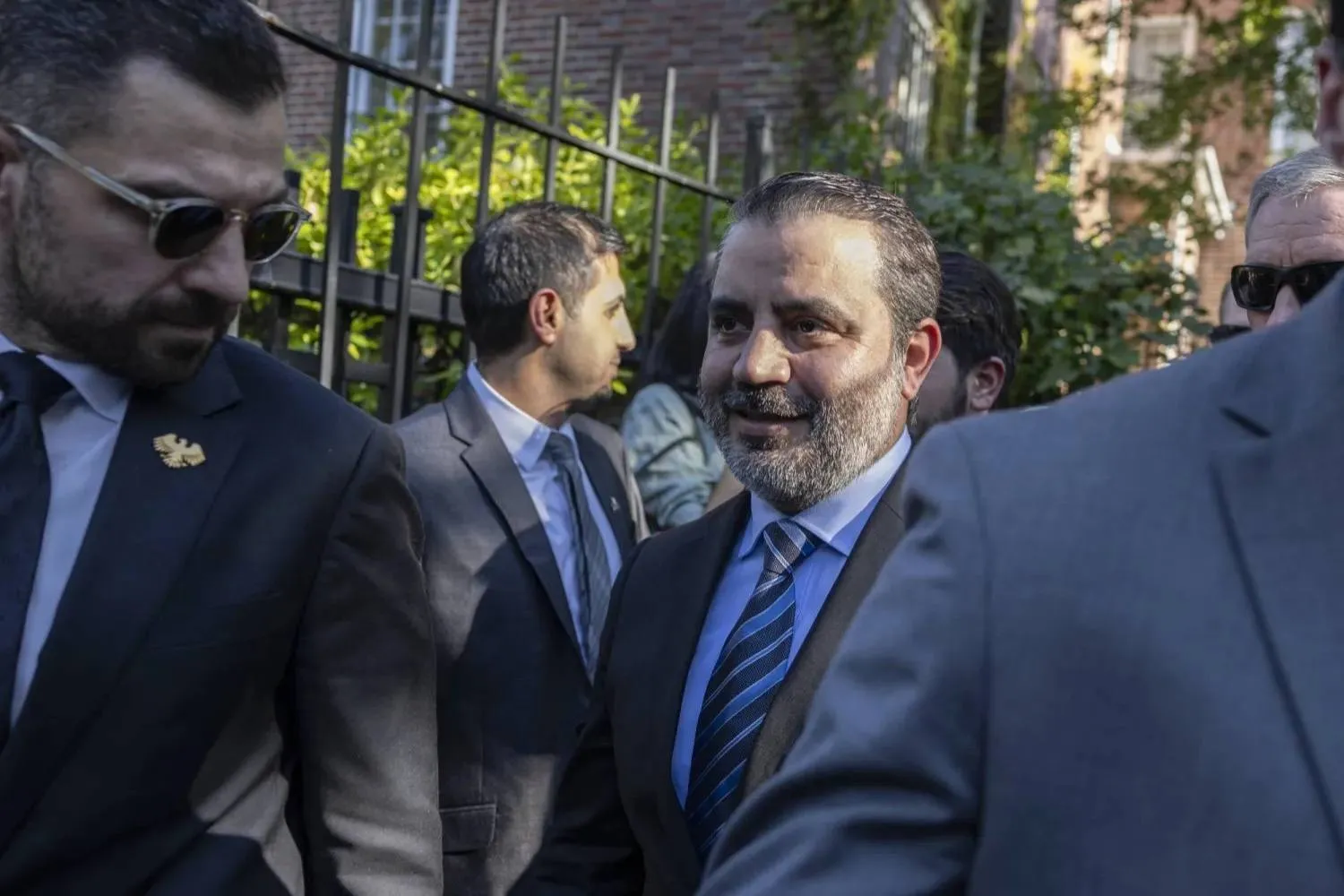
19 September 2025, US, Washington: Syrian Foreign Minister Asaad al-Shaibani attends a ceremony at the Syrian Embassy in Washington, D.C., where the newly adopted three-starred flag was raised for the first time in over a decade-since the suspension of diplomatic ties under the previous regime. Photo: Mehmet Eser/ZUMA Press Wire/dpa
TT

Syrian FM’s Washington Visit Opens Cautious Window to New Phase

19 September 2025, US, Washington: Syrian Foreign Minister Asaad al-Shaibani attends a ceremony at the Syrian Embassy in Washington, D.C., where the newly adopted three-starred flag was raised for the first time in over a decade-since the suspension of diplomatic ties under the previous regime. Photo: Mehmet Eser/ZUMA Press Wire/dpa

Syrian Foreign Minister Asaad al-Shaibani’s visit to Washington this week looked like a rare diplomatic breakthrough, testing the limits of what is possible in a relationship defined by hostility for decades.

In a highly unusual scene, Shaibani walked the halls of Congress and met senior officials at the State and Treasury departments, opening a cautious window onto what could be a new phase of cooperation between Damascus and Washington.

The outreach comes as Syrian President Ahmed al-Sharaa prepares to travel to New York for the United Nations General Assembly and the annual Concordia Summit, part of a push to signal Syria’s return to the international stage. A key objective for Damascus is to press for the easing or repeal of the “Caesar Act,” Washington’s main sanctions tool against the former Assad government since 2020.

US officials said discussions focused heavily on sanctions. The Trump administration has already taken tentative steps, including a Treasury Department general license issued in May allowing most economic dealings with the Syrian government and central bank, alongside a temporary State Department waiver to expand humanitarian investment. US President Donald Trump also ended the Syria emergency designation in June, in what was widely seen as a signal of readiness to loosen restrictions.

But sanctions remain in place, with Congress insisting on retaining a central role. Republican Senator Lindsey Graham and others warned that any relief must be tied to Damascus’ cooperation on counterterrorism, Israel’s security, and curbing narcotics and arms smuggling, making the issue a political and security matter as much as an economic one.

Deputy Secretary of State Christopher Landau and US envoy Tom Barrack discussed with Shaibani the future of Syria, its relations with Israel, counterterrorism, and implementation of a March 10 deal between Damascus and the US-backed Syrian Democratic Forces (SDF), as well as potential economic cooperation, the State Department said.

“We are interested in creating a peaceful, prosperous and stable path for Syria,” a US official told Reuters, adding that it would require inclusive governance embracing minorities and local groups from Alawites and Druze to tribes and Kurds.

Since the fall of Bashar al-Assad’s regime, Syria has been plagued by violence and instability. Coastal rebellions were met with harsh crackdowns by pro-government security forces, while Israeli airstrikes and clashes in the south deepened volatility. This fragility, some US officials argue, makes engagement with Damascus risky.

Washington’s broader goal is to close the “open circles” that allow Iran, Hezbollah, and militant groups to use Syria as a base for influence and trafficking. Tackling these issues, officials say, is a prerequisite for deeper political or economic partnerships.

The most sensitive file remains engagement with Israel. Leaked reports spoke of undisclosed contacts that could lead to security or economic understandings, though no details were confirmed. US officials hinted that any sanctions relief would be contingent on Damascus’ willingness to pursue this track.

Former Syrian diplomat Bassam Barabandi told Asharq Al-Awsat that building ties with Israel could unlock opportunities for regional and international cooperation in trade and security. But he cautioned that it would require a clear strategy to bolster internal stability and sustainable development, “so it does not become a source of domestic division.”

In a symbolic moment, Shaibani helped raise the Syrian flag over the embassy in Washington for the first time in more than a decade. Dozens of Syrians in the United States celebrated what they saw as the revival of Syrian diplomacy after years of isolation under Assad.

Yet the symbolism was undercut by a contradictory message: The Department of Homeland Security said it would end Temporary Protected Status for Syrian refugees, exposing thousands to possible deportation starting Nov. 21. The agency offered free flights and a $1,000 stipend for those leaving within 60 days.

“This is disappointing, though not surprising,” said Mohammed Ghanem of the Syrian American Council. He told Asharq Al-Awsat the group had expected the move after similar programs for other nationalities were terminated. “We warned beneficiaries – about 6,000 Syrians – to prepare alternatives, as immigration remains one of the most divisive issues between Republicans and Democrats, and a Trump priority.”

Alongside Shaibani’s Washington talks, Syrian opposition figures also met US officials to present alternative views. Sinam Mohamad of the Syrian Democratic Council office in Washington said the meetings showed discussions were not limited to the government.

Shaibani’s visit “is part of efforts to reinforce the legitimacy of the transitional government,” she told Asharq Al-Awsat. “But Washington must also take into account the concerns of Syria’s other communities if it wants to support lasting stability rather than a short-term political deal.”

As President al-Sharaa prepares to address the UN General Assembly and join world leaders at Concordia, US-Syrian relations appear to stand at a crossroads - with a door now open, but its future dependent on complex domestic, regional, and international dynamics.



Israeli Strikes Kill Five in Gaza, Say Local Health Authorities

 Makeshift tents shelter displaced Palestinians stand among buildings destroyed by Israeli air and ground operations in Gaza City Thursday, Jan. 15, 2026. (AP)
Makeshift tents shelter displaced Palestinians stand among buildings destroyed by Israeli air and ground operations in Gaza City Thursday, Jan. 15, 2026. (AP)
TT

Israeli Strikes Kill Five in Gaza, Say Local Health Authorities

 Makeshift tents shelter displaced Palestinians stand among buildings destroyed by Israeli air and ground operations in Gaza City Thursday, Jan. 15, 2026. (AP)
Makeshift tents shelter displaced Palestinians stand among buildings destroyed by Israeli air and ground operations in Gaza City Thursday, Jan. 15, 2026. (AP)

Two Israeli airstrikes killed five people, including a 16-year-old, in Deir al-Balah on Thursday, said local health authorities.

The Israeli military did not immediately respond to a Reuters request for comment on the incident.

It was not immediately clear what triggered the attacks, which were in areas outside the control of Israeli forces in the strip.

More than 400 Palestinians ‌and three Israeli ‌soldiers have been reported ‌killed ⁠since a ‌fragile ceasefire took effect in October.

Israel has razed buildings and ordered residents out of more than half of Gaza where its troops remain. Nearly all of the territory's more than 2 million people now live in ⁠makeshift homes or damaged buildings in a sliver of ‌territory where Israeli troops have withdrawn ‍and Hamas has ‍reasserted control.

The United Nations children agency ‍said on Tuesday that over 100 children have been killed in Gaza since the ceasefire, including victims of drone and quadcopter attacks.

Israel and Hamas have traded blame for violations of the ceasefire and remain far apart ⁠from each other on key issues, despite the United States announcing the second phase of the ceasefire on Wednesday.

Israel launched its operations in Gaza in the wake of an attack by Hamas-led fighters on October, 2023 which killed 1,200 people, according to Israeli tallies. Israel's assault has killed 71,000 people, according to health authorities in the strip, ‌and left much of Gaza in ruins.


Türkiye Says Syrian Government Could Use Force Against Kurds

 Türkiye's Foreign Minister Hakan Fidan answers questions from reporters during a news conference in Istanbul, Türkiye, Thursday, Jan. 15, 2026. (AP)
Türkiye's Foreign Minister Hakan Fidan answers questions from reporters during a news conference in Istanbul, Türkiye, Thursday, Jan. 15, 2026. (AP)
TT

Türkiye Says Syrian Government Could Use Force Against Kurds

 Türkiye's Foreign Minister Hakan Fidan answers questions from reporters during a news conference in Istanbul, Türkiye, Thursday, Jan. 15, 2026. (AP)
Türkiye's Foreign Minister Hakan Fidan answers questions from reporters during a news conference in Istanbul, Türkiye, Thursday, Jan. 15, 2026. (AP)

The Syrian government army could use further force against Kurdish militants after a flare-up in violence in northern Syria, the foreign minister of neighboring Türkiye, a strong backer of the Syrian authorities, said on Thursday.

More than 150,000 people have fled from two Kurdish-run pockets of Syria's northern city of Aleppo during five days of fighting between government forces and ‌Kurdish fighters. ‌Syria's health ministry says at least 23 ‌people ⁠have died.

Türkiye has itself threatened a potential military operation against the Syrian Kurdish groups it calls terrorists.

It says the Kurdish-led Syrian Democratic Forces (SDF) must integrate into the central government under a nearly year-old agreement that has stalled.

"I hope it doesn't come to ⁠that point ... but when problems are not solved through dialogue, unfortunately, I see from ‌here that the use of force is ‍also an option for the ‍Syrian government," Foreign Minister Hakan Fidan told a press conference in ‍Istanbul.

The violence in Aleppo has deepened one of the main faultlines in Syria, where President Ahmed al-Sharaa's promise to unify the country under one leadership after 14 years of war has faced resistance from Kurdish forces wary of his government.

Syria's military has declared a handful of Kurdish-held towns in the north as a "military zone" ⁠and said all non-state factions stationed there should leave the area.

On Wednesday and Thursday, it dispatched fighters and military equipment to the zone and opened a humanitarian corridor for people to flee.

Fidan said that the SDF must show good intentions and break out of a cycle of violence. Türkiye says the SDF is aligned with the outlawed Kurdistan Workers Party militant group, which is involved in a peace process with Ankara.

Fidan added that the peace process with the PKK should not become a missed opportunity, and Ankara hopes it ‌will continue.


Sudan Food Aid Could Run Out as Peace Efforts Stall

According to the UN, more than 21 million people are now facing acute food insecurity, with two-thirds in urgent need of assistance. (AFP)
TT

Sudan Food Aid Could Run Out as Peace Efforts Stall

According to the UN, more than 21 million people are now facing acute food insecurity, with two-thirds in urgent need of assistance. (AFP)

Food aid in Sudan is set to run out by the end of March unless new funding is secured, the United Nations said Thursday, raising fears for millions caught up in the world's largest hunger crisis.

Nearly three years of fighting between the army and paramilitary Rapid Support Forces have left tens of thousands dead, 11 million displaced and repeated attempts at peace blocked.

Efforts led by the US and regional mediators -- Egypt, Saudi Arabia and the United Arab Emirates, known as the Quad -- have failed to secure a ceasefire, as both sides wrestle for territorial gain.

A high-level meeting on Wednesday in Cairo brought together officials from the Quad countries, as well as the UN, European Union and regional organizations to discuss peace efforts, which have seen little progress.

"By the end of March, we will have depleted our food stocks in Sudan," said Ross Smith, the World Food Program's Director of Emergency Preparedness and Response.

"Without immediate additional funding, millions of people will be left without vital food assistance within weeks."

According to the UN, more than 21 million people -- almost half of Sudan's population -- are now facing acute food insecurity, with two-thirds in urgent need of assistance.

The UN's children agency UNICEF said last week that millions of children have been pushed "to the brink of survival" and humanitarian aid remains "far from sufficient" amid funding shortfalls and ongoing hostilities.

- 'Absolute minimum' -

In December, outgoing UN refugee chief Filippo Grandi said a wave of "drastic, irresponsible" aid cuts inflicted unnecessary suffering on those in need.

Smith said WFP has been forced to cut rations to the "absolute minimum for survival" and warned that previous "hard-earned gains" in hard-to-reach areas risk being reversed.

WFP says it urgently needs $700 million to continue its operations through June.

A UN-backed assessment confirmed last year that famine had taken hold in el-Fasher, the capital of North Darfur, which was overrun by the paramilitary forces in October.

On Wednesday, US senior advisor for Arab and African affairs Massad Boulos said the UN delivered more than 1.3 metric tons of humanitarian supplies to el-Fasher, the first such delivery since the city was besieged in May 2024.

But aid agencies warn that a deteriorating security situation across Darfur continues to jeopardize the delivery of desperately needed assistance.

Famine has also been confirmed in Kadugli, in neighboring Kordofan, now a key battleground in the conflict.

In Dilling, around 130 kilometers (80 miles) north, the UN says civilians are likely experiencing famine conditions, though insecurity has prevented formal declaration.

The UN warned that 20 more areas across Darfur and Kordofan are at risk.

- Renewed peace talks -

In November, US President Donald Trump pledged to help end the conflict, but his promise has yet to materialize.

In Egypt, the UN Secretary General's Sudan envoy Ramtane Lamamra met Wednesday with Boulos and other diplomats as part of the fifth meeting of the Consultative Mechanism to Enhance and Coordinate Peace Efforts.

Lamamra called it "a key and timely opportunity for international actors to align efforts and renew collective engagement", but a diplomatic source told AFP there are no new truce proposals currently on the table.

Egyptian Foreign Minister Badr Abdelatty said on Wednesday that there was a consensus on a humanitarian truce and the rejection of "foreign interference".

But he also emphasized what he described as Egypt's "red lines" and readiness to defend its southern neighbor's territorial integrity.