

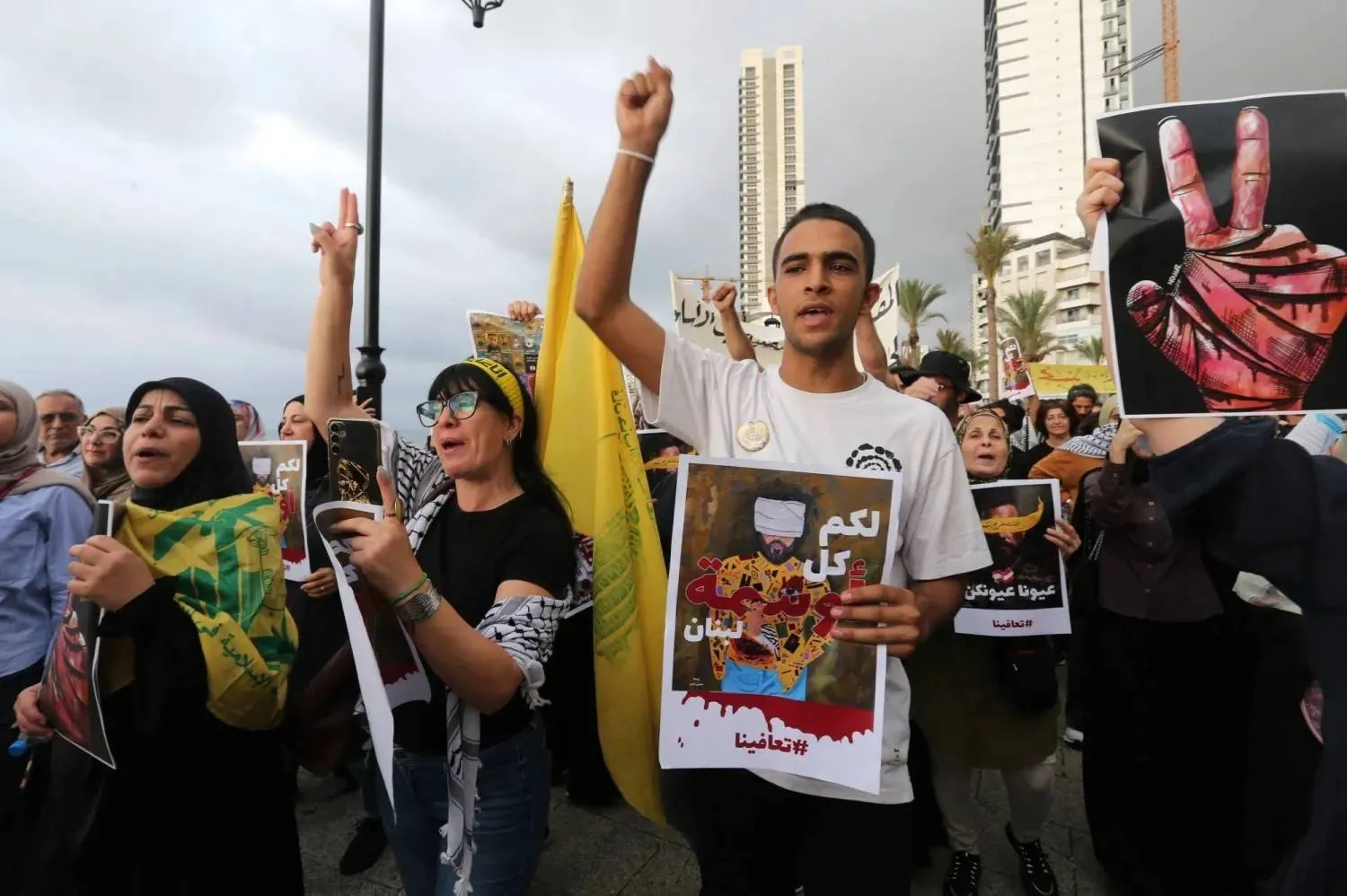

Israel Seeks to Isolate Hezbollah by Warning Residents Against Harboring Fighters

Hezbollah supporters march in Beirut commemorating pager device explosion (EPA)
TT

Israel Seeks to Isolate Hezbollah by Warning Residents Against Harboring Fighters

Hezbollah supporters march in Beirut commemorating pager device explosion (EPA)

Israel has stepped up psychological pressure on southern Lebanon in recent weeks, dropping warning leaflets over border villages, publishing maps of targeted areas and carrying out intensified airstrikes that in some cases hit residential buildings.

Residents and analysts say the strategy is aimed at isolating Hezbollah from its local support base by shifting the cost of its military activity onto civilians.

On Saturday, Israeli drones scattered leaflets over the village of Mais al-Jabal urging residents not to rent homes to Hezbollah or cooperate with the group.

The warnings coincided with a surge in air raids on Hezbollah positions, military sites and areas where civilians live. Within days, Israeli strikes stretched from Nabatieh in the south to Baalbek in the east, culminating in direct evacuation orders for residential buildings.

“The message is clear: keep away from Hezbollah or risk paying the price,” said retired Lebanese brigadier general Khalil Helou. He told Asharq Al-Awsat that Israel was moving from targeting commanders and weapons depots to striking civilian neighborhoods, citing recent leaflets over Mais al-Jabal, Debbeen and Kfar Tebnit.

Helou said the campaign seeks to enforce an informal buffer zone of 3 to 4 km inside Lebanon’s border without deploying troops, by pressuring residents not to return to their homes or rent them to Hezbollah members. Such a strategy, he said, aims to deprive Hezbollah of cover for launching Kornet anti-tank missiles, which have inflicted heavy Israeli losses and remain hard to intercept by Iron Dome defenses.

He noted that while Israel has long tried propaganda to drive a wedge between Hezbollah and its support base, the new factor is the combination of psychological warnings with airstrikes on homes. “The immediate goal is to create a social rift and push people to view Hezbollah as a burden, though its support base remains cohesive out of a perceived need for protection,” Helou said.

The airstrikes themselves have grown more destructive, with Israeli jets dropping 500-kg bombs on residential buildings. Analysts say this is meant both to terrify Hezbollah’s community by hitting the heart of civilian neighborhoods and to signal that any infrastructure suspected of military use will be targeted.

Helou said the escalation is carefully timed, coinciding with the anniversary of the assassination of Hezbollah’s former leader Hassan Nasrallah and with the UN General Assembly in New York, where Lebanon’s delegation is present. “Israel wants Lebanon raised as a security threat in international forums,” he said.

Still, he and other analysts downplayed the prospect of an imminent ground war. “What we are seeing is not preparation for a full-scale invasion but a continuation of a long war of attrition,” Helou said. He noted that any major ground operation would require at least two weeks of military build-up, while Israel is still bogged down in Gaza.



UN Force Says Israeli Tank Fired near Peacekeepers in Lebanon

United Nations peacekeepers with the UN Interim Force in Lebanon (UNIFIL) patrol in vehicles together with Lebanese soldiers in the Buwayda region of Marjayoun, near the border with Israel in southern Lebanon, on January 8, 2026. (Photo by Rabih DAHER / AFP)
TT

UN Force Says Israeli Tank Fired near Peacekeepers in Lebanon

United Nations peacekeepers with the UN Interim Force in Lebanon (UNIFIL) patrol in vehicles together with Lebanese soldiers in the Buwayda region of Marjayoun, near the border with Israel in southern Lebanon, on January 8, 2026. (Photo by Rabih DAHER / AFP)

The United Nations Interim Force in Lebanon said an Israeli tank fired near its peacekeepers on Monday, and warned that such attacks were becoming "disturbingly common".

UNIFIL has repeatedly reported Israeli fire near or towards its personnel in recent months, and less than two weeks ago said gunfire from an Israeli position hit close to peacekeepers twice, said AFP.

"UNIFIL peacekeepers observed two Merkava tanks move" from an Israel army position inside Lebanese territory "further into Lebanon" on Monday, the force said in a statement.

UNIFIL has acted as a buffer between Israel and Lebanon for decades, and recently has been working with Lebanon's army to support a year-old ceasefire between Israel and militant group Hezbollah.

Under the November 2024 truce, Israel was to withdraw its forces from south Lebanon, but it has kept them in five areas it deems strategic and carries out regular strikes on Lebanon, usually saying it is targeting Hezbollah sites and operatives.

"The peacekeepers requested through liaison channels that the tanks stop their activity," the statement said.

Later, "one of the tanks fired three shells from its main gun, with two impacts approximately 150 meters away from the peacekeepers," UNIFIL said, adding that "as the peacekeepers moved away for safety, they were continuously tracked with a laser from the tanks".

The statement reported no casualties but noted UNIFIL had informed the Israeli army of its activities in the area in advance.

"Attacks like these on identifiable peacekeepers ... are becoming disturbingly common," the statement said, urging a stop to such incidents.

It called them "a serious violation" of United Nations Security Council Resolution 1701, which ended a 2006 war between Israel and Hezbollah and forms the basis of the current truce.

Under heavy US pressure and fears of expanded Israeli strikes, Beirut has committed to disarming Hezbollah, and last week Lebanon's army said it had finished doing so in the area near the border.

UNIFIL's final mandate ends this year, and the force is to leave Lebanon in 2027.


Al-Alimi Orders Closure of Illegal Prisons in Southern Yemen

The Port of Aden during sunset, in Aden, Yemen, October 20, 2024. (Reuters)
TT

Al-Alimi Orders Closure of Illegal Prisons in Southern Yemen

The Port of Aden during sunset, in Aden, Yemen, October 20, 2024. (Reuters)

Chairman of Yemen's Presidential Leadership Council Dr. Rashad al-Alimi ordered on Monday the closure of all illegal prisons and detention centers in southern Yemen.

The prisons are located in the governorates of Aden, Lahj and Dhaleh.

Al-Alimi met in the Saudi capital Riyadh with Tobias Tunkel, Germany’s Commissioner for the Middle East, Near East and North Africa, and German Ambassador to Yemen, Thomas Schneider, the state news agency Saba reported.

Al-Alimi ordered the immediate release of detainees who have been illegally imprisoned. He tasked the security and military agencies to coordinate with the Defense Ministry public prosecution to carry out the order.

He made the order amid accusations by rights groups that forces aligned with the dissolved Southern Transitional Council had run illegal jails.

Al-Alimi warned against supporting these illegal armed groups, saying backing them does not help in the fight against terrorism.

Security chaos and legitimizing weapons outside state control are the greatest threat to the security of Yemen, the region and international waterways, he cautioned.

Al-Alimi and the German delegation discussed the latest developments in Yemen in wake of the handover of military camps to the legitimate forces and the withdrawal of the STC.

He said the move will help consolidate internal stability and pave the way for normal work to resume at state institutions, the flow of aid and restore the international community's trust.


Sudan Paramilitary Strike on Southeastern City Kills 27

RSF fighters. (AFP file photo)
TT

Sudan Paramilitary Strike on Southeastern City Kills 27

RSF fighters. (AFP file photo)

Sudan's paramilitary Rapid Support Forces launched drones at an army base in the southeastern city of Sinja on Monday, killing 27 people, military and health sources told AFP.

Sinja, the capital of Sennar state, lies around 300 kilometers (180 miles) southeast of the capital Khartoum, along a strategic road connecting the national capital to the army-controlled east.

The strike comes a day after the army-aligned government announced its return to Khartoum after close to three years operating from its wartime base in the eastern city of Port Sudan.

Since April 2023, the war between the army and the RSF has killed tens of thousands of people, displaced 11 million internally and across borders, and created the world's largest displacement and hunger crises.

Sinjah had largely been spared the fighting since the army recaptured the area in late 2024 as part of a wider offensive that saw it later retake Khartoum.

The military source, speaking anonymously because they were not authorized to brief the media, said RSF drones "targeted the headquarters of the army's 17th Infantry Division" in Sinja.

Ibrahim al-Awad, the Sennar state health minister, said that the attack carried out by the RSF also wounded 73 people.

A security source told AFP on condition of anonymity that the attack targeted the army headquarters "during a meeting attended by military, security and government officials" from several eastern and central states.

One resident of Sinja told AFP that they "heard explosions and anti-aircraft fire".

The Sennar region had last been targeted by drones in October.

- Fragile return -

In the year following its recapture, more than 200,000 people returned to Sennar state, according to the United Nations' migration agency.

But the agency has warned many such returns across the country remain "fragile", often taking place in areas with damaged infrastructure and ongoing insecurity.

Along with the government, millions of civilians had fled Khartoum early in the war when RSF fighters quickly overran it.

Since the army regained control last year, around 1.2 million have gradually returned, according to the latest UN figures.

Reconstruction efforts are underway, but the RSF, which with its allies now rules around a third of the country, sporadically launches long-range drones deep into army-controlled territory, particularly targeting infrastructure.

The army and its government control Sudan's north, east and center.

The RSF now dominates the vast western region of Darfur and has pushed through the southern region of Kordofan, aiming to capture cities that would bring it closer to Khartoum.

With multiple cities under paramilitary siege, hundreds of thousands face mass starvation in Kordofan.

The UN has called the conflict a "war of atrocities", with both sides accused of targeting civilians.