


Egypt Renews Concerns over Threats to Peace with Israel

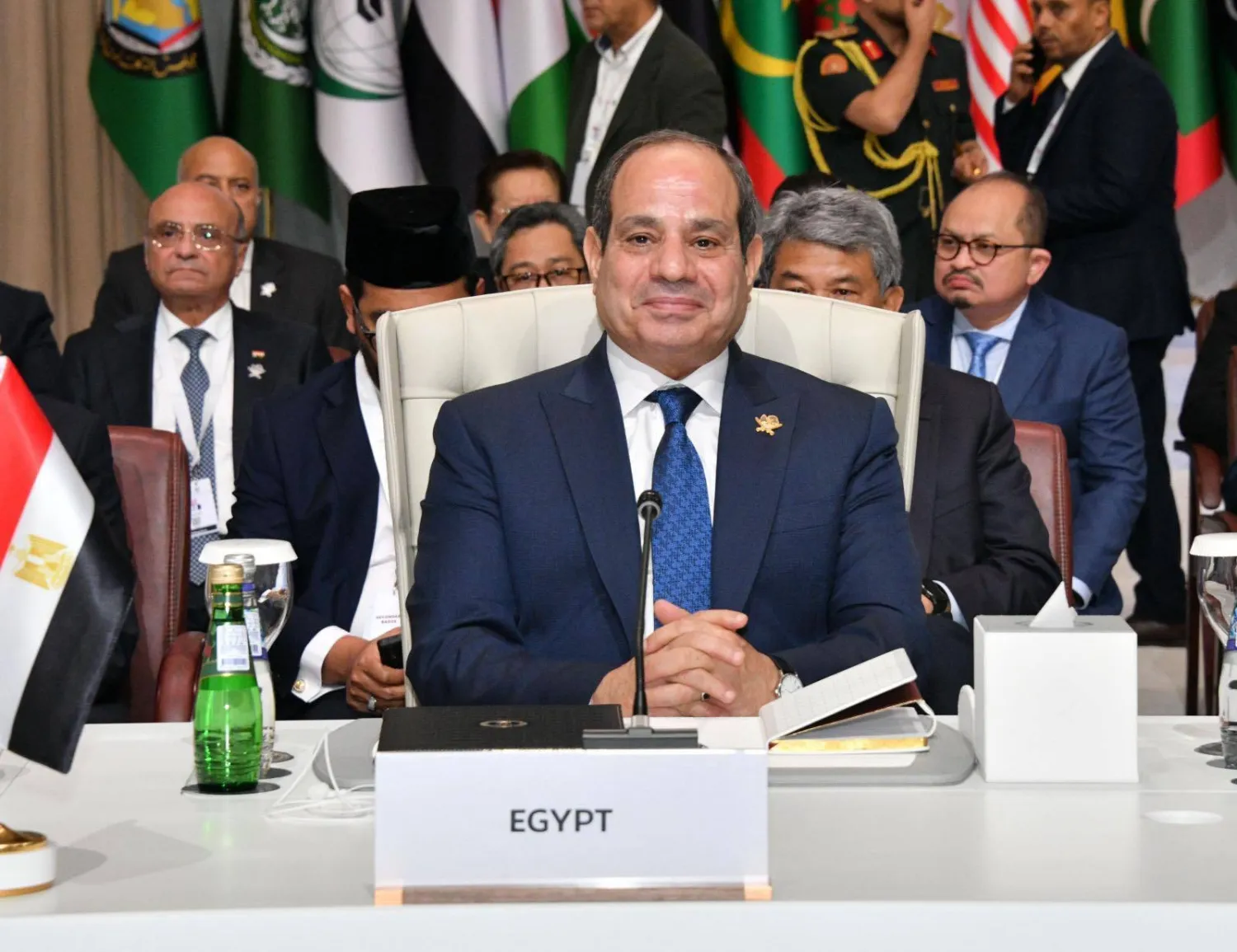
Egyptian President Abdel Fattah al-Sisi during the recent Doha Summit (Egyptian Presidency). 
TT

Egypt Renews Concerns over Threats to Peace with Israel

Egyptian President Abdel Fattah al-Sisi during the recent Doha Summit (Egyptian Presidency). 

Egypt has renewed warnings that Israel’s military operations in Gaza and the wider region could undermine the peace treaty that has bound the two countries for nearly five decades. The statement came amid mutual media accusations of violations of the 1979 Camp David peace agreement.

Speaking at a UN Security Council session on the Middle East late Tuesday, Egypt’s UN envoy Osama Abdel Khalek cautioned that Israel’s actions in Gaza “threaten a peace that has endured for five decades, with risks to the entire region that cannot be imagined.” He accused Israel of seeking to forcibly displace large parts of Gaza’s population through military pressure, starvation, and destruction of essential infrastructure, steps Cairo “completely rejects.”

The remarks followed similar warnings earlier this month from President Abdel Fattah al-Sisi at the Doha summit, where he stressed that Israel “must realize that peace cannot be achieved through military escalation, and that its reckless behavior will have dangerous consequences for international security.”

Egypt and Israel signed their landmark peace treaty on March 26, 1979, following the Camp David accords brokered by the United States. The agreement ended decades of conflict and set detailed security arrangements, particularly in the Sinai Peninsula.

Recent US media reports, however, suggested Israeli officials had expressed concern over Egyptian military deployments in Sinai, claiming they violated treaty restrictions that allow only light weaponry in some zones. Axios reported that Prime Minister Benjamin Netanyahu had even asked the Trump administration to pressure Cairo to scale back its forces. Egypt’s State Information Service dismissed the allegations, insisting all deployments were coordinated within the treaty framework and reiterating Cairo’s commitment to peace.

Former Deputy Foreign Minister Raouf Saad told Asharq Al-Awsat that Egypt’s stance reflects its firm rejection of any plan to displace Palestinians. He described Cairo’s messages as directed both at the Israeli public - warning that their government’s policies jeopardize their security - and at the Israeli leadership, which seeks to impose new realities on the ground “through killings, starvation, and forced displacement.”

Egypt, Saad added, views the current moment as a turning point and has escalated its rhetoric, including hints that peace itself could collapse, in an effort to halt Israeli plans. He suggested that possible Arab responses might include suspending the Abraham Accords.

Despite heightened tensions since the October 7 war, Cairo continues to act as a mediator between Israel and the Palestinians. Abdel Khalek reaffirmed before the Security Council that Egypt remains committed to de-escalation and is working with international mediators to secure a ceasefire in Gaza.


Netanyahu to Discuss Iran, Next Phase of Gaza Plan with Trump

Israeli Prime Minister Benjamin Netanyahu (C), Cypriot President Nikos Christodoulides (L) and Greek Prime Minister Kyriakos Mitsotakis (R) hold a joint press conference after a trilateral meeting at the Citadel of David Hotel in Jerusalem, 22 December 2025. EPA/ABIR SULTAN / POOL
TT

Netanyahu to Discuss Iran, Next Phase of Gaza Plan with Trump

Israeli Prime Minister Benjamin Netanyahu (C), Cypriot President Nikos Christodoulides (L) and Greek Prime Minister Kyriakos Mitsotakis (R) hold a joint press conference after a trilateral meeting at the Citadel of David Hotel in Jerusalem, 22 December 2025. EPA/ABIR SULTAN / POOL

Prime Minister Benjamin Netanyahu said on Monday he will discuss Iran's nuclear activities during his visit next week with US President Donald Trump.

Speaking at a joint press conference with Greek Prime Minister Kyriakos Mitsotakis and Cypriot President Nikos Christodoulides in Jerusalem, Netanyahu said Israel was aware Iran had been conducting "exercises" recently, without elaborating. Earlier on Monday, Iranian state media reported Iran had held missile drills in various cities during the day, the second such reported exercise in a ‌month.

Western powers regard ‌Iran's ballistic missile arsenal as both a conventional ‌military ⁠threat to Middle ‌East stability and a possible delivery mechanism for nuclear weapons should Tehran develop them. It denies any intent to build atomic bombs, Reuters reported.

Relations between eastern Mediterranean neighbors Israel, Greece and Cyprus have grown stronger over the past decade, with shared concerns over Türkiye’s influence in the region.

ISRAEL NOT SEEKING CONFRONTATION: NETANYAHU

Despite "great achievements" during a 12-day war with Iran in June, Netanyahu said basic Israeli and US ⁠expectations of Iran were unchanged, including lowering its uranium enrichment level.

"Obviously it will be an item ‌in our discussions," he said of his meeting ‍with Trump next week, adding, "We are ‍not seeking confrontation with" Iran but rather, "stability, prosperity and peace."

Still, Netanyahu said the ‍focus of his discussions with Trump in Washington will be on moving to the next phase of Trump's Gaza plan as well as dealing with Lebanon's Iran-based Hezbollah militants.

He cited Israel's "desire to see a stable sovereign Lebanon" and efforts to prevent the blocking of international shipping by Yemen's Iran-aligned Houthi forces.

Netanyahu, Mitsotakis and Christodoulides agreed to deepen security cooperation, while Netanyahu said the three ⁠countries intended to advance an initiative to connect India to Europe via the Middle East by sea and rail.

Christodoulides described the projects as offering a "southeastern gateway connecting Europe with the Middle East and beyond."

The three countries said they would seek to advance an undersea power cable project to integrate their electricity grids with Europe and the Arabian Peninsula.

Mitsotakis said Greece was a gateway for liquefied natural gas. "(It) is a new energy hub in southeastern Europe." Interconnection projects, he said, remained a key priority for the three countries.

Israeli Energy Minister Eli Cohen told Reuters after the press conference the trilateral meeting was important since it comes ‌when there are “countries that are working to uproot regional stability." He did not identify the countries.


Lebanon: Salam Urges Swift Approval of Law Aimed at Paying Back Depositors amid Objections

Lebanese Prime Minister Nawaf Salam. (Reuters)
TT

Lebanon: Salam Urges Swift Approval of Law Aimed at Paying Back Depositors amid Objections

Lebanese Prime Minister Nawaf Salam. (Reuters)

Lebanese Prime Minister Nawaf Salam urged cabinet to swiftly approve a draft law allowing depositors to gradually recover funds frozen in the banking system since a financial collapse in 2019, a move critical to reviving the economy.

The collapse - the result of decades of unsustainable financial policies, waste and corruption - led the state to default on its sovereign debt and sank the Lebanese pound.

The draft law marks the first time Beirut has put forward legislation aimed at addressing a vast funding shortfall - estimated at $70 billion in 2022 but now believed to be higher.

LAW AIMS TO BRING JUSTICE TO DEPOSITORS SAYS PM

The cabinet approved several articles on Monday. Discussions would continue on Tuesday, Information Minister Paul Morcos said. Lebanon's divided parliament must pass the law after cabinet approval.

Salam said the law is realistic and its goal is to ‌do "justice to depositors", ‌also spurring recovery in the banking sector.

Finance Minister Yassine Jaber told Reuters ‌implementation of ⁠the law would ‌boost the economy, pumping deposits of $3-$4 billion annually into the system.

REPAYMENTS DIFFER FOR SMALL, LARGE DEPOSITS

The draft, published on Friday, foresees repayments to small depositors – those with deposits valued at less than $100,000 – in monthly or quarterly instalments over four years.

Deposits larger than $100,000 will be repaid via tradable, asset-backed securities to be issued by the central bank or Banque du Liban (BDL), with no less than 2% of the value paid annually.

The maturity period will be set at 10 years for deposits valued at up to $1 million, at 15 years for deposits valued from $1 million to $5 million, and ⁠at 20 years for deposits valued at more than $5 million.

The securities will be backed by the income, revenues and returns of BDL-owned assets and ‌any proceeds from the sale of assets, if any occur. The ‍draft mentions precious metals, which have soared in value ‍this year, as one possible source of income.

It says commercial banks will bear 20% of the responsibility for ‍payments for the asset-backed securities. It says BDL and commercial banks will jointly finance the payments of the small deposits, with BDL's share not exceeding 60%.

Debt owed by the state to BDL will be converted into a bond whose maturity and interest rate would be agreed between the finance ministry and BDL.

The Association of Banks in Lebanon has objected to the draft, saying on Sunday that the proposals do not reflect banks' ability to meet "their obligations towards depositors" and that the state was not "fulfilling its outstanding debts to BDL".

UNANSWERED QUESTIONS

Mike Azar, an ⁠expert on the financial system, said the law appeared to be intentionally vague on politically sensitive but critical questions.

"For example, what happens if the BDL or the banks can’t pay what they owe to depositors," he said.

Swapping deposits for asset-backed securities issued by BDL could imply a big "contingent state debt," he said. The government has yet to provide quantitative analysis underpinning the plan, including deposit repayment amounts, sources of funding, and bank recapitalization needs, he added.

Jaber noted that the value of BDL's gold assets had risen with the price of gold since 2020, which would help provide confidence in the asset-backed securities.

The law requires an international auditing firm to evaluate BDL's assets within one month to determine the size of the funding shortfall. Banks must also conduct an asset quality review and recapitalize.

The law would write off some dollar deposits.

These would include deposits that resulted from funds being converted into dollars from pounds at ‌the official exchange rate long after it had collapsed as well as deposits containing illicit funds, in accordance with a law to counter money-laundering and financing for terrorism.


Syria State Media Says Kurdish Force Shelling Kills One Person in Aleppo City

A view of Aleppo, Syria in February 2018. (AFP)
TT

Syria State Media Says Kurdish Force Shelling Kills One Person in Aleppo City

A view of Aleppo, Syria in February 2018. (AFP)

Syrian state media said Kurdish force shelling in Aleppo killed one person on Monday, after clashes with government forces erupted in Kurdish-majority neighborhoods of the city, with both sides trading blame over who started the violence. 

"A civilian was killed in SDF bombardment with mortar shelling and rocket launchers on a number of neighborhoods of Aleppo," state news agency SANA said, referring to the US-backed, Kurdish-led Syrian Democratic Forces. 

Syria's interior ministry had said Kurdish forces attacked government personnel at joint checkpoints in the Kurdish-majority Sheikh Maqsud and Ashrafiyeh neighborhoods of the northern city of Aleppo. 

Authorities had earlier reported two members of the government forces, three civil defense personnel and several civilians were wounded. 

The SDF instead accused "factions affiliated with the interim government" of carrying out an attack. 

It reported two Kurdish-led security personnel and five civilians wounded in an "ongoing attack" on Sheikh Maqsud and Ashrafiyeh involving "mortars and heavy weapons". 

In October, Syria announced a comprehensive ceasefire with Kurdish forces following deadly clashes in the districts, which have repeatedly witnessed heightened tensions. 

Aleppo has been governed by Syria's new authorities since the toppling of former leader Bashar al-Assad in December last year. 

But Sheikh Maqsud and Ashrafiyeh have remained under the control of Kurdish units linked to the SDF and the Kurds' Asayish domestic security forces, despite the SDF having officially withdrawn in April under a disengagement agreement reached with the government.
