

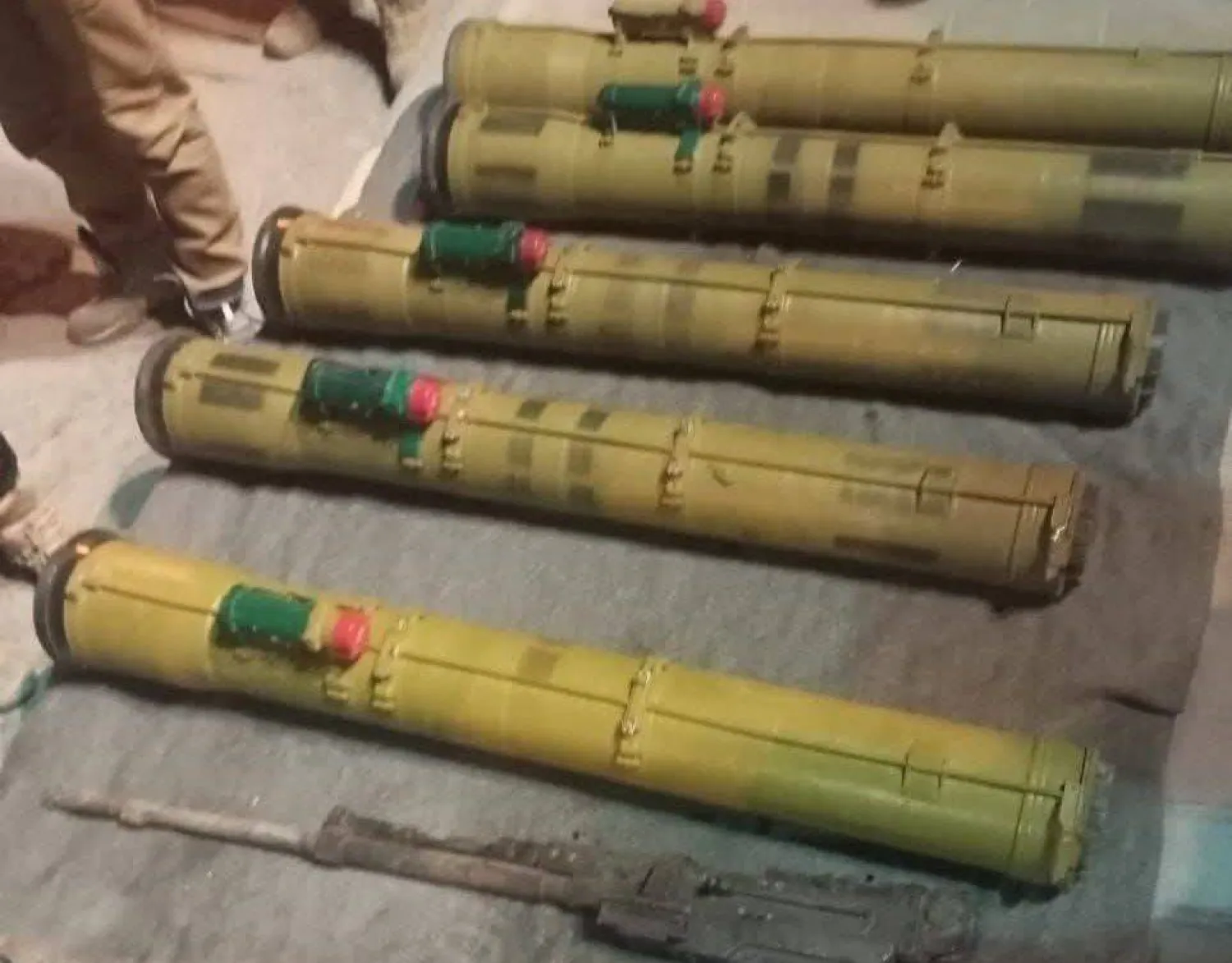

Syria Foils Weapons Smuggling Attempt Near Lebanese Border

A photo released by Syrian authorities shows weapons they said were intended to be smuggled across the border into Lebanon. (Rif Dimashq Media Directorate)
TT

Syria Foils Weapons Smuggling Attempt Near Lebanese Border

A photo released by Syrian authorities shows weapons they said were intended to be smuggled across the border into Lebanon. (Rif Dimashq Media Directorate)

Syrian authorities announced on Saturday the seizure of a shipment of weapons allegedly prepared for smuggling across the Syrian-Lebanese border, amid rising tensions along the frontier.

The Rif Dimashq Media Directorate said the weapons were confiscated in the al-Nabk area of the Qalamoun region, north of Damascus, but provided no details about the quantity or type of arms.

In a brief statement, the Internal Security Directorate said the shipment had been intended for smuggling into Lebanon.

Officials said the operation was part of ongoing efforts to combat organized crime and curb cross-border trafficking.

The seizure comes as concerns grow along the Syrian-Lebanese border following the Syrian army’s decision to reinforce its deployment along areas with both Lebanon and Iraq in a bid to tighten security and prevent the smuggling of weapons and narcotics.

Sources in Damascus told Asharq Al-Awsat that Syrian authorities are reviewing all options to address tensions with Hezbollah in border areas.

They said Damascus does not favor intervention, while emphasizing Syria’s support for Lebanon’s stability and the authority of the Lebanese state.

The sources added that Syria’s position remains aligned with that of Arab and regional countries supporting efforts to contain the current escalation.

Meanwhile, Hassan Abdul Ghani, spokesman for the Syrian Ministry of Defense, denied reports suggesting Syria intends to intervene militarily in Lebanon.

In an interview with a Lebanese television channel, he said the military buildup near the Lebanese border was a precautionary defensive measure rather than an offensive deployment.

Since the eruption of the US-Israel war on Iran and Israel intensified strikes against Hezbollah in Lebanon, Syrian President Ahmed al-Sharaa has reiterated Syria’s support for Lebanon’s stability and security, backing the Lebanese government’s efforts to restore sovereignty and strengthen state authority.

During a three-way phone call earlier this week with French President Emmanuel Macron and Lebanese President Joseph Aoun, al-Sharaa stressed the importance of opening a new chapter in Syrian-Lebanese relations based on cooperation and coordination between the two countries, reported the Syrian state news agency SANA.

Israel had previously destroyed many Hezbollah positions and weapons depots in Syria before the fall of Bashar al-Assad’s regime in 2024, including stockpiles in border areas of Homs and Damascus countryside.

Local sources say weapons were looted from former regime barracks and militia caches following the collapse of Assad’s rule.

While Syrian authorities continue campaigns to collect weapons and restrict them to state control, armed groups and criminal networks are reportedly picking up war remnants left behind in abandoned military sites.

The danger posed by such remnants has been underscored by recent incidents. Earlier this month, a missile left over from the former regime exploded in a metal workshop in the industrial zone of Sweida while it was being dismantled, killing five people and injuring three.

On Friday, two separate explosions linked to war remnants occurred in Homs and Aleppo. In Homs, more than 31 civilians were injured when a missile exploded inside an abandoned military barracks in the Abbasiya residential district.

In al-Atarib, in western Aleppo province, three civilians, including two children, were killed and eight others wounded when leftover munitions exploded inside a house.



Aoun: Lebanon Appreciates Saudi Crown Prince’s Efforts to Promote Regional Stability

FILE - Lebanese President Joseph Aoun gestures to journalists at the Presidential Palace, in Baabda, east of Beirut, Lebanon, Wednesday, May 21, 2025. (AP Photo/Hassan Ammar, File)
TT

Aoun: Lebanon Appreciates Saudi Crown Prince’s Efforts to Promote Regional Stability

FILE - Lebanese President Joseph Aoun gestures to journalists at the Presidential Palace, in Baabda, east of Beirut, Lebanon, Wednesday, May 21, 2025. (AP Photo/Hassan Ammar, File)

Lebanese President Joseph Aoun hailed on Wednesday the “balanced and wise” efforts made by Saudi Crown Prince and Prime Minister Mohammed bin Salman, saying his endeavors have created an “atmosphere to support stability, which Lebanon appreciates as a source of pride”.

In a post on media platform X, Aoun added: “We hope that Lebanon will be an integral part of this effort. The Kingdom of Saudi Arabia, as the sponsor of the Taif Agreement, is trusted by the Lebanese, the countries of the region and the world”.


Syria's Kurds Register for Citizenship after Decades of Marginalization

"Unregistered" Kurds, who have been stateless since a controversial 1962 census, have been flocking to registration centers across Syria. Delil SOULEIMAN / AFP
TT

Syria's Kurds Register for Citizenship after Decades of Marginalization

"Unregistered" Kurds, who have been stateless since a controversial 1962 census, have been flocking to registration centers across Syria. Delil SOULEIMAN / AFP

In a packed hall in Qamishli's sports stadium in northeast Syria, Firas Ahmad is one of dozens of Kurds waiting to apply for citizenship after many in the minority were barred from doing so for decades.

Since last week, "unregistered" Kurds, who have been stateless since a controversial 1962 census, have been flocking to registration centers across Syria to apply for citizenship, based on the interior ministry's instructions.

"A person without citizenship is considered as good as dead," Ahmad, 49, told AFP.

"Imagine not being able to register my children or our homes in our names," he said, adding that "my grandfather never had citizenship, and we have been living without official documents ever since".

On the tables facing long queues of people, registration forms were scattered along with personal photos and old documents, while government employees were recording the data.

The new measure follows Syrian President Ahmed al-Sharaa's January decree granting citizenship to Kurds residing in the country, including those who have been unregistered for decades.

It also enshrines the Kurds' cultural and language rights, and recognizes Kurdish as a national language.

The decree came during weeks of clashes between Kurdish fighters, who once controlled swathes of northeastern Syria, and government forces after which an agreement was reached to integrate the Kurdish administration into the central state.

The integration included government forces entering the previously Kurdish-controlled cities of Hasakeh and Qamishli in February, and the appointment in March of senior Kurdish military leader Sipan Hamo as assistant defense minister for the eastern region, among other steps.

- 'We suffered greatly' -

The lack of citizenship affected many aspects of daily life, from the inability to register births and property ownership to difficulties in studying, moving around, travelling and working, leaving many without full legal recognition of their existence.

"We suffered greatly," says Galya Kalash, a mother of five, speaking in Kurdish.

"My five children could not complete their education, and we could not travel at all. Even now, our house is not registered in our name."

Around 20 percent of Syria's Kurds were stripped of their Syrian nationality in a controversial 1962 census in the northeastern Hasakeh province.

Ali Mussa, a member of Hasakeh's Network of Statelessness Victims, told AFP that there are around 150,000 unregistered people in Syria today.

There are around two million Kurds in Syria, most of them in the northeast.

Mussa called on authorities to show "flexibility in implementing the decision and to provide facilities for residents outside Syria" who may not be able to travel due to their refugee status in Europe or fear of flight disruptions due to the Middle East war.

Authorities are expected to keep registration centers open for a month.

Abdallah al-Abdallah, a civil affairs official in the Syrian government, told AFP the period could be extended.

"The most important compensation for these people is gaining citizenship after being deprived of it for all these years," he said.

In the registration center, Mohammed Ayo, 56, said not having citizenship made him feel "helpless", including being unable to get a driver's license or book a hotel room in capital Damascus as it required prior security clearance.

"You study for many years, and in the end they say you have no certificate," he said, adding that, after finishing high school, he was unable to obtain an official document to study at university.

"We did not even have the right to run for office or vote."


Trump Says Israel and Lebanon Leaders to Hold Talks Thursday

TOPSHOT - US President Donald Trump speaks to the press outside the Oval Office at the White House in Washington, DC, on April 13, 2026. (Photo by Brendan SMIALOWSKI / AFP)
TT

Trump Says Israel and Lebanon Leaders to Hold Talks Thursday

TOPSHOT - US President Donald Trump speaks to the press outside the Oval Office at the White House in Washington, DC, on April 13, 2026. (Photo by Brendan SMIALOWSKI / AFP)

US President Donald Trump ‌said leaders of Lebanon and Israel will speak, saying he was "trying to get a little breathing room" between the countries, after more than six weeks of war between Israel and the Lebanese armed group Hezbollah. 

"It has been a long time since the two leaders have spoken, like 34 years. It will happen tomorrow. Nice!," Trump wrote in a social media post published before midnight on Wednesday, Washington ‌time. 

It did ‌not say which Lebanese and Israeli ‌leaders ⁠would speak, or give ⁠any further details, Reuters reported. 

The Israeli Prime Minister’s office did not immediately respond to a request for comment. There was no immediate response to a request for comment from the offices of Lebanese President Joseph Aoun and Prime Minister Nawaf Salam. 

The conflict spiraled out ⁠of the US-Israeli war with Iran, with ‌the Iran-backed Hezbollah opening ‌fire in support of Tehran on March 2, prompting ‌an Israeli offensive in Lebanon just 15 months after ‌the last conflict.  

Washington on Wednesday expressed optimism about reaching a deal to end the war with Iran.  

Israel's security cabinet convened late on Wednesday to discuss a possible Lebanon ‌ceasefire, a senior Israeli official said. Another senior Israeli official and a senior ⁠Lebanese official said ⁠Israeli Prime Minister Benjamin Netanyahu's government was under heavy pressure from Washington to reach a ceasefire in Lebanon. 

Netanyahu, in a video statement released late on Wednesday, said the Israeli military continued to strike at Hezbollah and was about to "overcome" the southern Lebanese town of Bint Jbeil. 

The senior Lebanese official said that Lebanon’s assessment was that Israel wanted to secure a victory in Bint Jbeil before diplomatic progress could be made.