Why Lebanon, Israel Chose Beaufort Castle as Pilot Zone

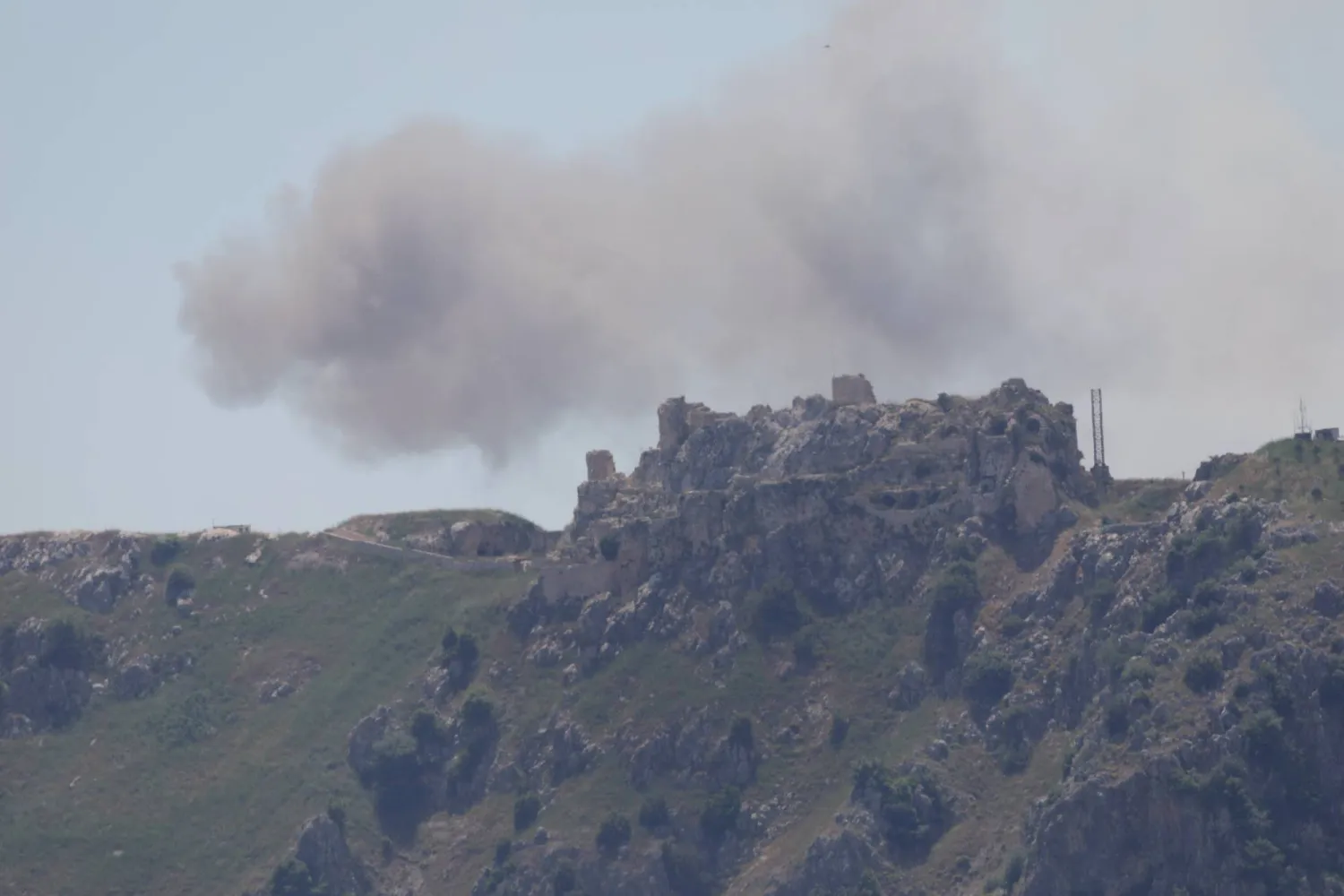
Smoke rises near the Beaufort Castle, as seen from Marjayoun, southern Lebanon, May 29, 2026. REUTERS/Stringer
TT

Why Lebanon, Israel Chose Beaufort Castle as Pilot Zone

Smoke rises near the Beaufort Castle, as seen from Marjayoun, southern Lebanon, May 29, 2026. REUTERS/Stringer

The ceasefire agreement between Lebanon and Israel provides for the creation of “pilot zones” in southern Lebanon, where the Lebanese army would assume exclusive control and ensure Hezbollah fighters are not present, in return for an Israeli military withdrawal from those areas.

Lebanese President Joseph Aoun said Beirut had proposed that the plan begin in the towns of Zawtar al-Sharqiya and Zawtar al-Gharbiya, along with Yohmor and Beaufort Castle, “given the symbolism of this area and its proximity to the city of Nabatieh.”

The zone carries strategic weight for both sides, security sources in southern Lebanon told Asharq Al-Awsat.

For Israel, it would be a test of security for northern towns and settlements. For Lebanon, it would push the Israeli army away from the surrounding areas of Nabatieh.

Israeli forces advanced last week in the area north of the Litani River, taking control of large parts of Zawtar al-Sharqiya and Yohmor.

By Sunday, they had reached the strategic historic site of Beaufort Castle before coming under Hezbollah fire from rockets and explosive drones, according to successive statements by the group. The security sources said Israeli forces carried out demolitions in parts of Yohmor and Zawtar, but did not establish a military position in the area.

The heights are among the most important military and geopolitical points in southern Lebanon. They overlook the Litani River, towns along its eastern bank, the Nabatieh to Marjayoun road to the east, Nabatieh and its suburbs to the west, and towns on both sides of Wadi al-Hujeir to the south.

For Israel, the elevated area forms a key security depth because it overlooks occupied areas in southern Lebanon and northern towns. It lies just 4 kilometers from the settlement of Metula.

Beaufort Castle has long been a focal point of fighting since the 1982 invasion. From the west, it overlooks the area between the Litani and Zahrani rivers and is the highest hill in that sector.

That position gives its holder a major military advantage. From Beaufort Castle and Yohmor, it is possible to overlook Taybeh, Deir Seryan, and Qantara, where the Israeli army is now deployed.

For that reason, “it cannot leave it outside its control, or without security arrangements, if it wants to remain in the area where it is stationed.”

For Lebanon, an Israeli withdrawal from the high ground is a priority for allowing residents to return to Nabatieh and its surroundings. The area overlooks territory to its west as far as the sea, meaning that an Israeli military presence there would leave nearby towns, as well as Nabatieh, exposed to strikes.

The city lies between 3 and 5 kilometers from Beaufort Castle, Yohmor, and Zawtar.

Sources in southern Lebanon say an agreement on the pilot zone would mean the area is demilitarized and falls under the control of the Lebanese army alone.

If the plan succeeds, it could gradually expand to other areas, including zones north of the yellow line in Majdal Zoun and Zebqine in the western sector, towns overlooking Wadi al-Slouqi in the central sector, or those overlooking Wadi al-Hujeir in the eastern sector.


Syrian Troop Killings Expose Repeated Attacks, Security Lapses

Syrian army personnel on a military vehicle in Deir Hafer, rural Aleppo, in January 2026. (Reuters)
TT

Syrian Troop Killings Expose Repeated Attacks, Security Lapses

Syrian army personnel on a military vehicle in Deir Hafer, rural Aleppo, in January 2026. (Reuters)

The recent killing of two Syrian army members near Manbij, east of Aleppo, was not an isolated attack. It was part of a recurring pattern of strikes on government forces, exposing serious administrative and security gaps that groups opposed to Syria’s new administration are using to target its personnel.

Syria’s Ministry of Defense media and communications department said on June 20 that two soldiers from the 76th Division were killed after unknown gunmen attacked them near Manbij.

The soldiers were riding a motorcycle on a road near the city when they came under direct fire.

Since the fall of the Assad regime, Asharq Al-Awsat has tracked many similar attacks on Syrian security and army personnel. Most have occurred as members were heading to or leaving their posts, often on motorcycles or via irregular transport.

Many see the pattern as evidence of weak protection measures and poor organization of personnel rotations.

Rural Aleppo has witnessed several assassinations this year. Among the most prominent were the killing of two Syrian army members in March and another member of the Interior Ministry in April near the town of al-Rai.

Similar incidents have also been reported across most Syrian provinces, including Daraa, Latakia, rural Hama and Homs.

Embarrassing the Syrian state

Demands have grown for personnel to avoid moving alone, wearing military uniforms or using motorcycles in remote areas where the risk is high and support is hard to reach.

Major Khaled al-Abdullah, director of the Syrian interior minister’s office, said the defense and interior ministries had repeatedly issued circulars banning personnel from wearing official uniforms outside working hours and requiring them to follow safety measures suited to Syria’s current conditions.

He said the immediate aim of attacks by groups opposed to the new administration, including Islamic State and remnants of the ousted regime, was to “try to embarrass the Syrian state.”

Abdullah stressed that authorities were working hard to impose security, eliminate armed groups and organizations, and had made significant progress on what he called a difficult path.

But in remarks to Asharq Al-Awsat, he also pointed to “continued internal and external challenges that the Syrian state is working to overcome and whose danger it seeks to end.”

Manbij, the most dangerous route

Abu Mohammed al-Hussein, who oversees a cluster of checkpoints in eastern rural Aleppo, said the movement of personnel had become a problem. He said he had repeatedly asked for buses to transport rotating shift members, especially in rural areas far from the city center.

Hussein said one member of his checkpoint group survived an assassination attempt on the Manbij-al-Bab road in eastern rural Aleppo at the end of March. The incident pushed him to issue special orders regulating how his personnel move.

“A civilian car offered to take one of my men to Aleppo city,” he said. “After they had driven several miles, they claimed there was an emergency and said they had to return. As soon as he got out, the driver’s companion fired several shots at him with a pistol. Two hit his magazine pouch and one pierced his foot. He survived by a miracle.”

He said shift rotations are “decided centrally by sector commanders” and are often carried out at night because service areas are far from where personnel live. He said a ban on carrying weapons and moving through residential areas had also made personnel easier targets.

“With repeated assassination attempts, I issued a decision banning nighttime shift rotations, prohibiting movement in civilian cars or on motorcycles, which have also become easy targets, and limiting transport to road security vehicles,” he added.

Hussein said they were still waiting for approval of a request to allocate a bus to transport security and military checkpoint personnel deployed along the Aleppo-Manbij road.

He described it as “one of the most dangerous land routes,” linking Aleppo to outlying areas and Raqqa province, and passing through an area that remained for years under the control of the ousted regime and the Syrian Democratic Forces.

Ban on keeping weapons

Haider al-Mohammed, a special tasks member, disagreed. He said “transport buses are, in practice, the easy target” and are often attacked, meaning the problem of securing personnel goes beyond transport.

He said decisions that stripped personnel of the means to protect their safety and identity were the direct reason behind the rise in assassinations, alongside the exceptional conditions in the country and the process of “clearing out groups that believe they can create chaos and fear.”

He said among the most important of these decisions were “the ban on wearing face coverings, the ban on keeping registered weapons, and the strict instruction not to carry personal weapons, along with leniency over wearing official uniforms.”

As a result, he said, personnel are exposed, easy targets for these groups, and left without weapons to defend themselves.

On this point, Major Khaled al-Abdullah said Syria’s security and military institutions were working to “implement solutions to facilitate and reduce regular movement in a way that helps end the threat and strengthen the safety of their personnel.”

He said the pattern of attacks “confirms their randomness.” The failure to select specific targets or have prior knowledge of the personnel being targeted, he said, was “an attempt to create chaos and confuse the Syrian state.”


Hamas Seeks to Put Gaza on US-Iran Talks Agenda

A Palestinian child weeps next to the body of his brother, killed in an Israeli strike in Khan Younis, southern Gaza, on Wednesday (AFP)
TT

Hamas Seeks to Put Gaza on US-Iran Talks Agenda

A Palestinian child weeps next to the body of his brother, killed in an Israeli strike in Khan Younis, southern Gaza, on Wednesday (AFP)

At a time when a purported ceasefire agreement in the Gaza Strip faces continued Israeli breaches and violations, Hamas has moved toward Iran in a step that showed it was counting on a “supportive” position on Gaza by having the issue placed on the agenda of ongoing talks between Washington and Tehran.

The Hamas move came in an announced phone call on Tuesday between Basem Naim, deputy head of the movement’s Arab and Islamic Relations Office, and Iranian Foreign Minister Abbas Araghchi.

According to a Hamas statement, Araghchi and Naim “discussed the latest developments in the Iranian-US negotiations and the Palestinian issue, especially as it relates to the Gaza Strip,” with Naim praising “Iran’s positions toward the Palestinian cause and its continued support for Gaza amid the continued Israeli aggression.”

A statement published by Iran’s Tasnim news agency on Wednesday quoted Araghchi as telling Naim that “the Iranian team will raise the Palestinian issue in the ongoing negotiations,” adding that it would also raise “the issue of the occupation’s continued aggression in all international forums.”

The call came amid Iranian-US negotiations that include an understanding on a ceasefire in Lebanon between Hezbollah and Israel.

It was the second Hamas-Iran call in June. On June 4, Araghchi called Khalil Al-Hayya, Hamas’s leader in Gaza and head of its negotiating delegation. The statement at the time, however, did not clearly refer to bringing Gaza into the Iranian-US negotiations.

It only said Hayya had praised the Iranian negotiating team’s position, which stressed the need for a simultaneous halt to the war on all fronts in the region.

Asharq Al-Awsat tried to contact Hamas official Basem Naim, but he did not respond to calls.

“Not a replacement for mediators”

Two senior Hamas sources abroad told Asharq Al-Awsat in separate remarks that the call between Naim and Araghchi came as part of “continued communication with various parties in an attempt to consolidate the ceasefire in Gaza.”

One of them said: “This does not amount to abandoning the negotiations track through the main mediator countries, Egypt, Qatar and Türkiye.”

One source said Naim’s mandate was to communicate with all Arab and Islamic parties as part of a policy of openness to all sides, in a way that serves the interests of the Palestinian people, especially in Gaza, as Israeli violations continue and no party has been able to compel Benjamin Netanyahu’s government to stop its violations in the enclave.

Still, the second source did not conceal that Hamas was “looking for a pressing Iranian role in the current negotiations to place Gaza on their agenda, as was the case in Lebanon, where Iran succeeded through its efforts in reaching a ceasefire,” according to his assessment.

The second source said: “We, Hamas, count on any position that supports us, the Gaza Strip and the Palestinian cause in general. But it is unlikely that such a step will succeed, given the insistence of the United States and Israel on separating the fronts as much as possible, and given the consensus and understanding inside the movement that the Gaza file has for some time been separate during the war.”

“Positive signs from Lebanon create an opening”

The two sources agreed, however, that there had been “a positive development on the Lebanon front” imposed by the Iranian-US negotiations. That has tempted some Hamas leadership circles to try to “use the opportunity to push for placing Gaza on the negotiations agenda, even though they expect their efforts to fail.”

In recent days, Hamas media outlets have intensified a similar narrative, attributed to an unnamed Iranian source, saying the negotiations include consolidating the ceasefire in Gaza.

A third Hamas source in Gaza said the movement had consistently looked for an Iranian position in support of it in the negotiations during the war. But “it is clear that the United States did not allow, and will not allow, that. It considers Gaza a separate front, and there are efforts being made on that front to consolidate the ceasefire.”

The source added: “It can be said clearly that Iran adopted the halt to the war on the Lebanon, Yemen, and Iraq fronts on the basis that those fronts entered the war more broadly after the assassination of former Iranian Supreme Leader Ali Khamenei, while the war in Gaza had started much earlier.”

A fourth source from a Palestinian faction that receives support from Iran said, “The leaders and members of factions linked to Tehran had hoped it would succeed in stopping the war in Gaza.”

“That would have counted heavily in their favor and in favor of the factions, given the inability of mediators and guarantors to compel Israel to abide by the agreement and stop the violations.”

Factional sources had said that “during the factions’ meetings in Cairo, leaders from several sides advised the Hamas leadership not to count on the Iranian negotiations track, and to take more important steps within the framework of a unified Palestinian position to produce a positive response to proposals related to weapons and other issues.”

Hamas’s evolving position, after the latest call between Naim and Araghchi, appears to come amid voices rejecting amendments made by Nickolay Mladenov, the High Representative for Gaza at the Board of Peace.

Some parties inside the movement viewed the amendments as “primarily serving Israel, and not adhering to US President Donald Trump’s plan, under which the ceasefire agreement was signed in October 2025.”


Israel Army Says Struck Suspected Hezbollah Fighters in Lebanon ‘Security Zone’

Stray dogs walk past the rubble of flattened homes and businesses, destroyed by the Israeli military, in the southern Lebanese village of Tibnin on June 24, 2026. (AFP)
TT

Israel Army Says Struck Suspected Hezbollah Fighters in Lebanon ‘Security Zone’

Stray dogs walk past the rubble of flattened homes and businesses, destroyed by the Israeli military, in the southern Lebanese village of Tibnin on June 24, 2026. (AFP)

The Israeli military said it carried out an airstrike targeting suspected Hezbollah fighters who crossed into the so-called "security zone" it has created in southern Lebanon, the second such incident it reported within hours on Wednesday.

"A short while ago, a vehicle carrying suspects was identified crossing the security zone in the Ali al-Taher Ridge area, posing a threat to Israeli soldiers," the military said.

"Following the identification, the Israeli Air Force struck the suspects in order to remove the threat," it added, vowing that the military "would not allow Hezbollah" fighters to harm its troops.