


Hezbollah’s Military Edge Wanes as Its Support Base Bears the Cost

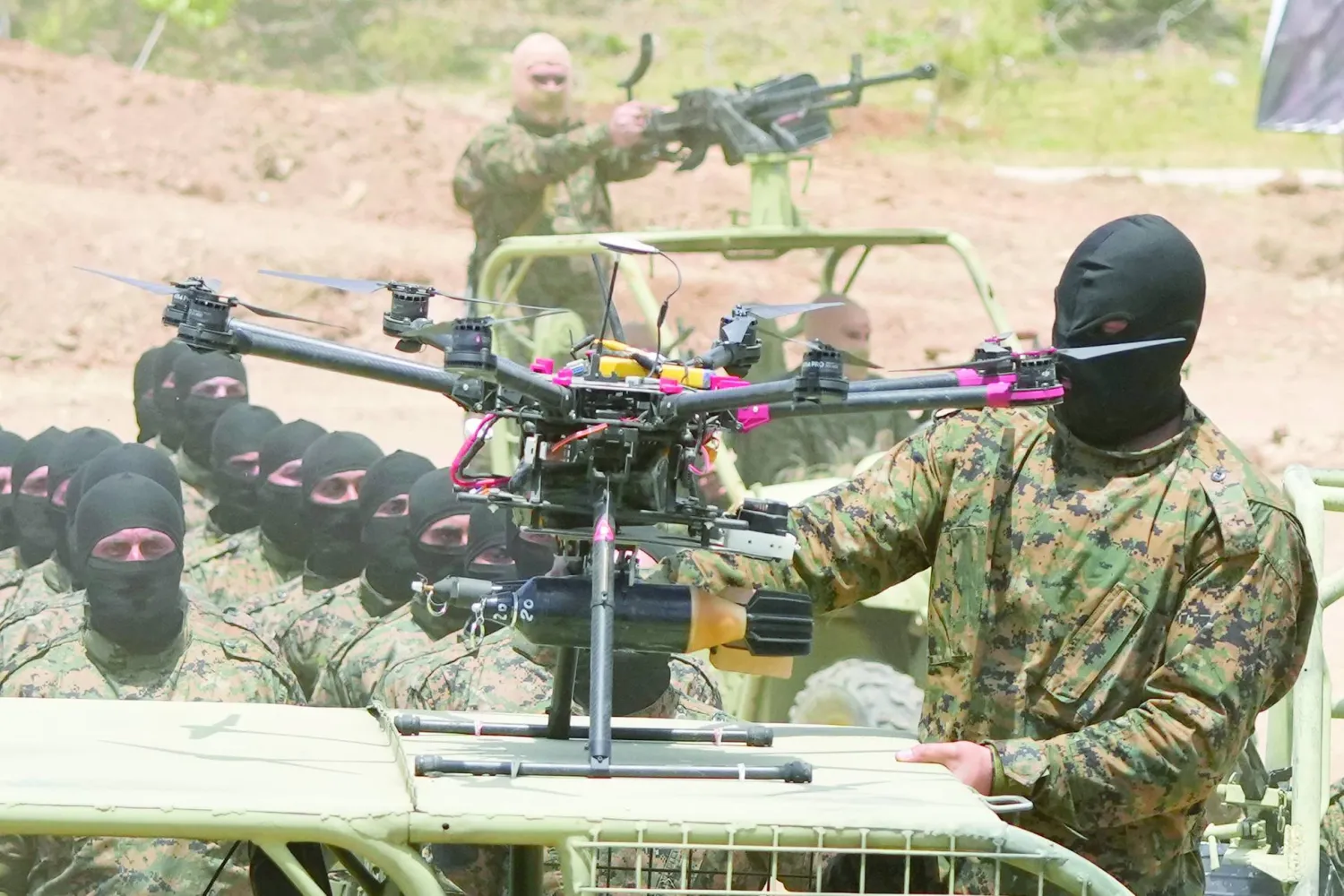
Hezbollah fighters during a military drill in southern Lebanon, May 2023 (File photo – AP).
TT

Hezbollah’s Military Edge Wanes as Its Support Base Bears the Cost

Hezbollah fighters during a military drill in southern Lebanon, May 2023 (File photo – AP).

One year after its latest war with Israel, Hezbollah enters 2025 burdened by deep military and social wounds. Once proud of its image as an “invincible force,” the movement still retains hidden capabilities, but experts say its offensive momentum has evaporated. Meanwhile, its support base in southern Lebanon and the Bekaa is paying the price, as Israel pushes forward with an intelligence-driven strategy that keeps it one step ahead.

Since the 2006 Lebanon War, Hezbollah worked to build a missile arsenal that, in its own narrative, enforced a balance of deterrence. The war in Syria in 2011 expanded its reach, with supply lines through Damascus and a missile-production hub in Masyaf. But the collapse of the Syrian regime and shifting regional balances eroded this strategic depth. The 2024 conflict then pushed Hezbollah’s military structure to the brink of exhaustion.

Israel’s New Target Bank

During the support war that stretched from October 8, 2023, until the November 27, 2024 ceasefire, Israel redrew the battlefield rules. Beyond destroying missile launchers and weapons depots, it began targeting the homes of Hezbollah members in southern villages.

Defense analyst Riad Kahwaji told Asharq al-Awsat this shift “greatly raised the social cost. The destroyed houses and mass displacement have left the support environment crushed by destruction and hardship, feeding back into Hezbollah’s weakening position both militarily and internally.”

Retired Brigadier General Said Kozah added that Hezbollah’s massive military machine, painstakingly built since 1985, collapsed almost instantly. “On the first day of serious fighting, Israel struck around 1,800 targets in the Bekaa, the south, and Beirut’s southern suburb - all weapons depots and storage sites - and destroyed them all,” he said.

Leadership Hit, Logistics Crippled

A wave of targeted assassinations struck at the heart of Hezbollah’s elite Radwan Force. Kahwaji argued that Israeli intelligence penetration now paralyzes the group, blocking it from mounting special operations. Kozah pointed to the “Pager Operation,” which lured Radwan fighters into a deadly trap, leaving many dead or permanently injured.

From Rockets to Drones

With its capacity to launch large rocket salvos diminished, Hezbollah leaned on cheap drones for surveillance and attack. Yet Kahwaji estimates only 30 percent of its short-range rockets remain, along with a small stock of drones and a handful of long-range missiles. This, he noted, “does not constitute a sustainable firepower base, only sporadic harassment.”

Israel meanwhile pushed deeper, dismantling tunnels, blowing up arms depots across Lebanon, and even destroying missile and drone factories in Syria before the Assad regime’s fall, a development that severed Hezbollah’s critical supply line.

Losing the Lifelines

Both analysts agree the collapse of Damascus as a loyal ally dealt Hezbollah a crippling blow. Masyaf had supplied heavy rockets; its loss left Hezbollah with only limited local production of short-range rockets and drones. “Any future war,” Kahwaji warned, “could be its last.”

Kazah stressed that with Syrian territory no longer a conduit for Iranian weapons, Hezbollah has lost its primary source of arms, funds, and logistics. Secretary-General Naim Qassem himself admitted casualties of some 6,000 dead and 13,000 wounded or disabled, nearly 20,000 fighters removed from the battlefield.

Shifting Domestic Scene

The consequences are visible inside Lebanon. Many displaced families remain unable to return home, villages lie in ruins, and public opinion has turned sharply. Former allies have distanced themselves, some urging Hezbollah to accept the government’s plan to place all weapons under state authority, in line with the Taif Accord and international resolutions.

“Hezbollah no longer possesses the capacity to confront Israel directly,” Kozah concluded. “Its infrastructure north of the Litani has been devastated, and politically, its partners are abandoning it. The party now faces not only military attrition but a profound crisis of legitimacy.”



Israel Says US Gaza Executive Board Composition Against its Policy

FILE - A displacement camp sheltering Palestinians on a beach amid stormy weather is seen in Gaza City, Jan. 13, 2026. (AP Photo/Jehad Alshrafi, File)
TT

Israel Says US Gaza Executive Board Composition Against its Policy

FILE - A displacement camp sheltering Palestinians on a beach amid stormy weather is seen in Gaza City, Jan. 13, 2026. (AP Photo/Jehad Alshrafi, File)

Prime Minister Benjamin Netanyahu's office said on Saturday that this week's Trump administration announcement on the composition of a Gaza executive board was not coordinated with Israel and ran counter to government policy.

It said Foreign Minister Gideon Saar would raise the issue with US Secretary of State Marco Rubio.

The ⁠statement did not specify what part of the board's composition contradicted Israeli policy. An Israeli government spokesperson declined to comment.

The board, unveiled by the White House on Friday, includes Turkish Foreign Minister Hakan Fidan. Israel ⁠has repeatedly opposed any Turkish role in Gaza.

Other members of the executive board include Sigrid Kaag, the UN special coordinator for the Middle East peace process; an Israeli-Cypriot billionaire; and a minister from the United Arab Emirates.

Washington this week also announced the start of the second phase of President ⁠Donald Trump's plan, announced in September, to end the war in Gaza. This includes creating a transitional technocratic Palestinian administration in the enclave.

The first members of the so-called Board of Peace - to be chaired by Trump and tasked with supervising Gaza's temporary governance - were also named. Members include Rubio, billionaire developer Steve Witkoff and Trump's son-in-law Jared Kushner.


Sisi Says he Values Trump Offer to Mediate Egypt-Ethiopia Dispute on GERD

FILE PHOTO: US President Donald Trump points as he attends a meeting with oil industry executives, at the White House in Washington, D.C., US, January 9, 2026. REUTERS/Evelyn Hockstein/File Photo
TT

Sisi Says he Values Trump Offer to Mediate Egypt-Ethiopia Dispute on GERD

FILE PHOTO: US President Donald Trump points as he attends a meeting with oil industry executives, at the White House in Washington, D.C., US, January 9, 2026. REUTERS/Evelyn Hockstein/File Photo

Egyptian President Abdel Fattah al-Sisi said he valued an offer by US President Donald Trump to mediate ⁠a dispute over Nile River waters between Egypt and Ethiopia.

In a post on ⁠X, Sisi said on Saturday that he addressed Trump's letter by affirming Egypt's position and concerns about the country's water ⁠security in regards to Ethiopia's Grand Ethiopian Renaissance Dam (GERD).

"I am ready to restart US mediation between Egypt and Ethiopia to responsibly resolve the question of 'The Nile Water Sharing' once and for all," Trump wrote to Sisi in the letter that was also posted on Trump’s Truth Social account.

Addis Ababa's September 9 inauguration of GERD has been a source of anger ⁠in Cairo, which is downstream on the Nile.

Ethiopia sees the $5 billion dam on a tributary of the Nile as central to its economic ambitions.

Egypt says the dam violates international treaties and could cause both droughts ⁠and flooding.

Sudan, another ​downstream country, has expressed concern about the regulation and safety of ⁠its own water supplies and dams.

Sudan's army leader Abdel Fattah al-Burhan also welcomed Trump's mediation offer on Saturday.


Kurds Say Sharaa's Decree Falls Short, Syrian Government Forces Enter Deir Hafer

Syrian army convoys enter the Deir Hafer area in the eastern Aleppo countryside, Syria, after the Kurdish-led Syrian Democratic Forces (SDF) announced the handover of the area west of the Euphrates to the Syrian government, 17 January 2026. EPA/AHMAD FALLAHA
TT

Kurds Say Sharaa's Decree Falls Short, Syrian Government Forces Enter Deir Hafer

Syrian army convoys enter the Deir Hafer area in the eastern Aleppo countryside, Syria, after the Kurdish-led Syrian Democratic Forces (SDF) announced the handover of the area west of the Euphrates to the Syrian government, 17 January 2026. EPA/AHMAD FALLAHA

Syria's Kurds on Saturday said a presidential decree recognizing the minority's rights and making Kurdish an official language fell short of their expectations as Syrian government forces entered the outskirts of a northern town.

In a statement, the Kurdish administration in Syria's north and northeast said the decree issued by President Ahmed al-Sharaa on Friday was "a first step, however it does not satisfy the aspirations and hopes of the Syrian people".

It added that "rights are not protected by temporary decrees, but... through permanent constitutions that express the will of the people and all components" of society.

Al-Sharaa’s decree affirmed that Syrian citizens of Kurdish origin are an integral and original part of the Syrian people, and that their cultural and linguistic identity is an inseparable component of Syria’s inclusive national identity.

The decree commits the state to protecting cultural and linguistic diversity and guarantees Kurdish citizens the right to preserve their heritage, arts, and mother tongue within the framework of national sovereignty.

It recognizes Kurdish as a national language and allows it to be taught in public and private schools in areas where Kurds make up a significant proportion of the population.

It also grants Syrian nationality to all residents of Kurdish origin living on Syrian territory, including those previously unregistered, while ensuring full equality in rights and duties.

The decree further designates Nowruz, celebrated annually on March 21, as an official public holiday.

Syrian government forces entered the outskirts of the northern town of Deir Hafer Saturday morning after the command of Kurdish-led fighters said it would evacuate the area in an apparent move to avoid conflict.

This came after deadly clashes erupted earlier this month between government troops and the US-backed and Kurdish-led Syrian Democratic Forces in the city of Aleppo, Syria’s largest.

It ended with the evacuation of Kurdish fighters from three neighborhoods taken over by government forces.

An Associated Press reporter saw on Saturday government tanks, armored personnel carriers and other vehicles, including pickup trucks with heavy machine-guns mounted on top of them, rolling toward the town of Deir Hafer from nearby Hamima after bulldozers removed barriers. There was no SDF presence on the edge of the town.

Meanwhile, the Syrian military said Saturday morning its forces were in full control of Deir Hafer, captured the Jarrah airbase east of the town, and were working on removing all mines and explosives. It added that troops would also move toward the nearby town of Maskana.

On Friday night, after government forces started pounding SDF positions in Deir Hafer, the Kurdish-led fighters’ top commander Mazloum Abdi posted on X that his group would withdraw from contested areas in northern Syria. Abdi said SDF fighters would relocate east of the Euphrates River starting 7 a.m. (0400 gmt) Saturday.

The easing of tension came after US military officials visited Deir Hafer on Friday and held talks with SDF officials in the area.

The United States has good relations with both sides and has urged calm.