


Israel Targets Families of Tribal Leaders and Notables in Gaza

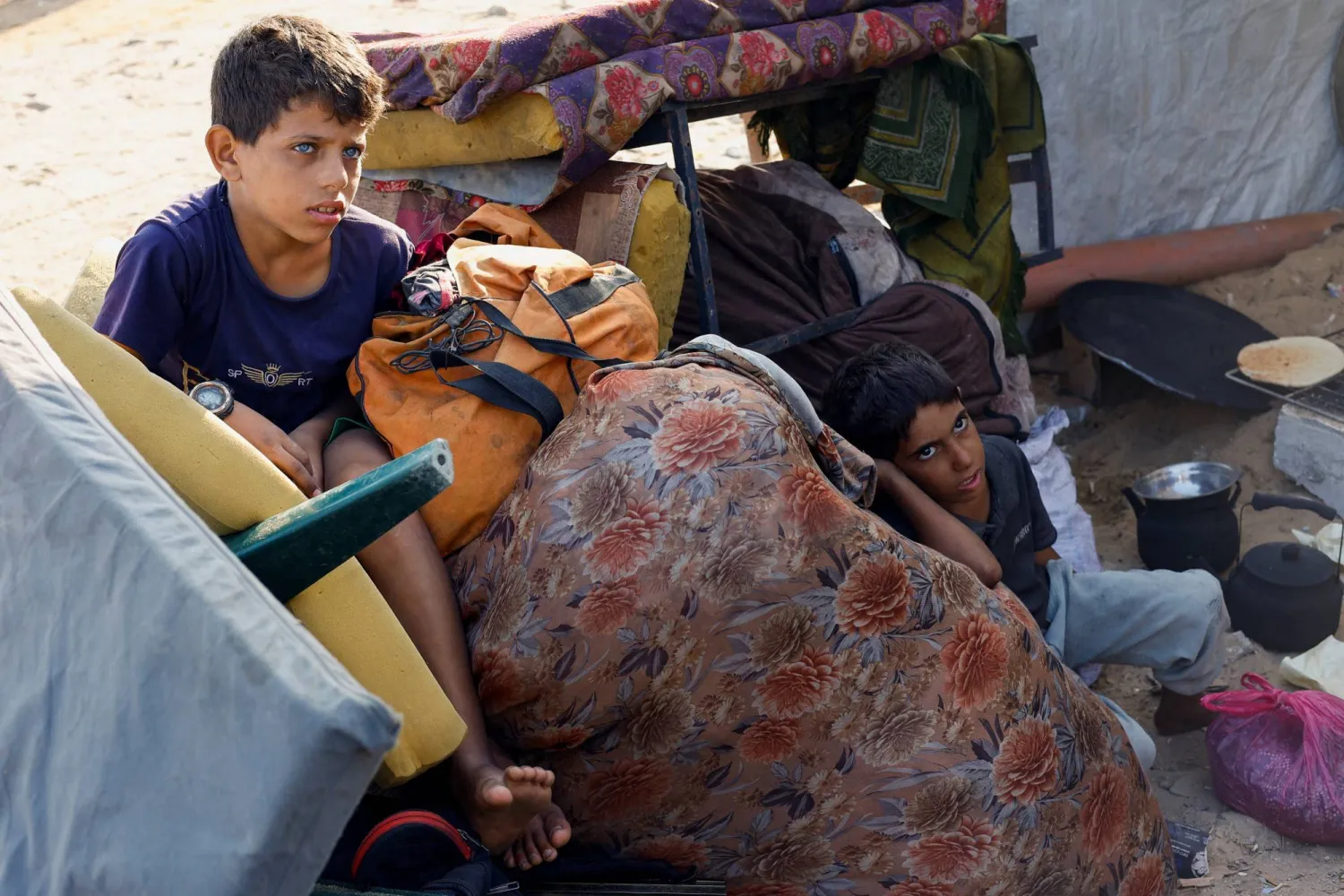
Two Palestinian boys flee with their family from Gaza City toward the south on Saturday (Reuters). 
TT

Israel Targets Families of Tribal Leaders and Notables in Gaza

Two Palestinian boys flee with their family from Gaza City toward the south on Saturday (Reuters). 

As the US administration and several Arab and Islamic states discuss the future of Gaza after the war, Israel has escalated strikes against families whose elders and tribal leaders rejected cooperation with Israeli attempts to form local governing bodies in certain areas. These discussions are taking place amid heightened tensions and ongoing military activity within the enclave.

The targeted strikes have focused on communities that resisted involvement in Israeli-backed efforts to establish local authorities. These governing bodies are modeled on armed groups previously established and supported by Israel in parts of Gaza.

In recent days and hours, Israeli airstrikes have intensified against well-known families and clans in Gaza City. It later emerged that their elders had turned down an offer from Israel’s domestic security service, Shin Bet, to participate in forming and managing local entities to oversee humanitarian aid and administer daily life in their communities.

Security and field sources in Gaza City told Asharq Al-Awsat that Shin Bet officers had approached leaders from the Bakr and Doghmosh families, asking them to join an Israeli plan to divide Gaza into local fiefdoms run by clans, families, or armed groups.

Under the scheme, these bodies would provide services to residents, oppose Hamas and other resistance factions, and supply Israel with intelligence, while also advancing Israel’s political objective of preventing a Palestinian government from ever taking charge in the strip. By doing so, Israel would consolidate its control and undercut prospects for a future Palestinian state.

According to the sources, after the families refused, Israeli forces launched a series of strikes on homes belonging to their members. Some houses were inhabited, others had been evacuated.

One of the deadliest attacks targeted the Doghmosh family in the Sabra neighborhood of southern Gaza City, where an Israeli airstrike killed 30 people in a single home. At least 20 more remain trapped under the rubble, beyond the reach of rescue teams.

At dawn on Saturday, a house belonging to the Bakr family south of al-Shati refugee camp was bombed, killing six members and wounding 11. Later the same day, another multi-story family residence was struck, injuring several more relatives. Israeli aircraft also hit an abandoned building near Gaza’s port.

A Bakr family elder told Asharq Al-Awsat that Israeli intelligence had contacted the family’s leaders and asked them to form an armed group to control the al-Shati camp after Israeli forces had cleared it of Hamas fighters. He said the family categorically rejected the idea.

The source, who requested anonymity for his safety, said the family immediately understood that they would face retaliation. A meeting was held at once, and members were urged to evacuate the area, especially women and children, and move southward.

The Bakr family is one of Gaza’s largest, known for its role in the fishing trade, and counts members affiliated with Fatah and Islamic Jihad among its ranks. Several have been killed in the current war and in previous conflicts. The family elder stressed that the refusal to cooperate with Israel was a principled national decision, not an expression of support for Hamas or any other faction.

Asharq Al-Awsat was unable to reach any of the Doghmosh family’s leaders for comment.

Israel has in recent weeks leaned on a strategy of fostering armed groups drawn from families and clans, or from individuals with criminal or security backgrounds, to exert local control. Such groups have appeared in areas east of Rafah, east of Khan Younis, parts of eastern Gaza City, and the north of the enclave.



US Says Gaza ‘Phase Two’ Beginning with Goal of Hamas Demilitarization

 A tent camp for displaced Palestinians stretches across the Zeitoun neighborhood of Gaza City, Wednesday, Jan. 14, 2026. (AP)
A tent camp for displaced Palestinians stretches across the Zeitoun neighborhood of Gaza City, Wednesday, Jan. 14, 2026. (AP)
TT

US Says Gaza ‘Phase Two’ Beginning with Goal of Hamas Demilitarization

 A tent camp for displaced Palestinians stretches across the Zeitoun neighborhood of Gaza City, Wednesday, Jan. 14, 2026. (AP)
A tent camp for displaced Palestinians stretches across the Zeitoun neighborhood of Gaza City, Wednesday, Jan. 14, 2026. (AP)

President Donald Trump's envoy said Wednesday that a plan to end the Gaza war was now moving to Phase Two with a goal of disarming Hamas, despite a number of Israeli strikes during the ceasefire.

"We are announcing the launch of Phase Two of the President's 20-Point Plan to End the Gaza Conflict, moving from ceasefire to demilitarization, technocratic governance, and reconstruction," envoy Steve Witkoff wrote on X.

The second phase will also include the setup of a 15-person Palestinian technocratic committee to administer post-war Gaza. Its formation was announced earlier Wednesday by Egypt, a mediator.

Phase Two "begins the full demilitarization and reconstruction of Gaza, primarily the disarmament of all unauthorized personnel."

"The US expects Hamas to comply fully with its obligations, including the immediate return of the final deceased hostage. Failure to do so will bring serious consequences," he said.


Lebanon Arrests Syrian Citizen Suspected of Funding Pro-Assad Fighters

A damaged portrait of Syria's ousted President Bashar al-Assad lies on the ground in the western Syrian port city of Latakia on Dec. 15, 2024. (AFP via Getty Images)
TT

Lebanon Arrests Syrian Citizen Suspected of Funding Pro-Assad Fighters

A damaged portrait of Syria's ousted President Bashar al-Assad lies on the ground in the western Syrian port city of Latakia on Dec. 15, 2024. (AFP via Getty Images)

Lebanese authorities have arrested a Syrian citizen who is suspected of sending money to fighters loyal to former Syrian President Bashar al-Assad in Syria, judicial officials said Wednesday.

Ahmad Dunia was detained in recent days in Lebanon’s region of Jbeil north of Beirut and is being questioned over alleged links to Assad’s maternal cousin Rami Makhlouf as well as a former Syrian army general who left the country after Assad’s fall in December 2024, the officials said.

The officials described Dunia as the “financial arm” of the wealthy Makhlouf, saying he had been sending money to former Assad supporters in Syria who work under the command of ousted Syrian general Suheil al-Hassan who is believed to be in Russia.

The officials said the money was mostly sent to pro-Assad fighters who are active in Syria’s coastal region, where many members of his Alawite minority sect live.

Allegations that Dunia was financing Assad allies was first reported by Qatar’s Al Jazeera TV. He was then arrested by Lebanese security forces, according to officials who spoke on condition of anonymity because they were not authorized to speak to the media.

The arrest came a week after a Syrian security delegation visited Beirut and handed over to officials in Lebanon lists of dozens of names of former members of Assad’s security agencies whom they said are directing anti-government operations in Syria from Lebanon. Dunia’s name was one of those on the list, the officials said.

Since Assad’s fall, there have been several skirmishes between his supporters and the country’s new authorities.

In March last year, violence that began with clashes between armed groups aligned with Assad and the new government’s security forces spiraled into sectarian revenge attacks and massacres that killed hundreds of civilians from the Alawite minority.


Sudan Peace Talks Resume in Cairo as War Nears 3-Year Mark

Displaced women fill water at displaced persons camp in El Obeid, North Kordofan State, Sudan, January 12, 2026. (Reuters)
TT

Sudan Peace Talks Resume in Cairo as War Nears 3-Year Mark

Displaced women fill water at displaced persons camp in El Obeid, North Kordofan State, Sudan, January 12, 2026. (Reuters)

Sudan peace efforts resumed in Cairo on Wednesday as Egypt, the United Nations and the United States called for the warring parties to agree to a nationwide humanitarian truce, as the war between the army and its rival paramilitary nears the three-year mark.

Egyptian Foreign Minister Badr Abdelatty told reporters that Egypt wouldn't accept the collapse of Sudan or its institutions, or any attempt to undermine its unity or divide its territory, describing such scenarios as “red lines.”

Abdelatty said during a joint news conference with Ramtane Lamamra, the UN secretary‑general’s personal envoy for Sudan, that Egypt won't stand idly and won't hesitate to take the necessary measures to help preserve Sudan’s unity.

″There is absolutely no room for recognizing parallel entities or any militias. Under no circumstances can we equate Sudanese state institutions, including the Sudanese army, with any other militias,” he said on the sidelines of the fifth meeting of the Consultative Mechanism to Enhance and Coordinate Peace Efforts.

Lamamra said that the fifth such meeting demonstrated that diplomacy remains a viable path toward peace.

The paramilitary Rapid Support Forces, or RSF, and the military have been at war since April 2023. The conflict that has seen multiple atrocities and pushed Sudan into one of the world’s worst humanitarian crises.

Although repeated attempts at peace talks have failed to end the war, Abdelatty said that there's a regional agreement to secure an immediate humanitarian truce, including certain withdrawals and the establishment of safe humanitarian corridors.

Humanitarian aid Massad Boulos, the US senior adviser for Arab and African Affairs, said Wednesday that more than 1.3 metric tons of humanitarian supplies entered el-Fasher, the capital of North Darfur, on Wednesday, with the help of American-led negotiations, marking the first such delivery since the city was besieged 18 months ago.

“As we press the warring parties for a nationwide humanitarian truce, we will continue to support mechanisms to facilitate the unhindered delivery of assistance to areas suffering from famine, malnutrition, and conflict-driven displacement,” Boulos posted on X.

Egyptian President Abdel Fattah al-Sisi discussed with Boulos the need to increase coordination between both countries to achieve stability in Sudan, with Sisi expressing appreciation to US President Donald Trump’s efforts to end the war.

US and key mediators Saudi Arabia, Egypt and the United Arab Emirates, known as the Quad, proposed a humanitarian truce, which both sides reportedly agreed to, but the conflict has persisted.

“The President emphasized that Egypt will not allow such actions, given the deep connection between the national security of both brotherly countries,” the Egyptian president’s office said in a statement.

The United States has accused the RSF of committing genocide in Darfur during the war, and rights groups said that the paramilitary group committed war crimes during the siege and takeover of el-Fasher, as well as in the capture of other cities in Darfur. The military has also been accused of human rights violations.

Latest wave of violence

The UN Office for the Coordination of Humanitarian Affairs, OCHA, said on Tuesday that at least 19 civilians were killed during ground operations in Jarjira in North Darfur on Monday.

A military-allied Darfur rebel group said that it carried out a joint military operation with the army in Jarjira, saying that the operation liberated the area and its surroundings and forced RSF fighters to flee south.

At least 10 others were killed and nine others injured, also on Monday, in a drone attack that hit Sinja, the capital city of Sennar province, according to OCHA and the Sudan Doctors Network.

Sudan Doctors Network said in a statement that the drone strike was launched by the RSF and hit several areas in the city, describing the attack as the latest crime added “to the long list of grave violations against civilians.”

The group said that civilians are being deliberately targeted in a “full-fledged war crime.”

The Sudan Doctors Network also said that it “holds the Rapid Support Forces fully responsible for this crime and demands an end to their targeting of civilians and the protection of civilian infrastructure.”

Recent violence displaced more than 8,000 people from villages in North Darfur, with some fleeing to safer areas within the province and others crossing into Chad, according to the latest estimate by the International Organization for Migration.
