


US Sends $230 Million to Lebanon as it Moves to Disarm Hezbollah

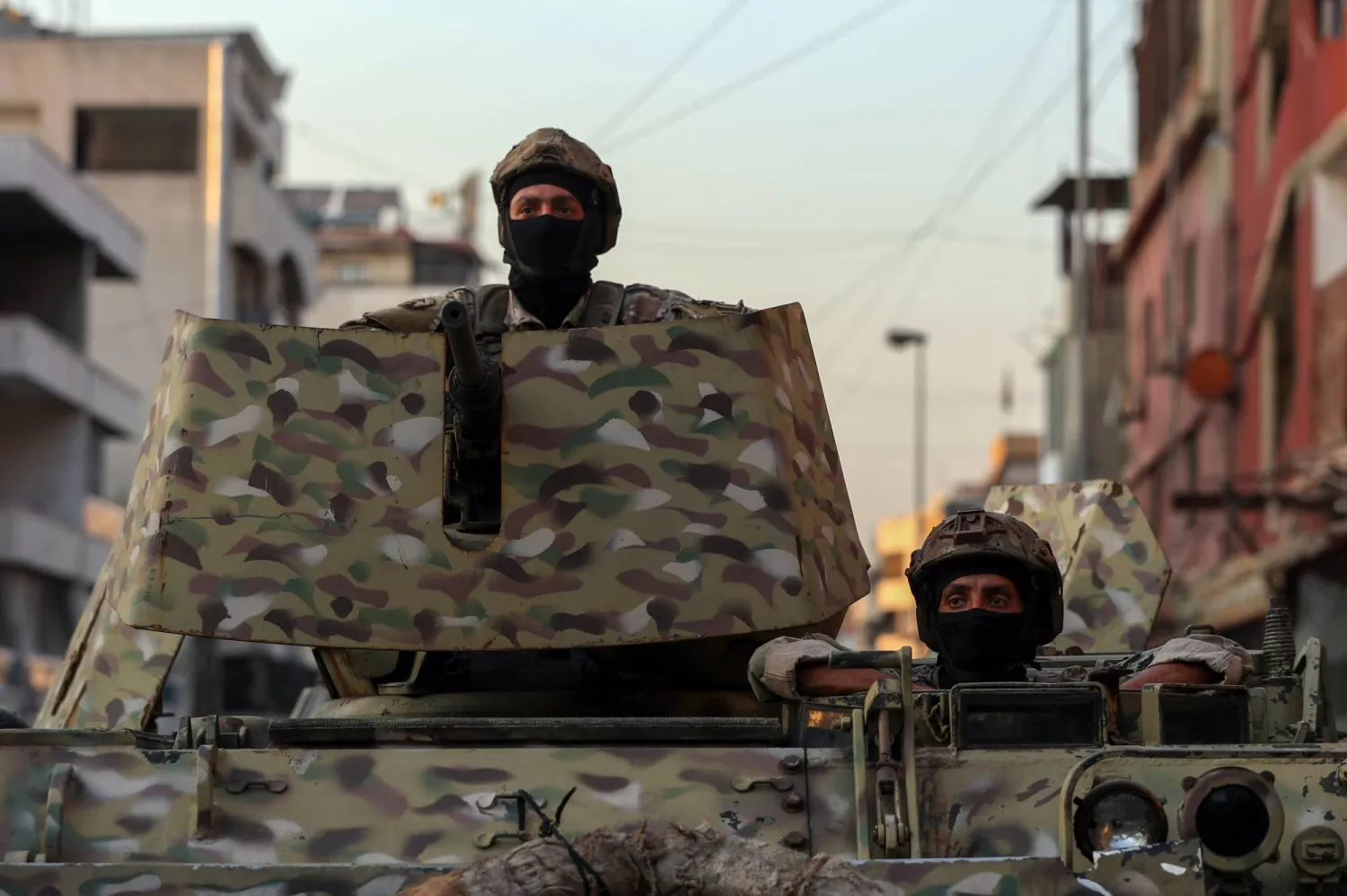
Lebanese soldiers sit on an armored personnel carrier at the entrance of Burj Barajneh Palestinian refugee camp in southern Beirut, Lebanon, 21 August 2025. EPA/WAEL HAMZEH
TT

US Sends $230 Million to Lebanon as it Moves to Disarm Hezbollah

Lebanese soldiers sit on an armored personnel carrier at the entrance of Burj Barajneh Palestinian refugee camp in southern Beirut, Lebanon, 21 August 2025. EPA/WAEL HAMZEH

US President Donald Trump's administration approved $230 million for Lebanon's security forces this week as they push to disarm the once powerful armed group Hezbollah, sources in Washington and Beirut said.

A Lebanese source familiar with the decision said the funding included $190 million for the Lebanese Armed Forces and $40 million for the Internal Security Forces.

Democratic US congressional aides said the funds had been released just before Washington's fiscal year ended on September 30. "For a small country like Lebanon, that's really, really significant," one of the aides said on a call with reporters, requesting anonymity in order to speak freely.

The funding was released at a time when the Republican president's administration has been slashing many foreign assistance programs, saying that its priority in spending taxpayer dollars is America First.

The release of the funds appeared to reflect the priority Trump has put on trying to resolve the conflict in Gaza and the wider region.

Asked for comment, a State Department spokesperson said in an emailed statement that US assistance supports Lebanese forces "as they work to assert Lebanese sovereignty across the country and fully implement UN Security Council Resolution 1701, the only viable framework for a durable security arrangement for both Lebanese and Israelis."

The resolution, adopted in August 2006, ended the last round of deadly conflict between Hezbollah and Israel.

A conflict between Israel and Lebanon that began a year ago has battered Hezbollah and left swathes of Lebanon in ruins.

President Joseph Aoun and Prime Minister Nawaf Salam asked the US-backed army on August 5 to devise a plan to ensure that all arms across the country would be in the hands of security forces by the end of the year.

Hezbollah has rejected calls to disarm since the devastating war with Israel. But the Iran-backed group is under pressure to give up its weapons from its rivals in Lebanon and from Washington.

The Lebanese source said the funding would allow the Internal Security Forces to take over internal security in Lebanon so the LAF can focus on other critical missions.


UN Says Only 3% of Gaza Cropland Accessible and Undamaged

Salvage workers shovel the scrapped rubble of a building that was destroyed during Israel's war against Hamas in Gaza, to use the recycled remains in the future, in Gaza City on August 16, 2026. (Photo by Omar AL-QATTAA / AFP)
TT

UN Says Only 3% of Gaza Cropland Accessible and Undamaged

Salvage workers shovel the scrapped rubble of a building that was destroyed during Israel's war against Hamas in Gaza, to use the recycled remains in the future, in Gaza City on August 16, 2026. (Photo by Omar AL-QATTAA / AFP)

Just three percent of the cropland in Gaza remains accessible and undamaged, the UN's Food and Agriculture Organization warned Tuesday, citing an analysis of satellite images.

The report found that since October 2025, when a fragile ceasefire between Israel and Hamas took hold, the area of accessible and undamaged cropland had fallen to 448 hectares from 601 hectares, a reduction of 25.5 percent, said AFP.

Another 3,643 hectares of cropland are accessible but too damaged to be farmed without rehabilitation, the FAO said.

"Without urgent action to restore safe access and provide farmers with the support they need, opportunities to restore local food production will continue to diminish," said Rein Paulsen, director of the agency's Office of Emergencies and Resilience.

Restrictions on the import of agricultural goods are also hampering recovery, with livestock farmers struggling to obtain animal feed and veterinary supplies.

Greenhouse availability has also declined, dropping 17.3 percent since October 2025 to 224 hectares that are accessible and undamaged.

The FAO said the reduced access could be explained mainly by the westward expansion of the so-called "Yellow Line" that separates the ceasefire zone from the area controlled by the Israeli military.

The Palestinian militant group Hamas launched an attack on Israel on October 7, 2023, that resulted in the deaths of 1,221 people, according to an AFP tally based on official Israeli figures.

Militants also took 251 hostages to Gaza.

Israel's retaliatory military campaign in Gaza has killed more than 73,000 people, according to the territory's health ministry, which operates under Hamas authority and whose figures are considered reliable by the United Nations.

A ceasefire took hold in October 2025 but progress on permanently ending the war has stalled, and Israeli forces currently control nearly 70 percent of the territory.

Before October 2023 agriculture accounted for about 10 percent of Gaza's economy and supported the livelihoods of more than 560,000 people, according to the FAO.


Syria Says 3 Dead in Hydrogen Tank Blast at Coastal Power Plant

The Banias power plant. (Tartus Governorate on Facebook)
TT

Syria Says 3 Dead in Hydrogen Tank Blast at Coastal Power Plant

The Banias power plant. (Tartus Governorate on Facebook)

A hydrogen tank explosion at a power plant in western Syria killed three people on Tuesday, an electricity company official said.

Alaa Sawda, head of the Syrian Electricity Company's media department told the official SANA news agency that "the explosion at the Banias thermal power plant was caused by maintenance work on the hydrogen tank, and occurred during the replacement of the tank's float valve, resulting in the death of three workers".

"The station continues its operations and was not affected by the explosion," he added.

SANA had initially reported "an explosion in the thermal power plant in Banias" with the cause under investigation.

It cited a regional health official as saying the blast resulted in three deaths.

Banias's thermal plant, located in the western Tartus province, is one of the most important electrical facilities in Syria.

Syria's dilapidated electricity sector suffered heavy blows during the country's civil war with heavy damage to its infrastructure, leading to power cuts that can last up to 20 hours a day.

Since the ousting of longtime ruler Bashar al-Assad in 2024, the new Syrian authorities have repeatedly vowed to increase electricity production.


Hamas Says It Is Committed to Gaza Deal After Kushner’s Israel Visit

 Palestinians walk amid the ruins of buildings destroyed by Israeli airstrikes during the war with Hamas, in Gaza City, Monday, Aug. 17, 2026. (AP)
Palestinians walk amid the ruins of buildings destroyed by Israeli airstrikes during the war with Hamas, in Gaza City, Monday, Aug. 17, 2026. (AP)
TT

Hamas Says It Is Committed to Gaza Deal After Kushner’s Israel Visit

 Palestinians walk amid the ruins of buildings destroyed by Israeli airstrikes during the war with Hamas, in Gaza City, Monday, Aug. 17, 2026. (AP)
Palestinians walk amid the ruins of buildings destroyed by Israeli airstrikes during the war with Hamas, in Gaza City, Monday, Aug. 17, 2026. (AP)

Hamas said on Tuesday it remained committed to the US-backed Gaza peace deal after White House envoy Jared Kushner spoke to Israel about steps towards the group's disarmament.

"Hamas is committed to this agreed-upon process. It is clear that, so far, the Israeli side has not given the mediators clear approval of the roadmap," Hamas spokesman Hazem Qassem told AFP.

"There are timelines and procedural steps that need to be worked out in detail, but there must first be Israeli approval of the roadmap," he said.

Kushner, President Donald Trump's son-in-law, held a rare meeting with Hamas on Sunday in Egypt before meeting the following day in Jerusalem with Israeli Prime Minister Benjamin Netanyahu, who has publicly rejected the latest phase of the deal.

Kushner, in a Fox News interview after the talks, said that Hamas's disarmament could begin in about 30 days and that reconstruction of Gaza would not begin until that happens.

Kushner also said that the United States is "not going to restrict Israel's right to defend itself if there are any imminent threats" in Gaza.

Netanyahu has demanded that Hamas fully disarm. In his talks with Kushner, the two sides agreed that a US general would oversee the surrender of weapons, according to an Israeli official.

Trump's Board of Peace implementing the deal has also told Netanyahu that Israel does not need to start withdrawing from Gaza until full disarmament, walking back an earlier call for Israel to start a phased pullout.

Israel has kept up airstrikes in Gaza despite the peace push.

The Israeli military said Tuesday that a strike two days earlier had killed a commander of the Islamic Jihad group who was responsible for abducting an Israeli during the October 7, 2023, attack that triggered the war.

Israeli operations have killed at least 1,265 Palestinians since a ceasefire came into effect on October 10, according to figures from Gaza's health ministry, which operates under Hamas authority and whose figures are considered reliable by the United Nations.

The Israeli army has reported five deaths in its ranks from Gaza operations over the same period.
