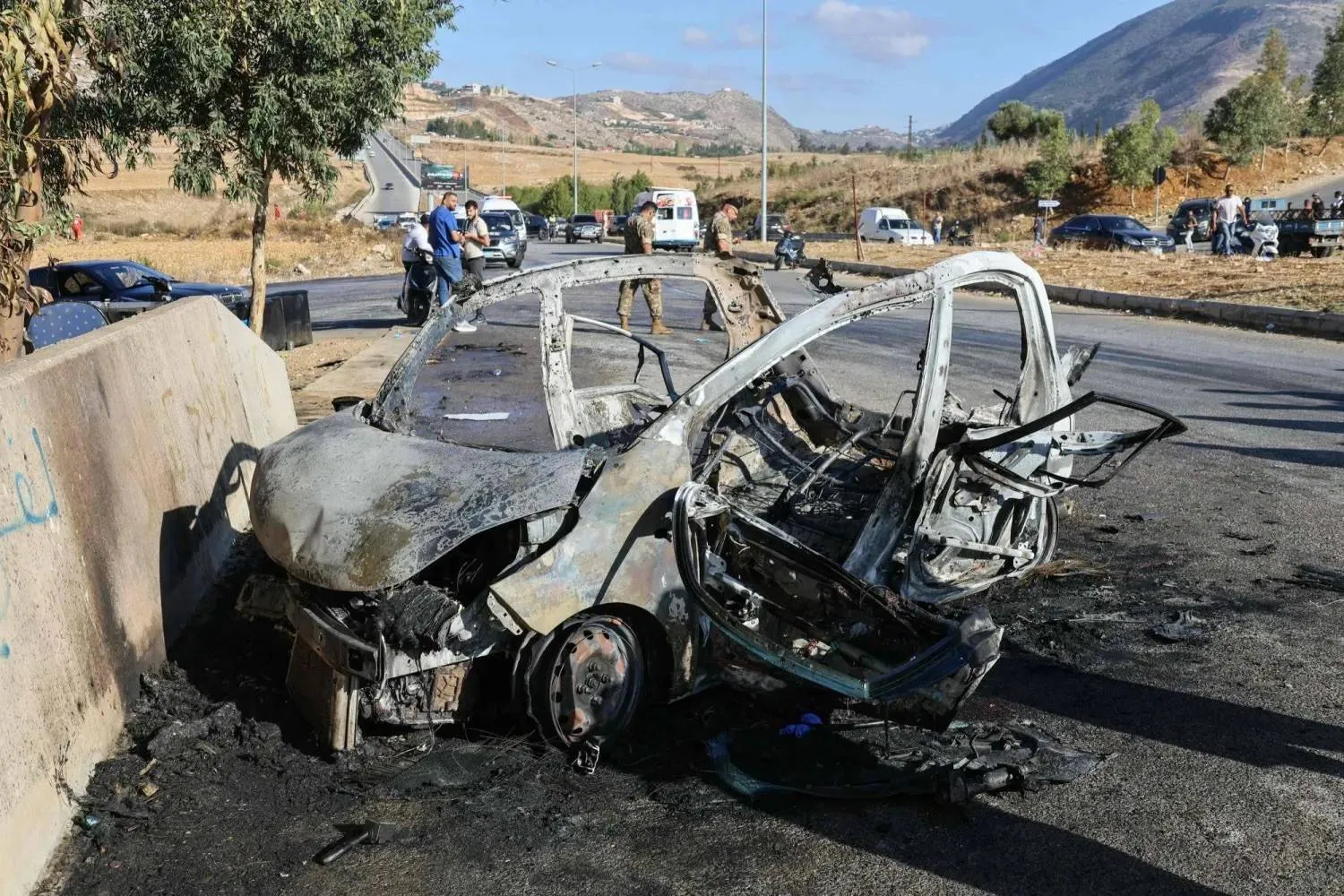

An Israeli airstrike on Thursday targeting a civilian vehicle on the Jarmaq–Khardali road in southern Lebanon has marked a new escalation in the conflict.
The attack killed two engineers, Ahmad Saad and Mustafa Rizk, both from the town of Kfar Rumman, and signaled what observers see as a shift in Israel’s strategy: from striking Hezbollah’s military infrastructure to hitting civilian institutions tied to the group.
According to Lebanon’s National News Agency (NNA), the engineers were on assignment assessing damage from previous strikes for the construction company Meamar when their vehicle was struck.
The Lebanese Ministry of Health confirmed one other person was injured. Following the strike, Israeli aircraft conducted heavy overflights across several southern towns, including Arnoun, Kfar Tibnit, Nabatieh al-Fawqa, and Jarmaq.
In parallel, Israeli drones carried out a show of force across border areas. They dropped sound bombs on the towns of Kfarkila, Markaba, and Maroun al-Ras, also targeting bulldozers near the latter’s public park.
Local sources described these tactics as part of a psychological campaign to keep southern Lebanon under constant pressure, blending real airstrikes with repeated harassment.
Military analyst Brig. Gen. (ret.) Hassan Jouni said the targeting of the engineers marked “a shift in Israel’s objectives.” He explained: “In previous cases, Israel justified its actions by claiming to hit military officials. This time, the victims were engineers engaged in reconstruction work, showing a clear intent to attack the logistical and civilian networks connected to Hezbollah.”
The choice of location was also deliberate, Jouni argued. The strike occurred near the Khardali Bridge, a symbolic and strategic point between north and south of the Litani River. “It was not random. Israel wanted to send a message that this territory remains under its rules of engagement,” he said.
Analysts believe Israel is signaling that reconstruction in southern Lebanon will not be tolerated without broader political agreements. With tensions mounting, Jouni warned that escalation is likely: “Israel appears committed to daily pressure on Hezbollah and Lebanon, and may intensify operations if a Gaza settlement allows it to refocus on the northern front.”
The attack has also reignited focus on Meamar, the company linked to Hezbollah and sanctioned by the US Treasury in 2020. Washington accused it of securing government contracts with political backing and funneling profits to Hezbollah’s executive council. Experts say the strike underscores a gradual Israeli approach to dismantle Hezbollah’s civilian and economic networks, complementing US financial sanctions.