Lebanon Says 7 Killed in Israeli Strike on Central Beirut

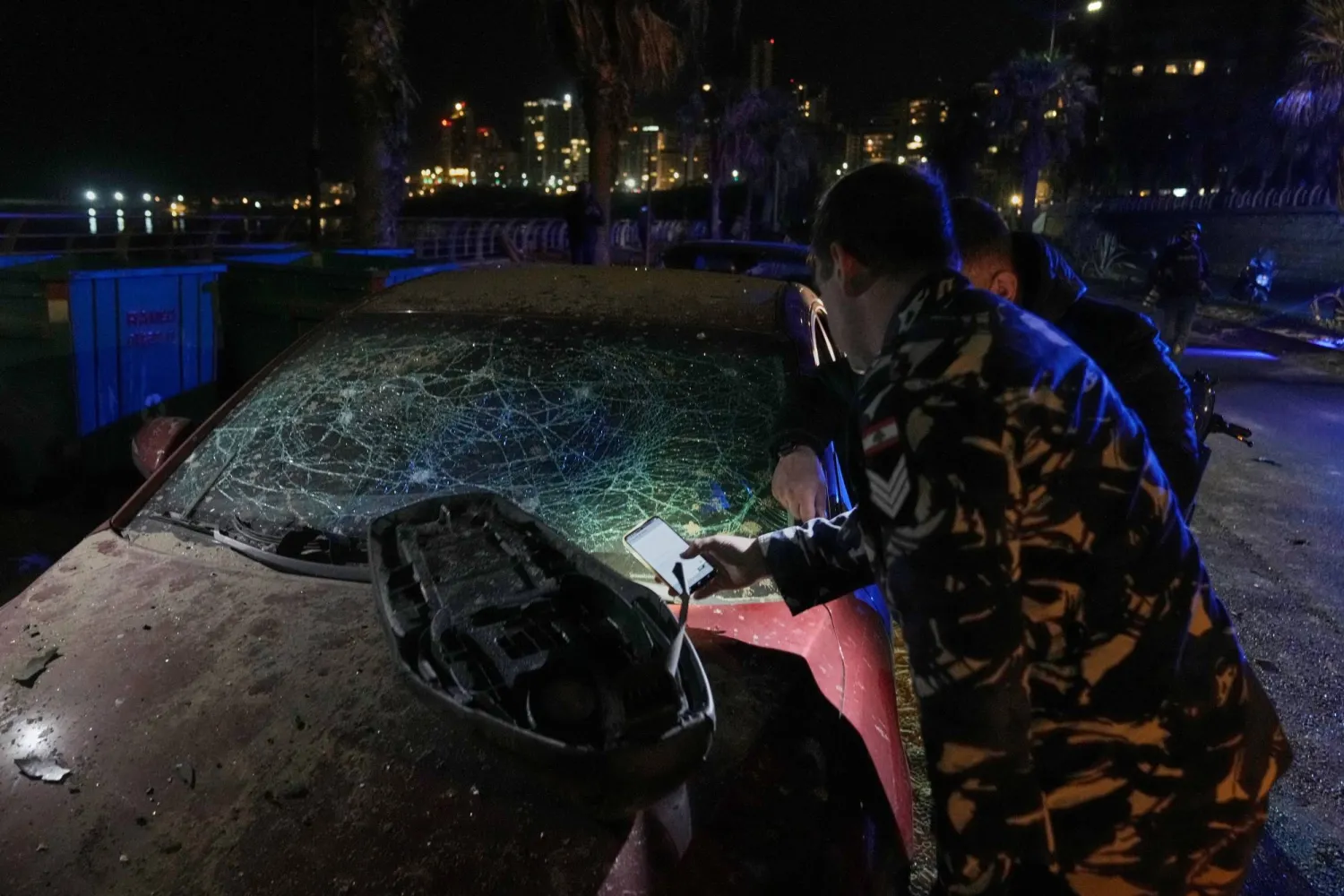
Police officers inspect a damaged car hit in an Israeli airstrike at the Ramlet al-Baida public beach in Beirut, Lebanon, early Thursday, March 12, 2026. (AP Photo/Bilal Hussein)
TT

Lebanon Says 7 Killed in Israeli Strike on Central Beirut

Police officers inspect a damaged car hit in an Israeli airstrike at the Ramlet al-Baida public beach in Beirut, Lebanon, early Thursday, March 12, 2026. (AP Photo/Bilal Hussein)

Lebanon said an Israeli strike on central Beirut's seafront killed at least seven people early on Thursday, another attack in the heart of the capital as Iran-backed Hezbollah launched more missiles at Israel.

The Israeli military said separately it had carried out strikes on Beirut's southern suburbs overnight against Hezbollah, which had announced a major new operation against Israel.

Local media aired footage showing smoke rising along the seaside road area after the strike in central Beirut, which state-run National News Agency (NNA) said targeted a car.

"The Israeli enemy strike on Ramlet al-Bayda in Beirut led to an initial toll of seven dead and 21 wounded," the health ministry said in a statement.

It was the third attack in the heart of the capital since the Middle East war began. Israel has also repeatedly hit the southern suburbs of Beirut where Israeli military said on Thursday it had hit 10 Hezbollah targets.

The NNA reported on Thursday that Israeli strikes had also hit several towns in southern Lebanon, including Taybeh and al-Sultaniyya as well as Qana, near the city of Tyre.

Hezbollah said early Thursday that it had fired off missiles at an Israeli military intelligence base in the suburbs of Tel Aviv.

Lebanon was drawn into the Middle East war last week when Hezbollah attacked Israel in response to the killing of Iranian supreme leader Ali Khamenei in US-Israeli strikes.

Israel, which kept up its strikes in Lebanon even before the war despite a 2024 ceasefire with Hezbollah, has since launched air raids across Lebanon and sent ground troops into border areas.

Its offensive has killed more than 630 people, according to Lebanese authorities, while more than 800,000 people have registered as displaced, with around 126,000 of them staying in collective shelters.

Some displaced people have been sleeping out in the open or in tents on the streets of Beirut, including in the seaside area of Ramlet al-Bayda.

- Hezbollah operation -

Late Wednesday, French President Emmanuel Macron called for Israel to halt its ground offensive in Lebanon and on Iran-backed group Hezbollah to "immediately" stop attacks, after speaking with the country's president Joseph Aoun.

Iran's Revolutionary Guards said earlier that they had carried out a joint missile operation with ally Hezbollah against targets in Israel.

In turn, the Israeli military said early Thursday that "over the past hours, the Israeli army has begun a wide-scale wave of strikes targeting terror infrastructure belonging to the Hezbollah terrorist organization across Lebanon."

It also said it hit "dozens of launchers" as well as Hezbollah intelligence and command sites in south Beirut.

It followed a string of Hezbollah statements saying its fighters fired barrages of rockets, advanced missiles and drones at towns, military bases and other locations, mainly in the Israel's north.

On Wednesday, Israel pounded south Beirut and the country's south and east, with the health ministry reporting several strikes that each killed at least eight people.

Authorities said a strike on an apartment in the densely populated Aisha Bakkar area in central Beirut wounded four people.

On Sunday, Israel hit a seafront hotel not far from Ramlet al-Bayda, saying it was targeting Iranian foreign operations officers. Iran later said the raid killed four of its diplomats.


Jordan Sentences 3 Men to Death over Karak Church Attack

Mourners carry the bodies of those who were killed in the attack that took place two days earlier at the Greek Orthodox Church during their funeral in the village of Hamoud in Jordan's Karak governorate on October 25, 2026. (Photo by Ahmad SHOURA / AFP)
TT

Jordan Sentences 3 Men to Death over Karak Church Attack

Mourners carry the bodies of those who were killed in the attack that took place two days earlier at the Greek Orthodox Church during their funeral in the village of Hamoud in Jordan's Karak governorate on October 25, 2026. (Photo by Ahmad SHOURA / AFP)

A Jordanian court on Sunday sentenced three men to death by hanging for carrying out last month's deadly gun attack on a church in the kingdom's south.

Gunmen killed nine people and wounded 25 others when they stormed a funeral at a Greek Orthodox church in Hamoud village, in Jordan's Karak governorate on October 23.

Authorities said three men, two Jordanian brothers and their relative by marriage, had fled after the attack and were arrested three days later.

In a statement Sunday, the Jordanian military said the "State Security Court issued its ruling sentencing to death the three criminals who carried out the terrorist attack" at the church.

The court found them guilty of "committing terrorist attacks" resulting in death, as well as weapons offences, "conspiracy to commit terrorist acts" and "promoting the ideas of a terrorist organization.”


France Reaffirms Support for Morocco's Position on Western Sahara

Moroccan Foreign Minister Nasser Bourita receives French Minister for Europe and Foreign Affairs Jean-Noël Barrot in Essaouira (Moroccan Foreign Ministry)
TT

France Reaffirms Support for Morocco's Position on Western Sahara

Moroccan Foreign Minister Nasser Bourita receives French Minister for Europe and Foreign Affairs Jean-Noël Barrot in Essaouira (Moroccan Foreign Ministry)

French Foreign Minister Jean-Noël Barrot reaffirmed France's unwavering support for Moroccan sovereignty over Western Sahara on Friday, declaring that the territory's "present and future fall exclusively within the framework of Moroccan sovereignty."

Speaking during talks with his Moroccan counterpart, Nasser Bourita, in the coastal city of Essaouira, Barrot reiterated Paris' full backing for Morocco's autonomy plan as the sole basis for a final political settlement to the regional dispute.

His remarks echoed France's longstanding position, reaffirmed at a UN Security Council meeting on Oct. 30.

Morocco's Foreign Ministry said the talks were part of efforts to put into practice the "Reinforced Exceptional Partnership" signed by King Mohammed VI and French President Emmanuel Macron on Oct. 28, 2024, a framework designed to strengthen bilateral ties and expand cooperation across multiple sectors.

The ministers welcomed the growing momentum in relations between Rabat and Paris, praising their strong ties of friendship and cooperation as a reflection of both leaders' determination to deepen their strategic partnership and make it more effective.

They reviewed cooperation in politics, trade, culture and humanitarian affairs, exploring ways to broaden ties in line with both countries' aspirations.

Turning to regional and international affairs, Barrot and Bourita welcomed their shared positions on key issues, particularly developments in the Middle East and prospects for implementing a two-state solution.

Both countries renewed their commitment to pursuing a just, comprehensive and lasting peace, while maintaining close coordination to advance security, stability and development across the Maghreb, the Sahel and the Mediterranean.

Barrot traveled to Morocco to attend a high-level session of the 2026 World Forum of Women for Peace, organized by the association Les Guerrières de la Paix in Essaouira.

His visit also included talks with senior Moroccan officials, visits to French cultural and educational institutions in the city and a meeting with representatives of the French community.


Damascus Moves to Reconnect Aleppo Countryside, End a Decade of Territorial Division

Preparations for the launch of the second phase of the “Echo of Resilience 2” project in Manbij (Ministry of Emergency and Disaster Management)
TT

Damascus Moves to Reconnect Aleppo Countryside, End a Decade of Territorial Division

Preparations for the launch of the second phase of the “Echo of Resilience 2” project in Manbij (Ministry of Emergency and Disaster Management)

A convoy of Syrian army heavy machinery headed to Manbij in northern Syria on Saturday to help tear down wartime earthen barriers and fill trenches stretching 841 kilometers across 255 cities and villages, in a drive to erase former frontlines and reunite areas divided by years of conflict.

The operation, in eastern Aleppo province, aims to consolidate state authority and reintegrate the affected areas administratively and economically.

Syria's Ministry of Emergency and Disaster Management, which oversees the "Echo of Resilience" project in cooperation with Aleppo governorate, said the campaign would dismantle military fortifications, clear their remnants, rehabilitate damaged areas and reopen roads between towns and villages.

The ministry said the work would improve public services and help restore normal life and stability in the affected areas.

The project's second phase began on Thursday in Manbij and its surrounding countryside and is expected to last seven months. It aims to make the area safer by clearing landmines and other remnants of war, allowing displaced residents to return home and farmers to reclaim access to their fields and resume cultivation.

The new phase follows an initial operation launched in early July around Azaz in northern Aleppo province, seven kilometers from the Turkish border.

That phase concluded on Nov. 12 after crews cleared 202 kilometers of earthen barriers and trenches, reconnecting about 33 towns and villages and easing civilian movement.

Manbij's Divided Past

The work in Manbij carries particular political and geographical weight. Before the fall of the former government, the city and its surroundings were a volatile meeting point for three rival military forces.

The Syrian Democratic Forces (SDF) and the Manbij Military Council controlled the city and surrounding areas, while Turkish-backed Syrian National Army factions held positions to the north and west. Forces of the former government, backed by Russia and Iran, were stationed to the south.

The rival deployments left hundreds of kilometers of trenches, double-layered earthen barriers and minefields along four main fronts.

The fortifications stretched from the Sajur River toward Jarablus in the north, through the area around Arima toward al-Bab in the west, and from Abu Kahf toward Deir Hafir in the south to the vicinity of Tishrin Dam and Qara Qozak Bridge on the Euphrates River's western bank in the east.

Removing those defenses is intended to reopen vital transport and trade routes linking eastern and northern Aleppo and restore access to farmland that had been isolated or off-limits for years.

From Military Frontlines to State Control

The two phases of the "Echo of Resilience" project coincide with efforts to implement a Jan. 29, 2026, agreement between the Syrian government and the SDF.

The agreement seeks to end territorial divisions, integrate the affected areas administratively and economically, extend state control across Syria and ensure the return of forcibly displaced people and other residents once suitable conditions are in place.

Around Azaz, once a flashpoint along the frontlines facing Tal Rifaat and Afrin, the removal of earthen barriers marked a practical step toward dismantling former lines of confrontation and reconnecting Syrian territory, officials overseeing the project told the Syrian Arab News Agency (SANA).

Observers of Syrian affairs say the dismantling of military fortifications by Syrian army units in a strategic area such as Manbij sends a clear political message: the state is consolidating control on the ground while reducing the military presence in residential and agricultural areas.

They say the shift could also strengthen border security and revive regional trade.