
Syrians say they want their new People’s Assembly to prioritize improving living conditions and act as a genuine voice for the people.
Citizens interviewed by Asharq Al-Awsat also urged the incoming parliament to embrace transparency and accountability, update outdated laws, and pass legislation guaranteeing women’s rights in employment and political participation.
Local sources in Sweida province—home to a Druze majority in southern Syria—and in areas under Kurdish-led self-administration in the north and northeast, meanwhile, highlighted the absence of representation for residents there, after the Damascus government excluded their regions from the voting process.
Rebuilding Trust
Houda Atassi, Co-Founder & Chairwoman at International Humanitarian Relief and a civil society activist, said the new parliament faces a “national responsibility” to rebuild trust between citizens and state institutions.
“The People’s Assembly must place people’s concerns and livelihoods at the heart of its priorities,” Atassi told Asharq Al-Awsat, calling for genuine inclusion of civil society and women as “essential partners in decision-making, not just symbolic participants.”
She expressed hope that the new body would enact laws promoting social justice, safeguarding women’s rights to work and political participation, and empowering them economically and socially. She urged the parliament to demonstrate transparency and accountability and to serve as a sincere voice for Syrians aspiring to a fair and capable state.
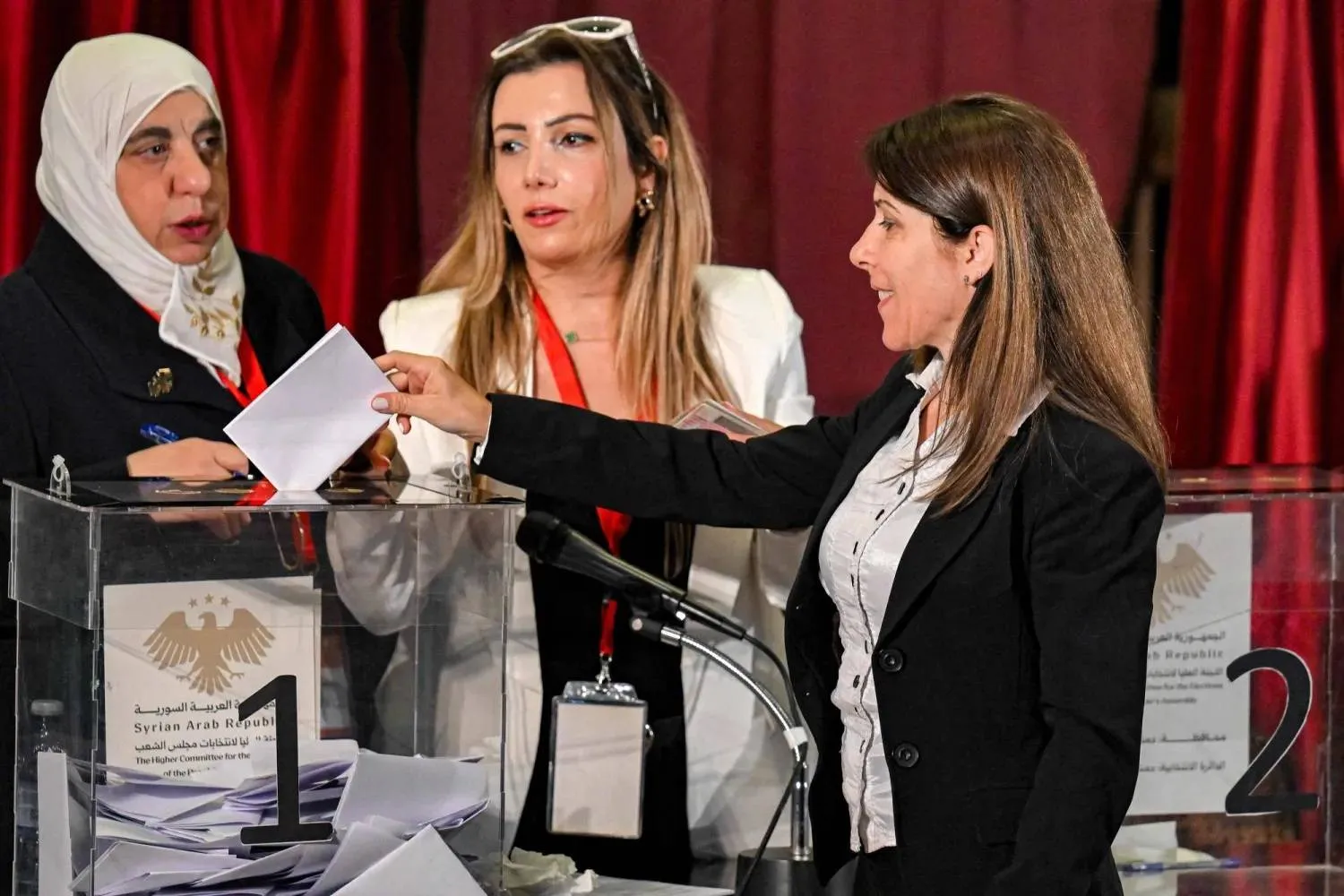
Sunday’s parliamentary vote was the first since the fall of Bashar al-Assad’s regime late last year. A total of 1,578 candidates competed for 140 seats. Meanwhile, President Ahmed al-Sharaa will appoint the remaining third of the 210-seat chamber, as stipulated in the constitutional declaration.
On Monday, the Higher Election Committee announced the final results. Its spokesman, Nawar Najmeh, said men won about 96% of the seats, compared with 4% for women—a disparity he described as “the main shortcoming of the electoral process.”
Atassi attributed the weak female representation to intertwined political, social, and cultural factors, noting that in many rural or conservative areas, “voters still hesitate to elect women because entrenched patriarchal norms link leadership and political representation with men rather than women.”
She said many electoral lists included women only for formality’s sake, without real backing or campaigning. “Ironically,” she added, “a large proportion of women voters end up casting ballots for male candidates—whether due to family influence, social security concerns, or political pragmatism—undermining the chances of female contenders who had counted on the women’s vote.”
Atassi said women’s visible presence in polling stations reflected civic awareness but had yet to translate into political trust or tangible empowerment at the ballot box.
Focus on Living Standards and Services
In Damascus, resident Ibrahim al-Fayyad said he hoped the new parliament would modernize legislation to better serve citizens, enable the government to assist them, and improve their deteriorating living standards—as well as basic services such as electricity, water, and telecommunications.
The vote took place amid rising prices, which have climbed again after dropping by roughly 50 percent following the previous regime’s fall. The government has since raised public sector salaries by 200 percent, bringing the monthly wage of a top-tier employee to around $150. Studies, however, estimate that a small Syrian family needs at least $500 per month to cover basic expenses.
Information engineer Mohammed Abuo Sweid said he hoped the parliament would push for digital governance and automation across public and private sectors to “save time, effort, and costs, and reduce the financial burden on the state.”
Golan Residents Call for Safeguarding National Sovereignty
The occupied Golan Heights also featured prominently in Syrians’ expectations. Tayyib Mahmoud Ahmad Rahban, a resident of the area, told Asharq Al-Awsat he hoped the parliament would “not concede a grain of Syria’s soil or ratify any treaty that compromises our rights as Syrians, and as Golan natives in particular.”
Rahban said he wanted the assembly to truly represent “the millions of Syrians who have endured years of death, displacement, and detention.”
In southern Daraa province, meanwhile, resident Mohammed Abdulrahman called on the parliament to support the economy, small and medium enterprises, and to introduce legislation fostering a safe investment environment that would encourage Syrian capital to return. He also urged lawmakers to “open prospects for a better future for youth and protect their rights.”
Druze Regret Exclusion from Vote
In Sweida, which was excluded from the elections amid tension between Damascus and local armed factions aligned with Druze religious leader Sheikh Hikmat al-Hijri, a senior Druze source expressed regret that residents could not cast their votes or choose representatives to participate in national decision-making.
Speaking on condition of anonymity, the source said it was “only natural” that the province did not take part in the vote following July’s deadly clashes between Druze fighters on one side and Bedouin and tribal groups alongside government forces on the other. He said those events had caused “a total loss of confidence in the current authorities.”
Political activist Maysa al-Abdullah, also from Sweida, told Asharq Al-Awsat that locals were more concerned with “how to shelter the displaced and cope with bread and electricity shortages” than with parliamentary participation.
Kurdish Areas Unmoved by the Vote
In Kurdish-administered northeastern Syria, where relations with Damascus remain strained, election day passed “like any other day,” said Imad Majoul, a Kurdish resident of Amuda in rural Hasakah.
“People only heard about the elections on social media,” he said, adding that he felt “nothing had changed politically in Syria,” describing the current phase as “a replica of the previous one but with new faces and terminology.”
As in Sweida, the Damascus government excluded Kurdish-held areas from taking part in the parliamentary elections.