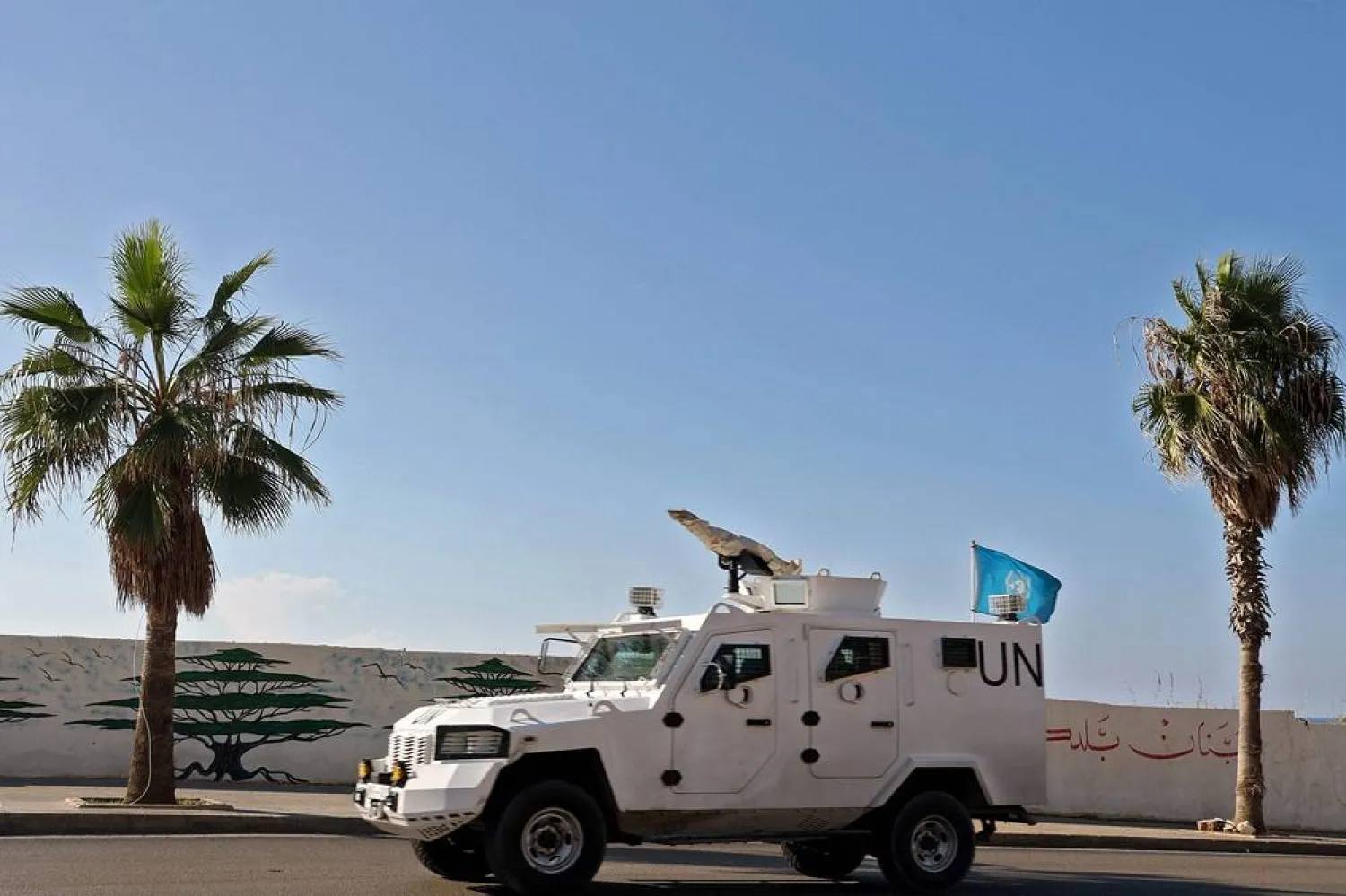
UN Force in Lebanon Says Peacekeeper Wounded by Israeli Grenade

A UNIFIL armored vehicle drives through Beirut as part of a UN peacekeeping convoy heading towards south Lebanon, on November 12, 2024. (AFP)
TT

UN Force in Lebanon Says Peacekeeper Wounded by Israeli Grenade

A UNIFIL armored vehicle drives through Beirut as part of a UN peacekeeping convoy heading towards south Lebanon, on November 12, 2024. (AFP)

The United Nations peacekeeping mission in Lebanon said Sunday that one of its members was wounded by an Israeli grenade dropped near a UN position in the country's south, the third incident of its kind in just over a month.

The United Nations Interim Force in Lebanon (UNIFIL) has been working with the Lebanese army to support a November ceasefire that sought to end more than a year of hostilities between Israel and group Hezbollah that culminated in two months of open war.

"Just before noon yesterday, an Israeli drone dropped a grenade that exploded near a UNIFIL position" in Kfar Kila, the force said in a statement published on Sunday.

"One peacekeeper was lightly injured and received medical assistance."

Earlier this month, UNIFIL said Israeli drones had dropped multiple grenades near peacekeepers providing security for workers clearing rubble left over from the war.

And in a similar episode in September, UNIFIL said Israeli drones had dropped four grenades near peacekeepers, with Israel insisting at the time that there had been "no intentional fire" directed at the force.

UNIFIL said Saturday's incident represented "another serious violation of resolution 1701 and concerning disregard for the safety of peacekeepers".

UN Security Council Resolution 1701 ended a 2006 conflict between Israel and Hezbollah and formed the basis of the November ceasefire.

Under the US-brokered ceasefire, Hezbollah and Israel were both required to withdraw from south Lebanon, while UNIFIL deployed there alongside the Lebanese military, in part to help dismantle Hezbollah infrastructure.

Israel has kept up regular strikes in Lebanon on what it says are Hezbollah targets despite the truce and has maintained its troops in five locations it deems strategic.

"We again call on the (Israeli army) to cease attacks on or near peacekeepers, who are working to rebuild the stability that both Israel and Lebanon have committed to restore," the UN peacekeeping force said.

UNIFIL has been deployed since 1978 to separate Israel and Lebanon, and numbers some 10,000 personnel from almost 50 countries.

In August, the Security Council voted to end UNIFIL's mission in 2027.


UN Security Council Delegation Visits South Lebanon, Urges All Sides to Stick to Truce

A convoy carrying a UN Security Council delegation, tours the border with Israel close to the southern Lebanese area of Naqura on December 6, 2025. (Photo by Mahmoud ZAYYAT / AFP)
TT

UN Security Council Delegation Visits South Lebanon, Urges All Sides to Stick to Truce

A convoy carrying a UN Security Council delegation, tours the border with Israel close to the southern Lebanese area of Naqura on December 6, 2025. (Photo by Mahmoud ZAYYAT / AFP)

A United Nations Security Council delegation on Saturday urged all parties to uphold a year-old ceasefire between Israel and Hezbollah, expressing support for a state weapons monopoly at the end of a Lebanon visit.

"We came to Beirut at a pivotal time for the implementation of... the cessation of hostilities agreement of November of last year," Slovenian UN ambassador Samuel Zbogar, whose country holds the rotating presidency of the UN body, told reporters.

"All parties must uphold the November 2024 cessation of hostilities agreement, and we recognize progress achieved by Lebanon this year," he said.

"We reaffirm the council's support for Lebanon's territorial integrity, sovereignty and political independence."

"We also reaffirm commitment to the full implementation of Resolution 1701 in support of Lebanon's -- as well as regional -- security and stability," he added, referring to a 2006 Security Council decision that forms the basis of the current truce.

The November 2024 ceasefire was supposed to end more than a year of hostilities between Israel and Hezbollah, but Israel has kept up strikes on Lebanon.

Israel has mainly said it is targeting the group, and has maintained troops in five south Lebanon areas it deems strategic.

The Lebanese government has committed to disarming Hezbollah, and the army is set to dismantle the group's military infrastructure near the border by year end before tackling the rest of the country.

"We support the Lebanese government's decision to ensure the state's monopoly of arms," Zbogar said, also urging "intensified international support" for Lebanon's army.

The delegation met senior officials including President Joseph Aoun, and on Saturday went to south Lebanon near the Israeli border, visiting UNIFIL peacekeepers.

In August, the Security Council voted to extend UNIFIL's mandate until the end of 2026 and then withdraw the force from Lebanon by the end of the following year.

The visit was a chance to "examine options for the implementation of Resolution 1701 following UNIFIL's departure from Lebanon", Zbogar said, adding that "this is a topic that will deserve a thorough conversation during 2026".

Zbogar also emphasized that the "safety of peacekeepers must be respected and that they must never be targeted", after Lebanon's army said it arrested six people following an attack by gunmen on UNIFIL personnel this week.


Egypt and Russia Discuss Developments in Sudan, Syria, Lebanon, Gaza

Egyptian President Abdel Fattah al-Sisi and Russian President Vladimir Putin during the launch of the installation of the pressure vessel for the first reactor at the El-Dabaa nuclear plant last month (Egyptian presidency)
TT

Egypt and Russia Discuss Developments in Sudan, Syria, Lebanon, Gaza

Egyptian President Abdel Fattah al-Sisi and Russian President Vladimir Putin during the launch of the installation of the pressure vessel for the first reactor at the El-Dabaa nuclear plant last month (Egyptian presidency)

Egypt and Russia discussed developments in Sudan, Syria, Lebanon and Gaza on Friday during a phone call between Egyptian Foreign Minister Badr Abdelatty and his Russian counterpart Sergei Lavrov, in the latest round of ongoing coordination and consultations between the two countries on bilateral ties and regional and international issues of mutual concern.

The Egyptian Foreign Ministry said the call covered the close relationship between Egypt and Russia, which it said has gained growing momentum across various areas of cooperation, particularly economic and trade fields.

Abdelatty expressed Egypt’s pride in the strategic partnership binding the two countries, describing it as the governing framework for bilateral cooperation across multiple sectors.

He stressed the need to continue joint work to advance ongoing projects, notably the Dabaa nuclear plant, in order to boost Russian investment in Egypt and expand cooperation between both sides.

Last month, Egyptian President Abdel Fattah al-Sisi and Russian President Vladimir Putin witnessed via video conference the installation of the pressure vessel for the first reactor unit at the nuclear plant, as well as the signing of the nuclear fuel procurement order.

Experts described the step as the first milestone toward nuclear energy production.

El-Dabaa plant is Egypt’s first nuclear power facility, located in the town of Dabaa in Marsa Matrouh governorate on the Mediterranean coast. Russia and Egypt signed a cooperation agreement in November 2015 to build the plant, with the contracts entering into force in December 2017.

Abdelatty underscored during Friday’s call the importance of implementing UN Security Council Resolution 2803 and moving ahead with the second phase of the US president’s peace plan for Gaza, noting the need to enable the international stabilization force to carry out its mandate and consolidate the ceasefire.

According to the Foreign Ministry, Abdelatty outlined Egypt’s efforts within the Quad mechanism to stop the conflict and preserve the unity and integrity of the Sudanese state. He also reiterated Egypt’s longstanding position supporting the unity, sovereignty, security and stability of Lebanon.

He renewed Cairo’s call for respecting the unity and sovereignty of Syrian territory and rejecting any actions or interventions that could undermine the country’s stability, urging the activation of a comprehensive political process that meets the aspirations of the Syrian people.

Egypt said in late November that it hoped to see the start of a political process in Sudan without exclusion and reaffirmed its respect for Sudanese sovereignty.

The Quad, which groups Saudi Arabia, Egypt, the United Arab Emirates and the United States, has been working to secure a ceasefire in Sudan.

It held a ministerial meeting in Washington in September and stressed the need to exert every effort to resolve the conflict. In August, it proposed a roadmap calling for a three-month humanitarian truce, followed by a permanent ceasefire, paving the way for a political process and the formation of an independent civilian government within nine months.

The call also touched on developments related to Iran’s nuclear program.

Abdelatty stressed the importance of continued efforts to de-escalate tensions, build confidence and create conditions that offer a real opportunity for diplomatic solutions and the resumption of talks aimed at reaching a comprehensive agreement that accommodates the interests of all parties and contributes to regional security and stability.

Separately, Abdelatty and Lavrov discussed the war in Ukraine.

The Egyptian foreign minister reiterated Cairo’s consistent position that efforts must continue to pursue peaceful settlements to crises through dialogue and diplomatic means in a way that preserves security and stability.


Yemen Leader Warns against Unilateral Actions Undermining Unity, State Sovereignty

Yemeni armed forces flash the V-sign for victory as they ride in the back of a lorry as they celebrate the 58th anniversary of National Independence Day, in the port city of Aden, November 30, 2025. (Photo by Saleh Al-OBEIDI / AFP)
TT

Yemen Leader Warns against Unilateral Actions Undermining Unity, State Sovereignty

Yemeni armed forces flash the V-sign for victory as they ride in the back of a lorry as they celebrate the 58th anniversary of National Independence Day, in the port city of Aden, November 30, 2025. (Photo by Saleh Al-OBEIDI / AFP)

Yemeni Presidential Leadership Council chief Rashad al-Alimi warned on Friday that unilateral actions and internal disputes within government-controlled areas risk undermining state sovereignty and strengthening the Iran-backed Houthi group.

Al-Alimi made the remarks before leaving the interim capital Aden for Saudi Arabia, where he is set to hold high-level consultations with regional and international partners amid sensitive developments in eastern Yemen, particularly Hadramout.

He reaffirmed the government’s commitment to national partnership and collective responsibility to complete the transitional phase in line with the 2022 power-transfer declaration and the Riyadh Agreement.

“The state alone bears responsibility for protecting its national institutions and safeguarding citizens’ interests,” Al-Alimi said, warning against any measures that would challenge the government’s or local authorities’ exclusive powers, harm security and stability, deepen humanitarian suffering, or undermine economic recovery and international confidence.

The council chief said restoring state institutions, ending Houthi militia control, and pursuing economic reforms would remain top national priorities. He cautioned that any distraction by side conflicts “only serves the Iranian project and its destructive tools,” according to the state-run Saba news agency.

Al-Alimi praised Saudi Arabia for mediating the latest truce agreement in Hadramout and urged full adherence to its terms. He said the deal should serve as a foundation for stability in Hadramout and the wider region, describing the province as “a cornerstone of Yemen’s and the region’s stability.”

He voiced full support for local authorities and tribal leaders seeking to restore calm and enable Hadramout residents to manage their own local affairs in line with the PLC’s pledges and plan to normalize conditions in the province.

Al-Alimi also instructed the local authorities and relevant ministries to form a committee to investigate alleged human rights and humanitarian law violations and damages to public and private property in the province’s Wadi and desert districts, and to ensure victims receive redress.

The Yemeni leader urged all political and social groups to put aside differences, act responsibly, and unite in facing common challenges. He called for rallying behind the government to fulfill its obligations and place citizens’ welfare and dignity above all else.