
Trump Says Peace Achieved as Israeli Hostages Swapped for Palestinian Detainees

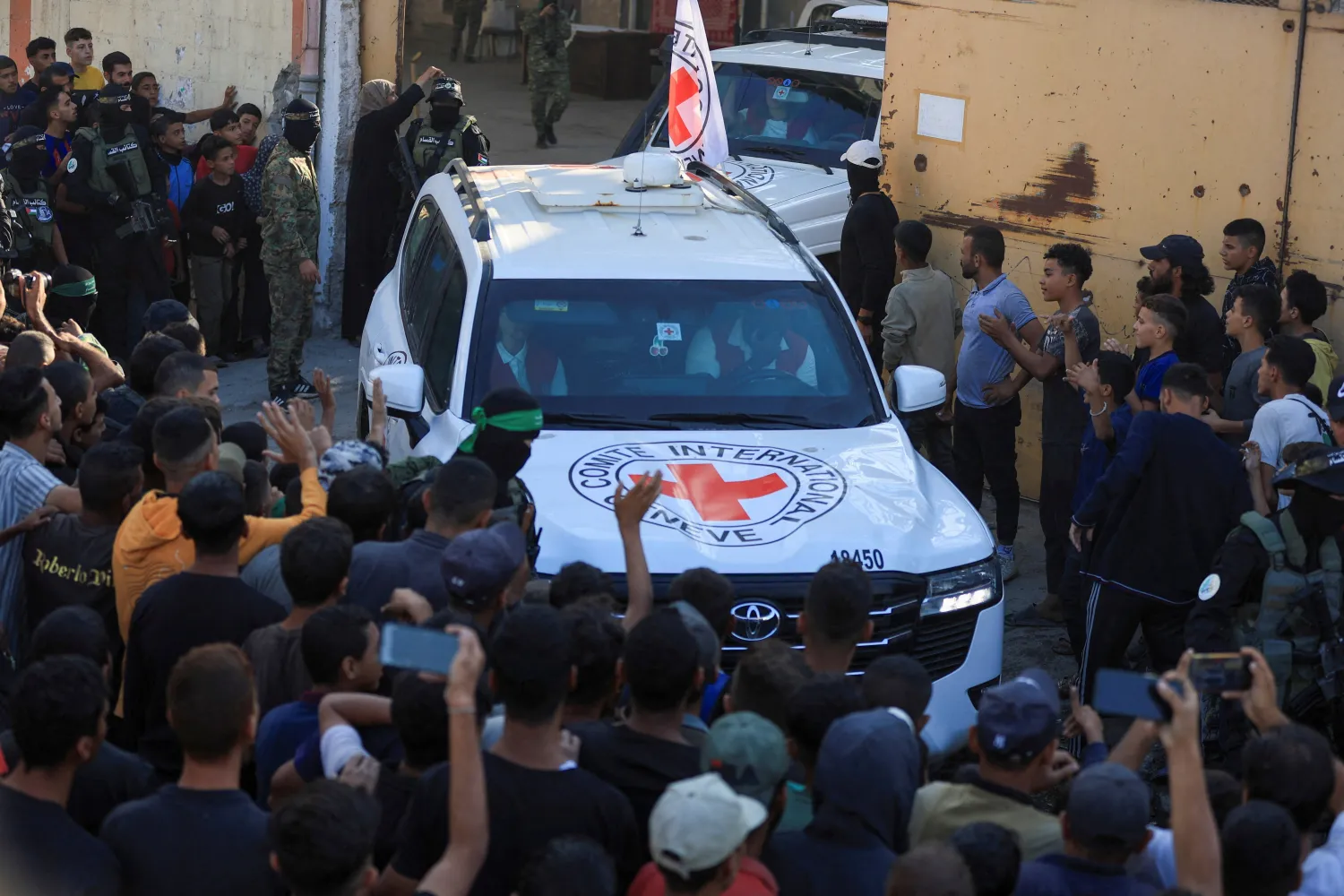
Red Cross vehicles transport hostages, held in Gaza since the deadly October 7, 2023 attack, following their handover as part of a ceasefire and hostages-prisoners swap deal between Hamas and Israel, in Gaza City October 13, 2025. REUTERS/Dawoud Abu Alkas
TT

Trump Says Peace Achieved as Israeli Hostages Swapped for Palestinian Detainees

Red Cross vehicles transport hostages, held in Gaza since the deadly October 7, 2023 attack, following their handover as part of a ceasefire and hostages-prisoners swap deal between Hamas and Israel, in Gaza City October 13, 2025. REUTERS/Dawoud Abu Alkas

Hamas freed the last living Israeli hostages from Gaza on Monday under a ceasefire deal and Israel sent home busloads of Palestinian detainees, as US President Donald Trump told Israel's parliament that peace had arrived. 

The Israeli military said it had received all hostages confirmed to be alive, after their transfer from Gaza by the Red Cross. The announcement prompted cheering, hugging and weeping among thousands waiting at "Hostage Square" in Tel Aviv. 

In Gaza, thousands of relatives, many weeping with joy, gathered at a hospital where buses brought home some of the nearly 2,000 Palestinian prisoners and detainees freed by Israel as part of the accord. 

"The skies are calm, the guns are silent, the sirens are still and the sun rises on a Holy Land that is finally at peace," Trump told the Knesset, Israel's parliament, saying a "long nightmare" for both Israelis and Palestinians was over. 

"Now it is time to translate these victories against terrorists on the battlefield into the ultimate prize of peace and prosperity for the entire Middle East," he said before departing for a summit in Egypt intended to cement the truce. 

He arrived in the Egyptian beach resort of Sharm el-Sheikh about an hour before sundown for the summit of more than 20 world leaders, which Trump will chair alongside President Abdel Fattah al-Sisi. 

FORMIDABLE OBSTACLES REMAIN 

The release of the last living hostages captured in the October 2023 attacks, which killed 1,200 Israelis and precipitated the war, in return for around 2,000 Palestinian prisoners and detainees follows a ceasefire and partial Israeli withdrawal. 

Thousands of Palestinians have been able to return to the ruins of homes they fled in the Gaza Strip, where health authorities say 68,000 people were killed in fighting that displaced nearly the entire 2.2 million-strong population. 

However, formidable obstacles remain, even to securing an enduring ceasefire, much less to bringing a wider, more durable peace. Among the immediate issues still to be resolved: recovering the remains of another 26 hostages believed to have died and two whose fates are unknown. 

Hamas says recovering the bodies could take time as not all burial sites are known. It said on Monday it would soon hand over four bodies. Israel's defense minister said handing over so few would be a "gross violation" of the group's commitments. 

Aid supplies are meant to flow more smoothly into the enclave under Trump's plan. UN aid chief Tom Fletcher underlined the need to "get shelter and fuel to people who desperately need it and to massively scale up the food and medicine and other supplies going in." 

Beyond that, crucial issues have yet to be resolved, including how to govern and police Gaza, and the ultimate future of Hamas, which still rejects Israel's demands to disarm. 

Hamas gunmen, seeking to assert their presence, launched a security crackdown in Gaza City after Israel's pullback, killing 32 members of a rival group, a Palestinian security source said. 

The Gaza War has also reshaped the Middle East through spillover conflicts, with Israel imposing punishing damage in a 12-day war against Iran and campaigns against its regional allies, including Lebanon's Hezbollah and Yemen's Houthis. 

Trump, who has presented his plan as the catalyst for a wide regional peace settlement, even floated the idea of a peace deal between arch Middle East enemies Iran and Israel to the Knesset, saying he thought Iran wanted one: "Wouldn't it be nice?" 

JOY, RELIEF ON BOTH SIDES 

Beaming with relief and joy, two hostages waved to cheering crowds from vans on the way to an Israeli hospital, one hoisting a large Israeli flag then forming a heart with his hands. 

Video footage captured emotional scenes of families receiving phone messages from their loved ones as they were being released, their faces lighting up with disbelief and hope after months of anguish. 

"I am so excited. I am full of happiness. It's hard to imagine how I feel this moment. I didn't sleep all night," said Viki Cohen, mother of hostage Nimrod Cohen, as she travelled to Reim, an Israeli military camp where hostages were being transferred. 

Palestinians meanwhile rushed to embrace prisoners freed by Israel. Several thousand gathered inside and around Nasser Hospital in Khan Younis in southern Gaza, some waving Palestinian flags, others holding photos of their relatives. 

"I am happy for our sons who are being freed, but we are still in pain for all those who have been killed by the occupation, and all the destruction that happened to our Gaza," a Gaza woman, Um Ahmed, told Reuters in a tearful voice message. 

Freed prisoners arrived in buses, some of them posing from the windows, flashing V-for-Victory signs. The appearance of armed masked Hamas fighters at the scene underscored the difficulty of resolving Israel's demand that they disarm. 

Israel was due to release 1,700 detainees it captured in Gaza, as well as 250 prisoners from its jails convicted or suspected of security offences, including attacks on Israelis. 

Samer Halabeya, a doctor freed from jail where he was serving a sentence for planning an attack that wounded an Israeli officer, stood by his weeping mother in Ramallah in the occupied West Bank. 

The prisoners had only learned they would be released long after the agreement had been signed, he said: "We hope that everyone gets freed." 


Some South Lebanon Residents Trickle Back as Israel-Hezbollah Fighting Pauses

A man walks past a destroyed building targeted by Israeli air strikes on the historic old market in the town of Nabatieh, southern Lebanon, 21 June 2026, following the ceasefire between Israel and Hezbollah. (EPA)
TT

Some South Lebanon Residents Trickle Back as Israel-Hezbollah Fighting Pauses

A man walks past a destroyed building targeted by Israeli air strikes on the historic old market in the town of Nabatieh, southern Lebanon, 21 June 2026, following the ceasefire between Israel and Hezbollah. (EPA)

Some south Lebanon residents cautiously headed back to their hometowns on Sunday after fighting paused between Israel and Hezbollah the previous evening, even as Lebanon's army warned locals to delay returns.

In the southern city of Nabatieh, AFP correspondents saw just a few residents trickling back to inspect homes and businesses.

Mohammad Salloum said he had come back briefly to check on his shop but would return to the city of Sidon further north where he has taken refuge.

"Nabatieh is disaster-stricken," he told AFP while inspecting the damage.

But "God willing, the city will return to life within two or three months", he added.

Lebanon's army on Sunday emphasized "the need for residents to delay their return to southern border villages and towns" and to comply with army instructions "to preserve their safety from the danger of Israeli violations and attacks".

In the southern Tyre region, an AFP correspondent reported a cautious return of some residents, but said many were waiting for the outcome of further Middle East war talks on Sunday and the green light from local authorities.

Hezbollah's backer Iran, which is holding talks in Switzerland with the United States on Sunday, had warned it would not enter into negotiations on a broader agreement with Washington unless the war in Lebanon came to an end.

The latest Israel-Hezbollah ceasefire was announced on Friday, but Lebanese authorities said Israeli strikes on the country's south and east on Saturday killed at least 30 people before fighting paused in the evening.

Israel's Defense Minister Israel Katz on Sunday said Israeli forces had standing orders to act against any threat inside Lebanon, insisting troops would remain in a so-called security zone inside Lebanese territory.

Israeli military operations have recently been focused on the Nabatieh region, and Lebanon's central bank on Saturday said an Israeli strike targeted its branch in the city.

Mayor Abbas Badreddine told AFP that "the scope of destruction in the city of Nabatieh in the past 48 hours amounts to about half of what happened" during the rest of the war.

Lebanon says Israeli attacks have killed more than 4,000 people since Hezbollah drew the country into the Middle East conflict on March 2 with rocket fire at Israel in support of Tehran.


Israel PM Says Troops to Stay in South Lebanon ‘as Long as Necessary’

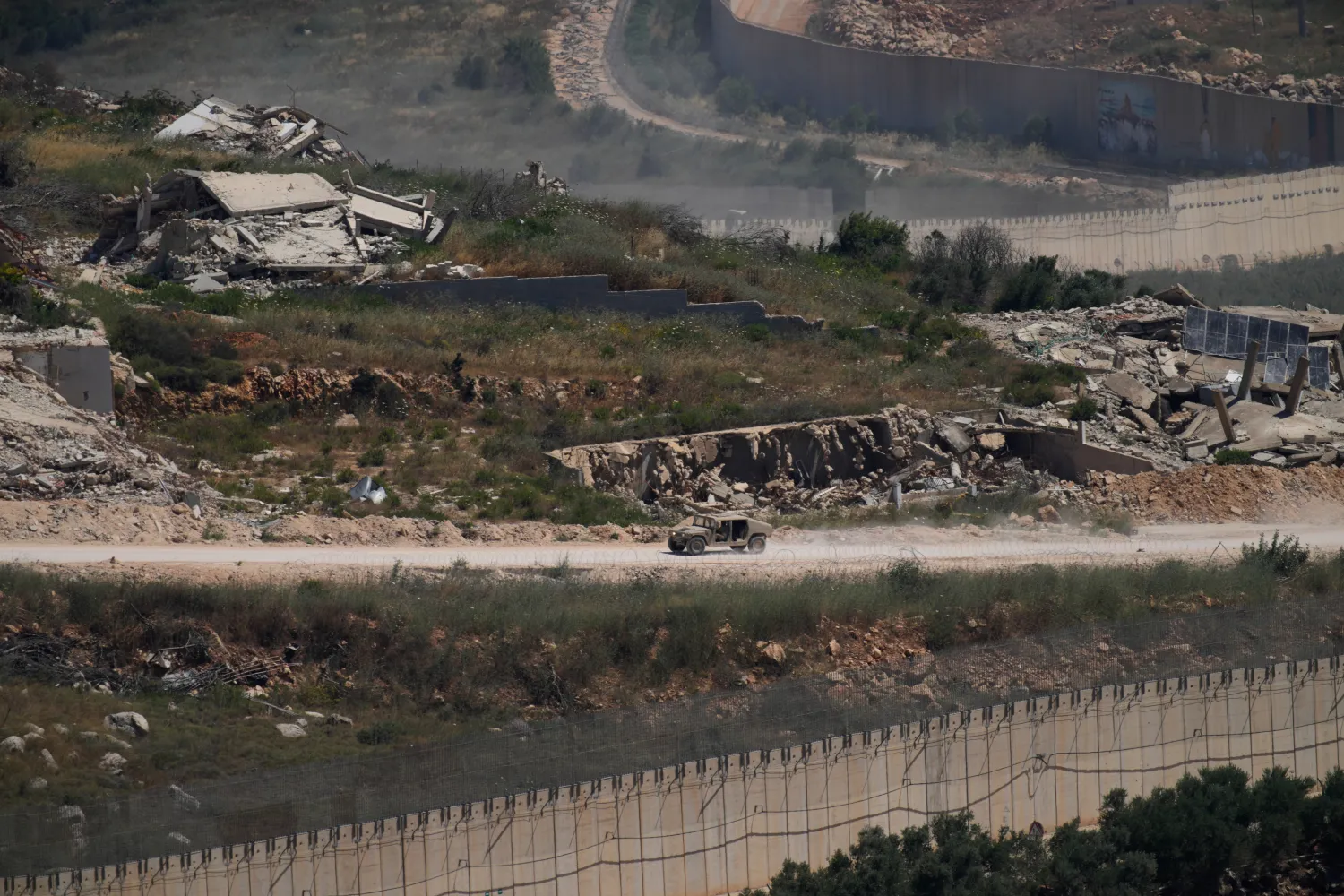
 An Israeli military vehicle moves past destroyed buildings in southern Lebanon as seen from northern Israel, Sunday, June 21, 2026. (AP)
An Israeli military vehicle moves past destroyed buildings in southern Lebanon as seen from northern Israel, Sunday, June 21, 2026. (AP)
TT

Israel PM Says Troops to Stay in South Lebanon ‘as Long as Necessary’

 An Israeli military vehicle moves past destroyed buildings in southern Lebanon as seen from northern Israel, Sunday, June 21, 2026. (AP)
An Israeli military vehicle moves past destroyed buildings in southern Lebanon as seen from northern Israel, Sunday, June 21, 2026. (AP)

Israeli Prime Minister Benjamin Netanyahu said on Sunday that Israeli forces would remain in occupied regions of southern Lebanon "as long as necessary", while also vowing to prevent Iran from acquiring nuclear weapons. 

"We will remain in the security zone in southern Lebanon for as long as necessary to protect the cherished residents of the north and all the citizens of Israel... Nothing will alter that commitment," Netanyahu said. 

"And with regard to Iran: whatever political developments may unfold, I will not allow Iran to acquire nuclear weapons. As long as I serve as prime minister of Israel, that will not happen." 

Israel's military chief said on Sunday that Hezbollah had suffered a severe blow fighting Israeli forces and was now in a "very difficult position", as he met with troops in southern Lebanon. 

He spoke as the United States and Iran held talks in Switzerland after signing a preliminary agreement to end the broader Middle East war, with the conflict in Lebanon threatening to derail the deal. 

"Hezbollah has suffered a severe and significant blow, and we are committed to remaining prepared to continue operating and prevent its rebuilding," Lieutenant General Eyal Zamir said, according to a military statement. 

"Hezbollah is in a very difficult position," he added. 

Hezbollah had pulled Lebanon into the Middle East war in early March when the Iran-backed Lebanese group fired rockets at Israel in retaliation for the killing of Iran's supreme leader in US-Israeli strikes. 

Despite a new ceasefire announcement on Friday as part of the memorandum of understanding signed by Tehran and Washington, Israel and Hezbollah had continued to clash. 

However, there were no reports of fresh strikes in Lebanon since Saturday evening. 

Zamir vowed to defend the communities of northern Israel from Hezbollah rockets. 

"This is the purpose guiding all our efforts... The ceasefire that has been declared is fragile, and we must maintain a high level of readiness for the renewal of combat operations," Zamir said. 

- Qassem - 

Hezbollah chief Naim Qassem on Sunday rejected any Israeli security zone in Lebanon. 

Israeli troops "remaining on Lebanese land is impossible. There are no security zones for Israel... we have a national army which deploys, and it is responsible for preserving sovereignty, and it is who we cooperate with," Qassem said in a televised address. 

"Israel is an aggressor and must leave. America bears full responsibility," he said, adding that "Israel will not remain in Lebanon, even if it increases its crimes, and we will defend ourselves." 

Qassem's address came as Washington and Tehran held talks in Switzerland after this week signing a preliminary agreement to end the broader Middle East war, which includes a halt to the hostilities in Lebanon. 

Ongoing Israeli strikes in recent days have threatened to derail the deal, but fighting in Lebanon has paused since Saturday evening, after Iran again closed the strategic Strait of Hormuz in response to Israel's attacks on Lebanon. 

"Any ceasefire under the banner of a comprehensive cessation of hostilities -- we have already committed to this if it happens, but we will not accept any violation. We will confront any violation... we will deal with it as we see fit," Qassem said. 

He urged Lebanese authorities to "take advantage of the path of the memorandum of understanding." 

"Look at the great Iran, closing the Strait of Hormuz for the sake of Lebanon. This is a weapon in your hands," he said, addressing the Lebanese authorities, adding, "Take up this weapon and use it." 

Under US pressure, Lebanon in April began direct talks with Israel in Washington aimed at ending the hostilities and separating the Israel-Hezbollah conflict.

Hezbollah has firmly rejected the direct talks, a fifth round of which is due to begin next week. 

Earlier on Sunday, Defense Minister Israel Katz said Israeli forces had standing orders to act against any threat inside Lebanon and insisted they would remain in the so-called security zone established within occupied Lebanese territory. 

"There has never been, and there is currently no restriction on Israeli soldiers in Lebanon from acting to eliminate threats... As Prime Minister Benjamin Netanyahu and I have made clear: Israel will not withdraw from the security zone in Lebanon," Israel Katz said in a statement, referring to an area extending roughly 10 kilometers (six miles) into Lebanese territory that Israel is occupying. 

Israeli forces and Hezbollah fighters engaged in fierce clashes this week, with Lebanese officials reporting dozens of people killed and the Israeli military reporting five of its own soldiers dead. 


Iran Says Lebanon Conflict 'Main Topic' in US Talks

Smoke billows from southern Lebanon following an Israeli strike, as seen from Nabatieh, Lebanon, June 20, 2026. REUTERS/Stringer
TT

Iran Says Lebanon Conflict 'Main Topic' in US Talks

Smoke billows from southern Lebanon following an Israeli strike, as seen from Nabatieh, Lebanon, June 20, 2026. REUTERS/Stringer

Iran said on Sunday that the ongoing conflict in Lebanon between Israel and militant group Hezbollah will top the agenda in talks with the United States in Switzerland, as well as issues such as frozen Iranian funds and the sale of the country's oil.

"The Zionist regime continues to violate its commitment in Lebanon, this issue will be the main topic of discussion in today's talks," foreign ministry spokesman Esmaeil Baqaei said in a video shared by IRNA state news agency.

Tehran said on Thursday it had signed a deal with Washington to end months of hostilities that began on February 28 following US-Israeli attacks on Iran.

Under the agreement, the Israel-Hezbollah conflict in Lebanon was also due to stop, said AFP.

Iran's military announced on Saturday that it has closed the Strait of Hormuz again over ongoing Israeli attacks in Lebanon.

But there were no reports of fresh strikes in Lebanon after Saturday evening and Baqaei said since Saturday "a fragile cessation (in Lebanon) has been established".

He added that Tehran would also pursue the issue of its frozen and inaccessible funds during the talks.

"The issue of making available Iran's frozen or restricted assets, as well as the discussion related to issuing the necessary licenses for the sale of Iranian oil, will also be on the agenda," he said from Switzerland.

Iran has not officially disclosed the value of its frozen assets, though media reports have estimated them at more than $100 billion, largely frozen since the 1979 Iranian Revolution that toppled the US-backed shah.

According to Baqaei, the Iranian delegation will meet the US delegation in a "quadrilateral meeting" that will also include mediators Pakistan and Qatar.