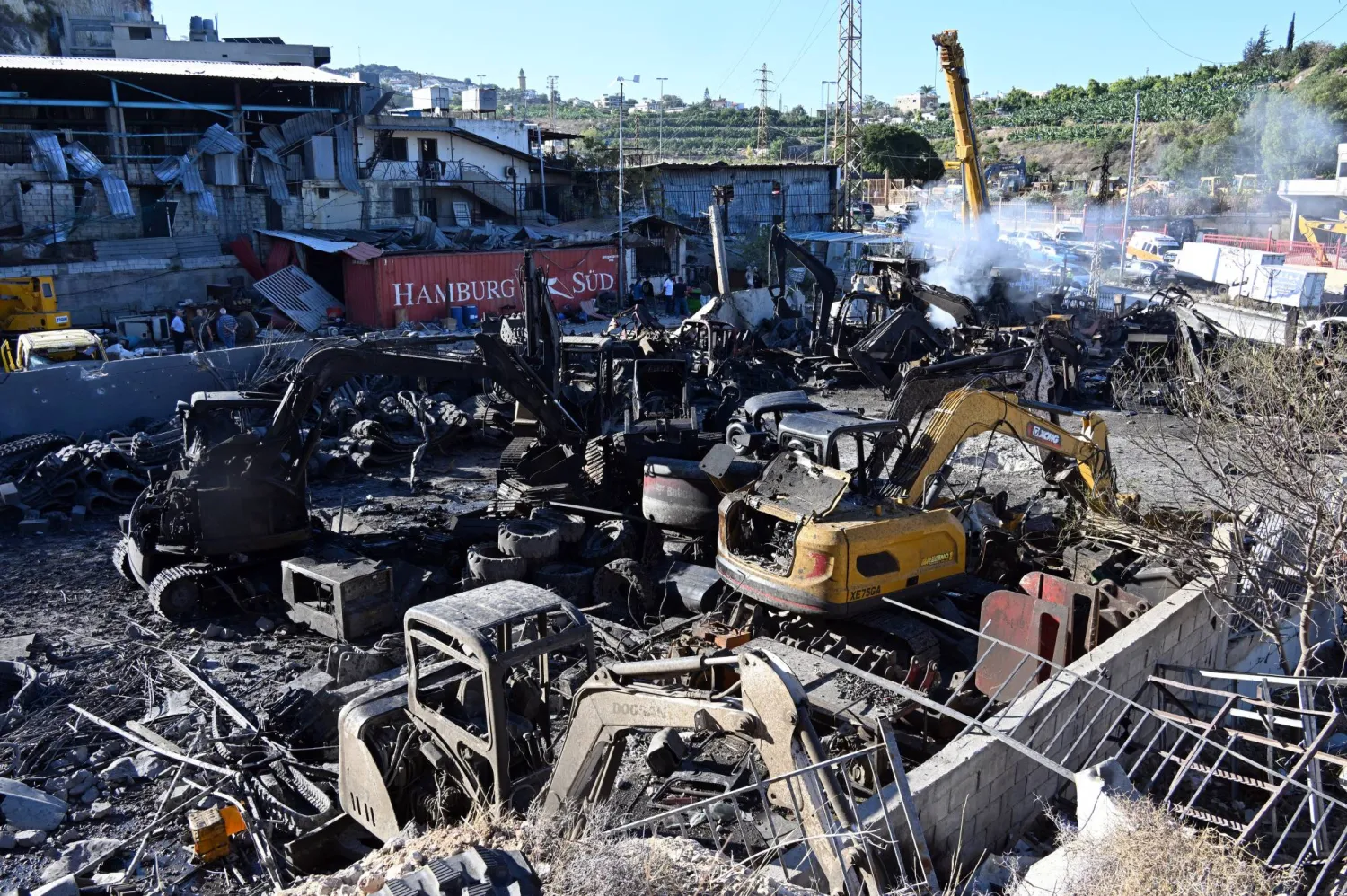

Lebanese political powers are in agreement that the Israeli strikes on the southern village of Msayleh was “a fiery message” to parliament Speaker Nabih Berri, who hours earlier had insisted that the government dedicate part of the 2026 budget to the reconstruction of southern regions destroyed in the Israeli war on Hezbollah.
The message was clear: “Reconstruction is forbidden, demonstrated by Israel’s destruction of over 300 vehicles used for reconstruction.”
Berri, who has a residence in Msayleh, told Asharq Al-Awsat that Israel had effectively intervened in the debate that he erupted between him and Prime Minister Nawaf Salam over the budget.
The speaker had criticized the government for omitting an article related to the reconstruction in next year's budget.
“Our insistence on reconstructing the destroyed villages and infrastructure is our response to Israel’s plan to turn by force border villages into a nearly uninhabitable weapons-free zone. Reconstruction is our top priority,” he stressed.
Berri turned to the United States as a sponsor – alongside France – of the ceasefire agreement. “Where is its credibility? Lebanon has fully committed to the ceasefire, while Israel continues to violate it while the international body dedicated to overseeing its implementation stands idly by,” he remarked.
The committee will meet on October 15. Berri wondered “why it was not intervening to stop Israel from carrying out its violations. What does it have to say about the United Nations Interim force in Lebanon (UNIFIL) statements that have repeatedly accused Israel of violating the ceasefire, in contrast to Hezbollah, which has not fired one shot since the ceasefire took effect in November?”
“Lebanon has been and continues to support a diplomatic solution to Israel’s occupation, but where is diplomacy?” he asked. Lebanon is committed to the implementation of UN Security Council resolution 1701, while Israel, in the absence of American pressure, continues to obstruct these efforts.
Moreover, Berri stated: “We were the first to welcome the end of the war on Gaza and to back US President Donald Trump’s peace plan. We were hoping that the end of the conflict would have also included southern Lebanon.”
“It turns out that Washington has the final say in matters and has the ability to pressure Israel should it decide that the plan must also include the South. Isn’t it time for Israel to withdraw from Lebanon? Why is Lebanon not allowed to enjoy stability? For how long will we be on the waiting list?” he went on to say.
“Israel’s message (from the Msayleh attack) has been received and we must reply to it through national unity that demands that we rise above trading accusations and stoking tensions. We must intensify our diplomatic efforts and do more than issue statements,” he stressed.
Lebanon has since filed a complaint to the Security Council over the attack.
“Israel's attack is aimed at making us kick off direct negotiations with it – something that is unanimously rejected by the Lebanese people,” Berri said, dismissing Israel’s claim that it targeted Hezbollah military infrastructure in Msayleh.
“It struck vehicles and equipment needed for reconstruction,” stressed Berri. “The attack will not deter us from our insistence on reconstructing our towns.”
Meanwhile, a political source told Asharq Al-Awsat that the message behind the attack went beyond reconstruction and sought to pressure Berri to in turn pressure Hezbollah to agree to the government’s decision to impose state monopoly over weapons.
Hezbollah’s possession of weapons does not enjoy Arab and international support, and it doesn’t even have the support of the majority of the Lebanese people, said the source. The Gaza plan does and so the situation in Lebanon cannot be compared to that in the Palestinian enclave.
Berri is required to “contain Hezbollah so that it does not stand as an obstacle in the state’s efforts to impose its authority throughout the country. Washington, meanwhile, is obligated to make Israel commit in full to the ceasefire,” it added.