
'We Have Peace in the Middle East,' Trump Tells Gaza Summit

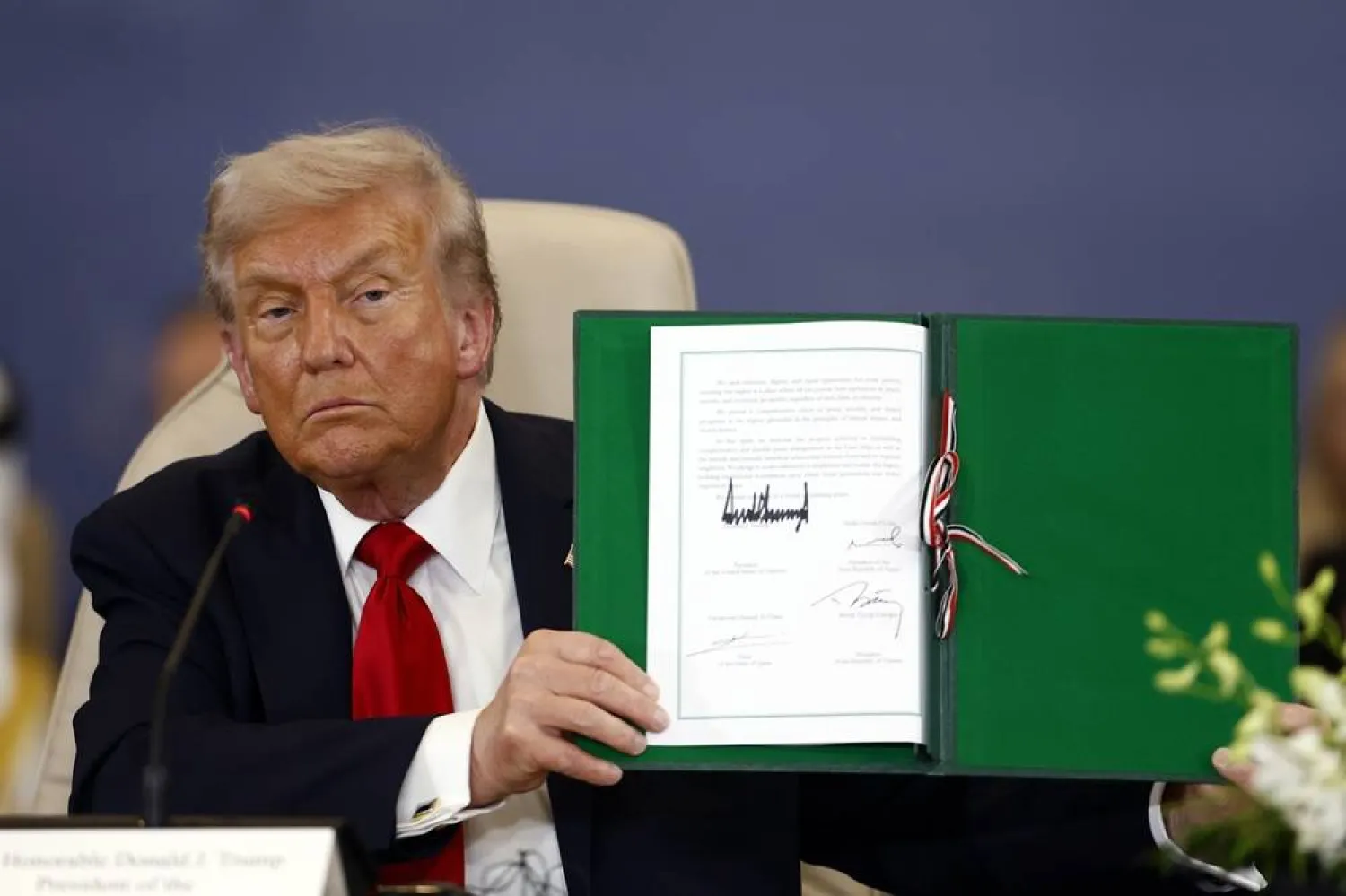
 President Donald Trump shows a signed document during the signature ceremony at the Gaza International Peace Summit, in Sharm el-Sheikh, Egypt, Monday, Oct.13 2025. (AP)
President Donald Trump shows a signed document during the signature ceremony at the Gaza International Peace Summit, in Sharm el-Sheikh, Egypt, Monday, Oct.13 2025. (AP)
TT

'We Have Peace in the Middle East,' Trump Tells Gaza Summit

 President Donald Trump shows a signed document during the signature ceremony at the Gaza International Peace Summit, in Sharm el-Sheikh, Egypt, Monday, Oct.13 2025. (AP)
President Donald Trump shows a signed document during the signature ceremony at the Gaza International Peace Summit, in Sharm el-Sheikh, Egypt, Monday, Oct.13 2025. (AP)

US President Donald Trump declared "peace in the Middle East" Monday after world leaders at a summit in Egypt signed a declaration as the guarantors of a Gaza deal aimed at ending two years of war.  

"Together we have achieved what everybody said was impossible. At long last, we have peace in the Middle East," Trump said in a speech to fellow leaders. 

"This is the day that people across the region and around the world have been working, striving, hoping and prayed for," he added. "They have done things over the last month that I think were really unthinkable. Nobody thought this could happen. With the historic agreement we've just signed, those prayers of millions have finally been answered."  

"A new and beautiful day is rising," he said. "And now, the rebuilding begins." 

The United States, Egypt, Qatar and Türkiye signed a declaration on Monday as the guarantors of a Gaza deal aimed at ending two years of war.  

"The document is going to spell out rules and regulations and lots of other things," Trump said before signing, repeating twice that "it's going to hold up". 

World leaders gathered Monday in Egypt for a summit aimed at supporting the ceasefire reached in Gaza, ending the Israel-Hamas war and developing a long-term vision to rebuild the devastated Palestinian territory.  

Addressing the summit, Egyptian President Abdel Fattah al-Sisi said Egypt was welcoming a "brave and peace-loving president" in Trump.  

He expressed his gratitude to "our partners the US, Türkiye and Qatar," hoping that the war on Gaza would be the final war in the Middle East.   

"The security of peoples cannot be achieved through military force alone," he went on to say, stressing that "peace remains our strategic choice."   

"The Palestinian people have the right to determine their fate and to live in freedom in a state that exists side by side with Israel," Sisi declared.   

"The rivals of today can become the partners of tomorrow," he said. "I tell the Israeli people, let this moment be the beginning of a just and lasting future."   

"Today’s agreement paves the way for a new Middle East," he added, revealing that Egypt will host a Gaza reconstruction summit.  

Israel and Hamas came under pressure from the US, Arab countries and Türkiye to agree on the ceasefire’s first phase negotiated in Qatar through mediators. The truce began Friday.  

But major questions remain over what happens next, raising the risk of a slide back into war. The gathering reflects the international will to follow through on the deal.  

More than 20 world leaders attended the summit, including King Abdullah of Jordan, Turkish President Recep Tayyip Erdogan, Qatar’s Emir Sheikh Tamim bin Hamad Al Thani, French President Emmanuel Macron and the British Prime Minister Keir Starmer.  

Israel and Hamas have no direct contacts and were not expected to attend. Israeli Prime Minister Benjamin Netanyahu did not travel to the meeting because of a Jewish holiday, his office said. Trump headed to Egypt after a stop in Israel.  

Israel has rejected any role in Gaza for the internationally backed Palestinian Authority, whose leader, Mahmoud Abbas, arrived in the Egyptian Red Sea resort town of Sharm el-Sheikh on Monday before the gathering.  

The summit unfolded soon after Hamas released 20 remaining living Israeli hostages and Israel started to free hundreds of Palestinians from its prisons, crucial steps under the ceasefire. 


26 Women, 4 Children Killed in Sudan RSF Drone Strike

FILE PHOTO: A collapsed mosque wall following a drone strike in Khartoum North, in Bahri city, Sudan, August 12, 2026. REUTERS/El Tayeb Siddig/File Photo
TT

26 Women, 4 Children Killed in Sudan RSF Drone Strike

FILE PHOTO: A collapsed mosque wall following a drone strike in Khartoum North, in Bahri city, Sudan, August 12, 2026. REUTERS/El Tayeb Siddig/File Photo

A drone strike launched by Sudan's Rapid Support Forces killed 26 women and four children on Friday near the southeastern border with Ethiopia, an official and eyewitnesses told AFP.

The latest front line in Sudan's war between the regular army and the RSF is the border region with Ethiopia, which is facing its own internal conflict that threatens to escalate into a regional war.

Since Sudan's war broke out in April 2023, it has killed more than 200,000 people, aid workers estimate, and created the world's largest hunger and displacement crises.

This year alone, nearly 100,000 people have been displaced across Blue Nile state, according to UN figures.

In a displacement camp in Blue Nile's Abu Shendi, survivors "buried 26 women and four children" from Friday's strike, one person involved in the burial told AFP.

The drone hit just outside the camp, near an informal gold mining site, where women earn a daily wage using chemicals and their bare hands to clear gold nuggets from clumps of earth men have extracted.

The victims included "young girls who work with their families in refining the gold", another eyewitness said.

The country's multi-billion-dollar gold trade, built mostly on makeshift operations like Abu Shendi's, fuels the war efforts of both sides.

Mahgoub al-Sheikh, the governor of Wad al-Mahi where the attack took place, said the drone was launched from "inside Ethiopia".

Sudan has repeatedly accused Ethiopia of harboring RSF fighters and bases within its territory.

Ethiopia has denied the accusations, though local sources say the porous border is a key supply line for the paramilitary and its allies.

Throughout this year, the RSF has pushed an offensive approaching state capital El-Damazin.

The advance could put the army in a bind, forcing it to defend territory on both the Blue Nile front and in the Kordofan region, where a year of deadly drone strikes has left the two sides in a stalemate.

The Sudan war, now in its fourth year, has evolved into an ever more sophisticated conflict using armed drones, enabling both sides to launch far-reaching attacks without sacrificing their fighters.

More than 1,100 people were killed by drone strikes during the first five months of this year alone, according to UN figures.

The conflict, which the UN calls a "war of atrocities", has visited a litany of horrors on civilians including ethnic massacres, famine and indiscriminate attacks on residential areas.


Operation ‘Dawn of Yemen’ Clears Bab al-Mandab and its Islands of Remaining Houthi Forces

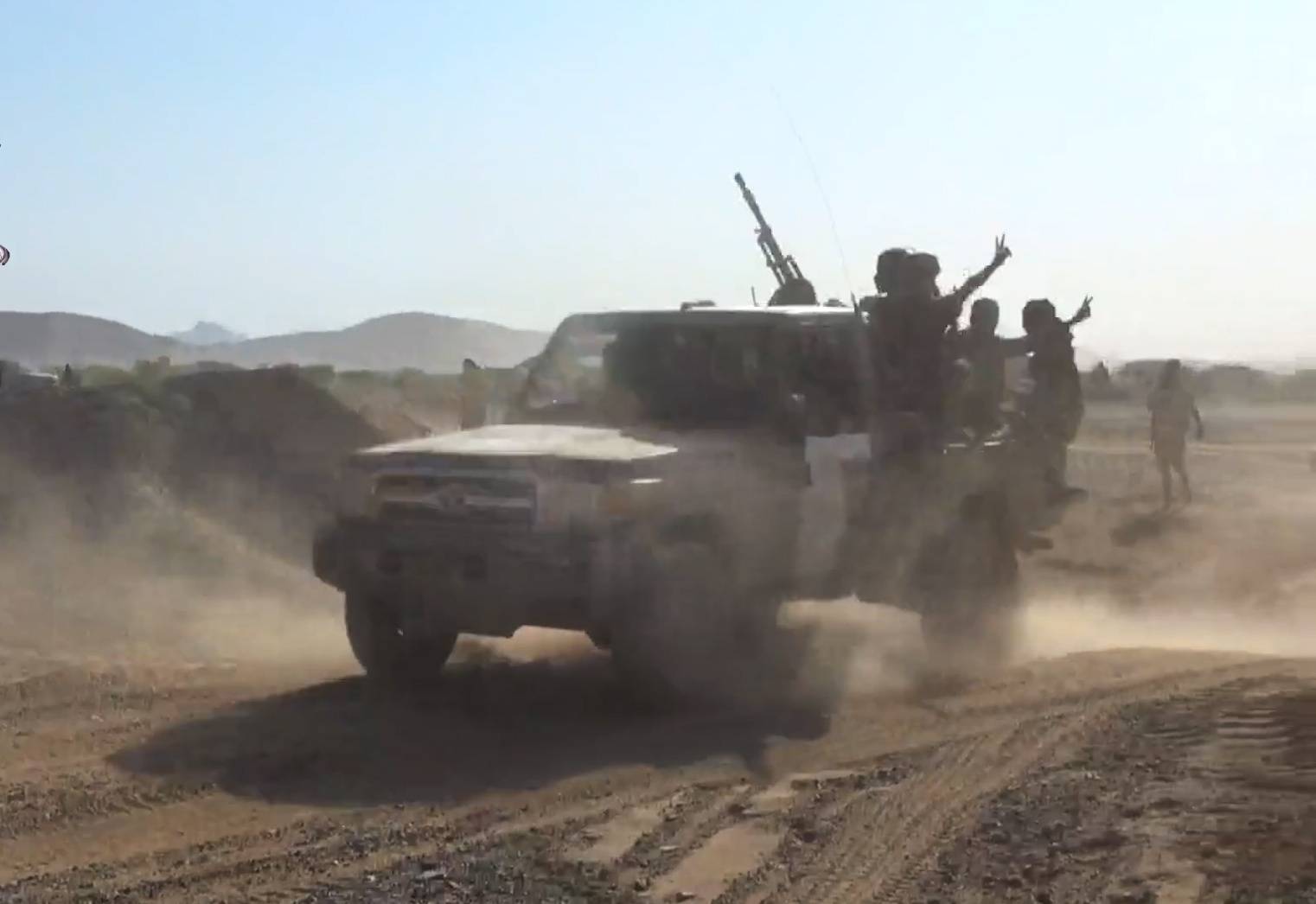
Members of Yemeni government forces during confrontations with the Houthis (AP)
TT

Operation ‘Dawn of Yemen’ Clears Bab al-Mandab and its Islands of Remaining Houthi Forces

Members of Yemeni government forces during confrontations with the Houthis (AP)

The military operation “Dawn of Yemen” entered its fifth day on Friday, as government forces completed the clearing of the Bab al-Mandab Strait and the strategic Mayyun Island, while consolidating their positions on the highlands overlooking the international shipping route.

The development strengthens government gains along the western coast, even as fighting continues in the southern and western countryside of Taiz, alongside an expanding aerial campaign targeting Houthi militia positions and movements across several parts of the country.

Military sources said that the Giants Brigades and Nation Shield Forces, backed by air support from the coalition supporting Yemen’s internationally-recognized government, had established full control over Bab al-Mandab, the Al-Ardi military camp, coast guard observation posts, Mayyun Island, and the mountain ranges surrounding the strait, including positions overlooking the vital maritime corridor.

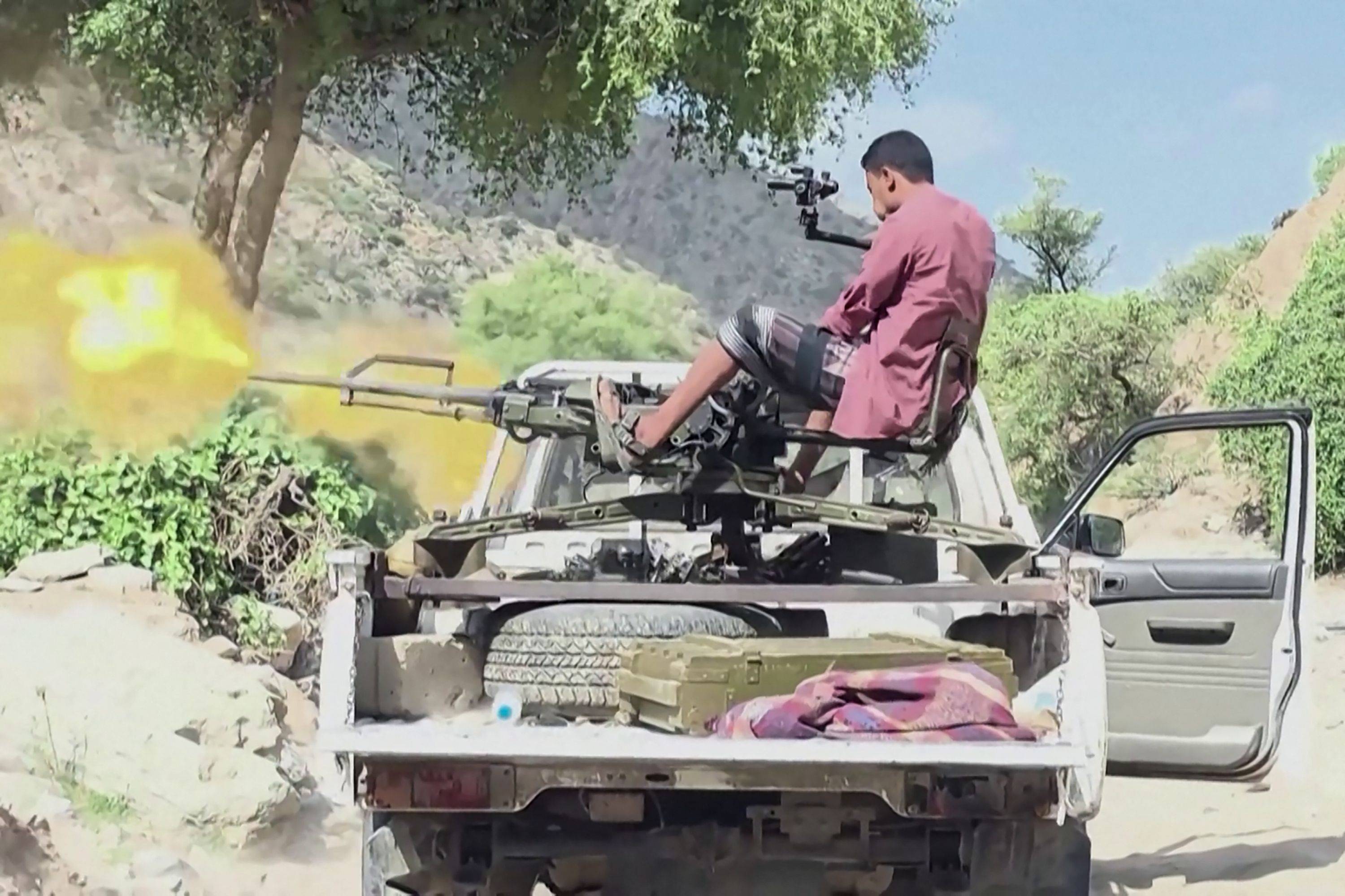
Yemeni government forces advance in Al-Wazi'iyah and push to complete the cleansing of Bab al-Mandab (EPA)

According to the sources, government forces carried out a surprise maneuver that bypassed the Houthis’ frontline defenses and reached their newly established trenches and tunnels. The clashes reportedly resulted in dozens of Houthi fighters being killed, while others surrendered.

If the announced control is maintained, securing the strait and Mayyun Island would mark a significant turning point in operations along the western coast, given the area’s strategic location at the southern entrance to the Red Sea and its importance to international navigation.

The latest developments follow the government forces’ announcement that they had seized the Kahboub Heights, which overlook vast areas surrounding Bab al-Mandab.

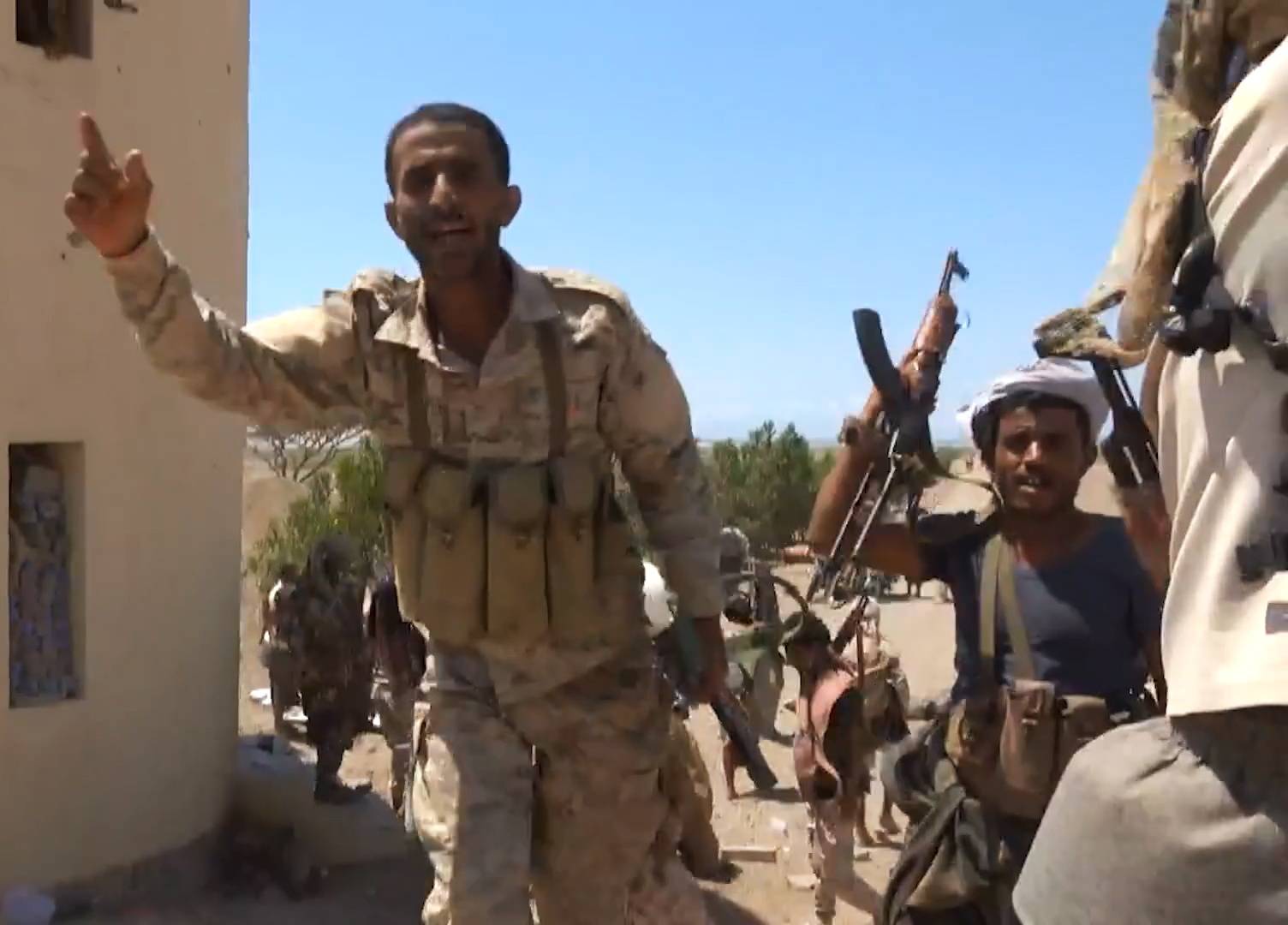
A member of Yemeni government forces on the southern Taiz fronts (AFP)

Advance Toward Al-Wazi’iyah

After consolidating their new positions, Yemeni government forces continued operations on the Al-Wazi’iyah front west of Taiz, aiming to secure the district’s eastern highlands and tighten the encirclement of Houthi positions around Dhubab and Al-Omari Camp, paving the way for a broader advance toward Mokha, according to field reports.

The operations were accompanied by airstrikes targeting Houthi military sites and movements in Al-Wazi’iyah, Al-Shamayatayn, and Jabal Habashi, as well as positions in Sharjab, Al-Turbah, and Jabal Qaham, which overlooks the districts of Al-Maqatirah and Al-Ahkoum along the border between Taiz and Lahj.

Field sources reported that Houthi vehicles and reinforcements were targeted in the Al-Haql and Al-Qahaf areas of Jabal Habashi district. Meanwhile, the media center of the government’s Taiz Military Axis stated that one airstrike neutralized or wounded 23 Houthi fighters. Additional strikes hit positions in the Numan Mountains, Al-Saybara, Al-Harthah, and Jardad in Al-Shamayatayn district.

On the other hand, Houthi forces continue to pressure rural areas south and west of Taiz in an effort to retain their positions. Local sources reported that the group had taken control of Al-Mahsha, Al-Adaf, and Al-Armah in Jabal Habashi district on the western front and was advancing toward the Al-Shariq area. A schoolteacher was reportedly killed in Al-Mahsha.

Fighters from the Giants Brigades on the Bab al-Mandab front (EPA)

1,729 Military Strikes

In a sign of the widening scope of military operations, Colonel Majed Al-Nuzaili, spokesman for the Yemeni Armed Forces, announced on Thursday that 1,729 precision strikes had been carried out against Houthi military targets across various fronts as part of Operation Dawn of Yemen.

Al-Nuzaili said the operations resulted in the neutralization of 1,370 Houthi fighters and the destruction or disabling of 300 military vehicles and pieces of equipment, in addition to strikes against military positions, observation posts, command-and-control centers, weapons depots, supply lines, and reinforcements.

At the same time, airstrikes expanded into eight governorates: Taiz, Ibb, Al-Bayda, Abyan, Saada, Sanaa, Raymah, and Al-Hodeidah, according to local reports. Targets included sites in the Houthi-held capital Sanaa, a Houthi camp in Yarim in Ibb, positions in Al-Siyani district, sites in Bani Matar west of Sanaa, locations in Kismah district in Raymah governorate, and positions in the Jamil, Jarjarah, and Al-Nasreen mountain areas of Al-Bayda. Other strikes targeted Tharah Pass and locations in Al-Hodeidah and Saada.

In Lahj, government forces announced that they had repelled a Houthi attack targeting the areas of Al-Aghbarah, Al-Muhawalah, and Al-Mashamirah northwest of Al-Mudarabah district, and had regained positions on Jabal Saif with the support of tribal reinforcements. Meanwhile, clashes, reciprocal shelling, and drone operations continued on the fronts south of Marib and in Al-Jawf, while airstrikes targeted Mas Camp and positions in the Al-Labanat area.


Palestinians Set to Delay Legislative Elections Due to Worsening Conditions, Letter Says

Palestinian vice president Hussein al-Sheikh attends a meeting with ambassadors in Ramallah, in the occupied West Bank, on February 10, 2026. ZAIN JAAFAR/Pool via REUTERS
TT

Palestinians Set to Delay Legislative Elections Due to Worsening Conditions, Letter Says

Palestinian vice president Hussein al-Sheikh attends a meeting with ambassadors in Ramallah, in the occupied West Bank, on February 10, 2026. ZAIN JAAFAR/Pool via REUTERS

Palestinian Vice President Hussein Al Sheikh has informed France that a Palestinian legislative election planned for November 28 will be postponed for several months because of worsening ‌conditions throughout the ‌Palestinian territories, ‌according ⁠to a letter ⁠seen by Reuters.

"The assessment concluded that the anticipated political, security and economic conditions, on which ⁠the scheduling of ‌the legislative ‌elections for 28 ‌November 2026 was ‌based, have not materialized," said according to the letter, which was ‌addressed to French Foreign Minister Jean-Noel Barrot ⁠and ⁠dated October 8.

It added that "holding them under the current circumstances faces fundamental obstacles affecting their inclusiveness, freedom of participation, and the integrity of the electoral process."