

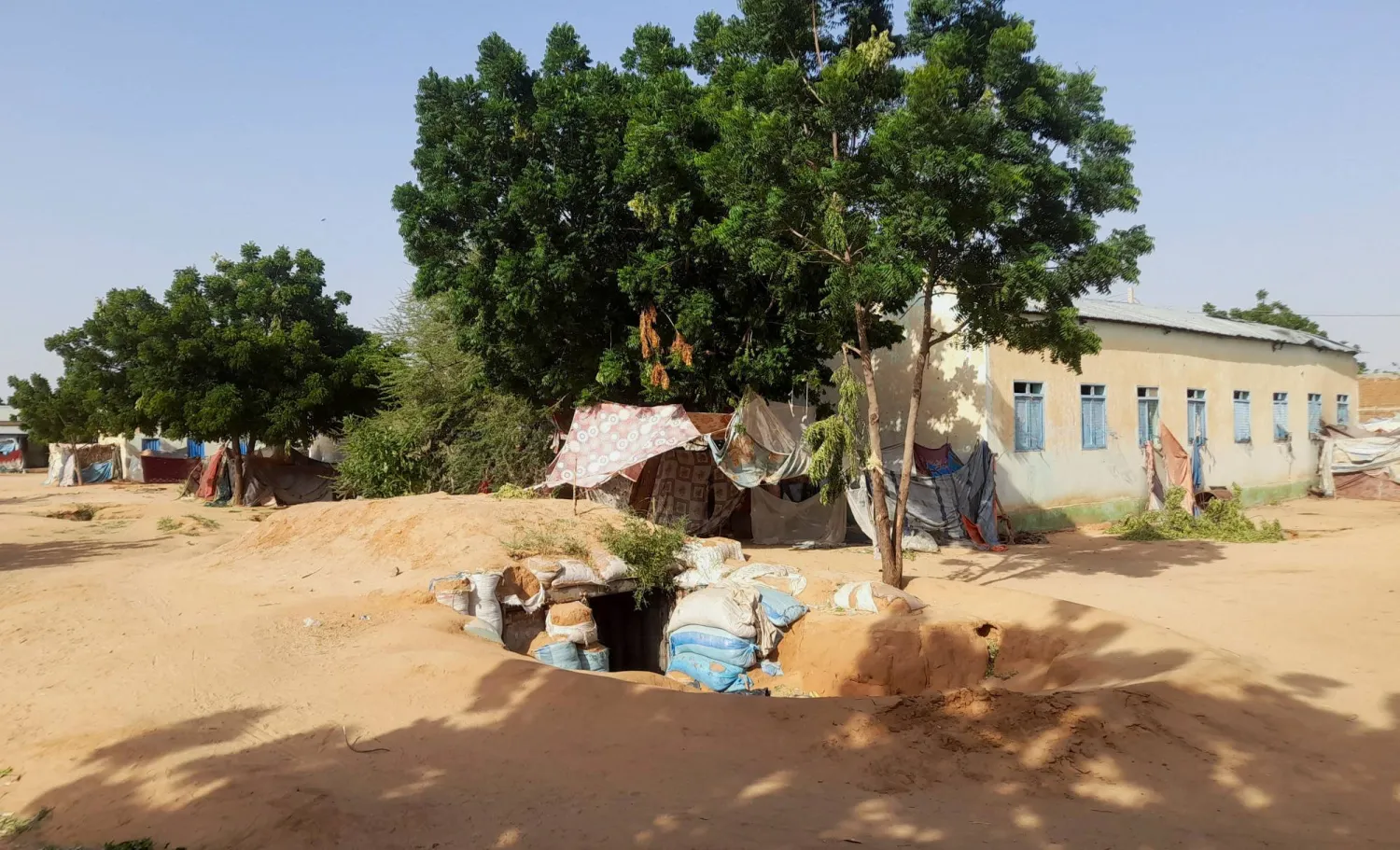

Drone Attack Strikes Sudan Capital 

A shelter where displaced people protect themselves from the shelling in El-Fasher, Sudan, October 7, 2025. (Reuters)
TT

Drone Attack Strikes Sudan Capital 

A shelter where displaced people protect themselves from the shelling in El-Fasher, Sudan, October 7, 2025. (Reuters)

A series of drone attacks targeted the Sudanese capital Khartoum for multiple hours on Wednesday, eyewitnesses and an army source told AFP.

A military official said the army had shot down "most of the drones", which targeted two army bases in the capital's northwest.

Sudan's army has been at war since April 2023 with the paramilitary Rapid Support Forces, who have regularly attacked army positions using drones.

The war has killed tens of thousands of people and created the world's largest hunger and displacement crises.

The capital has been mostly calm since the army regained control earlier this year, with fighting for territory now concentrated in the country's south and west.

But the RSF has been repeatedly accused of carrying out long-range drone attacks on military and civilian infrastructure.

Eyewitnesses in Omdurman, part of greater Khartoum, said they saw drones flying over the city and heard "loud explosions coming from the north" throughout the night on Wednesday.

It was the second day in a row drone strikes targeted the capital, according to the Sudan Shield Forces.

The armed group, an ally of the army, said two of its members were killed on Tuesday by a drone in the East Nile district of Khartoum.

The Sudan Shield Forces are commanded by Abu Aqla Kaykal, who last year defected from the RSF to the army, helping pave the way for the military's gains. His forces have been accused of atrocities on both sides.

Following the army's offensive and recapture of Khartoum, over 800,000 people have returned to their homes.

The army-backed government has launched a vast reconstruction program and is looking to move its officials back from the wartime capital of Port Sudan.

Vast swathes of Khartoum are still devastated and lack reliable access to services, with millions of people regularly experiencing blackouts as a result of the RSF's long-range drone attacks.

The paramilitary's fiercest attacks are in the western region of Darfur, where RSF fighters have surrounded and attempted to seize the city of El-Fasher for close to 18 months.

If it succeeds, the RSF will control all of Darfur and, with its allies, parts of Sudan's south, while the army holds the center, east and north.

El-Fasher is Darfur's last major city to elude the RSF's grasp, and has become the war's most important strategic front.

The UN says over 400,000 civilians are trapped in the city, where mass starvation has taken hold and daily attacks rip through mosques and hospitals.

The RSF has attacked multiple famine-hit displacement camps, and the UN has warned of mass ethnic killing.



Al-Alimi: Bab Al-Mandab Should Not Become Another Strait of Hormuz

Yemeni Presidential Leadership Council Chairman Rashad Al-Alimi (Saba)
TT

Al-Alimi: Bab Al-Mandab Should Not Become Another Strait of Hormuz

Yemeni Presidential Leadership Council Chairman Rashad Al-Alimi (Saba)

Head of Yemen’s Presidential Leadership Council (PLC) Dr. Rashad Al-Alimi has stressed that Bab Al-Mandab must not be allowed to become another Strait of Hormuz, nor should Yemen be turned into a platform for geopolitical blackmail on behalf of Tehran.

Alimi met on Thursday with Head of the European Union Delegation Patrick Simonnet and Ambassador of the Netherlands Janet Sebben. They discussed areas of bilateral cooperation, as well as the latest local and regional developments.

He affirmed the state would continue to fulfill the aspirations of the Yemeni people. “It would continue to assume its responsibility to protect its citizens, restore its institutions, extend its authority throughout the national territory, and safeguard its coastline, ports, and territorial waters,” Alimi said.

Al-Alimi stressed that Yemen, as it defends Bab Al-Mandab, its coastline, and territorial waters and makes sacrifices to protect them, is defending not only its own security and sovereignty, but also contributing to international security and protecting global interests.

He said Yemen is helping to secure one of the world’s most important maritime routes for trade, energy supplies, and life-saving food commodities.

He stressed that this shared responsibility requires a more effective international partnership to support the Yemeni state and strengthen its ability to protect this strategic maritime route.

The President pointed to the clear link between this escalation and Iran’s broader strategy of shifting the cost of international pressure on Iran onto others. This is done by targeting neighboring countries, threatening energy facilities, and disrupting the Red Sea and supply chains, thereby turning Iran’s crisis with the international community into a crisis for the region and the global economy.

He stressed that Bab Al-Mandab must not be allowed to become another Strait of Hormuz, nor should Yemen be turned into a platform for geopolitical blackmail on behalf of the Iranian regime.

Al-Alimi affirmed that the government did not initiate this round of the war. Rather, the militias chose to resume the escalation by operating unauthorized flights and attacking civilians, displacement camps, the Port of Mocha, and civilian facilities in an attempt to impose new military realities on the ground.

“Therefore, we do not want international discourse to return to the same traditional equation of calling on both sides to exercise restraint, as if responsibility were equally shared,” he said. “The party that initiated the escalation must be identified, and those who launch attacks must hold responsibility for the escalation and its consequences at all levels,” he added.

Al-Alimi called for urgent European action, in coordination with the United Nations and donors, to provide shelter, food, healthcare, and other essential services to displaced persons, and to support local authorities. He warned against leaving thousands of Yemenis facing a new wave of displacement while the international community confines itself to statements of concern.

He also renewed his call to move from managing the threat to addressing its source. This requires the effective implementation of relevant UN Security Council resolutions and tighter measures to prevent the smuggling of weapons, technology, and dual-use components to the militias.

Al-Alimi urged EU member states to maintain their economic, humanitarian, and development support for the government and to encourage donors to support the reform and recovery program. He said this would strengthen state institutions’ capacity to provide services and meet their obligations.

He said a capable state is the real guarantee for peace. He stressed that peace based on state weakness, while militias retain their weapons and decision-making power over war, would amount to nothing more than a truce until the next round of fighting.


Mansouri Destruction Tests Limits of Southern Lebanon’s ‘Yellow Line’

Smoke rises from the site of an Israeli strike on the southern Lebanese village of Mansouri on Sept. 9, 2026 (AFP)
TT

Mansouri Destruction Tests Limits of Southern Lebanon’s ‘Yellow Line’

Smoke rises from the site of an Israeli strike on the southern Lebanese village of Mansouri on Sept. 9, 2026 (AFP)

Israel has stepped up demolitions, explosions and bulldozing in the coastal town of Mansouri, south of Tyre, making it one of the hardest-hit areas in southern Lebanon in recent days.

The intensity of the destruction has raised questions over why Israel is focusing on the town — and whether it is targeting specific military installations or pursuing a broader aim:

reshaping the terrain to control Mansouri by fire without fully occupying it.

A documented tally of Israeli attacks over the past seven days shows a sharp surge in explosions inside the town. More than 75 were recorded between Sept. 3 and midday Thursday, alongside airstrikes and repeated artillery shelling.

The campaign peaked on Wednesday, with dozens of explosions in a single day. Another 12 were recorded on Thursday morning. The figures are a minimum estimate, with further explosions reported but not precisely counted.

According to available information, Israeli forces have recently adopted a method of demolishing homes and residential neighborhoods remotely. Drones drop barrels packed with powerful explosives onto rooftops before detonating them.

A similar tactic was recorded in Bani Hayyan, where a drone dropped explosives onto homes before they were blown up.

Mansouri is strategically important because it lies along the coastal route and close to several positions occupied by Israeli forces. The mounting destruction suggests Israel’s actions go beyond daily military operations, raising questions about the military reality it is seeking to impose in the town and its surroundings.

Reshaping the terrain

Retired Brig. Gen. Hassan Jouni links Israel’s focus on Mansouri to the area’s geography. But he says the presence of Hezbollah infrastructure alone does not explain the scale of the destruction.

“This is linked to Mansouri’s geography and its geographical extent,” Jouni told Asharq Al-Awsat. “The area forms a corridor that Hezbollah historically used extensively in its operations.

My assessment is that infrastructure exists there.”

“The terrain, dense woodland and a long corridor stretching from north of Tyre to the border made the area particularly useful to Hezbollah,” he said.

“It is likely to contain extensive and varied infrastructure, especially given its proximity to the border. During the fighting, reports spoke of drones and rockets being launched from this area.”

But Jouni stressed that this “does not mean every explosion carried out by Israel is targeting such infrastructure.”

“Israel is reshaping the geography and altering the terrain to create a military landscape better suited to its army,” he said.

“The natural geography is being changed to make surveillance, observation and monitoring easier for the Israeli army. What we are seeing is more an effort to reshape the geography than simply to target infrastructure in Mansouri.”

Jouni said the same logic applied to the destruction of buildings.

“Some homes stand at commanding, elevated locations that overlook the surrounding area,” he said.

“They are being destroyed because of the importance of their position — not necessarily because they contain infrastructure or ammunition, or because they belong to Hezbollah or its members. Some are destroyed solely because of where they stand.”

Jouni described Mansouri as a “pivotal target” for Israel because it “lies between Israeli army positions in the western sector and the city of Tyre.”

A shifting operational zone

Jouni said the “yellow line” should not be understood as a fixed boundary on the ground.

“The yellow line being discussed cannot be drawn as a line on the ground,” he said. “It is a series of operational zones extending in the west from the vicinity of Mansouri and Majdal Zoun, moving north toward Haddatha and then east to the vicinity of Ali al-Taher.”

“There is no yellow line like the one in Gaza, marked by signs or concrete blocks,” he added.

“Here, we are talking about a fluid, dynamic operational zone. It has been called the yellow line, but in practice, it is not fixed.”

Jouni said the limits of the Israeli army’s presence in southern Lebanon were defined not by a fixed line, but by shifting operations.

In Israeli calculations, he said, Mansouri is “a vital central target separating the city of Tyre from Israeli army positions along the southern border or in the buffer zones.”

“Israel views Mansouri strategically,” he said. “It is treating the town as a barrier village — and seeking to remove that barrier.”

Control by fire

Retired Brig. Gen. Saeed Qazah said Israel appeared to be trying to strip Mansouri of cover and control it from surrounding positions, rather than occupy it and station troops inside.

“Mansouri appears to contain many Hezbollah installations and infrastructure sites,” Qazah told Asharq Al-Awsat. “I do not know whether Hezbollah members are still able to infiltrate or move through them, but that may be one reason the Israelis are targeting the town so heavily.”

“They appear to be trying to destroy Mansouri — its infrastructure and its buildings — to leave it exposed without having to occupy it physically,” he said.

“They can control it by fire from Majdal Zoun, Bayyada and Shamaa. Once the buildings are destroyed and the area is exposed, they can detect any movement inside and respond.”

Qazah said the scale of destruction did not necessarily mean Israel was preparing to occupy the town.

“Mansouri lies on the edge of what has been declared the yellow line,” he said. “It is close to Majdal Zoun, Bayyada and Shamaa, while Majdal Zoun stands on higher ground overlooking it.”

“The Israelis enter, plant explosives and destroy infrastructure and homes to turn the area into exposed, scorched ground.”

Qazah said Israel appeared to want Mansouri cleared and exposed, allowing it to monitor the town from surrounding hills and positions.

“They would then be able to use firepower against any armed movement inside without having to station forces in the heart of the town, as long as they can control it by fire,” he said.

Qazah said Majdal Zoun lies southeast of Mansouri, while Bayyada and Shamaa lie to the south, alongside the Buyout al-Sayyad area. Their terrain and elevation, he said, allow Israel to monitor the town and its surroundings.

“Mansouri is tied to this coastal route,” Qazah said.

“It appears to contain many installations that are being entered and destroyed, while homes are also being demolished to leave the area devastated and completely exposed, allowing any potential movement inside it to be detected.

“This is particularly important because any movement from Mansouri could head toward Majdal Zoun or areas where Israeli forces are deployed.”


Algeria Severs Ties with UAE as Abu Dhabi Says it Is Committed to Joint Interests

Algerian President Abdelmadjid Tebboune. (Algerian Presidency)
TT

Algeria Severs Ties with UAE as Abu Dhabi Says it Is Committed to Joint Interests

Algerian President Abdelmadjid Tebboune. (Algerian Presidency)

Algeria abruptly severed diplomatic relations with the United Arab Emirates on Thursday, giving it ambassador 48 hours to leave the country. 

"The Ministry of ‌Foreign Affairs (MoFA) affirms ‌the UAE’s appreciation for the brotherly Algerian people and its pride ‌in the ⁠bonds that unite ⁠the two peoples, particularly through the Algerian community residing in the UAE and Algerian visitors," the ministry said. 

The UAE ambassador was summoned to Algeria's foreign ministry, informed of the decision and given 48 hours to comply, the ministry said. 

It said the UAE's actions had reached a point where they could no longer be considered acceptable or tolerable and that it had "exhausted all means of preserving bilateral relations." 

The Algerian foreign ministry said it had warned Abu Dhabi several times but the UAE "persisted in its actions, reaching a point where they could no longer be considered acceptable or tolerable". 

"Algeria spared no effort to draw the Emirati side's attention to, and to warn it against, the dire consequences that could result from its regrettable and unjustified conduct," the ministry said. 

The UAE hoped Algeria's decision to cut diplomatic ties would be temporary, its foreign ministry said in a statement later in the day, adding that Abu Dhabi remained committed to preserving ties between the two countries' peoples and shared interests. 

Algeria said Thursday it was also closing its airspace to Emirati-registered civilian and military aircraft. 

The Algerian defense ministry said the airspace ban would go into effect Friday, with the exception of commercial flights to and from Algiers airport, which would continue until the end of 2026. 

Anwar Gargash, diplomatic adviser to the UAE president, said on X that diplomatic relations should be based on "rationality, communication and clarity of interests", rather than "riddles and signals that require decoding". 

Gargash, who did not explicitly mention Algeria ⁠or link his comments to its decision, said successful diplomacy depended on clear ‌positions and the effective management of interests and disagreements. 

In wake of Algiers’ position, the Emirati Foreign Ministry said: "The UAE reaffirms the importance it attaches to its relations with all countries and its commitment to developing and strengthening them to serve shared interests and promote understanding, cooperation and prosperity. 

"The UAE expresses hope that this decision will be temporary, in a manner that preserves the fraternal ties between the two brotherly peoples." 

"Furthermore, the Ministry of Foreign Affairs (MoFA) reaffirmed the UAE’s deep appreciation for the brotherly Algerian people and its pride in the strong ties connecting the two nations, particularly through the Algerian community residing in the UAE and Algerian visitors. The UAE remains committed to safeguarding and further strengthening these longstanding ties and mutual interests," it added. 

Algerian President Abdelmadjid Tebboune has often referred to the UAE as a "micro-state" or "statelet" seeking to destabilize several countries in the region, citing Libya, Mali and Sudan. 

Disagreements between Algeria and the UAE had deepened since Tebboune's first presidential term in 2020, particularly following the UAE's joining of the Abraham Accords and its normalization of relations with Israel. 

When Tebboune was asked about that step, he said that he does not favor "this rush" toward normalization. 

Algerian media outlets close to the authorities accuse the UAE of interfering in Algeria's internal affairs and in neighboring countries, especially in Libya and the African Sahel region. 

The newspaper El Khabar had published a headline on its front page last July 19, which read: "Towards cutting diplomatic relations with the UAE." 

Last year, Algerian state television denounced what it called a hostile media campaign after a UAE-based broadcaster aired an interview with historian Mohamed Amine Belghit, in which he described the Amazigh language as a "Zionist-French project." 

Belghit was sentenced to five years in prison on charges of harming state symbols following his statements regarding Amazigh, which is a national language in Algeria, before benefiting from a presidential pardon at the end of 2025. 

In February, Algeria began the process of cancelling an air services agreement with the UAE that was signed in Abu Dhabi in May 2013.