6 Injured as Israel Carries Out Series of Airstrikes in South Lebanon

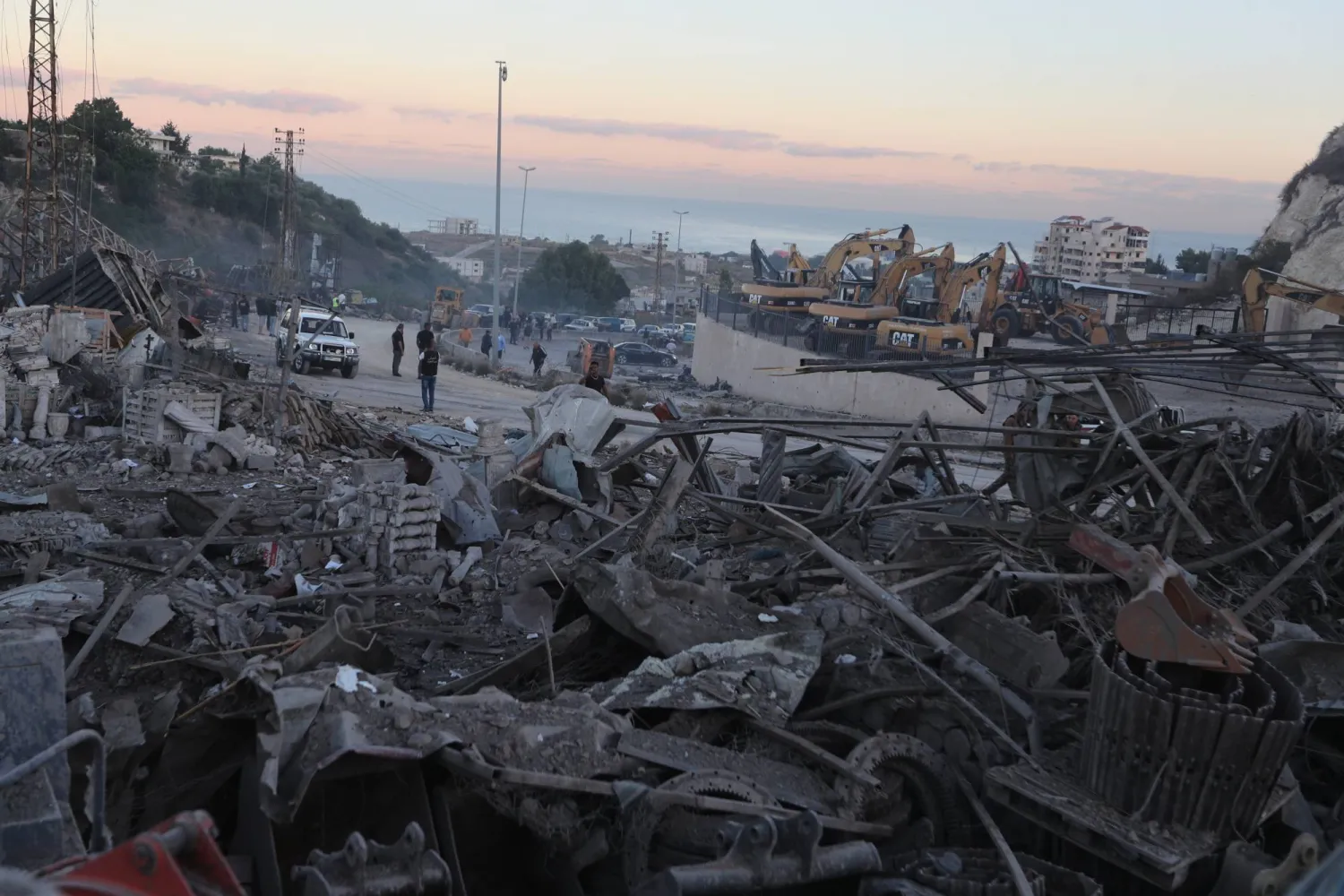
People gather at a site that sold heavy machinery, where a large number of vehicles were destroyed in Israeli airstrikes, in the southern village of Msayleh, Lebanon, Saturday, Oct. 11, 2025. (AP Photo/Mohammed Zaatari)
TT

6 Injured as Israel Carries Out Series of Airstrikes in South Lebanon

People gather at a site that sold heavy machinery, where a large number of vehicles were destroyed in Israeli airstrikes, in the southern village of Msayleh, Lebanon, Saturday, Oct. 11, 2025. (AP Photo/Mohammed Zaatari)

Israeli airstrikes have targeted a cement plant and quarry and a site belonging to an environmental group that Israel accused of being affiliated with Lebanon’s Hezbollah, injuring six people.

The Israeli army said in a statement on Thursday that Hezbollah was using the quarry “with the aim of rebuilding terrorist facilities and infrastructure.”

A few days earlier, Israel had struck several lots storing bulldozers and excavators in the southern town of Msayleh, also claiming that the equipment was intended for use by Hezbollah.

The Israeli military said the environmental group it targeted, Green Without Borders, “was used by Hezbollah to conceal terrorist activities aimed at rebuilding the organization’s infrastructure.”

Lebanon’s health ministry said that six people were injured in Thursday’s strikes in the towns of Bnaafoul and Ansar.

The strikes sparked massive explosions that could be seen and heard in areas far from the targeted site, “causing tremors that sparked panic and tension among citizens,” the state-run National News Agency reported.


Hospital Officials in Gaza Receive Bodies of 15 Palestinians Returned from Israel

A Palestinian man sits on the rubble of a destroyed building in Jabalia, in the northern Gaza Strip, on November 7, 2025. (Photo by Omar AL-QATTAA / AFP)
TT

Hospital Officials in Gaza Receive Bodies of 15 Palestinians Returned from Israel

A Palestinian man sits on the rubble of a destroyed building in Jabalia, in the northern Gaza Strip, on November 7, 2025. (Photo by Omar AL-QATTAA / AFP)

Hospital officials in Gaza said on Saturday that they have received the bodies of 15 Palestinians returned from Israel under the terms of the US-brokered ceasefire agreement.

The bodies arrived at Nasser Hospital in Khan Younis, the officials said.

It followed the return by Palestinian militants of a body of an Israeli hostage the previous day.

Israel identified the latest body returned from Gaza by Hamas and Islamic Jihad as Israeli-Argentinian hostage Lior Rudaeff, the Israeli army said Saturday.

As part of the deal, Israel has returned the remains of 15 Palestinians for each Israeli hostage.

Under the October ceasefire deal Hamas turned over all 20 living hostages still held in Gaza since the group's 2023 attack on Israel, in return for nearly 2,000 Palestinian convicts and wartime detainees held in Israel.

The ceasefire agreement also included the return of remains of 28 deceased hostages in exchange for remains of 360 militants.


Israel Identifies Latest Returned Body as Israeli-Argentinian Hostage

This undated photo provided by the Hostages and Missing Families Forum shows Israeli hostage Lior Rudaeff, whose body was returned to Israel after being held in Gaza by Palestinian militants. (Hostage's Family Forum via AP)
TT

Israel Identifies Latest Returned Body as Israeli-Argentinian Hostage

This undated photo provided by the Hostages and Missing Families Forum shows Israeli hostage Lior Rudaeff, whose body was returned to Israel after being held in Gaza by Palestinian militants. (Hostage's Family Forum via AP)

Israel has identified the latest body returned from Gaza by Hamas and Islamic Jihad as Israeli-Argentinian hostage Lior Rudaeff, the Israeli army said Saturday.

"Following the completion of the identification process by the National Institute of Forensic Medicine... IDF (military) representatives informed the family of Lior Rudaeff that he had been returned for burial," the military said in a statement.

Rudaeff, 61, was killed in Nir Yitzhak kibbutz while trying to protect his community with four other residents on October 7, 2023 during the Hamas attack on Israel that triggered the Gaza war, and his body was taken to the Palestinian territory that day.

Under the October ceasefire deal Hamas turned over all 20 living hostages still held in Gaza since the group's 2023 attack on Israel, in return for nearly 2,000 Palestinian convicts and wartime detainees held in Israel.

The ceasefire agreement also included the return of remains of 28 deceased hostages in exchange for remains of 360 militants.

Including Rudaeff, 23 hostage bodies have been returned in exchange for 285 bodies of Palestinians, though not all have been identified, according to Gaza's health authorities.


Lebanon Reaffirms Negotiations as Path to Resolve Dispute with Israel

President Joseph Aoun between Prime Minister Nawaf Salam and Speaker Nabih Berri (Lebanese Presidency file photo)
TT

Lebanon Reaffirms Negotiations as Path to Resolve Dispute with Israel

President Joseph Aoun between Prime Minister Nawaf Salam and Speaker Nabih Berri (Lebanese Presidency file photo)

Senior Lebanese officials reaffirmed their commitment to negotiations with Israel through the international committee tasked with overseeing the November 2024 ceasefire agreement, known as the ceasefire monitoring mechanism, following Hezbollah’s statement on Thursday in which the group told them it rejects any form of political negotiation.

Communication between Lebanon and Israel is limited to a United Nations-backed monitoring mechanism involving France and the US. The two sides meet separately under UN auspices but do not engage in direct talks.

Berri: No to normalization

While President Joseph Aoun underscored Lebanon’s adherence to this mechanism, Parliament Speaker Nabih Berri said there is no alternative to it. Prime Minister Nawaf Salam responded to Hezbollah by saying that decisions of war and peace rest solely with the state.

Berri told Asharq Al Awsat that normalization with Israel is out of the question.

“Anyone calling for normalization should know it is impossible,” he said.

“I remain firm in my position on the mechanism, which brings together all parties, Lebanon, Israel, the United States, France and the United Nations. There is no objection to bringing in civilian specialists when needed, as happened during the demarcation of the Blue Line in 2000, when geological and mapping experts were involved.”

Berri added that Israel’s threats and airstrikes will not alter Lebanon’s stance.

On the electoral law, Berri said he has not yet received the draft. Once it reaches him, he will decide his position. The government had approved a draft law scrapping the six seats allocated to expatriates and allowing overseas voters to cast ballots in their place of residence, according to their electoral registration. Berri and Hezbollah oppose the changes.

Berri has insisted on implementing the current parliamentary election law, saying it remains technically and legally viable. He also questioned why some political actors are backtracking on previous positions “for maneuvers we all know are futile.” He said: “This law was once described by George Adwan (Lebanese Forces deputy leader) as his own. So what was valid in past elections is suddenly not valid today?”

Aoun: We are committed to the November agreement

The President reaffirmed “Lebanon’s commitment to the cessation of hostilities agreement reached in November 2024 under US and French sponsorship.”

Speaking during a meeting with a World Bank delegation, he said Israel had not complied.

“According to this deal, Israel was supposed to withdraw completely and fully from the South sixty days after the agreement, but it still occupies five hills and is escalating its attacks on Lebanon amidst increasing daily threats against the country and its people,” said Aoun.

Salam: Decisions of war and peace rest with the government

The Prime Minister said Lebanon is moving steadily toward reclaiming its natural role within the Arab region.

He voiced satisfaction at “Lebanon’s return to the Arabs and the Arabs’ return to Lebanon,” saying this renewed relationship forms “a foundation for national recovery in technology, the economy and security.”

Speaking at an event dedicated to technology and artificial intelligence, Salam recalled that the government has made a “clear decision” regarding the state’s monopoly over arms, stressing that the Lebanese Army’s plan to achieve this “is progressing according to well-defined stages.”

This plan is still in its first phase, Salam noted, alluding to the disarmament of Hezbollah south of the Litani River.

Responding to Hezbollah’s statement, Salam said that decisions of war and peace lie exclusively with the Lebanese government, which alone is responsible for protecting sovereignty and maintaining stability.

He described Israeli escalation as dangerous and a threat to regional security, saying the government is seeking Arab and international support to stop Israeli attacks on Lebanese territory and strengthen the state’s ability to assert full authority across its land.

On Lebanese-Syrian relations, Salam said the era of interference in Syria’s affairs has ended. Lebanon is committed to a policy of self-distancing and to mutual respect with all Arab states, he reaffirmed.