


Trump Says Hamas Will Be 'Eradicated' If They Breach Gaza Deal

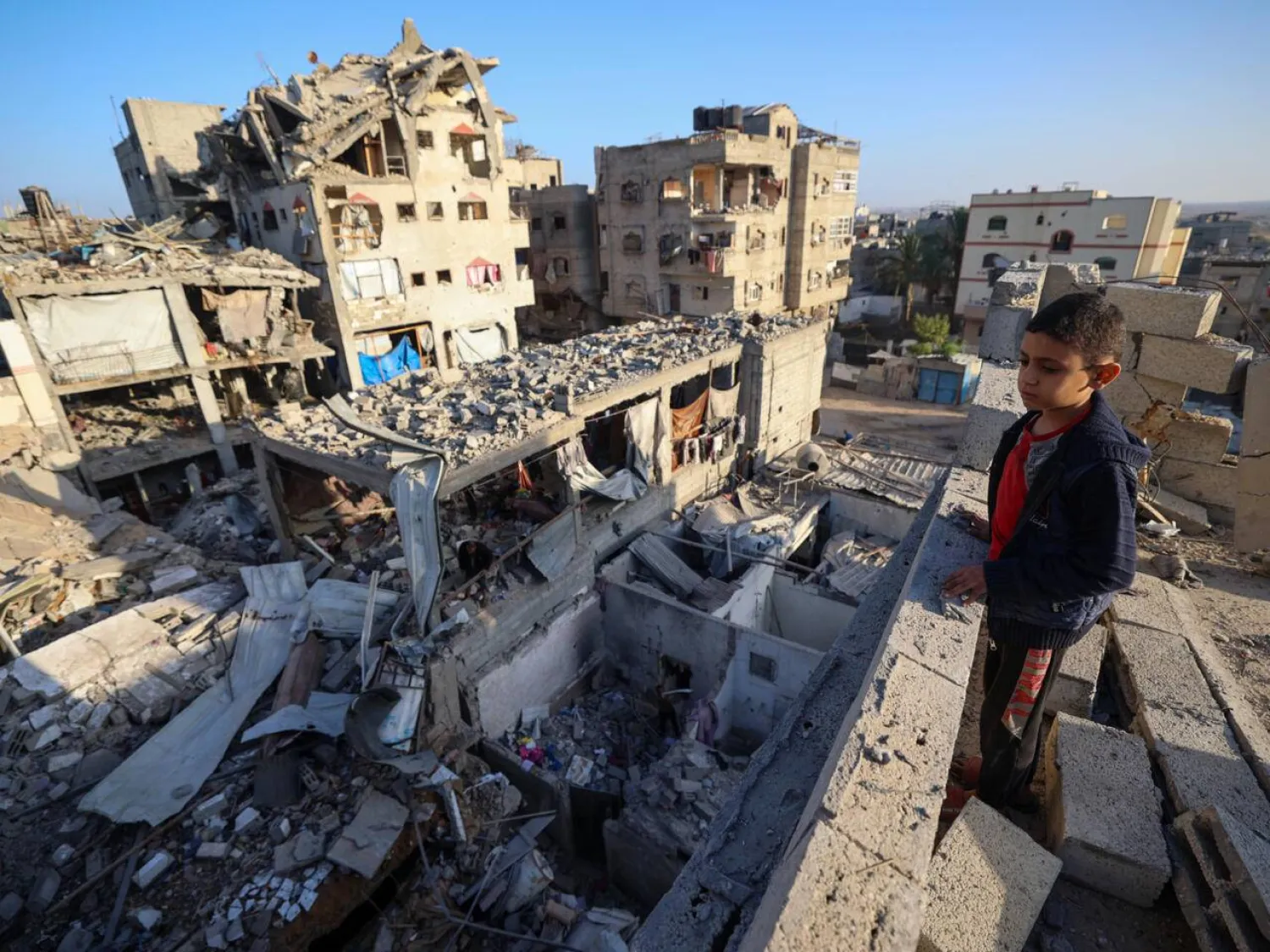
The war in Gaza has devastated much of the territory. Eyad BABA / AFP
TT

Trump Says Hamas Will Be 'Eradicated' If They Breach Gaza Deal

The war in Gaza has devastated much of the territory. Eyad BABA / AFP

US President Donald Trump said Monday that he would give Hamas a "little chance" to honor the Gaza truce deal with Israel but warned the group would be "eradicated" if it fails to do so.  

"We made a deal with Hamas that they're going to be very good, they're going to behave," Trump told reporters. "And if they're not, we're going to go and we're going to eradicate them. If we have to, they'll be eradicated." 

US envoys met Israeli Prime Minister Benjamin Netanyahu on Monday aiming to corral Israel and Hamas to get the Gaza ceasefire plan back on track after an explosion of violence over the weekend that threatened to derail the week-old truce. 

Israel and Hamas have both recommitted to the ceasefire plan pushed by Trump since Sunday's flare-up in which a Palestinian attack that killed two soldiers prompted an Israeli bombardment killing at least 28 people in Gaza. 

However, with even the first stages of the truce shaken by repeated flashes of violence, including on Monday, it is far from clear whether the US will be able to keep pressure on the two sides and maintain momentum to end the conflict. 

TALKS ON NEXT PHASE OF CEASEFIRE PLAN 

The US envoys, Steve Witkoff and Trump's son-in-law Jared Kushner, were expected to push to shore up the truce and then start talks on the next, more difficult, phase of the 20-step plan during their visit. 

US Vice President JD Vance was also due to visit Israel on Tuesday, with Netanyahu saying the pair would discuss regional challenges and opportunities. 

High-level US diplomacy in the region, with talks also due later on Monday with Hamas in Egypt, underscores the importance of cementing the ceasefire to Trump, who last week proclaimed "the historic dawn of a new Middle East". 

On Monday, Palestinian medics said three more people had been killed by Israeli tank fire near the "yellow line" demarcating Israel's military pullback inside Gaza from the main populated areas. The Israeli military said forces had fired at fighters who crossed that line. 

Gaza City residents said they were confused about the line, with electronic maps available but physical markings not established yet on most of the route. 

"The whole area is in ruins. We saw the maps, but we can't tell where those lines are," said Samir, 50, who lives in Tuffah. 

Israel's defense minister on Monday published video showing bulldozers towing yellow blocks into place to mark out the line. 

HAMAS TO HAND OVER BODY OF ANOTHER HOSTAGE 

Witkoff and Kushner's visit to Israel, aimed at discussions on the next phase of Trump's complex ceasefire plan, was scheduled before Sunday's flare-up in violence, according to US and Israeli sources. 

Israel is unlikely to publicize any progress in the talks until the remains of more hostages are returned, and it believes Hamas could hand over up to six more bodies immediately out of the 16 still in Gaza. Other bodies may be hard to recover because of destruction in the enclave. 

Hamas said it would hand over the body of another hostage later on Monday. 

Egypt will host talks in Cairo on Monday with Khalil Al-Hayya, Hamas' exiled Gaza chief, over ways to follow up on implementing the ceasefire, the group said in a statement. 

A Palestinian official close to the talks said the group's delegation would discuss ways to push forward the formation of a technocratic body to run Gaza without Hamas representation. 

Hamas and other allied factions reject any foreign administration of Gaza, as envisaged in the Trump plan and has so far resisted calls to lay down arms, which may complicate implementation of the deal. 

RESIDENTS FEAR MORE OUTBREAKS OF VIOLENCE 

Both Israel and Hamas have said they remain committed to the ceasefire after Sunday's violence. 

Israel said it launched strikes across the enclave in response to a Palestinian attack that killed two soldiers operating within the agreed deployment line in Rafah in southern Gaza. 

"Israel will not accept any violations of the ceasefire in the Gaza Strip," an Israeli government spokesman said on Monday, repeating that Hamas could have no future role inside Gaza and would be disarmed. 

Hamas' armed wing, which has refused to commit to disarmament under the plan, said it was unaware of clashes in Rafah and had not been in contact with groups there since March. 

Hamas has detailed what it calls a series of violations by Israel that it says killed 46 people and stopped essential supplies from reaching the enclave. 

Israeli Defense Minister Israel Katz said any Hamas fighters in areas of Gaza still under Israeli control must leave immediately and anyone remaining beyond the yellow line would be targeted without warning. 

Despite an earlier threat to withhold supplies from Gaza over the brief truce breakdown, an Israeli security official said aid convoys would continue to enter the enclave. 

With the truce still uncertain, Gaza residents fear more violence. 

"I felt my heart dropping to the ground, I felt the ceasefire collapsed," said Abu Abdallah, a Gaza City businessman displaced in the central Gaza Strip. 

"What happened yesterday made people go crazy to buy food, greedy merchants hiked the prices. The deal looks so fragile," he told Reuters via a chat app. 


Iraqi Officials Arrest Man Wanted by Australian Police as ‘Number One Priority'

Australian Federal Police Commissioner Krissy Barrett said the arrested man, Kazem Hamad, was a threat to national security. (Getty Images file)
TT

Iraqi Officials Arrest Man Wanted by Australian Police as ‘Number One Priority'

Australian Federal Police Commissioner Krissy Barrett said the arrested man, Kazem Hamad, was a threat to national security. (Getty Images file)

Iraqi officials have arrested a man wanted by Australian Federal Police as a person of interest in ​the investigation into a spate of firebombings, including an antisemitic attack on a Melbourne synagogue, police said on Wednesday.

Australian Federal Police Commissioner Krissy Barrett said the arrested man, Kazem Hamad, was a threat to national security and that she had identified ‌him as her "Number ‌One priority".

Iraq's National ‌Center ⁠for ​International ‌Judicial Cooperation said in a statement that Kadhim Malik Hamad Rabah al-Hajami had been arrested as part of a drugs investigation, after a request from Australia.

Barrett said Iraqi officials had made an independent decision to arrest the man ⁠in their own criminal investigation, after Australian Federal Police provided ‌information to Iraqi law enforcement ‍late last year.

"This ‍arrest is a significant disruption to an ‍alleged serious criminal and his alleged criminal enterprise in Australia," she said in a statement.

In October, Barrett said that in addition to being a ​suspect in arson attacks in Australia linked to the tobacco trade, the man ⁠was "a person of interest in the investigation into the alleged politically-motivated arson attack on the Adass Israel Synagogue" in Melbourne.

Australia expelled Iran's ambassador in August after the Australian Security Intelligence Organization traced the funding of hooded criminals who allegedly set fire to the Melbourne synagogue in December 2024 to Iran's Revolutionary Guard Corps.

Hamad, previously convicted in Australia for drug trafficking ‌offences, was deported from Australia to Iraq in 2023.


Syria Asks Lebanon to Hand Over Assad-Era Officers

A drone view shows the port of the coastal city of Latakia, Syria, March 11, 2025. (Reuters)
TT

Syria Asks Lebanon to Hand Over Assad-Era Officers

A drone view shows the port of the coastal city of Latakia, Syria, March 11, 2025. (Reuters)

Syrian authorities have asked Lebanese security forces to hand over more than 200 senior officers who fled to Lebanon after the fall of Bashar al-Assad, following a Reuters investigation that showed how the neighboring country was a hub for insurgent plotting.

On December 18, a ​top Syrian security official, Brig. Abdul Rahman al-Dabbagh, met with his Lebanese counterparts in Beirut to discuss the exiled Assad-era officers, according to three senior Syrian sources, two Lebanese security officials, and a diplomat with knowledge of the visit.

The meetings came days after a Reuters investigation detailed rival plots being pursued by Rami Makhlouf, the billionaire cousin of the ousted president, and Maj. Gen. Kamal Hassan, former head of military intelligence, both living in exile in Moscow, to finance potential Alawite militant groups in Lebanon and along the Syrian coast. Syria and Lebanon share a 375-kilometer border.

The two rival camps aim to undermine the new Syrian government under President Ahmed al-Sharaa. Reuters found they are sending money to intermediaries in Lebanon to try and stir uprisings that would divide Syria and allow the plotters to regain control over the coastal areas. The population of those areas is dominated ‌by Alawites, the minority ‌sect associated with the Assad family and the dictatorship’s ruling elite.

Al-Dabbagh, an aide to the ‌head ⁠of ​internal security ‌in Syria’s Latakia province, an Alawite stronghold, met with Lebanese intelligence chief Tony Kahwaji and Major General Hassan Choucair, head of the General Security Directorate, and presented them with the list of senior officers wanted by Syria.

The visit focused on gathering information about the whereabouts and legal status of the officers, as well as trying to find ways to prosecute or extradite them to Syria, according to the Syrian sources.

They described it as a direct request from one security agency to another, rather than a demand for extradition.

Three senior Lebanese security officials confirmed the meetings. One of the Lebanese officials denied receiving any demands from the Syrians to hand over the officers. Two others acknowledged receiving a list of names but said none were senior officers.

One of the Lebanese security ⁠officials said there is no evidence of any insurgency being planned, despite the threats against Syria’s new government detailed in the Reuters reporting.

All the officials spoke on condition of anonymity to reveal details of ‌a highly sensitive cross-border issue.

Among the names handed over by Syrian officials to ‍Lebanon were several high-ranking figures acting as intermediaries for Makhlouf or Hassan in ‍Lebanon, according to a Syrian source who saw the list.

A Lebanese judicial official said Syria had not made a formal extradition request to ‍Lebanon, typically done through the two countries’ justice and foreign ministries.

Accompanying Dabbagh on his Beirut visit was Khaled al-Ahmad, a former Assad advisor and childhood friend of Sharaa, who is leading the government’s efforts to win over the Alawite community through development projects and aid, according to two witnesses who saw the men together on that mid-December day.

According to the two witnesses, who are both ex-Assad officers, al-Ahmad and Dabbagh went together to an upscale Beirut restaurant that is popular among Assad’s ​men. The two witnesses said they and others interpreted the outing as a warning to those trying to influence Alawites to rise up against Syria’s new leaders that Lebanon is no longer a haven.

In a January 2 post on X, Lebanese Deputy Prime Minister Tarek Mitri called on his government’s security agencies to verify the information circulating in the media and take action against the Lebanon-based agents for Assad’s former insiders, Makhlouf and Hassan.

“It is incumbent upon them, and upon all of us, to avert the dangers of any actions that undermine Syria’s unity or threaten its security and stability, whether in Lebanon or originating from it,” the tweet read.

In response to questions from Reuters, Lebanon’s General Security referred to January 11 remarks by Lebanese President Joseph Aoun, who said Lebanon’s military intelligence and other security agencies had carried out raids in several areas of the country’s north and east.

Aoun said the raids did not produce evidence of the presence of officers linked to the Assad dictatorship and said Lebanon was continuing to coordinate with Syria on the issue.

Syrian government officials did not respond to requests for comment.

From January 3 to January 6, Lebanese soldiers raided locations and shelters housing displaced Syrians. The Lebanese Army said 38 Syrians were arrested during the raids on different charges such as possession of drugs or weapons, or entering the country illegally.

A senior Lebanese security official told Reuters those ‌raids were linked to the exiles’ plots.

Another senior Lebanese security official emphasized that there was no arrest warrant for the Syrian officers in Lebanon, nor Interpol requests for them.

“We can't do anything against them,” the official added.


Israel Army Says Killed Six Gaza Gunmen Despite Ceasefire

 Internally displaced Palestinians move between the ruins of destroyed buildings at Al Rashid road in the west of Gaza City on, 06 January 2026, amid a ceasefire between Israel and Hamas. (EPA)
Internally displaced Palestinians move between the ruins of destroyed buildings at Al Rashid road in the west of Gaza City on, 06 January 2026, amid a ceasefire between Israel and Hamas. (EPA)
TT

Israel Army Says Killed Six Gaza Gunmen Despite Ceasefire

 Internally displaced Palestinians move between the ruins of destroyed buildings at Al Rashid road in the west of Gaza City on, 06 January 2026, amid a ceasefire between Israel and Hamas. (EPA)
Internally displaced Palestinians move between the ruins of destroyed buildings at Al Rashid road in the west of Gaza City on, 06 January 2026, amid a ceasefire between Israel and Hamas. (EPA)

The Israeli military said Wednesday it had killed six gunmen in an updated toll from an exchange of fire in Gaza the day before, accusing them of violating the ceasefire in the territory.

The military said in a statement late on Tuesday that it had killed two of six fighters it had identified adjacent to its troops in western Rafah and that tanks had fired on them.

It said they were killed in an ensuing exchange of fire, including aerial strikes, while troops continued to search for the rest.

In a statement on Wednesday, the military said that "following searches that were conducted in the area, it is now confirmed that troops eliminated the six terrorists during the exchange of fire".

It said the presence of the gunmen adjacent to troops and the subsequent incident were a "blatant violation of the ceasefire agreement".

A security source in Gaza reported late on Tuesday that Israeli forces had "opened fire west of Rafah city".

Under a truce that entered into force in October following two years of war between Israel and Hamas, Israeli forces in Gaza withdrew to positions behind a demarcation known as the "yellow line".

The city of Rafah is located behind the yellow line, under Israeli army control. The area beyond the yellow line remains under Hamas authority.

Both sides have repeatedly accused the other of violating the ceasefire.

According to the health ministry in Gaza, which operates under Hamas authority, at least 165 children have been killed in Israeli attacks since the ceasefire began on October 10.

The UN children's agency UNICEF said on Tuesday that at least 100 children -- 60 boys and 40 girls -- had been killed since the truce.

Israeli forces have killed a total of at least 447 Palestinians in Gaza since the ceasefire took effect, according to the ministry.

The Israeli army says gunmen have killed three of its soldiers during the same period.
