


Civilians in Sudan's al-Fasher Cower from Drones as Siege Worsens Hunger

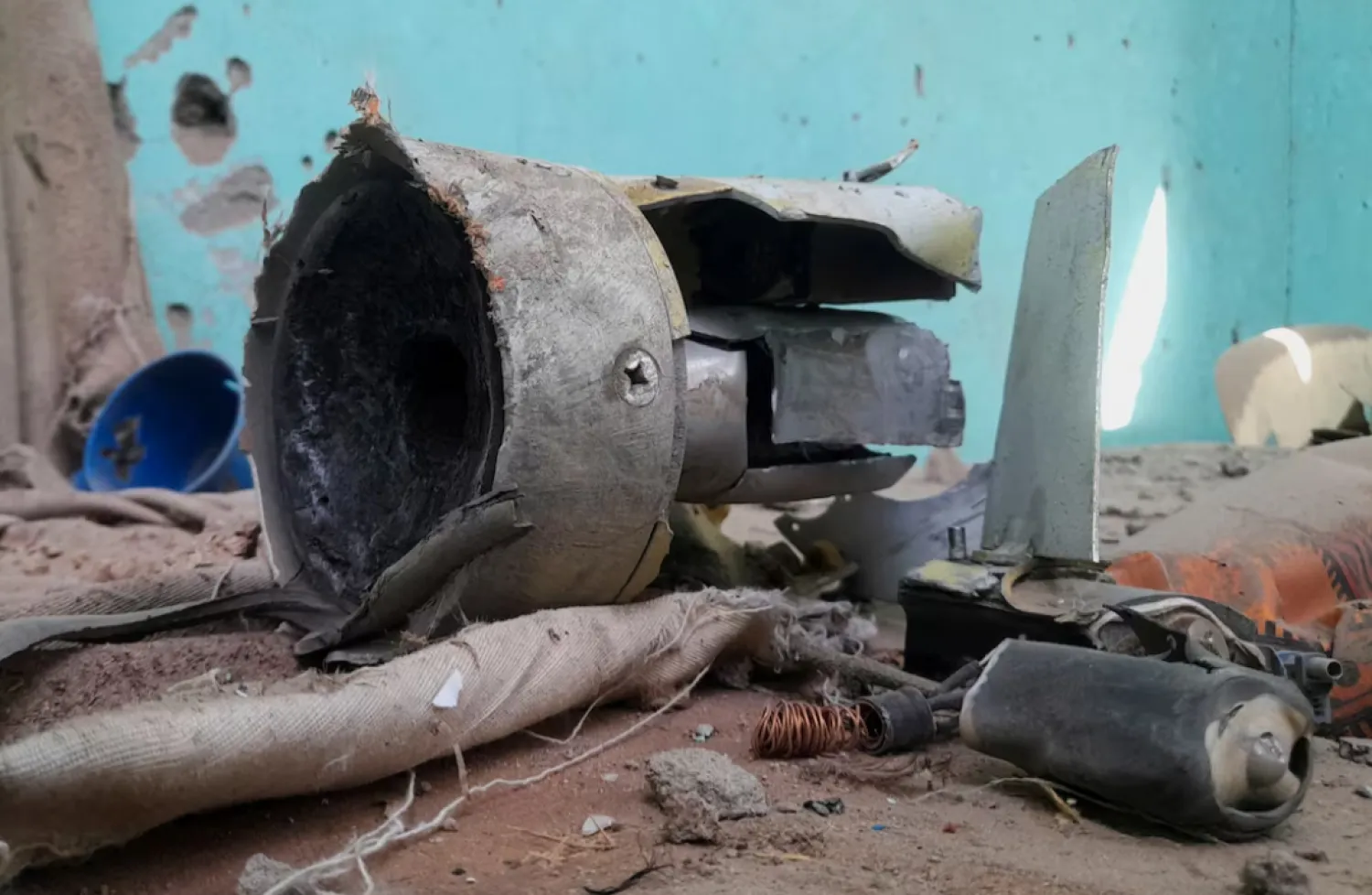
Remnants of a shell that targeted the refugee center, in El Fasher, Sudan, October 7, 2025. REUTERS/Mohyaldeen M Abdallah
TT

Civilians in Sudan's al-Fasher Cower from Drones as Siege Worsens Hunger

Remnants of a shell that targeted the refugee center, in El Fasher, Sudan, October 7, 2025. REUTERS/Mohyaldeen M Abdallah

Residents of Sudan's besieged city of al-Fasher have been taking refuge in underground bunkers to try to protect themselves from drones and shells after intensifying attacks on displacement shelters, clinics and mosques.

Famine-stricken al-Fasher is the Sudanese army's last holdout in the vast, western region of Darfur as it battles the Rapid Support Forces (RSF) in a civil war that has raged for two-and-a-half years, Reuters reported.

The conflict, which erupted from an internal power struggle, has triggered ethnic killings, drawn in foreign powers and created a massive humanitarian crisis.

The army has been gaining ground elsewhere in Sudan, but Darfur is the RSF's stronghold where it aims to base a parallel government, potentially cementing a geographical splintering of the country.

More than one million have fled al-Fasher during an 18-month siege by the RSF, according to the UN, but it has become dangerous and expensive to leave. An estimated quarter of a million civilians remain, and there are fears of mass reprisals if the city falls.

STRUGGLE TO AVOID DRONE STRIKES

Many of those still in the city have dug bunkers for protection after repeated strikes on civilians, according to more than a dozen residents reached by phone as well as footage obtained and verified by Reuters.

The residents described avoiding drones by limiting movements and large gatherings during daytime, and not using lights after dark.

"We can only bury people at night, or very early in the morning," said Mohyaldeen Abdallah, a local journalist. "It's become normal for us."

Five residents said drones have followed civilians into areas where they gather, such as clinics. "When you're walking around you stick to the wall like a gecko so the drone won't see you go inside," said Dr. Ezzeldin Asow, head of al-Fasher's now-abandoned Southern Hospital.

At one shelter in al-Fasher's Abu Taleb school at least 18 people were killed in the week from September 30 by bombardment, a drone attack and an RSF raid, said Abdallah, who visited the site before and after the attacks.

Footage verified by Reuters showed the school's shattered ceilings and scarred walls. On the school grounds, it showed a dead body lying outside a shipping container buried in the ground to create a shelter, with sandbags around the entrance.

Neither the army nor the RSF responded to written requests or calls seeking comment on the incidents at Abu Taleb school and elsewhere in al-Fasher.

Residents captured in the footage blamed the RSF for attacks. Reuters could not independently verify who was responsible.

"They don't distinguish between civilians and soldiers, if you're human they fire at you," Khadiga Musa, head of the North Darfur health ministry, told Reuters by phone from al-Fasher.

The RSF and its allies have been blamed for waves of ethnically driven violence in Darfur during the war, with the US determining last year that they had committed genocide. Its leadership denies ordering such attacks and says rogue soldiers will face justice.

In a statement on October 12, the RSF said al-Fasher was "devoid of civilians". The army and allied self-defense fighters and former rebels had "turned hospitals and mosques into military barracks and rocket launchers," the RSF said.

The Sudanese army, which has denied responsibility for civilian deaths, has also used drones in al-Fasher.

REPEATED ATTACKS ON SECOND SHELTER

On October 10-11 another displacement shelter, Dar al-Arqam, located on university grounds that also house a mosque, suffered repeated strikes. The center's manager, Hashim Bosh, recorded 57 dead including 17 children, among them three babies.

"They were aiming at the mosque. They attacked right after Friday prayer," he said in a voice note to Reuters, describing the first strike. A second strike, he said, came from a drone that followed people running to another shipping container used as a shelter.

The next morning four more shells hit during dawn prayers, Bosh said. Residents interviewed in footage taken by local activists and verified by Reuters confirmed the attacks.

The footage also showed what appear to be 10 bodies covered in sheets at the site, a child-sized body covered by a small prayer rug, and several bodies, mangled and uncovered, inside the container.

Satellite imagery published by the Yale Humanitarian Research Lab (HRL) on October 16 showed six impact points on Dar al-Arqam's buildings.

BODIES SCATTERED IN THE STREETS

According to HRL, as of October 4 the RSF had extended earthen barriers to almost fully encircle al-Fasher.

As a result, activists warned last week that even ambaz, an animal feed people had resorted to eating, had become unavailable.

Activists from a local network, the al-Fasher Resistance Committee, say on average 30 people a day are dying from violence, hunger, and disease.

So many bodies were scattered in the streets that it was a health risk, according to the Abu Shouk Emergency Response Room, a volunteer network.

Those who spoke to Reuters said they feared being kidnapped, robbed, or killed if they left.

"Al-Fasher is basically lifeless," said a member of the Abu Shouk Emergency Response Room who only gave his first name, Mohamed. "But leaving is even more dangerous than staying."



Netanyahu will Meet Trump on Gaza on December 29, Spokesperson Says

US President Donald Trump and Israeli Prime Minister Benjamin Netanyahu reach to shake hands at a joint press conference in the State Dining Room at the White House in Washington, DC, US, September 29, 2025. REUTERS/Jonathan Ernst/ File Photo
TT

Netanyahu will Meet Trump on Gaza on December 29, Spokesperson Says

US President Donald Trump and Israeli Prime Minister Benjamin Netanyahu reach to shake hands at a joint press conference in the State Dining Room at the White House in Washington, DC, US, September 29, 2025. REUTERS/Jonathan Ernst/ File Photo

Israeli Prime Minister Benjamin Netanyahu will meet US President Donald Trump on December 29 to discuss the next steps of the Gaza ceasefire, an Israeli government spokesperson said on Monday, Reuters reported.

On Sunday, Netanyahu said that he will be discussing with Trump the second phase of a US plan to end the war in Gaza later this month. A ceasefire between Israel and Hamas came into effect in October.

Both sides have repeatedly accused each other of violating the truce and wide gaps remain on key issues yet to be discussed under Trump's plan to end the war, including Hamas disarmament, the governance of post-war Gaza and the composition and mandate of an international security force in the enclave.

"The Prime Minister will meet with President Trump on Monday, December 29 they will discuss the future steps and phases and the international stabilization force of the ceasefire plan," government spokesperson Shosh Bedrosian said in an online briefing to reporters.

The prime minister's office said on December 1 that Trump had invited Netanyahu to the White House. Israeli media have since reported that the two leaders may meet in Florida.


Iraq Shuts Down Lukoil West Qurna 2 Field Due to Leak

FILE PHOTO: A general view shows the West Qurna-2 oilfield in southern Basra, Iraq, April 17, 2017. REUTERS/Essam Al-Sudani/File Photo/File Photo
TT

Iraq Shuts Down Lukoil West Qurna 2 Field Due to Leak

FILE PHOTO: A general view shows the West Qurna-2 oilfield in southern Basra, Iraq, April 17, 2017. REUTERS/Essam Al-Sudani/File Photo/File Photo

Iraq has shut down the entire oil production at Lukoil's West Qurna 2 oilfield, one of the world's largest, due to a leak on an export pipeline, two Iraqi energy officials told Reuters on Monday.

Lukoil declared force majeure last month at West Qurna 2 as it was hit with sanctions alongside Rosneft as part of US President Donald Trump's push to end the war in Ukraine.

The field, with output of around 460,000 barrels per day, accounts for about 0.5% of world oil supply and 9% of total output in Iraq, OPEC's second-largest producer.

Lukoil's 75% operational stake in the field is its largest foreign asset.

Iraq has frequently produced above its output target agreed with OPEC and allies including Russia, known as OPEC+.

The sanctions have drawn a growing list of potential bidders for Lukoil's global assets that includes oil majors.


UN Palestinian Aid Agency Says Israeli Police ‘Forcibly Entered’ Compound in Jerusalem 

Offices of the United Nations agency for Palestinian refugees, known as UNRWA, are seen in the Shuafat refugee camp in Jerusalem, Monday, Jan. 27, 2025. (AP)
TT

UN Palestinian Aid Agency Says Israeli Police ‘Forcibly Entered’ Compound in Jerusalem 

Offices of the United Nations agency for Palestinian refugees, known as UNRWA, are seen in the Shuafat refugee camp in Jerusalem, Monday, Jan. 27, 2025. (AP)

Israeli police forcibly entered the compound of the United Nations agency for Palestinian refugees in East Jerusalem early Monday, escalating a campaign against an organization that has been banned from operating on Israeli territory.

The UN Relief and Works Agency for Palestinian Refugees in the Near East, or UNRWA, said in a statement that “sizeable numbers” of Israeli forces including police on motorcycles, trucks and forklifts entered the compound in the Palestinian neighborhood of Sheikh Jarrah and cut communications to the compound.

“The unauthorized and forceful entry by Israeli security forces is an unacceptable violation of UNRWA’s privileges and immunities as a UN agency,” the agency said.

Photos taken by an Associated Press photographer show police cars on the street and an Israeli flag planted on the compound's roof. Photos provided by UNRWA staff show a group of Israeli police officers inside the compound.

Police said in a statement they entered for a “debt-collection procedure” spearheaded by Jerusalem's municipal government, which did not immediately respond to a request for comment.

The raid was the latest action in Israel's campaign against the agency, which provides aid and services to some 2.5 million Palestinian refugees in Gaza, the occupied West Bank and east Jerusalem, as well as 3 million more refugees in Syria, Jordan and Lebanon.

The agency was established to help the estimated 700,000 Palestinians who fled or were driven out of what is now Israel during the 1948 war surrounding Israel’s creation. UNRWA supporters say Israel hopes to erase the Palestinian refugee issue by dismantling the agency. Israel says the refugees should be permanently resettled outside its borders.

For more than a year of the Israel-Hamas war that began Oct. 7, 2023, UNRWA was the main lifeline for Gaza's population, which was largely reliant on aid because of humanitarian crisis unleashed by heavy Israeli bombardment and restrictions on the entry of goods.

Throughout the war, Israel has accused the agency of being infiltrated by Hamas, allegations the UN has denied. After months of mounting attacks from Prime Minister Benjamin Netanyahu and his far-right allies, Israel formally banned it from operating on its territory in January.

The US, formerly the largest donor to UNRWA, halted funding to the agency in early 2024.

UNRWA receives assistance from other agencies UNRWA has since struggled to continue its work in Gaza, with other UN agencies including WFP and UNICEF stepping in to help compensate for a gap UNRWA says is unfillable.

“If you squeeze UNRWA out, what other agency can fill that void?” said Tamara Alrifai, UNRWA’s director of external relations and communications, on the sidelines of the Doha Forum on Saturday.

The agency has been excluded from US-led talks on Phase 2 of the ceasefire, she added.

UNRWA shut down its Jerusalem compound in May after far-right protesters, including at least one member of Israeli Parliament, overran its gate in view of the police. Israel’s far-right has pushed to turn the compound into a settlement and the country's housing minister said last year he had instructed the ministry to “examine how to return the area to the state of Israel and utilize it for housing.”