


Israel Identifies Remains of a Hostage as Hamas Says It Is Committed to Ending the War 

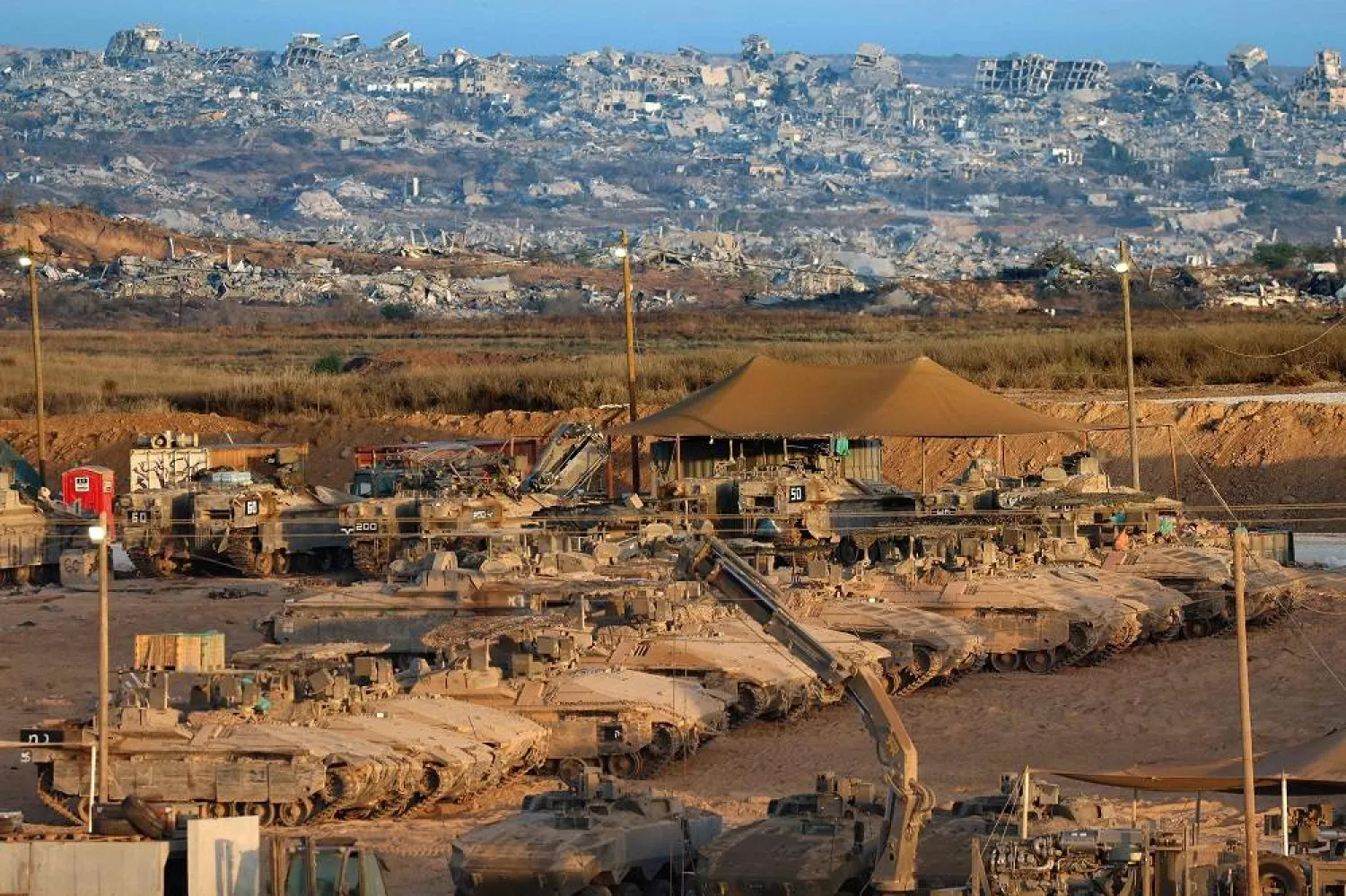
Israeli army tanks are positioned along the border fence between Israel and the Gaza Strip with the destruction in the besieged Palestinian territory seen in the background from an undisclosed position in southern Israel on October 21, 2025. (AFP)
TT

Israel Identifies Remains of a Hostage as Hamas Says It Is Committed to Ending the War 

Israeli army tanks are positioned along the border fence between Israel and the Gaza Strip with the destruction in the besieged Palestinian territory seen in the background from an undisclosed position in southern Israel on October 21, 2025. (AFP)

Israel said on Tuesday it had identified the body of a hostage that was released by Hamas overnight, while the group's chief negotiator said Hamas is determined to implement the ceasefire agreement with Israel.

US Vice President JD Vance is expected in the region on Tuesday to shore up the fragile ceasefire, which has teetered over the past few days.

Israel confirmed that Hamas released the body of Tal Haimi, who was killed on Oct. 7, 2023, and abducted from Kibbutz Nir Yitzhak on the Gaza border. Haimi, 42, a fourth-generation resident of Kibbutz Nir Yitzhak, was part of the emergency response team. He had four children, including one born after the attack.

Under the terms of the ceasefire, Israel is still waiting for Hamas to turn over the remains of 15 deceased hostages. Thirteen bodies have been released since the ceasefire began.

After trading strikes earlier this week, Hamas negotiators reiterated that the group is committed to ensuring the war “ends once and for all.”

“From the day we signed the Sharm el-Sheikh agreement, we were determined and committed to seeing it through to the end,” Hamas chief negotiator Khalil al-Hayya, who is in Cairo, told Egypt’s Al-Qahera News television late Monday.

He said the Sharm el-Sheikh summit, hosted by Egyptian President Abdel Fattah al-Sisi and US President Donald Trump, represented “an international will declaring the war in Gaza is over.”

Al-Hayya said Hamas received assurances from mediators and Trump that “give us confidence that the war has ended for good.”

He said Israel has complied with aid deliveries in the crossings according to the agreement but asked mediators to pressure Israel to deliver more shelter, medical supplies and winterization items before the weather changes.

On Sunday, Israel’s military said fighters had fired at troops, killing two Israeli soldiers in areas of Rafah in southern Gaza that are Israeli-controlled according to agreed-upon ceasefire lines.

Retaliatory strikes by Israel killed 45 Palestinians, according to the territory’s Health Ministry, which says a total of 80 people have been killed since the ceasefire took effect.

Similar strikes occurred on Monday in Gaza City and Khan Younis, where Israel said fighters had crossed the yellow ceasefire line and posed an “immediate threat” to its troops.

The Israeli military said Monday it was using concrete barriers and painted poles to more clearly delineate the so-called yellow line in Gaza where troops have withdrawn to. It said several instances of violence have occurred.



Hundreds in Somalia’s Capital Protest Israel’s Recognition of Breakaway Territory of Somaliland

People protest against Israel’s recognition of the self-declared Republic of Somaliland in Mogadishu, Somalia, Thursday, Jan. 8, 2026. (AP)
TT

Hundreds in Somalia’s Capital Protest Israel’s Recognition of Breakaway Territory of Somaliland

People protest against Israel’s recognition of the self-declared Republic of Somaliland in Mogadishu, Somalia, Thursday, Jan. 8, 2026. (AP)

Hundreds of demonstrators gathered in Somalia’s capital to protest Israel’s recognition of the self-declared Republic of Somaliland, waving Somali flags and chanting patriotic songs in a show of national unity.

The protest on Thursday night took place at Taleh Square in downtown Mogadishu, where the crowds condemned Israel’s move as a violation of sovereignty and territorial integrity in the east African country. Demonstrators carried placards rejecting what they described as foreign interference in Somalia’s internal affairs.

The rally came two weeks after Israel announced that it recognized Somaliland as an independent and sovereign nation — and two days after Israel’s foreign minister visited Hargeisa, the Somaliland capital. On his visit, Foreign Minister Gideon Saar said that Israel would soon open an embassy and appoint an ambassador.

Thursday night's demonstration was the third such event since Israel recognized Somaliland on Dec. 26.

“We are protesting against the division of our country,” demonstrator Said Gedi said. “This is against the sovereignty, independence and territorial integrity of Somalia, and we hope Somalia will stand united.”

Another protester, Abdirahman Abdulkadir, said that the demonstration was meant to send a message of unity.

“Somalia cannot be divided,” he said. “We are united by one religion, one culture and the same heritage.”

The demonstration coincided with a televised address by President Hassan Sheikh Mohamud, who strongly rejected Israel’s decision and urged dialogue between Somaliland’s leaders and the federal government in Mogadishu.

“I want to make it clear once again that the Republic of Somalia is a sovereign and united country,” Mohamud said. “Its territory cannot be divided or ceded by any letter written by Israel or signed by (Israeli Prime Minister Benjamin) Netanyahu.”

Mohamud warned that the dispute could undermine Somalia’s political stability, economic recovery and development if not handled carefully. He urged Somaliland’s leadership to aim for talks, saying successful secessions elsewhere usually happened through political agreements. He cited examples including South Sudan, which became independent of Sudan in 2011.

Israel has no historical, cultural or economic ties with Somalia, he said.

Somaliland, a former British protectorate, declared independence from Somalia in 1991 following the collapse of the central government. Despite maintaining its own institutions and relative stability, it had never been recognized by a UN member state.

More than 20 mostly Middle Eastern or African countries and the Organization of Islamic Cooperation rejected Israel’s move.

Egyptian Foreign Minister Badr Abdelatty said Tuesday that Israeli recognition of Somaliland was a “dangerous precedent that threatens regional and international peace and security.”

US and Israeli officials told The Associated Press last year that Israel had approached Somaliland about taking in Palestinians from Gaza as part of US President Donald Trump’s plan at the time to resettle the territory’s population. Somalia's foreign ministry says such a proposal has neither been discussed nor considered.

Washington has since abandoned that plan, and the US State Department says it continues to recognize the territorial integrity of Somalia, “which includes the territory of Somaliland.”


Israel Casts Doubt on Hezbollah Disarmament South of the Litani

A French peacekeeper of the United Nations Interim Force in Lebanon (UNIFIL) stands by munitions formerly used by Iran-backed Hezbollah at a position that was held by the group in the Khraibeh Valley in el-Meri in south Lebanon on August 27, 2025. (AFP)
TT

Israel Casts Doubt on Hezbollah Disarmament South of the Litani

A French peacekeeper of the United Nations Interim Force in Lebanon (UNIFIL) stands by munitions formerly used by Iran-backed Hezbollah at a position that was held by the group in the Khraibeh Valley in el-Meri in south Lebanon on August 27, 2025. (AFP)

Israel on Thursday voiced skepticism over the Lebanese Army’s announcement that its plan to seize weapons from southern Lebanon has reached an advanced stage, calling the effort insufficient.

The reaction came even as Israeli Prime Minister Benjamin Netanyahu described the move as an “encouraging beginning,” while reiterating accusations that Hezbollah is rearming with Iranian support.

In a statement, Netanyahu’s office said the efforts by the Lebanese government and army to disarm Hezbollah amount to “a promising start, but absolutely not enough.”

It accused the group of attempting to rebuild its military infrastructure with backing from Iran, stressing that the US-brokered ceasefire agreement clearly calls for Hezbollah’s complete disarmament.

Israel’s Foreign Ministry echoed this skepticism, saying Hezbollah’s military infrastructure south of the Litani River remains intact and that the goal of disarming the group in southern Lebanon “is still far from being achieved.”

The ministry described the Lebanese Army’s efforts as limited, repeating claims that Hezbollah continues to rearm with Iranian assistance.

The Israeli security establishment adopted a sharper tone. Army Radio quoted military sources as saying statements by the Lebanese Army about disarmament in the south “do not reflect reality on the ground,” asserting that Hezbollah fighters and infrastructure are still present south of the Litani.

A military source told Haaretz that Israel’s assessment of the disarmament process “is not based on declarations, but on data and operational results,” adding that as long as Hezbollah’s military structures remain in place, there can be no talk of genuine disarmament.

Yedioth Ahronoth, citing military sources, reported that the Lebanese announcement had been expected and that Israel is inclined to reject claims that the area south of the Litani has been effectively disarmed.

According to the paper, the Israeli army believes Hezbollah still maintains combat capabilities there, describing the Lebanese Army’s performance as slow and partial, despite reaching sites where it was tasked with collecting Hezbollah weapons.

Lebanese parliamentary sources said Israel’s skeptical stance comes as no surprise. MP Mohammed Khawaja, of the Development and Liberation bloc, warned that Israeli threats against Lebanon “have not stopped and continue through its media,” stressing that the danger is aimed at all Lebanese, not a specific group or faction.

Speaking to Asharq Al-Awsat, Khawaja said Israel is openly threatening the region and that Lebanon has long been part of its ambitions.

MP Waddah Al-Sadek said Netanyahu’s recent remarks suggest that, from Israel’s perspective, the continuation of the ceasefire is now conditional on Hezbollah’s full disarmament.

He argued that Israel’s description of Lebanese efforts as encouraging but inadequate may be a sign that an escalation could happen in the future despite assurances from Lebanon’s leaders and army command of their commitment to the ceasefire.

In Israel’s view, he said, such commitments are meaningless without concrete measures and a clear timetable for disarmament, conditions that risk providing Israel with justification for further escalation.


Chinese Envoy Visited Israel and Ramallah This Week, Ministry Says

Israeli Foreign Minister Gideon Saar speaks during a meeting with Hungary's Foreign Minister Peter Szijjarto (not pictured), in Budapest, Hungary, October 27, 2025. (Reuters)
TT

Chinese Envoy Visited Israel and Ramallah This Week, Ministry Says

Israeli Foreign Minister Gideon Saar speaks during a meeting with Hungary's Foreign Minister Peter Szijjarto (not pictured), in Budapest, Hungary, October 27, 2025. (Reuters)

A Chinese envoy visited Israel and Ramallah ​this week and met senior officials from both sides, China's foreign ministry said in statements on ‌Friday.

Zhai Jun, ‌special ‌envoy ⁠of ​the ‌Chinese government on the Middle East issue, was in Israel from Tuesday to Thursday and held talks ⁠with Israeli officials ‌including Foreign Minister Gideon ‍Saar ‍and "exchanged views on ‍regional hot issues".

In a separate statement, the ministry said Zhai ​also visited Ramallah in the West Bank ⁠on Wednesday and held a meeting with Palestinian President Mahmoud Abbas in which they discussed China-Palestinian relations and the Palestinian issue.