


RSF Drones Target Khartoum Airport for Second Consecutive Day 

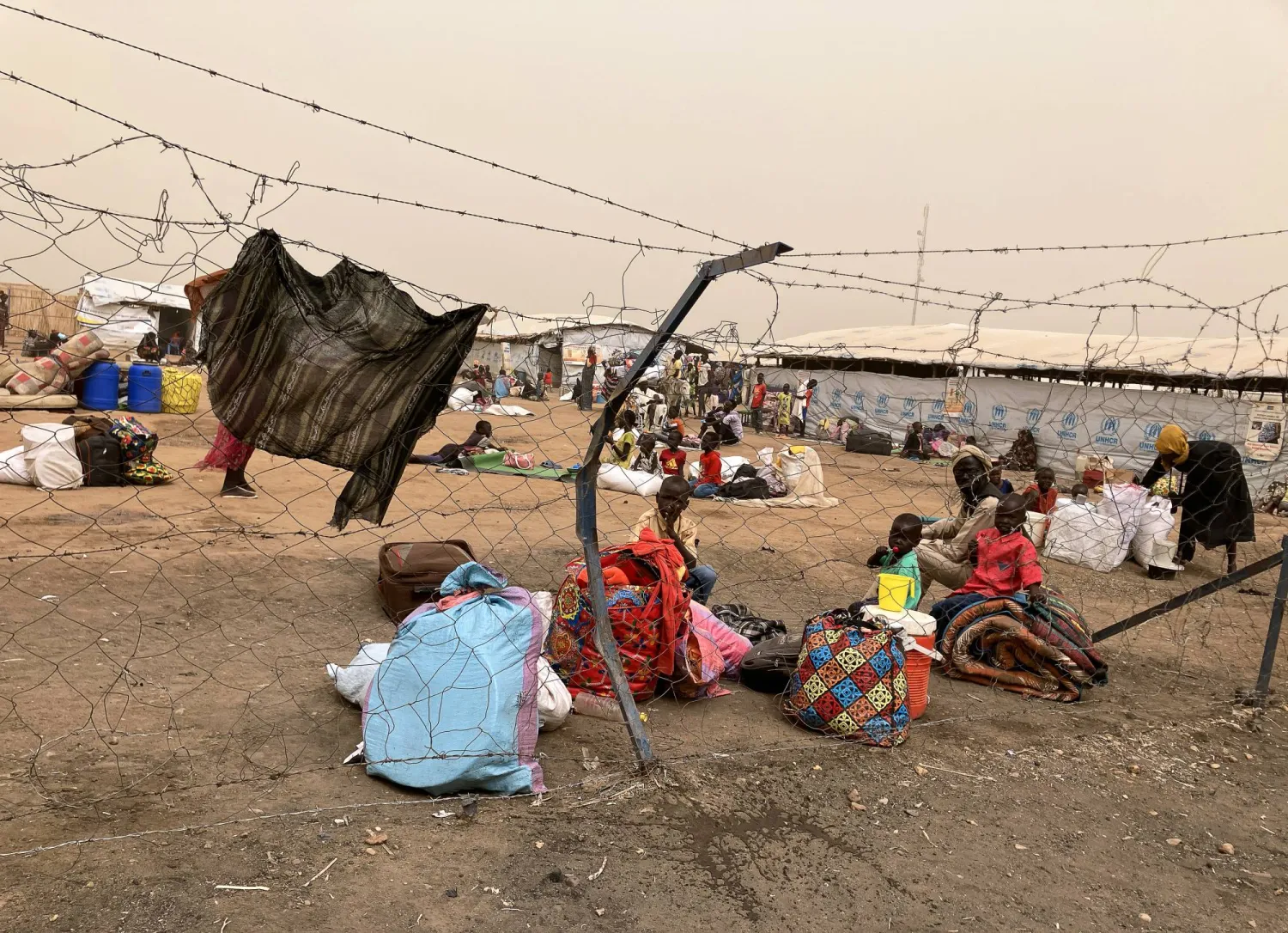
19 March 2024, South Sudan, Joda: Refugees from Sudan wait behind the border crossing into South Sudan to continue their journey. (dpa)
TT

RSF Drones Target Khartoum Airport for Second Consecutive Day 

19 March 2024, South Sudan, Joda: Refugees from Sudan wait behind the border crossing into South Sudan to continue their journey. (dpa)

Paramilitary drones targeted Khartoum International Airport on Wednesday for a second consecutive day, a Sudanese military source told AFP.

The source, who spoke anonymously because he was not authorized to brief the media, said "drones targeted Khartoum airport once again at dawn" on Wednesday.

He added that army air defenses intercepted the drones he said had been launched by a "terrorist militia" -- a reference to the Rapid Support Forces (RSF), which have been fighting the army since April 2023.

Sudan's Civil Aviation Authority had said the airport would reopen on Wednesday, with domestic flights resuming gradually after technical and operational preparations were completed.

But no further announcements on the reopening were made after Tuesday's attack and it remains unclear whether operations will go ahead as planned following the latest strikes.

On Tuesday, witnesses reported hearing numerous explosions in an area near the airport in the early morning. The facility appeared intact during a visit later that day by army chief Abdel Fattah al-Burhan.

Speaking from inside the airport, Burhan said the army was "determined to crush this rebellion" -- a reference to the RSF led by his former ally Mohamed Hamdan Daglo.

The RSF has not claimed responsibility for the attacks, but has been repeatedly accused of using drones to target military and civilian infrastructure in recent months.

In a speech released late on Tuesday on social media, Daglo asserted the RSF "attacks military positions only" and vowed to remove the army, which he called a "cancer".

Khartoum has seen a relative lull in ground fighting since the army retook parts of the capital earlier this year, but drone strikes have continued amid ongoing efforts by the government to restore services and relocate key institutions back from the de facto capital of Port Sudan on the Red Sea.

More than one million people have returned to the capital within the last ten months, according to the UN's migration agency.

Large parts of Khartoum, however, remain in ruins, with millions still experiencing frequent blackouts linked to RSF drone activity.

The most intense violence meanwhile is now concentrated in the west, where RSF forces have surrounded El-Fasher, the last major city in Darfur not under their control.

The paramilitary force has tried to seize the city for over 18 months.

The UN warned on Monday of escalating violence in North and West Darfur states as well as the Kordofan region and Blue Nile state in the south with drone strikes and ground clashes reported across the regions.

In Blue Nile State late on Tuesday, the army said its air defenses intercepted drones that targeted power stations in the city of Roseis.

Despite repeated international efforts to broker a ceasefire, both sides have shown little willingness to compromise.

"We do not want any mercenary or militia to have a role in Sudan's future," Burhan said on Tuesday, referring to the RSF.

The broader conflict has killed tens of thousands, displaced nearly 12 million people, and created the world's largest displacement and hunger crises.



Syria State Media Says Kurdish Force Shelling Kills One Person in Aleppo City

A view of Aleppo, Syria in February 2018. (AFP)
TT

Syria State Media Says Kurdish Force Shelling Kills One Person in Aleppo City

A view of Aleppo, Syria in February 2018. (AFP)

Syrian state media said Kurdish force shelling in Aleppo killed one person on Monday, after clashes with government forces erupted in Kurdish-majority neighborhoods of the city, with both sides trading blame over who started the violence. 

"A civilian was killed in SDF bombardment with mortar shelling and rocket launchers on a number of neighborhoods of Aleppo," state news agency SANA said, referring to the US-backed, Kurdish-led Syrian Democratic Forces. 

Syria's interior ministry had said Kurdish forces attacked government personnel at joint checkpoints in the Kurdish-majority Sheikh Maqsud and Ashrafiyeh neighborhoods of the northern city of Aleppo. 

Authorities had earlier reported two members of the government forces, three civil defense personnel and several civilians were wounded. 

The SDF instead accused "factions affiliated with the interim government" of carrying out an attack. 

It reported two Kurdish-led security personnel and five civilians wounded in an "ongoing attack" on Sheikh Maqsud and Ashrafiyeh involving "mortars and heavy weapons". 

In October, Syria announced a comprehensive ceasefire with Kurdish forces following deadly clashes in the districts, which have repeatedly witnessed heightened tensions. 

Aleppo has been governed by Syria's new authorities since the toppling of former leader Bashar al-Assad in December last year. 

But Sheikh Maqsud and Ashrafiyeh have remained under the control of Kurdish units linked to the SDF and the Kurds' Asayish domestic security forces, despite the SDF having officially withdrawn in April under a disengagement agreement reached with the government. 


Turkish Foreign Minister Urges Kurds Not to Be Obstacle to Syria’s Stability

This handout photograph released by the Turkish Foreign Ministry press service shows Turkish Foreign Minister Hakan Fidan (2nd-L) and Turkish Minister of National Defense Yasar Guler (L) meeting with Syria's Foreign Minister Asaad al-Shaibani (2nd-R) and Syria's Defense Minister Murhaf Abu Qasra (R) in Damascus on December 22, 2025. (Turkish Foreign Ministry Press Service / AFP)
TT

Turkish Foreign Minister Urges Kurds Not to Be Obstacle to Syria’s Stability

This handout photograph released by the Turkish Foreign Ministry press service shows Turkish Foreign Minister Hakan Fidan (2nd-L) and Turkish Minister of National Defense Yasar Guler (L) meeting with Syria's Foreign Minister Asaad al-Shaibani (2nd-R) and Syria's Defense Minister Murhaf Abu Qasra (R) in Damascus on December 22, 2025. (Turkish Foreign Ministry Press Service / AFP)

Visiting Turkish Foreign Minister Hakan Fidan on Monday urged Kurdish-led forces to integrate into Syria's army and not obstruct the country's stability, as the deadline for implementing a deal between Damascus and the Kurds approaches. 

Türkiye and Syria have developed close ties since the toppling of longtime ruler Bashar al-Assad late last year and Ankara, a key supporter of the new authorities, sees the presence of Kurdish forces on its border with Syria as a security threat. 

Fidan, Turkish Defense Minister Yasar Guler and intelligence chief Ibrahim Kalin met with Syrian President Ahmed al-Sharaa, a presidency statement said. 

The visit aimed to address issues including progress on implementing a March 10 agreement between Damascus and the US-backed, Kurdish-led Syrian Democratic Forces (SDF), Türkiye had said. 

Under the deal, the Kurds' civil and military institutions should be integrated into the central government by year end. 

But differences between the sides have held up the deal's implementation despite international pressure, particularly from Washington. 

"It is important that the SDF be integrated into the Syrian administration through dialogue and reconciliation, in a transparent manner, and that it no longer acts as an obstacle to Syria's territorial integrity and long-term stability," Fidan told a press conference with his Syrian counterpart Asaad al-Shaibani. 

Shaibani said Damascus had received a response from the SDF regarding a draft Syrian defense ministry proposal on integrating the Kurdish-led forces into the army. 

"Work is currently underway to study this response and how it responds to the national interest in achieving the integration and achieving a single unified Syrian territory," Shaibani told Monday's press conference. 

Last week, a Kurdish official told AFP on condition of anonymity that Damascus's proposal included splitting the Kurdish-led forces into three divisions and a number of brigades, including one for women. 

The forces would be deployed under Kurdish commanders in areas of northeast Syria currently under SDF control, the official said. 

- Israel - 

It was the first time Damascus had submitted a written proposal to the SDF since the March agreement was signed, the official added, noting "international and regional efforts" to finalize the agreement by the end of the year. 

Last week, Fidan warned the SDF -- which controls vast swathes of Syria's oil-rich northeast -- that patience among key actors was "running out" and advised against further delays to integrate its forces. 

Türkiye shares a 900-kilometer (550-mile) border with Syria and has launched successive offensives to push the SDF from its frontier. 

On Monday, Fidan said the sides also discussed regional security, noting "Syria's stability means Türkiye’s stability". 

He also expressed hope that talks between Syria and neighboring Israel, which has carried out bombings and incursions in Syria since Assad's fall, would "reach a conclusion". 

"For the stability of the region and for Syria's stability, progress in this regard is important," Fidan said, urging Israel to adopt "an approach based on mutual consent and understanding" rather than "pursuing an expansionist policy". 

Shaibani said the talks also addressed "security issues linked to combating terrorism and preventing" a resurgence of the ISIS group in Syria. 

Last week, US forces said they struck dozens of ISIS targets in Syria following a deadly December 13 attack on American personnel in central Syria's Palmyra. 

With support from the coalition, the SDF spearheaded the offensive that led to ISIS's territorial defeat in Syria in 2019, but the extremists still maintain a presence, particularly in the country's vast desert. 

Syria recently joined the international coalition against ISIS. 


Lebanon Says 3 Killed in Israeli Strike on Vehicle Near Sidon

Smoke rises after an Israeli strike on the Haret Saida neighborhood, Sidon, Lebanon, 27 October 2024. (EPA)
TT

Lebanon Says 3 Killed in Israeli Strike on Vehicle Near Sidon

Smoke rises after an Israeli strike on the Haret Saida neighborhood, Sidon, Lebanon, 27 October 2024. (EPA)

Lebanon said three people were killed Monday in a strike near Sidon that Israel said targeted Hezbollah operatives, days ahead of a deadline for Lebanon's army to disarm the group near the border.

Israel has kept up regular strikes on Lebanon, usually saying it is targeting Hezbollah, despite a November 2024 ceasefire that sought to end more than a year of hostilities with the Iran-backed militant group, which it accuses of rearming.

Lebanon's state-run National News Agency said Monday's strike on a vehicle was carried out by an Israeli drone around 10 kilometres (six miles) from the southern coastal city of Sidon and "killed three people who were inside".

The health ministry reported the same toll.

An Israeli military statement said the army "struck several Hezbollah terrorists in the area of Sidon".

Under heavy US pressure and amid fears of expanded Israeli strikes, Lebanon has committed to disarming Hezbollah, starting with the south.

The Lebanese army plans to carry out the task south of the Litani River -- about 30 kilometres from the border with Israel -- by year's end.

The latest strike came after Lebanese and Israeli civilian representatives on Friday took part in a meeting of the ceasefire monitoring committee for a second time, after holding their first direct talks in decades earlier this month, also under the committee's auspices.

The committee comprises representatives from Lebanon, Israel, the United States, France and the United Nations Interim Force in Lebanon (UNIFIL).

Lebanese President Joseph Aoun said Monday that the goal of the negotiations was to "stop the hostilities, achieve Israel's withdrawal, return prisoners held in Israel and return southern residents to their villages".

- 'Days away' -

Israel has also kept troops in five south Lebanon areas that it deems strategic.

"Lebanon awaits positive steps from the Israeli side," Aoun told visiting Italian Defense Minister Guido Crosetto on Monday, a presidency statement said.

In a separate statement, Crosetto said that "even after UNIFIL, Italy will continue to do its part, supporting with conviction the international presence and supporting the capacity development of the Lebanese armed forces".

Asked by AFP if this meant Italy wanted to maintain a military presence in the country, a ministry spokesman confirmed that was the case.

UNIFIL has acted as a buffer between Israel and Lebanon since 1978, but the UN Security Council voted in August to withdraw the peacekeepers in 2027.

Aoun said Lebanon "welcomes the participation of Italy and other European countries in any force that takes the place" of UNIFIL.

On Saturday, Prime Minister Nawaf Salam said the first phase of the plan to restrict weapons to the state south of the Litani River was "days away from completion", according to a statement from his office.

"The state is ready to move to the second phase, north of the Litani River, based on the plan prepared by the Lebanese army," he added.

More than 340 people have been killed by Israeli fire in Lebanon since the ceasefire, according to an AFP tally of Lebanese health ministry reports.

On Sunday, Israeli strikes in south Lebanon near the border killed one person and wounded another, as Israel also said it targeted Hezbollah members.