


Egypt Seeks to Accelerate Implementation of ‘Strategic Partnership’ with EU

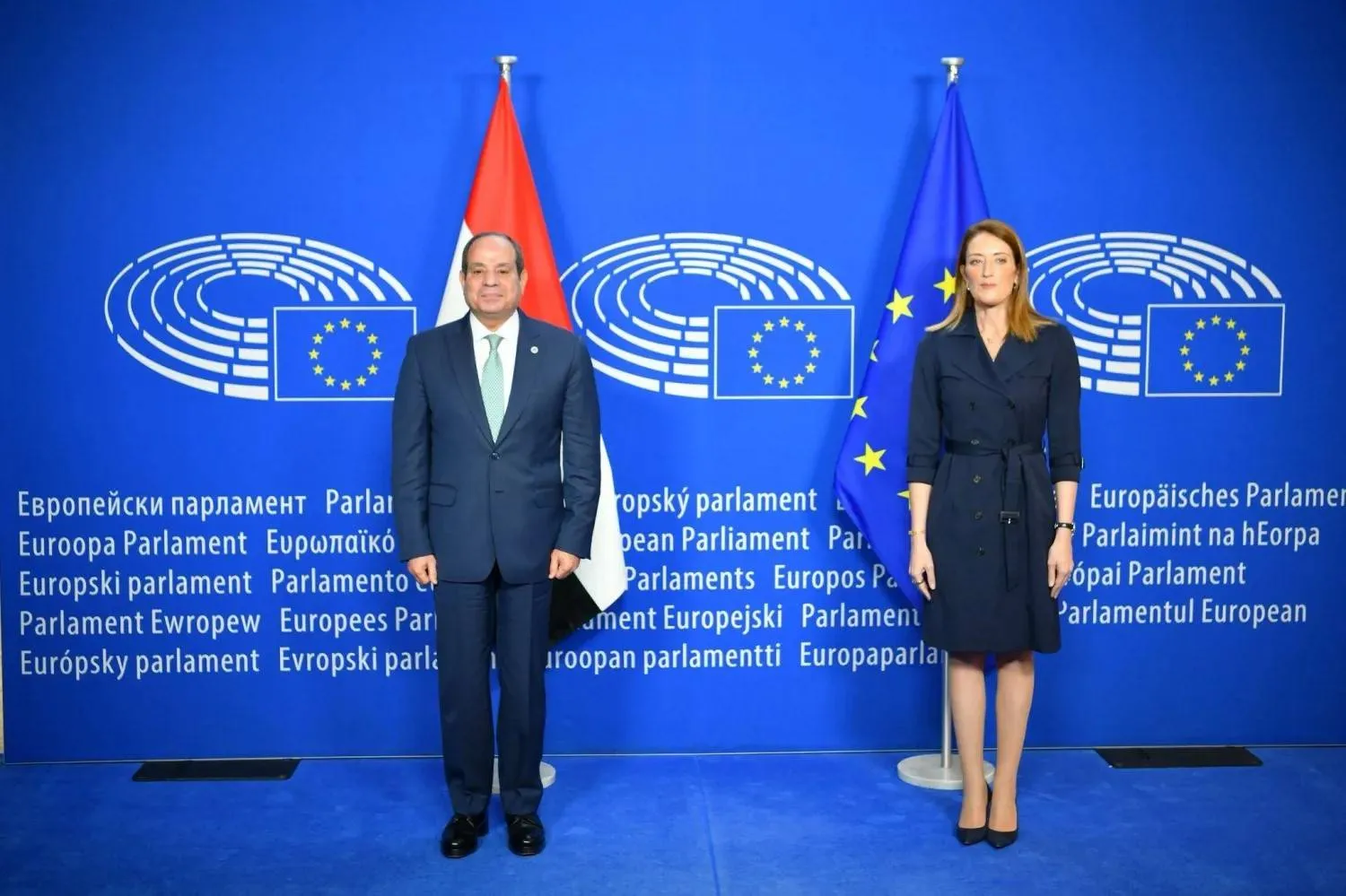
Egyptian President Abdel Fattah al-Sisi met with the President of the European Parliament, Roberta Metsola, in Brussels on Thursday (Egyptian Presidency) 
TT

Egypt Seeks to Accelerate Implementation of ‘Strategic Partnership’ with EU

Egyptian President Abdel Fattah al-Sisi met with the President of the European Parliament, Roberta Metsola, in Brussels on Thursday (Egyptian Presidency) 

Egypt seeks to accelerate the implementation of the axes of strategic partnership with the European Union, and bolster the Egyptian-European parliamentary dialogue as a bridge of communication between the peoples of the two shores of the Mediterranean.

On Thursday, Egyptian President Abdel Fattah al-Sisi held talks with President of the European Parliament, Roberta Metsola, as part of his visit to Brussels, Belgium, to participate in the first Egypt-EU summit.

The President reviewed Egypt's efforts to consolidate security and stability in the Middle East, including the mediation that, in cooperation with other countries, led to an agreement to end the war in the Gaza Strip, in addition to Egypt's hosting of the Sharm el-Sheikh peace summit with high-level international participation.

Both sides emphasized the necessity of underpinning the ceasefire in Gaza, allowing sufficient humanitarian aid into the Strip, and providing the necessary medical care for the injured.

Metsola said the EU is pushing towards the implementation of the two-state solution.

The meeting then touched on Egypt's efforts to resolve regional crises. Metsola expressed her great appreciation for the pivotal role played by Cairo in this regard.

In return, al-Sisi expressed his country’s appreciation for the honorable position adopted by the European Parliament in support of the Palestinian cause, embodied in the demand to stop the war and end the suffering of the people in the Gaza Strip.

He stressed the need for integrated efforts between Egypt and European countries during the next phase to ensure the full implementation of the agreement to end the war, provide humanitarian aid, and begin the reconstruction of the Gaza Strip.

The two sides then welcomed Egypt's hosting of the Gaza Reconstruction and Recovery Conference, scheduled for November 2025.

Also, the officials addressed the issue of illegal immigration. Egypt's efforts that have resulted in halting the departure of illegal immigration boats from its shores since September 2016 were commended, according to presidential spokesperson Mohamed El-Shennawy.

The two sides emphasized the importance of strengthening European cooperation by providing job opportunities for skilled Egyptian workers and facilitating studying and training in European countries, as well as the need to strive for development and consolidate stability in the relevant countries.


US Ambassador to Beirut Stresses Importance of Aoun-Trump Meeting

A poster depicting the portrait of Lebanon's President Joseph Aoun that reads "The decision-maker, the protector of Lebanon, Lebanon first...The State always. We are with you" hangs at the entrance of a tunnel on a street in eastern Beirut's Ashrafieh neighborhood on April 28, 2026. (AFP)
TT

US Ambassador to Beirut Stresses Importance of Aoun-Trump Meeting

A poster depicting the portrait of Lebanon's President Joseph Aoun that reads "The decision-maker, the protector of Lebanon, Lebanon first...The State always. We are with you" hangs at the entrance of a tunnel on a street in eastern Beirut's Ashrafieh neighborhood on April 28, 2026. (AFP)

US Ambassador to Lebanon Michel Issa reiterated on Monday the importance of President Joseph Aoun visiting the United States, saying it should not be viewed as “defeat”.

He also underlined his efforts to achieve rapprochement between various Lebanese officials, meeting with parliament Speaker Nabih Berri and Maronite Patriarch Beshara al-Rahi.

Sources close to the presidency told Asharq Al-Awsat that Aoun has not received an invitation to visit the US.

They added that a meeting between Aoun and Israeli Prime Minister Benjamin Netanyahu is not on the table at the moment.

They instead said that a third meeting between Lebanese and Israeli ambassadors to the US is expected to be held in Washington this week.

In Beirut, Issa met with Berri for talks on the developments in Lebanon and the region, said a statement from the speaker’s office. The ambassador left the meeting without making any statement.

After meeting with al-Rahi, Issa said a meeting between Aoun and US President Donald Trump must not be seen as a “defeat” for Lebanon.

He explained that instead, Aoun could visit Washington and clearly present his positions to Trump and even Netanyahu. Trump could be witness to these stances. Afterwards and upon his return to Lebanon, negotiations with Israel can begin.

Asked if Aoun will coordinate his stances with the parliament speaker and prime minister ahead of going to negotiations, Issa said the president will present all of Lebanon’s demands, starting with underlining the importance of Lebanon’s sovereignty.

Moreover, he noted that when Israel says that it has no territorial ambitions in Lebanon, but that it wants peace, that means that Hezbollah no longer has any justification for its existence.

If Israel maintains its presence in Lebanon even after that, then that means it has undisclosed ambitions, he added.

Issa stressed that at the moment, efforts are focused on delivering the message that the US wants to help Lebanon and protect its independence, economy and “dignity”. He revealed that he is working with the American administration to deliver this message to the international community.

Asked about the purpose of his meeting with Berri, Issa said he wanted to learn why the speaker was not meeting with the president and that he wanted to come to the bottom of the differences between them.

He noted that the two leaders were coordinating with each other, but it came to a stop for unknown reasons.

He urged the need for Lebanon’s leaders to communicate with each other regardless of the circumstances.

Qassem

Meanwhile, Hezbollah leader Naim Qassem continued to slam officials, accusing the authorities of “reaching an agreement with Israel to confront the resistance [Hezbollah].”

He reiterated the importance of Iran’s role in the Lebanese file, rejecting that negotiations over Lebanon be separated from the negotiations between the US and Iran.

“Is there a country in the world in which the ruling authorities agree with the enemy in confronting the resistance that is fighting occupation?” he wondered.

Lebanon is the victim here and it needs guarantees for its security and sovereignty, he demanded.

On the ground, Qassem said the Lebanese army has deployed south of the Litani River in line with the November 2024 ceasefire, but Hezbollah has since “developed means to adapt” with the changes.

He said the Iran-backed party is relying on guerrilla tactics against Israel to deal it losses and prevent it from consolidating its occupation.

The resistance is firm in its drive to liberate territories and it will not surrender, he declared.

“The solution does not lie in surrender or by making Lebanon a weak and subordinate country,” he added. “The situation demands that the resistance continue and for benefitting from the Iranian-American agreement.”


Intense Negotiations Underway to Form New Iraqi Govt

President of the Kurdistan Region in Iraq Nechirvan Barzani and PM-designate Ali al-Zaidi meet in Erbil last week. (Barzani on X)
TT

Intense Negotiations Underway to Form New Iraqi Govt

President of the Kurdistan Region in Iraq Nechirvan Barzani and PM-designate Ali al-Zaidi meet in Erbil last week. (Barzani on X)

Iraqi parties are holding intense negotiations with Prime Minister-designate Ali al-Zaidi over the formation of a new government to ensure that they reap their share in the cabinet, reportedly based on their representation in parliament.

Appointments are based on points, meaning the president, parliament speaker and prime minister boast around 15 points, which translates into 30 parliamentary seats. Obtaining a sovereign portfolio in government, such as the oil or foreign ministry, requires five points, translated into ten seats in parliament. Non-sovereign ministries demand four points, or around eight seats.

The PM-designate has some three weeks to form a government before the end of a constitutional deadline. He will submit a lineup to the parliament for a vote.

The lineup is expected to win a vote a confidence given the support he already enjoys with the majority of the political parties in parliament, US President Donald Trump and the majority of regional and western countries.

Parliamentary sources predicted that al-Zaidi will submit a preliminary lineup next week.

The government is expected to be formed of 22 portfolios, 12 that will go to the ruling Shiite Coordination Framework, six to Sunni blocs and four to Kurdish parties.

The government formation process will be a test to al-Zaidi given his lack of political experience. Observers have questioned whether he will be able to run a country suffering from so many security problems tied to armed factions, as well as a crumbling economy tied to the closure of the Hormuz Strait.

They have also questioned his ability to stand up to political parties and groups that have held sway in Iraq for years. He will be tested in whether he will hold his ground against figures that want to obtain influential government posts even though they are not qualified for the post as is often the case in the country.

An informed source predicted that al-Zaidi will rely on a trusted “formula”, meaning he will ask parties to submit their candidates for various positions, and he will then choose who he deems fit. He will undoubtedly come under pressure from various parties to name their favored candidates.

Speaking on condition of anonymity, the source told Asharq Al-Awsat that an unprecedented number of parties are clamoring for government positions, unconcerned with the cabinet’s actual ministerial program or the proposals al-Zaidi will offer to tackle Iraq’s pressing problems.

President of the Kurdistan Region in Iraq Nechirvan Barzani was in Baghdad on Monday for talks with Framework leaders over political developments and government formation efforts.

He is expected to meet with al-Zaidi and other parties during his two-day visit to settle the issue of Erbil’s share in the government.

The Kurdistan Democratic Party is expected to obtain two or three portfolios in the cabinet, including the sovereign ministry, such as the foreign ministry. The Patriotic Union of Kurdistan will not receive any ministry because one of its members is president of Iraq.


Lebanese President Says Security Deal with Israel Must Come Before Netanyahu Meeting

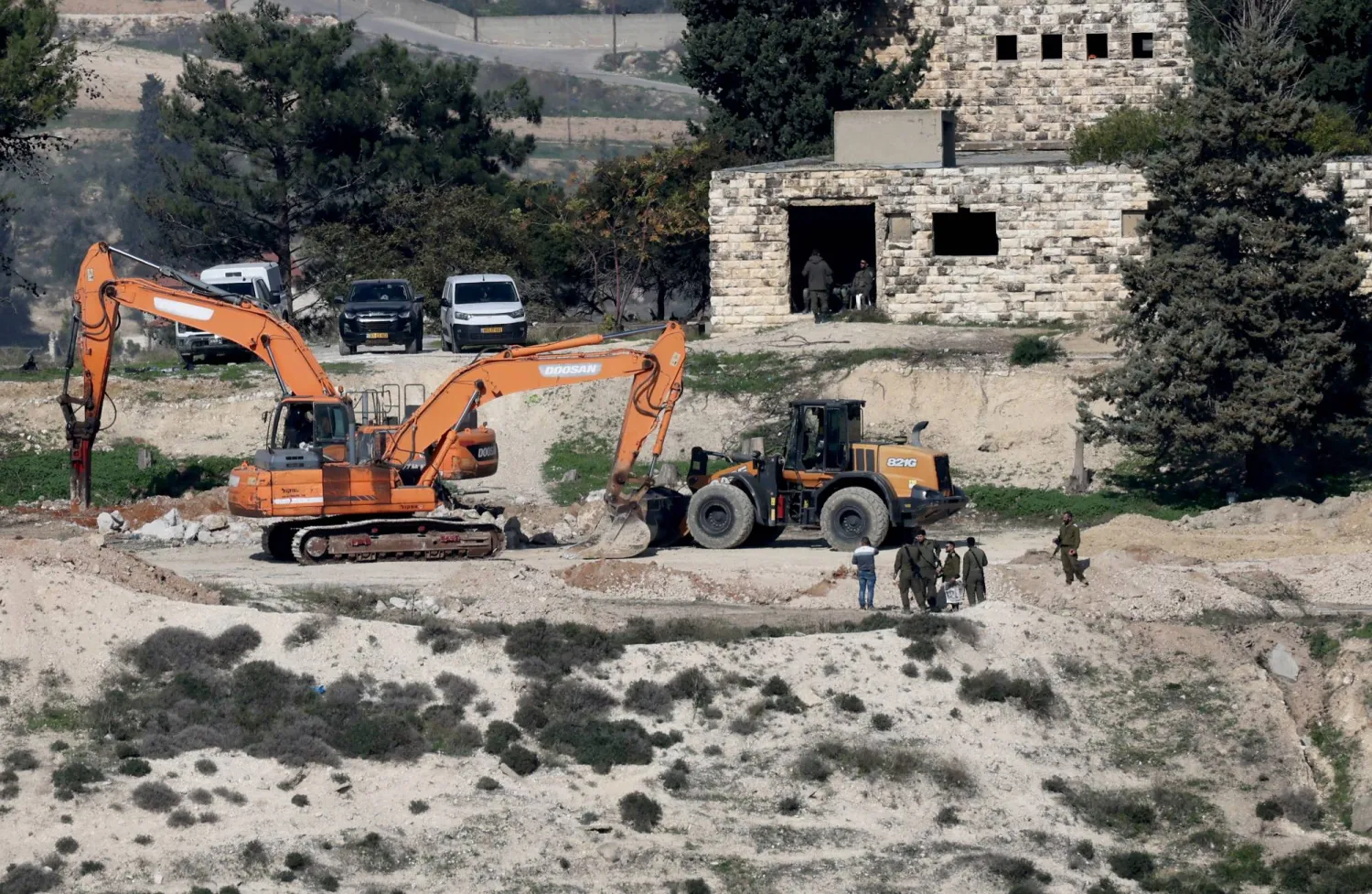
Israeli troops maneuver on the Lebanese side of the border, as seen from the Upper Galilee in northern Israel, 04 May 2026, amid a ceasefire between Israel and Lebanon. (EPA)
TT

Lebanese President Says Security Deal with Israel Must Come Before Netanyahu Meeting

Israeli troops maneuver on the Lebanese side of the border, as seen from the Upper Galilee in northern Israel, 04 May 2026, amid a ceasefire between Israel and Lebanon. (EPA)

Lebanese President Joseph Aoun on Monday said a security deal and an end to Israeli attacks were needed before any meeting with Israeli Prime Minister Benjamin Netanyahu, sought by Washington. 

Aoun's office said in a statement that the president "reiterated his view that the timing is not appropriate now for a meeting" with Netanyahu. 

The statement quoted Aoun as saying: "We must first reach a security agreement and stop the Israeli attacks on us before we raise the issue of a meeting between us." 

Israeli and Lebanese representatives last month met twice in Washington -- the first such meetings in decades, which came after Iran-backed Hezbollah drew Lebanon into the Middle East war on March 2, sparking heavy Israeli strikes and a ground invasion. 

After the first talks, US President Donald Trump announced a 10-day ceasefire in Lebanon that began on April 17, and a three-week extension after the second round. 

The two countries are preparing for direct negotiations. 

The statement from Aoun's office said a third round of "preparatory talks" were expected "in the coming days". 

At the second meeting later in April, Trump said he expected Aoun and Netanyahu to meet jointly with him at the White House "over the next couple of weeks". 

Last week, the US embassy in Beirut urged such a meeting, saying that "Lebanon stands at a crossroads. Its people have a historic opportunity to reclaim their country and shape their future," adding that "the time for hesitation is over". 

A direct meeting between Aoun and Netanyahu, "facilitated by President Trump, would give Lebanon the chance to secure concrete guarantees" including on sovereignty, the embassy added, at a time when Israeli troops are still operating in south Lebanon. 

The planned negotiations have caused a rift in Lebanon, with Hezbollah rejecting direct negotiations as well as Beirut's previous commitment to disarm it. 

Hezbollah chief Naim Qassem earlier Monday criticized direct talks, saying they put Lebanon "under tutelage", and instead called for diplomacy that leads to an end to the war. 

"Direct negotiations are a gratuitous concession, without results," Qassem said. 

Aoun said "there is no turning back from the path of negotiations, because we have no other option", according to the statement from his office, reiterating that the process sought to achieve an Israeli withdrawal from Lebanon. 

Israeli strikes have killed almost 2,700 people in Lebanon, including dozens since the ceasefire. 

On the ground, Hezbollah said its fighters clashed with Israeli soldiers in south Lebanon near the border where its troops are still operating, despite the ceasefire. 

Hezbollah in a statement said that after Israeli troops attempted to advance near the town of Deir Seryan -- which is inside the Israeli-declared "yellow line" where Lebanese residents have been told not to return -- its fighters "opened fire on the enemy force and engaged in heavy clashes with them". 

The Israeli military confirmed there were clashes with Hezbollah fighters in south Lebanon. 

"Earlier today, two soldiers were moderately injured as a result of a close-quarters encounter with Hezbollah terrorists in southern Lebanon," the military said in a statement. 

"The soldiers were evacuated to receive medical treatment at a hospital."
