

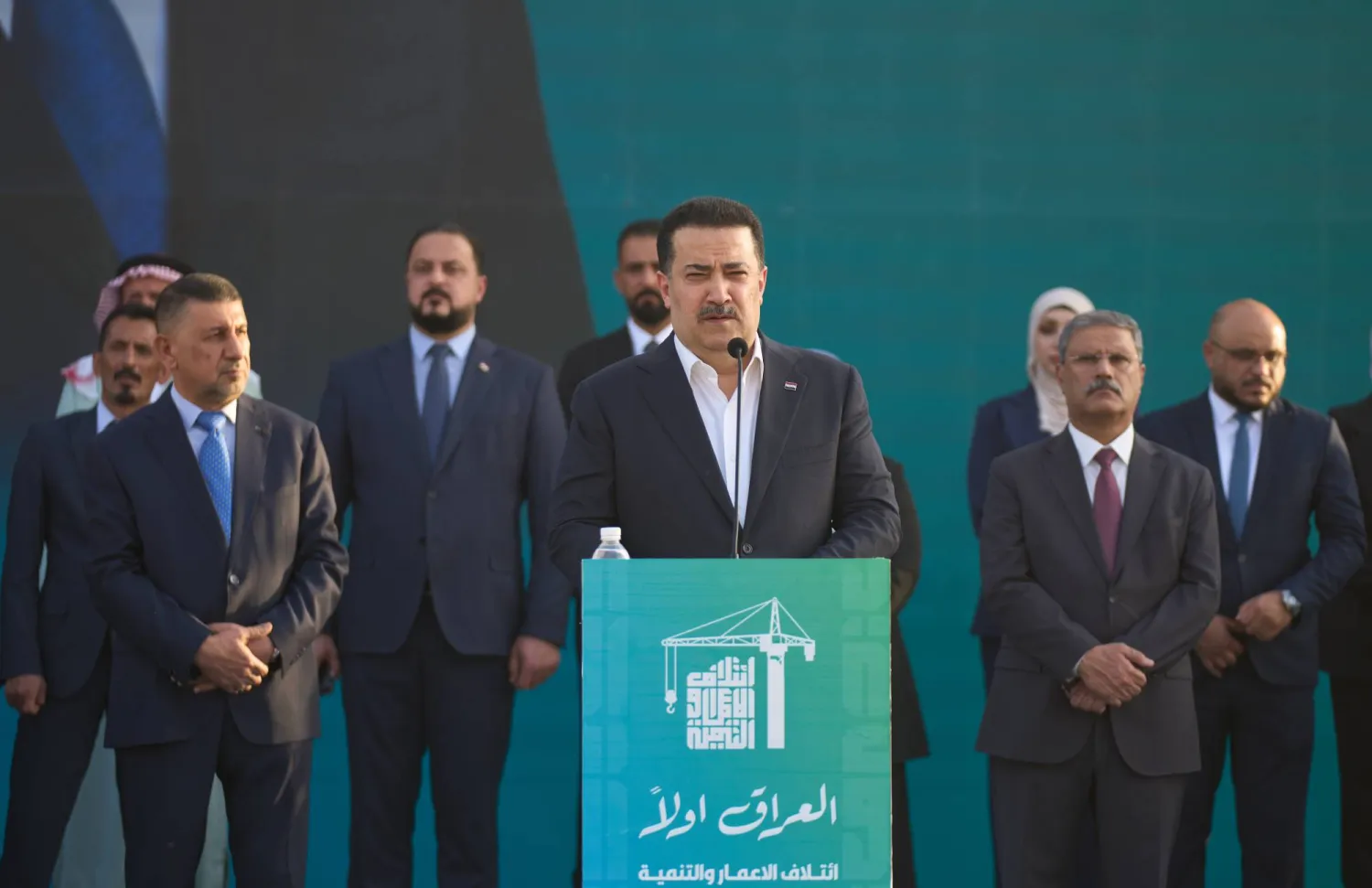

Iraq's Coordination Framework Has Limited Options in Disarming Factions 

Prime Minister Mohammed Shia al-Sudani speaks at his political block campaign rally before the parliamentary elections in Mosul, Iraq, Oct. 18, 2025. (AP)
TT

Iraq's Coordination Framework Has Limited Options in Disarming Factions 

Prime Minister Mohammed Shia al-Sudani speaks at his political block campaign rally before the parliamentary elections in Mosul, Iraq, Oct. 18, 2025. (AP)

Tensions between Baghdad and Washington have been growing more strained in recent days, particularly after the telephone talks between Prime Minister Mohammed Shia al-Sudani and US Secretary of State Marco Rubio, who urged Iraq to disarm Iran-backed militias.

US President Donald Trump also sprung a surprise with the appointment of Iraqi-American businessman Mark Savaya as his special envoy to Iraq.

During their telephone call earlier this week, Rubio “highlighted the urgency in disarming Iran-backed militias that undermine Iraq’s sovereignty, threaten the lives and businesses of Americans and Iraqis, and pilfer Iraqi resources for Iran,” said the State Department.

“The Secretary reiterated the US commitment to working closely with Iraqi partners to advance our shared interests: safeguarding Iraqi sovereignty, bolstering regional stability, and strengthening our economic ties,” it added.

The talks have put the ruling Iran-backed Coordination Framework coalition in Iraq in a tight spot. Sources from the coalition said it met on Wednesday night to discuss the latest American position on Iraq. Rubio’s disarmament call sparked outrage in the coalition, which brings together Iraq’s most prominent Iran-backed Shiite political forces.

The meeting tackled the telephone call, as well as the framework agreement on the withdrawal of US troops from Iraq, said an informed source, according to local media. It also discussed security pledges between Baghdad and Washington.

These developments took place as debate is growing in Iraq about the future of relations with US, especially in wake of Savaya’s appointment, which observers interpreted as a shift in Washington’s policy towards Baghdad after years of “inaction”.

The Coordination Framework did not issue a statement after the meeting, but informed sources told Asharq Al-Awsat that its leaders have very limited options at their disposal when it comes to disarming the militias. Calculations related to the November 11 parliamentary elections have also taken precedence over this issue.

Iraq’s highest Shiite authority Ali al-Sistani had in June called for state monopoly over arms, warning that the circumstances that have prevailed in wake of the Iran-Israel war are “very dangerous”.

‘Conspiracies’

Former Prime Minister and head of the State of Law Coalition of the Coordination Framework Nouri al-Maliki, meanwhile, warned of “conspiracies against the political process in Iraq.”

Speaking at an electoral gathering in Karbala, he described the upcoming polls as a “national and constitutional duty that must not be obstructed.”

“Parliament is the spirit of the state through which democracy is built and governments are formed,” he added.

He spoke of “threats targeting its national unity and elections,” saying they were part of a “broader plot targeting the Iraqi state and its democratic system.”

Former MP Haider al-Mulla told Asharq Al-Awsat that Hamas’s October 2023 attack against Israel marked a turning point in the region, as well as the “phase of relations between Shiite powers and the US and the beginning of a new phase between Washington and some Sunni forces in the region.”

He predicted that “these changes will be capped with changes in Syria and collapse of the Iranian axis,” noting that Trump’s appointment of a new envoy is evidence of the new phase.

Iraq will feel the negative and positive repercussions of the changes in Syria and Iran, he remarked, stressing that the disarmament of militias is now “inevitable after the reasons for carrying weapons no longer exist.”

Media professor Ghaleb al-Daami told Asharq Al-Awsat that the latest American statements have put the Iraqi government “on the spot”, especially since its stances appear to be different than Washington’s.

“The problem doesn’t lie with the government itself, but with its ties to the Coordination Framework, whose options are becoming more limited. The US is no longer willing to give it room to maneuver,” he said.

Politician Abbas Abboud said relations between Baghdad and Washington are “facing their greatest test since 2003.”

Savaya’s appointment is a sign that the American administration “is no longer on side with the parties that were handling communication” with Iraq, he noted.

The Coordination Framework, for its part, does not have a united stance towards Washington in that it does not want to spark a crisis with it, while at the same time, it cannot abandon its regional commitments.



Muscat Detainee Swap Deal Tests Houthi Credibility

Prisoner swap success hinges on Houthi commitment, seriousness (Gov’t Media)
TT

Muscat Detainee Swap Deal Tests Houthi Credibility

Prisoner swap success hinges on Houthi commitment, seriousness (Gov’t Media)

The agreement reached by the Yemeni government in Muscat with the Houthis to exchange about 2,900 prisoners and detainees from both sides marks a new test of the group’s credibility in closing one of the conflict’s most complex humanitarian files after years of delays and failure.

Despite a broad local and international welcome for the deal, doubts still surround its implementation mechanisms, given the absence of final lists and continuing ambiguity over the fate of Mohammed Qahtan, a senior figure in the Islah party who has been abducted for nearly a decade.

According to sources close to the talks, the agreement, sponsored by the office of the United Nations' special envoy for Yemen and supported by the International Committee of the Red Cross, remains at this stage only a preliminary understanding, expected to be implemented within a month.

Sources familiar with the negotiations said the first clause of the agreement is limited to the release of prisoners affiliated with the Saudi-led coalition supporting Yemen’s internationally recognized government, in addition to Mohammed Qahtan. Other details of the deal, including the names of those to be included, remain subject to further bargaining and negotiations between the parties and the mediators.

The same sources stated that what has been achieved so far does not amount to a final settlement, noting that previous negotiation rounds have repeatedly been tied to complex Houthi demands. These have included the insertion of names of fighters missing on the front lines, whom the group claims are held by the government without providing evidence, as well as its repeated refusal to include abducted civilians on the grounds that they are “under judicial process.”

Circles close to the negotiations said appointing Yahya al-Razami, the Houthis’ representative on the military committee, to lead the group’s negotiating team instead of Abdul Qader al-Murtada helped create an atmosphere conducive to reaching the preliminary agreement.

They said al-Murtada, who has been accused of involvement in the torture of some detainees, was a key reason behind the failure of several previous negotiation rounds because of his hardline stance and insistence on what were described as unrealistic conditions.

The same sources added that al-Razami’s presence at the head of the Houthis’ team facilitated discussions and paved the way for agreement on the principle of a comprehensive exchange of prisoners and detainees from both sides, although this remains conditional on the Houthis’ commitment to their pledges and the sincerity of their intentions in providing accurate and reliable information about detainees.

In contrast, the Yemeni government, according to the same assessments, has voiced serious concerns that the Houthis may seek to strip the agreement of its humanitarian substance through stalling tactics or by reintroducing the same conditions that derailed previous attempts.

These indications underline that the success of the deal hinges on the Houthis’ seriousness in honoring their commitments and fully disclosing the fate of all abductees, foremost among them Mohammed Qahtan.

The fate of Mohammed Qahtan remains one of the primary obstacles to implementing the agreement. Although his name was included in the first phase of the deal, his fate has been unknown since his arrest in 2015 at a security checkpoint near the entrance to the city of Ibb. To date, the Houthis have not disclosed whether he is still alive.

According to the sources, this ambiguity has undermined previous understandings and led to the collapse of earlier negotiation rounds, after the Houthis demanded 30 prisoners if Qahtan was alive, or 30 bodies if his death was confirmed.

Officials involved in the file said such behavior raises serious doubts about his fate after more than 10 years and eight months of enforced disappearance, weakening the prospects for building the trust needed to advance the remaining stages of the exchange agreement.

The sources emphasized that the success of any prisoner exchange cannot be achieved without addressing the Qahtan case with clarity and transparency, as it represents both a humanitarian and a political issue, and a genuine test of the Houthis’ commitment to international humanitarian law.

Under the announced understandings, the deal is to be implemented in three main phases. The first phase includes the release of prisoners affiliated with the coalition supporting the Yemeni government, in addition to Mohammed Qahtan. In the second phase, which begins approximately a week later, a joint committee will be formed to conduct field visits to detention sites and document the names of all detainees related to the conflict.

The verified lists will then be submitted to the office of the UN special envoy for Yemen and the International Committee of the Red Cross for official approval and the launch of the exchange process. The third phase will be dedicated to the remains file, covering the exchange of bodies of those killed and the search for the remains of the missing in battle areas, with the aim of closing this painful chapter.

The sources stated that it was agreed upon to include a total number of individuals in the exchange from both sides, with names to be finalized within a month, as well as the recovery of all bodies from various fronts and their handover through the International Committee of the Red Cross. It was also agreed to form committees to visit prisons after the exchange and identify any remaining prisoners, in preparation for their release.

The greatest burden, the sources said, will fall on international mediators, particularly the office of the UN special envoy and the International Committee of the Red Cross, to ensure the agreement is implemented, prevent any party from circumventing it, and establish a clear timeline starting with gathering prisoners and abductees at designated points, matching lists, and setting a start date for the exchange operation.


Brother Details to Asharq Al-Awsat Luring, Disappearance of Lebanese Retired Officer

Abdul Salam Shukr speaks to Asharq Al-Awsat from Nabi Sheet. (Asharq Al-Awsat)
TT

Brother Details to Asharq Al-Awsat Luring, Disappearance of Lebanese Retired Officer

Abdul Salam Shukr speaks to Asharq Al-Awsat from Nabi Sheet. (Asharq Al-Awsat)

Shock still grips the family of retired Lebanese General Security captain Ahmed Shukr, who was abducted days ago, as Lebanese security and judicial assessments increasingly point to Israeli intelligence as being behind his disappearance, over suspected links to the 1986 vanishing of Israeli airman Ron Arad in southern Lebanon.

His brother, Abdul Salam Shukr, told Asharq Al-Awsat the story began when a Lebanese expatriate living in Kinshasa, identified as A.M., contacted Ahmed and asked to rent his apartment in the Choueifat area, south of Beirut.

The two agreed months ago, and the man paid $500 in rent.

The expatriate made repeated visits to Lebanon and met Shukr at his home during one of them. He later contacted the retired officer to say that a wealthy African investor named Salim Kassab, later found to be a fake name, was interested in purchasing a plot of land in the eastern city of Zahle and needed his assistance.

Abdul Salam said the expatriate inspected the land, then called two weeks after leaving Lebanon to say the investor had agreed to buy it and would visit the country. He asked Ahmed to meet him at the site at 4:30 p.m. on the day of the abduction.

He said the expatriate insisted on the timing because it suited the buyer, despite Ahmed’s objections that darkness would have fallen by then, and the land’s features would not be visible. The expatriate later apologized for not attending, claiming he had broken his foot, and said the investor would visit the site alone with Ahmed.

At the time of the meeting, Ahmed disappeared.

“We know nothing about him except what we have heard through security and judicial leaks,” Abdul Salam said. He added that the abductors had rented a house in Zahle and erased all traces from it after kidnapping Ahmed.

Surveillance cameras tracked the vehicle as it headed toward the town of Souireh in the western Bekaa, where the trail then vanished. Souireh was previously used as a smuggling route from southwestern Damascus into Lebanon.

Loyalty to the state

“My brother served 40 years in the military establishment. His loyalty was only to the state and its institutions. He never belonged to any party,” Abdul Salam said. “We are a family that does not engage in politics.”

Ahmed was lured last week in a carefully planned operation that began in his hometown of Nabi Sheet in the northern Bekaa, before he went missing at a point very close to the city of Zahle.

Family members and residents have been gathering at the home of Nabi Sheet’s mukhtar, Abbas Shukr, to voice their protest and condemnation of the abduction.

The family said Ahmed Shukr retired nine years ago after serving for four decades in the General Security, during which he held several posts, including the Masnaa border crossing with Syria and the Qaa crossing in northeastern Lebanon.

“My brother joined the military in 1979, which means he was an ‘officer of the state’ when Arad disappeared in 1986,” Abdul Salam told Asharq Awsat. “An officer of the state does not belong to parties.”

He rejected attempts to link the family by kinship to Fuad Shukr, a Hezbollah leader killed by Israel in July 2024 in Beirut’s southern suburbs, saying no one in the town even knew him.

“He left the town in the early 1980s and never returned. He was distant even from his relatives,” he said, adding that since retiring, his brother “never left the Bekaa. He stayed at home and played cards with friends at night.”

The family home remains in a state of disbelief, a scene that has persisted since his disappearance last week. The case only began to move officially after Vice President of the Supreme Islamic Shiite Council Sheikh Ali al Khatib contacted Lebanese President Joseph Aoun and Interior Minister Ahmed al-Hajjar, according to Abdul Salam.

He said Aoun pledged to instruct security and judicial authorities to expand the investigation and uncover the circumstances surrounding the incident. Officials from the Amal Movement were also in constant contact with Parliament Speaker Nabih Berri, who is head of the movement, to follow up on the case.

Mystery remains

“We demand that the judiciary and security agencies confirm or deny the leak about an alleged link to Ron Arad’s disappearance,” Abdul Salam said.

“That leak does not concern us. What matters is what the security agencies say, including General Security, where Ahmed served, and the Information Branch of the Internal Security Forces, which is leading the investigation.”

He said the key to the mystery lies with A.M., a native of the southern town of Qana who lives in Kinshasa and has been evading the family’s calls.

“The Lebanese state must ask Interpol to arrest him and bring him to Lebanon for questioning,” he urged, adding that the man no longer answers his phone and that all available information about him, including video clips, is now in the hands of security agencies.

Abdul Salam said the family believes the expatriate coordinated the plot with Israel’s Mossad, guiding them to this point and enabling an operation carried out with precision and professionalism.

He said Lebanese security agencies told the family the abductors left no fingerprints, neither at the Zahle property nor at the Choueifat apartment, and that no evidence has been found. The kidnappers’ vehicle also remains unidentified.


UK, Canada, Germany and Others Condemn Israel’s West Bank Settlement Plan

A Palestinian woman walks past the Israeli settlement of Har Homa, southeast of Jerusalem, on November 21, 2025. (AFP)
TT

UK, Canada, Germany and Others Condemn Israel’s West Bank Settlement Plan

A Palestinian woman walks past the Israeli settlement of Har Homa, southeast of Jerusalem, on November 21, 2025. (AFP)

Countries including Britain, Canada and Germany and others on Wednesday condemned the Israeli security cabinet's approval of 19 new settlements in the occupied West ‌Bank, saying ‌they violated ‌international ⁠law and risked ‌fueling instability.

"We call on Israel to reverse this decision, as well as the expansion of ⁠settlements," said a joint ‌statement released ‍by Britain, ‍which also included ‍Belgium, Denmark, France, Italy, Iceland, Ireland, Japan, Malta, the Netherlands, Norway and Spain.

"We recall that such unilateral actions, as ⁠part of a wider intensification of the settlement policies in the West Bank, not only violate international law but also risk fueling instability," the statement ‌added.