
US Warns Baghdad Against Armed Faction Interference in Planned Operations

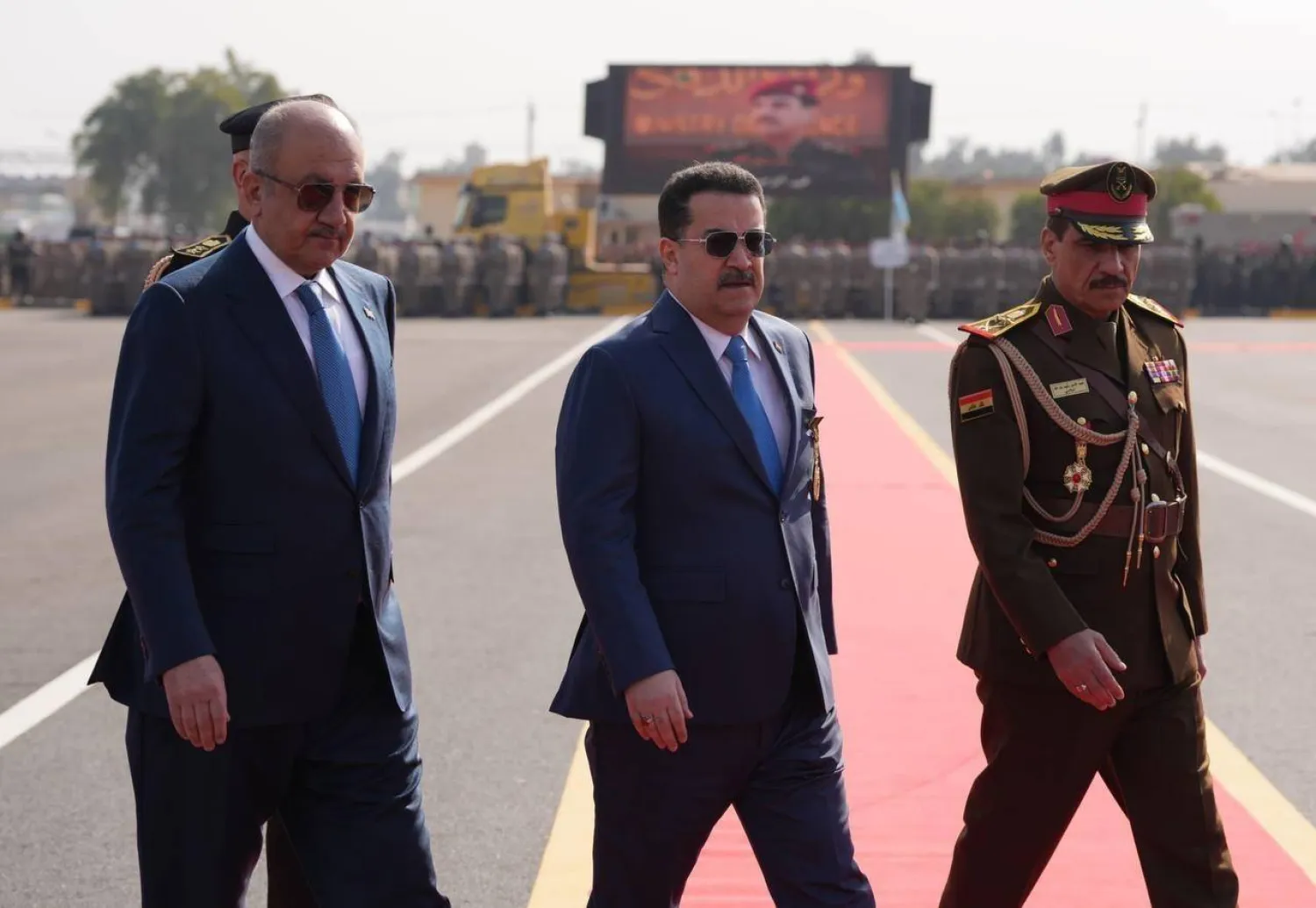
Prime Minister Mohammed Shia al-Sudani with Defense Minister Thabet al-Abbasi and Army Chief of Staff General Abdul Amir Rashid Yarallah (Archive–Prime Minister’s Office)
TT

US Warns Baghdad Against Armed Faction Interference in Planned Operations

Prime Minister Mohammed Shia al-Sudani with Defense Minister Thabet al-Abbasi and Army Chief of Staff General Abdul Amir Rashid Yarallah (Archive–Prime Minister’s Office)

Just two days after a US message reassured Baghdad about the future of bilateral relations, the Iraqi government appears to have received its sternest warning yet from the White House regarding armed factions.

The message contained a direct threat should these groups carry out any retaliatory actions in response to planned US operations in areas near Iraq in the coming days.

Iraq is preparing for its sixth parliamentary elections since the 2003 US-led invasion, amid deep divisions among political forces.

In this context, the mixed signals from Washington have fueled growing concern across the political spectrum, particularly among Shiite factions.

Two days after what seemed a clear signal of support for Prime Minister Mohammed Shia al-Sudani, who is contesting the elections amid intense internal disputes within the Shiite Coordination Framework, Baghdad received a sharply worded warning from US Secretary of War Pete Hegseth, conveyed in a phone call to his Iraqi counterpart, Defense Minister Thabet al-Abbasi.

In a televised interview, al-Abbasi said Hegseth, via the US chargé d’affaires in Baghdad, warned of upcoming military operations in the region, cautioning against any interference by Iraqi factions. No further operational details were provided.

Al-Abbasi said the call lasted 11 to 12 minutes and included Iraq’s Chief of Staff, Deputy Joint Operations Commander, Assistant Operations Chief, and Director of Military Intelligence. The discussion also covered drone cooperation, a proposed security and intelligence cooperation memorandum, and the planned delivery of Bell helicopters to Iraq.

Al Abbasi concluded that Hegseth ended the call with a pointed warning: This is your final notice and you know well how the current administration will respond.

Experts Warn of Serious Concerns
Analysts speaking to Asharq Al-Awsat acknowledged serious concerns over the future of US-Iraq relations, regardless of the upcoming election results.

Dr. Ihsan Al-Shammari, head of the Iraqi Center for Political Thought, told Asharq Al-Awsat that the US administration’s strategy, particularly regarding armed factions and Iranian allies, is still in its initial testing phase.

Therefore, the fact that Washington has not yet taken concrete action suggests that steps are expected within a formal state framework.

Al-Shammari added that the US Secretary of War’s message reflects this approach and carries a clear warning. It signals that these groups are now targeted and have no option but to either align with the state and disarm or face potential US military action.

He noted that statements by US envoy Mark Savaya and Secretary Hegseth constitute a roadmap for political forces forming the next government, in line with American options.

Political analyst Dr. Abbas Abboud Salem told Asharq Al-Awsat that the US warning is not new in terms of Washington’s stance toward armed factions, as the conflict has been ongoing for years. The question now is why the threat comes at this particular moment.

Abboud said regional transformations, including developments in Syria and shifting regional power balances, mark a new phase in which secondary actors can no longer play significant roles.

He added that the US is not seeking an equal partnership with Iraq as it does with other countries. Its primary goal is to curb Iranian influence in Iraq and the broader region, particularly during elections, when some factions are participating, a scenario Washington finds unacceptable.

Security and strategy expert Mukhlid Hazem told Asharq Al-Awsat that it is clear that military arrangements are underway in the region, possibly targeting Iran, with coordinated air operations against Iranian-backed armed factions.

Hazem noted that this is not the first US warning. Secretary of State Marco Rubio previously issued a similar warning during a call with the Iraqi prime minister. Savaya also sent a clear warning in his latest message, and any targeting could occur at any moment, as al-Abbasi publicly confirmed.

He added that there is an unmistakable US escalation against Iran, putting everyone on alert. Military operations against Tehran could happen soon, whether by the US or Israel.

The Muhandis Controversy

Separately, Iraq’s Ministry of Communications responded to a US media report claiming it had contracted the Muhandis company, affiliated with the Popular Mobilization Forces PMF, for a project.

The ministry said in a statement that the company is government-owned, under the PMF, and is entitled to participate in tenders and execute projects according to applicable regulations. It added that all ministry formations have the right to contract with any government-owned companies.

The statement clarified that the contract with Muhandis was fully compliant with Government Contract Execution Instructions No 2, after the company and others from the Ministries of Construction, Housing, and Industry were invited to participate in the maintenance of fiber-optic cable routes and the excavation and extension of new routes.

It stressed that this work is not linked in any way to Iraq’s Communications Administration, which exclusively manages and operates the fiber-optic network, using ministry staff only.

The US Treasury had imposed new sanctions on October 9 targeting Iraqi banking figures and companies linked to the Iranian Revolutionary Guard and Hezbollah Brigades, including Muhandis, described as the PMF’s economic arm. Washington said the sanctions aimed to dismantle corruption and money-laundering networks enabling armed groups to operate inside and outside Iraq.


Sudan Named Most Neglected Crisis of 2025 in Aid Agency Poll 

Sudanese families displaced from el-Fasher reach out as aid workers distribute food supplies at the newly established El-Afadh camp in Al Dabbah, in Sudan's Northern State, Sunday, Nov. 16, 2025. (AP)
TT

Sudan Named Most Neglected Crisis of 2025 in Aid Agency Poll 

Sudanese families displaced from el-Fasher reach out as aid workers distribute food supplies at the newly established El-Afadh camp in Al Dabbah, in Sudan's Northern State, Sunday, Nov. 16, 2025. (AP)

The humanitarian catastrophe engulfing Sudan, unleashing horrific violence on children and uprooting nearly a quarter of the population, is the world's most neglected crisis of 2025, according to a poll of aid agencies.

Some 30 million Sudanese people - roughly equivalent to Australia's population - need assistance, but experts warn that warehouses are nearly empty, aid operations face collapse and two cities have tipped into famine.

"The Sudan crisis should be front page news every single day," said Save the Children humanitarian director Abdurahman Sharif.

"Children are living a nightmare in plain sight, yet the world continues to shamefully look away."

Sudan was named by a third of respondents in a Thomson Reuters Foundation crisis poll of 22 leading aid organizations.

Democratic Republic of Congo (DRC), widely considered the deadliest conflict since World War Two, ranked second.

Although Sudan has received some media attention, Sharif said the true scale of the catastrophe remained "largely out of sight and out of mind."

The United Nations has called Sudan the world's biggest humanitarian crisis, but a $4.16 billion appeal is barely a third funded.

The poll's respondents highlighted a number of overlooked emergencies, including Myanmar, Afghanistan, Somalia, Africa's Sahel region and Mozambique.

Many agencies said they were reluctant to single out just one crisis in a year when the United States and other Western donors slashed aid despite soaring humanitarian needs.

"It feels as though the world is turning its back on humanity," said Oxfam's humanitarian director Marta Valdes Garcia.

'INDICTMENT OF HUMANITY'

The conflict between the Sudanese army and the paramilitary Rapid Support Forces, which erupted out of a power struggle in April 2023, has created the world's largest displacement crisis with 12 million people fleeing their homes.

Aid groups cited appalling human rights violations, including child cruelty, rape and conscription.

"What is being done to Sudan's children is unconscionable, occurring on a massive scale and with apparent impunity," said World Vision's humanitarian operations director Moussa Sangara.

Hospitals and schools have been destroyed or occupied, and 21 million people face acute hunger.

The UN World Food Program (WFP) has warned that without additional funds it will have to cut rations for communities in famine or at risk.

Aid organizations say violence, blockades and bureaucratic obstacles are making it hard to reach civilians in conflict zones.

"What we are witnessing in Sudan is nothing short of an indictment of humanity," said the UN refugee agency's regional director Mamadou Dian Balde.

"If the world does not urgently step up - diplomatically, financially, and morally - an already catastrophic situation will deteriorate further with millions of Sudanese and their neighbors paying the price."

'BREAKING POINT'

South Sudan and Chad, both hosting large numbers of Sudanese refugees, were also flagged in the survey.

Charlotte Slente, head of the Danish Refugee Council, said Chad - a country already dealing with deep poverty and hunger exacerbated by the climate crisis - was being pushed "to breaking point."

"Chad's solidarity with the refugees is a lesson for the world's wealthiest nations. That generosity is being met by global moral failure," Slente said.

In South Sudan, Oxfam said donors were pulling out, forcing aid agencies to cut crucial support for millions of people.

'HELLSCAPE FOR WOMEN'

Several organizations sounded the alarm over escalating conflict in DRC.

Around 7 million people are displaced and 27 million face hunger in the vast resource-rich country, where rape has been used as a weapon of war through decades of conflict.

"This is the biggest humanitarian emergency that the world isn't talking about," said Christian Aid's chief executive Patrick Watt.

On a recent visit, he said villagers told him how armed groups had stolen livestock, torched homes, recruited boys to fight and subjected women and girls to terrifying sexual violence.

Rwandan-backed M23 rebels seized a swathe of eastern Congo this year in their bid to topple the government in Kinshasa. Fighting has continued despite a US-led peace deal signed this month by DRC and Rwanda.

DRC's conflict has intensified amid soaring global demand for minerals needed for clean energy technologies, smartphones and more.

Watt said people now face economic disaster due to Kinshasa's blockade on M23-controlled areas and aid cuts that have hollowed out the humanitarian response.

ActionAid said the violence had "created a hellscape" for women, while the Norwegian Refugee Council (NRC) called Congo "a case study of global neglect."

"This neglect is not an accident: it is a choice," said NRC Secretary General Jan Egeland.

UN aid chief Tom Fletcher named Myanmar as the most neglected crisis, describing it as "a billion-dollar emergency running on fumes."

A $1.1 billion appeal for the southeast Asian country is only 17% funded despite mass displacement, rising hunger and rampant violence.

Although donors raced to help after Myanmar's massive earthquake in March, Fletcher said the world had turned away from the "grinding crisis" underneath.

"Myanmar is becoming invisible," he said.


Fidan, Barrack Discuss Merging of SDF in Syrian Army, Erdogan Warns of Israeli Violations

Turkish Foreign Minister Hakan Fidan and US special envoy to Syria Tom Barrack meet on Tuesday. (Turkish Foreign Ministry)
TT

Fidan, Barrack Discuss Merging of SDF in Syrian Army, Erdogan Warns of Israeli Violations

Turkish Foreign Minister Hakan Fidan and US special envoy to Syria Tom Barrack meet on Tuesday. (Turkish Foreign Ministry)

Turkish Foreign Minister Hakan Fidan and US special envoy to Syria Tom Barrack held talks on Tuesday on the latest developments in Syria a year after the ouster of Bashar al-Assad's regime.

They discussed the measures needed to establish stability in Syria and maintain its territorial integrity.

Turkish sources said the meeting focus primarily on the implementation of the agreement between Syrian interim President Ahmed al-Sharaa and Syrian Democratic Forces (SDF) leader Abdi Mazloum on the merger of the Kurdish forces in the Syrian army.

The agreement was signed in Damascus in March and should have been completed by December.

Fidan and Barrack also tackled the Israeli violations and attacks against Syria and their “negative impact on its stability and unity.” They discussed sanctions on Syria and the support for political steps during the country’s transition, added the sources.

Fidan had on Saturday accused Israel of “encouraging” the SDF to renege on the March agreement.

In a televised interview, he warned that the developments in southern Syria were the “greatest danger.” He explained that the problem isn’t in the extent of the developments, but in how Israel has intervened in them.

The danger in Syria could impact Türkiye, he added.

He stressed the need for the SDF to fulfill its commitments to the March agreement and to dissolve itself and for its foreign fighters to leave Syria.

Turkish President Recep Tayyip Erdogan condemned on Tuesday the Israeli violations in Syria, saying they were the “greatest obstacle” to the country’s security and stability at the time and for the long-term.

Speaking before ambassadors to Türkiye, he vowed that Ankara will continue to support Damascus “as it has always done”.

He echoed Fidan’s demand on the SDF to commit to the March agreement, saying any delay will lead to a new crisis in Syria.

He also slammed the international silence over the “massacres that were committed in Syria” during its 13 years of civil war.

Throughout those years, “except for a few with a real conscience, we didn’t hear anything from the supporters of democracy and defenders of human rights,” he added.


Sudanese Powers Sign Declaration of Principles to End the War 

The gatherers in Nairobi held the warring parties and their allies fully responsible for any violations and war crimes. (Asharq Al-Awsat)
TT

Sudanese Powers Sign Declaration of Principles to End the War 

The gatherers in Nairobi held the warring parties and their allies fully responsible for any violations and war crimes. (Asharq Al-Awsat)

The political and civilian parties of Sudan’s Somoud alliance signed in Nairobi on Tuesday a joint declaration of principles with the Sudan Liberation Movement/Army, led by Abdul Wahid al-Nur, and the Arab Socialist Baath Party to end the war in Sudan and completely eliminate the Islamic movement from politics.

The declaration is the first act of rapprochement between Sudanese parties that are opposed to the ongoing war between the army and Rapid Support Forces (RSF). Former Prime Minister and Somoud leader Abdalla Hamdok was among the signatories.

The declaration said that “there can be no military solution to the crisis”, urging the immediate end to the war.

It called for greater pressure to be applied on the military and RSF to end the conflict and commit to the roadmap drafted by the international Quad that includes Saudi Arabia, the US, United Arab Emirates and Egypt in August.

The declaration called for the swift implementation of a proposed three-month humanitarian truce and for an unconditional ceasefire.

Sudan Liberation Movement/Army deputy leader Abdullah Harran said the signatories of the declaration agreed on the need to expand it further and to bring in more parties to sign it, excluding the ousted National Congress.

Harran told a press conference that the declaration aims to establish a wide popular civilian base that will embark on a transitional phase, leading up to holding free and transparent elections.

The Sudan Liberation Movement/Army holds some regions in central Darfur and has extended its influence in northern parts of the province. It has received tens of thousands of refugees from el-Fasher in areas under its control.

Leading member of the Arab Socialist Baath Party Wajdi Saleh said the gatherers in Nairobi agreed on a “unified vision” to end the war.

They signed three documents, he revealed. The first is the declaration of principles to build a new nation, the second is a roadmap to stop the war and the third aims to designate the National Congress and Islamic movement as terrorist.

Moreover, he declared that the warring parties would be barred from taking part in the democratic transition.

The gatherers held the warring parties and their allies fully responsible for any violations and war crimes, calling on regional and international powers, led by the Quad, to intervene decisively to implement a humanitarian truce.