


Damascus Denies US Planning to Establish Military Presence in Syria 

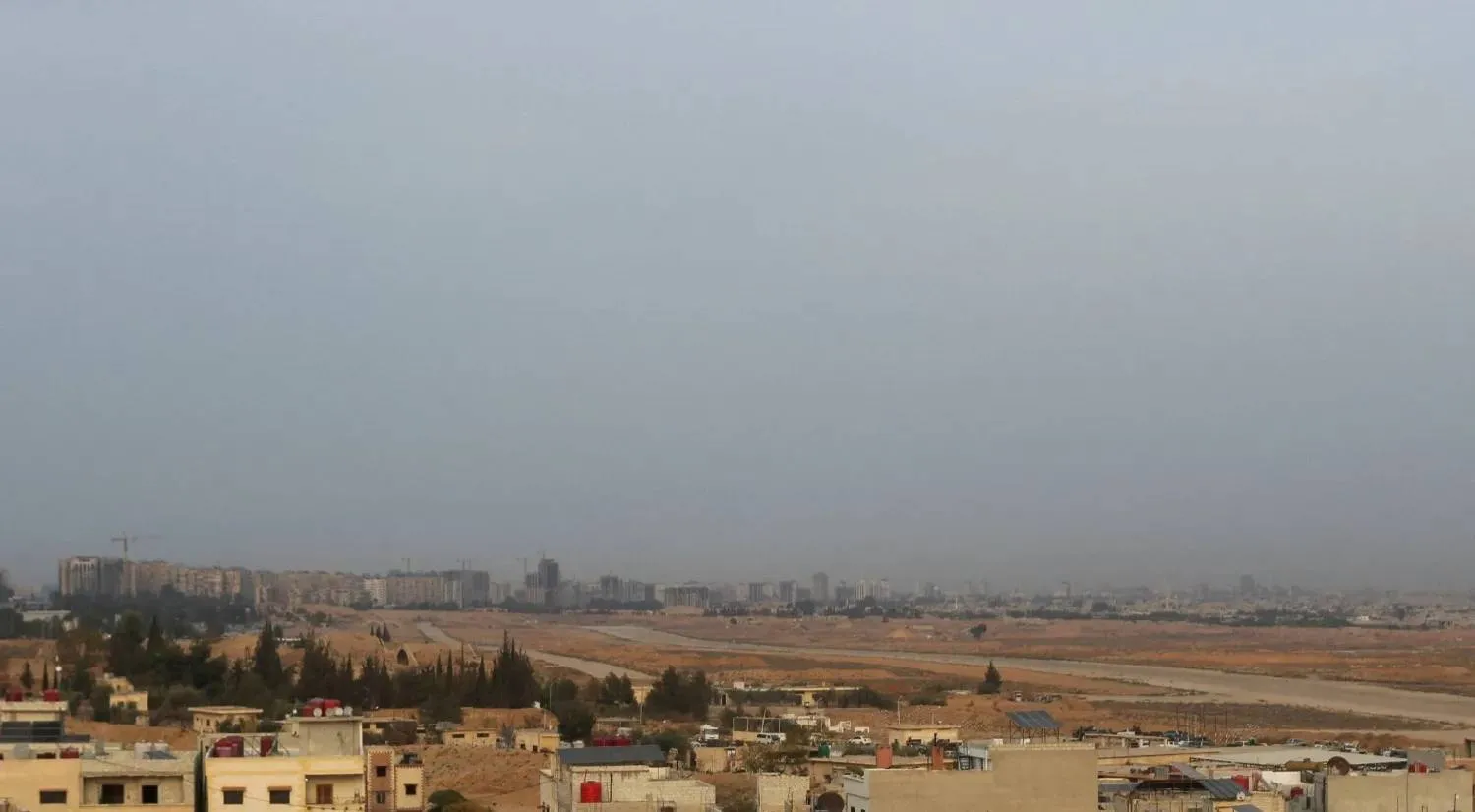
A view of the Mezzeh military airbase in southeastern Damascus. (Reuters file photo)
TT

Damascus Denies US Planning to Establish Military Presence in Syria 

A view of the Mezzeh military airbase in southeastern Damascus. (Reuters file photo)

The Syrian Foreign Ministry denied on Thursday reports saying the United States was planning on establishing a military presence in the country.

Six sources familiar with the matter told Reuters that the US is preparing to establish a military presence at an airbase in Damascus to help enable a security pact that Washington is brokering between Syria and Israel.

After publication, a Syrian foreign ministry source denied the report, saying it was "false", state news agency SANA reported late on Thursday.

"Work is underway to transfer the partnerships and understandings that were necessarily made with provisional entities to Damascus, within the framework of joint political, military and economic coordination," SANA added, citing the source.

The US plans for the presence in the Syrian capital, which have not previously been reported, would be a sign of Syria's strategic realignment with the US following the fall last year of longtime leader Bashar al-Assad, an ally of Iran, continued Reuters.

The base sits at the gateway to parts of southern Syria that are expected to make up a demilitarized zone as part of a non-aggression pact between Israel and Syria. That deal is being mediated by US President Donald Trump's administration.

TRUMP SET TO MEET SYRIAN PRESIDENT ON MONDAY

Trump will meet Syrian President Ahmed al-Sharaa at the White House on Monday, the first such visit by a Syrian head of state.

Reuters spoke to six sources familiar with preparations at the base, including two Western officials and a Syrian defense official, who confirmed the US was planning to use the base to help monitor a potential Israel-Syria agreement.

The Pentagon and Syrian foreign ministry did not immediately respond to requests for comment on the plan. The Syrian presidency and defense ministry did not immediately respond to questions about the plan sent via the Syrian information ministry.

A US administration official said the US was "constantly evaluating our necessary posture in Syria to effectively combat ISIS and (we) do not comment on locations or possible locations of (where) forces operate."

The official requested that the name and location of the base be removed for operational security reasons. Reuters has agreed to not reveal the exact location.

A Western military official said the Pentagon had accelerated its plans over the last two months with several reconnaissance missions to the base. Those missions concluded the base's long runway was ready for immediate use.

Two Syrian military sources said the technical talks have been focused on the use of the base for logistics, surveillance, refueling and humanitarian operations, while Syria would retain full sovereignty over the facility.

A Syrian defense official said the US had flown to the base in military C-130 transport aircraft to make sure the runway was usable. A security guard at one of the base's entrances told Reuters that American aircraft were landing there as part of "tests".

It was not immediately clear when US military personnel would be dispatched to the base.

JOINT SYRIAN-AMERICAN PRESENCE

The new US plans appear to mirror two other new US military presences in the region monitoring cessation of hostilities agreements: one in Lebanon, which closely watches last year's ceasefire between Lebanese armed group Hezbollah and Israel, and one in Israel that monitors the Trump-era truce between Palestinian group Hamas and Israel.

The US already has troops stationed in northeastern Syria, as part of a decade-long effort to help a Kurdish-led force there combat ISIS. In April, the Pentagon said it would halve the number of troops there to 1,000.

Sharaa has said any US troop presence should be agreed with the new Syrian state. Syria is set to imminently join the US-led global anti-ISIS coalition, US and Syrian officials say.

A person familiar with the talks over the base said the move was discussed during a trip by Admiral Brad Cooper, commander of the US Central Command (CENTCOM), to Damascus on September 12.

A CENTCOM statement at the time said Cooper and US envoy to Syria Thomas Barrack had met Sharaa and thanked him for contributing to the fight against ISIS in Syria, which it said could help accomplish Trump's "vision of a prosperous Middle East and a stable Syria at peace with itself and its neighbors." The statement did not mention Israel.

The US has been working for months to reach a security pact between Israel and Syria, two longtime foes. It had hoped to announce a deal at the United Nations General Assembly in September but talks hit a last-minute snag.

A Syrian source familiar with the talks told Reuters that Washington was exerting pressure on Syria to reach a deal before the end of the year, and possibly before Sharaa's trip to Washington.



US Embassy Compound in Baghdad Hit in Missile Attack as Airstrike Kills 2

US soldiers inspect the damage caused by a bombing in Baghdad, Saturday, March 14, 2026. (AP Photo/Hadi Mizban)
TT

US Embassy Compound in Baghdad Hit in Missile Attack as Airstrike Kills 2

US soldiers inspect the damage caused by a bombing in Baghdad, Saturday, March 14, 2026. (AP Photo/Hadi Mizban)

The US embassy in the Iraqi capital Baghdad was hit in a missile attack on Saturday, causing smoke to rise from the building, Iraqi security sources said.

They did not have further details on the ‌strike.

Earlier, an airstrike hit a house in Baghdad, killing at least one person, according to a security official and another affiliated with the Iranian-backed armed groups in the country.

The strike in Baghdad’s Karrada district also wounded two people, they said, speaking on condition of anonymity because they weren’t authorized to speak to the press.

In a statement, the Iraqi military condemned the strike as “a blatant violation of all humanitarian values and a disregard for international conventions.”


Hamas Urges Iran to Stop 'Targeting Neighboring' Countries

FILED - 20 February 2025, Palestinian Territories, Khan Younis: Hamas fighters stand guard at the site where Hamas handed over the bodies of four Israeli hostages to the Red Cross in Khan Yunis. Photo: Abed Rahim Khatib/dpa
TT

Hamas Urges Iran to Stop 'Targeting Neighboring' Countries

FILED - 20 February 2025, Palestinian Territories, Khan Younis: Hamas fighters stand guard at the site where Hamas handed over the bodies of four Israeli hostages to the Red Cross in Khan Yunis. Photo: Abed Rahim Khatib/dpa

Hamas on Saturday called on Iran to refrain from targeting neighboring countries, while affirming Tehran's right to defend itself against Israel and the United States.

"While affirming the right of the Islamic Republic of Iran to respond to this aggression by all available means in accordance with international norms and laws, the movement calls on the brothers in Iran to avoid targeting neighboring countries," Hamas said in a statement.

Hamas, which fought a devastating two-year war with Israel in Gaza, also called on the international community to "work towards halting" the ongoing war immediately.

The group previously condemned the killing of Iran's supreme leader, Ali Khamenei, on the first day of the war as a "heinous crime", openly acknowledging his longstanding support for the Palestinian movement.

"He provided all forms of political, diplomatic and military support to our people, our cause, and our resistance," the movement said soon after the killing of Khamenei.


Ongoing Strikes in Iraq Expose Political, Security Divisions

Mourners attend the funeral of members of Iraq's PMF, who were killed in an airstrike in the town of al‑Qaim near the Syrian border, amid heightened regional tensions due to the US-Israel conflict with Iran, in Baghdad, Iraq, March 12, 2026. REUTERS/Stringer
TT

Ongoing Strikes in Iraq Expose Political, Security Divisions

Mourners attend the funeral of members of Iraq's PMF, who were killed in an airstrike in the town of al‑Qaim near the Syrian border, amid heightened regional tensions due to the US-Israel conflict with Iran, in Baghdad, Iraq, March 12, 2026. REUTERS/Stringer

Strikes targeting armed groups in Iraq are continuing amid the US-Israel war on Iran, piling pressure on decision-makers in Baghdad to maintain a unified stance even as factions declare their participation in the fighting alongside Tehran.

Over the past two weeks, the Iraqi government has repeatedly called for “distinguishing targets” and avoiding “mixing up the cards,” a reference to the need not to target Iraqi state institutions or official forces. The stance clashes with announcements by prominent armed factions declaring their involvement in military operations supporting Iran.

Those factions include Kataib Hezbollah, Harakat al-Nujaba and Ansar Allah al-Awfiya. In statements, they said “collaborators” were providing coordinates to what they described as the “enemy.”

Akram al-Kaabi, leader of Harakat al-Nujaba, said in a statement that recent strikes resulted from information provided by “informants,” without identifying them.

A leader in one of the factions fighting alongside Iran, however, claimed the person in question could be linked to a security agency.

Popular Mobilization sites

According to faction statements, some recent strikes targeted sites linked to the Popular Mobilization Forces (PMF), a security institution that includes several brigades affiliated with armed factions.

Observers say strikes on PMF-linked sites, alongside locations belonging to other factions, have created confusion in the political discourse over the nature of the targets and whether the strikes are aimed at specific factions or at an official security structure.

The Iraqi presidency and the prime minister’s office issued statements in recent days stressing the need to avoid dragging Iraq into the regional conflict, while reaffirming their rejection of using Iraqi territory as an arena for settling scores.

Political divisions

At the same time, divisions are widening among the armed factions themselves and between some factions and the government. Analysts say the rifts appear on two levels: military, over the extent of involvement in the war, and political, over the future of power in Baghdad.

Some factions have announced direct participation in military operations. Others have limited themselves to statements of support for Iran, while a third group has remained silent, awaiting developments in the confrontation.

The divisions are also visible within the Coordination Framework alliance, which includes the main Shiite political forces, particularly over the selection of the next prime minister.

Government formation

Iraqi politicians say the regional military escalation is further complicating an already deadlocked political scene, with parties still unable to agree on a new prime minister.

Former Prime Minister Nouri al-Maliki is the declared candidate of the Coordination Framework alliance. But sources say international objections, including from the United States, are hindering his nomination to form a government.

According to those sources, Maliki has stipulated that if he withdraws from the race, neither the current Prime Minister, Mohammed Shia al-Sudani, nor the former Prime Minister, Haider al-Abadi, should be tasked with forming the government.

Analysts say rising regional tensions could push some political forces to exploit the war to strengthen their negotiating positions inside Iraq, particularly as pressure on Tehran grows, and prospects for regional understandings that previously influenced power arrangements in Baghdad diminish.

Additional complications

The picture is further complicated by ongoing disagreements among Kurdish parties over who should be named the presidential candidate. Under the constitution, the president appoints the nominee of the largest parliamentary bloc to form the government.

Observers say delays by Kurdish parties in agreeing on a presidential candidate are effectively obstructing the formation of a new government, while some political forces are using the delay to justify postponing a decision on the premiership.

Tensions have also risen after reports that areas in the Kurdistan region were struck in connection with the escalation between armed factions and their opponents, potentially adding a new dimension to political disputes between Baghdad and Erbil.