

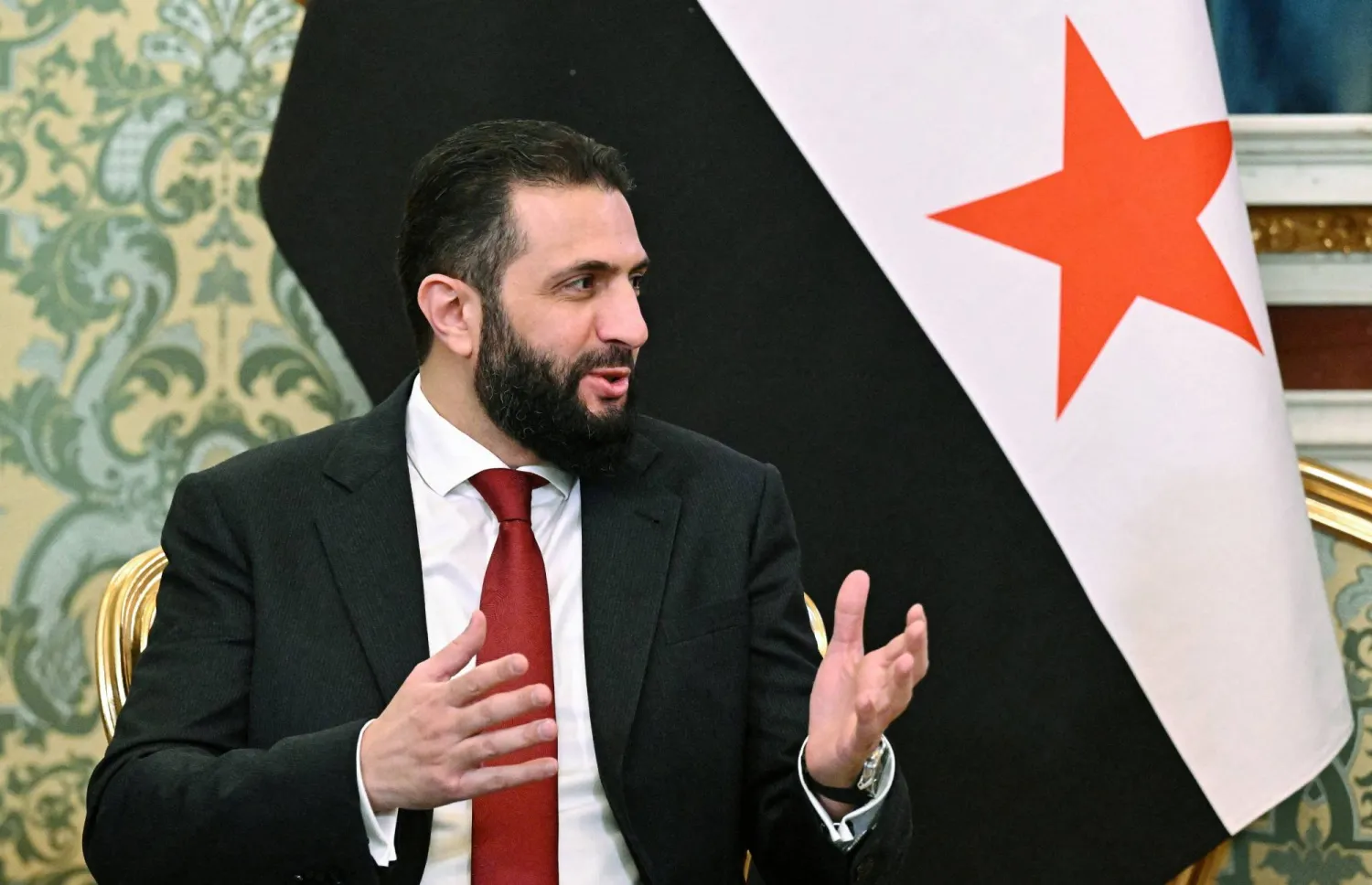

Syrian President in the US for Landmark Visit

FILE PHOTO: Syria's President Ahmed al-Sharaa speaks during a meeting with Russia's President Vladimir Putin in Moscow, Russia, October 15, 2025. Sputnik/Sergey Bobylyov/Pool via REUTERS
TT

Syrian President in the US for Landmark Visit

FILE PHOTO: Syria's President Ahmed al-Sharaa speaks during a meeting with Russia's President Vladimir Putin in Moscow, Russia, October 15, 2025. Sputnik/Sergey Bobylyov/Pool via REUTERS

Syria's President Ahmed al-Sharaa arrived in the United States on Saturday for a landmark official visit, his country's state news agency reported, a day after Washington removed him from a terrorism blacklist.

Sharaa, whose opposition forces ousted longtime ruler Bashar al-Assad late last year, is due to meet US President Donald Trump at the White House on Monday, according to AFP.

It's the first such visit by a Syrian president since the country's independence in 1946, according to analysts.

The interim leader met Trump for the first time in Riyadh during the US president's regional tour in May.

US envoy to Syria Tom Barrack said earlier this month that Sharaa would "hopefully" sign an agreement to join the international US-led alliance against the ISIS extremist group.

The United States plans to establish a military base near Damascus "to coordinate humanitarian aid and observe developments between Syria and Israel", a diplomatic source in Syria told AFP.

The State Department's decision Friday to remove Sharaa from the blacklist was widely expected.

State Department spokesman Tommy Pigott said Sharaa's government had been meeting US demands including on working to find missing Americans and on eliminating any remaining chemical weapons.

"These actions are being taken in recognition of the progress demonstrated by the Syrian leadership after the departure of Bashar al-Assad and more than 50 years of repression under the Assad regime," Pigott said.

The spokesman added that the US delisting would promote "regional security and stability as well as an inclusive, Syrian-led and Syrian-owned political process."

Transformation

Sharaa's Washington trip comes after his landmark visit to the United Nations in September -- his first time on US soil -- where he became the first Syrian president in decades to address the UN General Assembly in New York.

On Thursday, Washington led a vote by the Security Council to remove UN sanctions against him.

Since taking power, Syria's new leaders have sought to break from their violent past and present a moderate image more tolerable to ordinary Syrians and foreign powers.

The White House visit "is further testament to the US commitment to the new Syria and a hugely symbolic moment for the country's new leader, who thus marks another step in his astonishing transformation from militant leader to global statesman," International Crisis Group US program director Michael Hanna said.

Sharaa is expected to seek funds for Syria, which faces significant challenges in rebuilding after 13 years of brutal civil war.

In October, the World Bank put a "conservative best estimate" of the cost of rebuilding Syria at $216 billion.



Lebanese, Syrian Presidents Agree on Tightening Border Control

This handout photograph released by the Lebanese Presidency Press Office shows Lebanon's President Joseph Aoun giving a joint-press conference with Germany's president at the Presidential Palace in Baabda, east of Beirut, on February 16, 2026. (Lebanese Presidency Press Office / AFP)
TT

Lebanese, Syrian Presidents Agree on Tightening Border Control

This handout photograph released by the Lebanese Presidency Press Office shows Lebanon's President Joseph Aoun giving a joint-press conference with Germany's president at the Presidential Palace in Baabda, east of Beirut, on February 16, 2026. (Lebanese Presidency Press Office / AFP)

The Lebanese and Syrian presidents agreed Tuesday on the need to step up control over their shared frontier following a pair of incidents involving cross-border fire.

Lebanon's Joseph Aoun and Syria's Ahmed al-Sharaa agreed during a phone call that "the current sensitive situation requires enhancing coordination and consultation... especially with regard to the necessity of controlling the border", a Lebanese presidency statement said.

Sharaa also "expressed his support for the Lebanese president's efforts to disarm Hezbollah and spare the region the repercussions of the current conflict", according to a statement from the Syrian presidency.

The phone call between the leaders came hours after Syria accused pro-Iran Hezbollah of firing artillery shells into its territory.

Syrian army officials said shells fired from Lebanon landed near the town of Serghaya, west of Damascus, the state news agency SANA reported on Tuesday.

"The Syrian Arab Army will not tolerate any aggression targeting Syria," the army said in a statement to official media.

Earlier, a Lebanese soldier was moderately wounded on Friday by "gunfire from the Syrian side targeting a Lebanese army post in the Qasr-Hermel area", Lebanon's army said.

"An investigation is underway to determine the circumstances of the incident in coordination with the relevant Syrian authorities."

Lebanon was drawn into the Middle East war last week when Hezbollah attacked Israel in response to the killing of Iranian supreme leader Ali Khamenei during US-Israeli strikes. Syria has so far remained on the sidelines.

In recent days, areas adjacent to Syria and controlled by Hezbollah in eastern Lebanon have witnessed fierce clashes between the group and Israeli commando forces.

Syria responded to the outbreak of the regional war last week by stationing additional troops on its borders with Lebanon and Iraq.

Hezbollah had been a key ally of Damascus during the rule of former president Bashar al-Assad, and it intervened militarily in support of him in 2013, remaining in Syria for years in a number of border towns and crossings.


Report: Hezbollah Returns to Guerrilla Roots, Awaits Israeli Invasion

 Rockets are launched from Lebanon, as seen from the Israeli side of the Israel-Lebanon border, amid escalation between Hezbollah and Israel, and amid the US-Israeli conflict with Iran, in northern Israel, March 10, 2026. (Reuters)
Rockets are launched from Lebanon, as seen from the Israeli side of the Israel-Lebanon border, amid escalation between Hezbollah and Israel, and amid the US-Israeli conflict with Iran, in northern Israel, March 10, 2026. (Reuters)
TT

Report: Hezbollah Returns to Guerrilla Roots, Awaits Israeli Invasion

 Rockets are launched from Lebanon, as seen from the Israeli side of the Israel-Lebanon border, amid escalation between Hezbollah and Israel, and amid the US-Israeli conflict with Iran, in northern Israel, March 10, 2026. (Reuters)
Rockets are launched from Lebanon, as seen from the Israeli side of the Israel-Lebanon border, amid escalation between Hezbollah and Israel, and amid the US-Israeli conflict with Iran, in northern Israel, March 10, 2026. (Reuters)

Lebanon's Hezbollah is applying lessons from its last war with Israel as it braces for a possible full-scale Israeli invasion and protracted conflict, returning to its roots in guerrilla warfare in south Lebanon, four Lebanese sources told Reuters.

Operating in small units, fighters from the Iran-backed group are avoiding the use of communication devices that could be at risk of Israeli tapping, and are rationing the use of key anti-tank rockets as they engage Israeli troops, said the sources, who are familiar with Hezbollah military activities.

Some 15 months since Israel pounded Hezbollah in their last war, the group sparked a new Israeli offensive last week by opening fire to avenge the killing of Supreme Leader Ali Khamenei at the start of the US-Israeli war on Iran.

Heavily criticized in Lebanon for dragging the country into a war that has displaced 700,000 people, Hezbollah ‌has described its actions ‌as "existential defense", framing it as a response to Israeli attacks that have continued since ‌a ⁠2024 ceasefire.

While Israel ⁠plans for the likely continuation of its Lebanon offensive after the Iran war, the four sources said Hezbollah's calculations are based on Iran's clerical leadership surviving the war, leading to a regional ceasefire of which it would be part.

FIGHTING FOCUSED AT INTERSECTION OF SYRIAN, ISRAELI BORDERS

The sources who are familiar with Hezbollah thinking declined to be named due to the sensitivity of the matter. The details of how Hezbollah is operating in the field have not previously been reported.

Hezbollah's media office didn't immediately respond to a request for comment.

Hezbollah, a Shiite group founded by Iran's Revolutionary Guards in 1982, was the only Lebanese group ⁠to keep its weapons at the end of the 1975-90 civil war to fight Israeli ‌troops who occupied the south until withdrawing in 2000.

Hezbollah's role in ‌driving them out has underpinned its popularity among many Shiites, though its decision to enter the Iran war has drawn criticism from ‌within the Shiite community.

This war has come at a critical juncture for Hezbollah.

Greatly weakened during the 2024 war, ‌Hezbollah has faced pressure from the Lebanese state to disarm. The Beirut government last week banned Hezbollah's military activities.

Adding to the pressures on Hezbollah since the 2024 war, its Syrian ally President Bashar al-Assad was toppled in December of that year, severing the main supply route from Iran.

The sources said much of Hezbollah's fighting on the ground had been focused so far near the town of ‌Khiam, near the intersection of Lebanon's border with Israel and Syria.

This is one area where Hezbollah believes any Israeli land invasion could begin.

Reuters reported last week that Hezbollah's ⁠elite Radwan fighters, who withdrew ⁠from the south following the 2024 ceasefire, had returned to the area.

ISRAELI SOURCE: HEZBOLLAH STABILIZING RANKS DESPITE BLOWS

An Israeli security source said there was no sign that Hezbollah was looking to de-escalate - quite the opposite. While Israel had eliminated a few of Hezbollah's very senior commanders, it seemed that the group was managing to stabilize its ranks and make and execute decisions.

Two of the Lebanese sources said four deputies had been appointed for every Hezbollah commander, to ensure continued operations.

The Israeli military says it has struck hundreds of Hezbollah targets since March 2, launching airstrikes in the south, Beirut's Hezbollah-controlled southern suburbs, and the eastern Bekaa Valley.

The Israeli military has also sent more soldiers into south Lebanon, where some of its troops had remained since 2024, establishing what it has called forward defensive positions to guard against the risk of Hezbollah attacks on northern Israel.

Two Israeli soldiers have been killed in Lebanon.

Hezbollah has launched daily drone and rocket attacks at Israel.

In 2024, not only did Israel booby-trap hundreds of pagers used by Hezbollah, but it also penetrated the group's private phone network, according to Lebanese officials familiar with Hezbollah's post-war investigation into breaches.

The sources said Hezbollah was avoiding any devices that could be susceptible to eavesdropping.


Iraq Seeking New Oil Export Routes after Hormuz Disruption

FILE PHOTO: Tankers are seen off the coast of Fujairah, as Iran vows to fire on ships transiting the Strait of Hormuz, amid the US-Israel conflict with Iran, in Fujairah, United Arab Emirates, March 3, 2026. REUTERS/Amr Alfiky/File Photo
TT

Iraq Seeking New Oil Export Routes after Hormuz Disruption

FILE PHOTO: Tankers are seen off the coast of Fujairah, as Iran vows to fire on ships transiting the Strait of Hormuz, amid the US-Israel conflict with Iran, in Fujairah, United Arab Emirates, March 3, 2026. REUTERS/Amr Alfiky/File Photo

Iraqi authorities are exploring alternative routes to export oil after transit through the Strait of Hormuz was disrupted by the Middle East war, an oil ministry spokesperson told AFP Tuesday.

Saheb Bazoun said that "much like other countries in the region, oil production and marketing have been severely impacted, leaving the government no choice but to seek alternative" export routes.

Iraq has several oil shipments stuck at sea, he said.

Iraq is a founding member of the OPEC cartel, and crude oil sales make up 90 percent of the country's budget revenues.

Before the war, it was exporting more than 3.5 million barrels per day.

The Strait of Hormuz remains closed to almost all oil tankers, and Iran has vowed that not one litre of oil would be exported from the Gulf while its war with the United States and Israel continues.

Iraq's oil production and exports have sharply decreased, Bazoun said.

Iraqi authorities are considering several options for exports, including a pipeline which runs thought Iraq's northern Kurdistan region to the port of Ceyhan in Türkiye.

They are also considering transporting oil by land, but many plans will require time to be implemented, according to Bazoun.

A senior official in Iraq's Kurdistan region told AFP talks are underway to facilitate oil exports from federal Iraq.

He said that Baghdad had requested to "export 200,000 bpd" via the Ceyhan pipeline, which has a capacity of 700,000 bpd.

But regional authorities asked for several measures in return, including that Baghdad facilitates the region's access to US dollars through banks.

"We have made it clear to Baghdad that the relief on dollars should happen first," the Kurdish official said, claiming that there is a "100 percent dollar embargo on Kurdistan."

Since the start of the year, Iraq has been dealing with a US dollar liquidity shortage that has affected many sectors across the country.

Oil production has also been disrupted in the Kurdistan region since foreign oil companies have halted production as a precautionary measure since the start of the war.