


Netanyahu and Kushner Meet as Gaza Ceasefire’s First Phase Winds Down

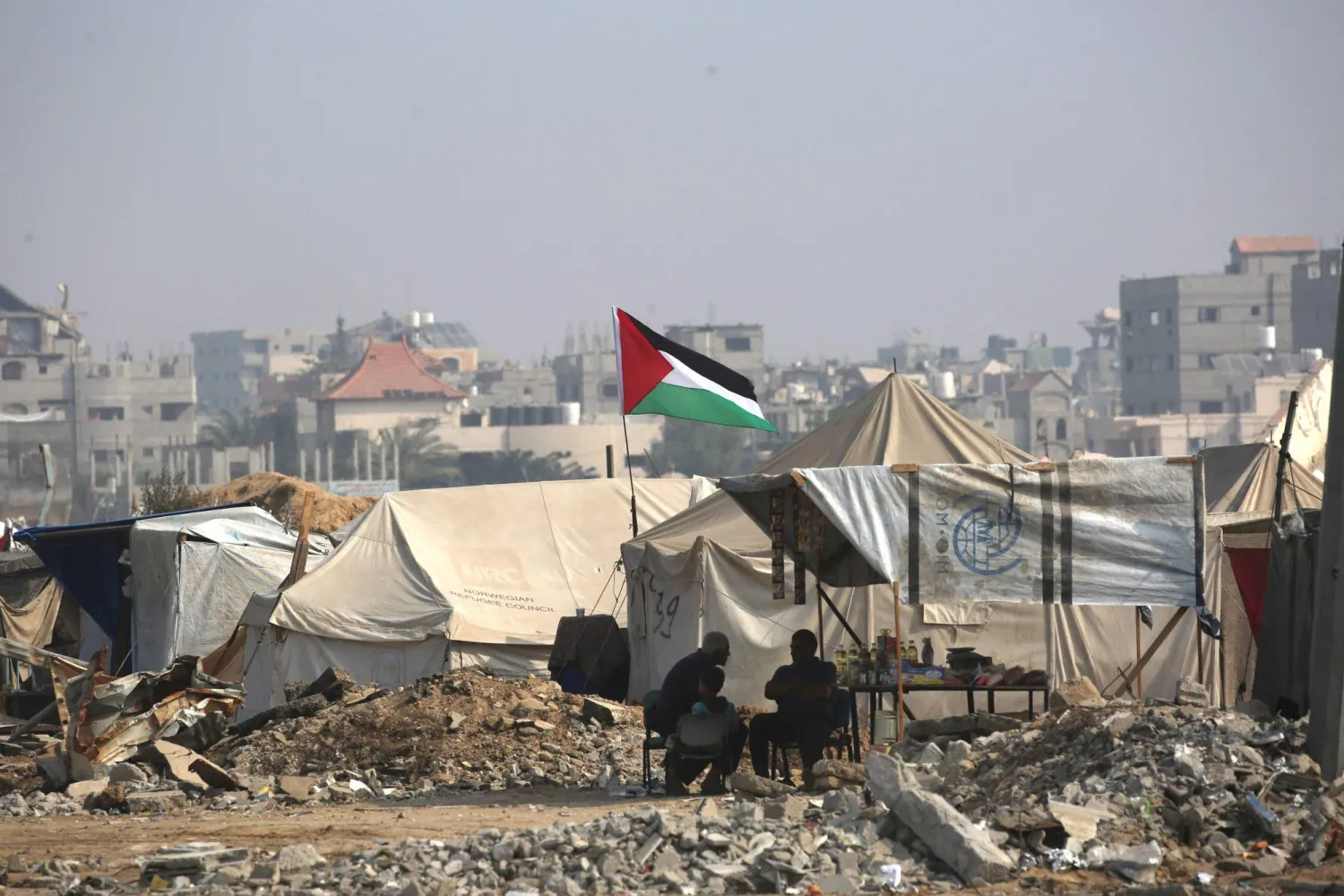
Palestinians sit outside their make shift homes along a road near the Nuseirat refugee camp in the central Gaza Strip, on November 9, 2025, following a US-brokered truce that halted the two-year war. (AFP)
TT

Netanyahu and Kushner Meet as Gaza Ceasefire’s First Phase Winds Down

Palestinians sit outside their make shift homes along a road near the Nuseirat refugee camp in the central Gaza Strip, on November 9, 2025, following a US-brokered truce that halted the two-year war. (AFP)

US President Donald Trump’s son-in-law, Jared Kushner, met on Monday with Israeli Prime Minister Benjamin Netanyahu to discuss the next stages of the fragile Gaza ceasefire, while Israel returned the remains of another 15 Palestinians. 

The remains of four hostages are still in Gaza after Palestinian fighters released the remains of another on Sunday. 

The first stage of the ceasefire agreement that took effect on Oct. 10 is nearing its end. The next stage calls for the implementation of a governing body for Gaza and the deployment of an international stabilization force. It is not clear where either stands. 

Israel ended the previous ceasefire agreement earlier this year after a period of exchanging hostages for Palestinian prisoners. At the time, mediators were unable to bring Hamas and Israel to the table to negotiate a troop withdrawal and a plan for the future governance of Gaza. 

The latest exchange of bodies  

For each Israeli hostage returned, Israel has been releasing the remains of 15 Palestinians — an exchange central to the ceasefire's first phase. The Gaza Health Ministry said the total number of remains received is now 315. 

Only 91 have been identified, the ministry said. Forensic work is complicated by a lack of DNA testing kits in Gaza. The ministry posts photos of the remains online in the hope that families will recognize them. 

One mother waited at Nasser Hospital in the southern city of Khan Younis, wondering whether her missing 15-year-old son was among the new remains returned. He disappeared while on the way to school on Oct. 7, 2023, when Hamas launched an attack on Israel that started the war. 

“Rayyan has been missing for two years. I don’t know his fate, whether he’s still alive or dead,” Shaima Abu Ouda said. She said he vanished near the wall separating Gaza and southern Israel. Her husband and eldest son were killed during the war. 

On Sunday, Israel confirmed it had received the remains of Hadar Goldin, a soldier killed in the Gaza Strip in 2014, closing a painful chapter for the country. The 23-year-old was killed two hours after a ceasefire took effect in that year’s war between Israel and Hamas. 

His remains had been the only ones left in Gaza predating the current war between Israel and Hamas. A funeral was scheduled for Tuesday. 

Around 1,200 people, mostly civilians, were killed in the 2023 Hamas-led attack on Israel, and 251 people were kidnapped. 

On Saturday, Gaza’s Health Ministry said the number of Palestinians killed in Gaza has risen to 69,176. Its count does not distinguish between fighters and civilians, but the ministry says more than half of those killed were women and children. 

The ministry, part of the Hamas-run government and staffed by medical professionals, maintains detailed records viewed as generally reliable by independent experts. 

US officials try to push ceasefire forward  

Netanyahu and Kushner discussed the progress and future of the ceasefire, said Israeli government spokesperson Shosh Bedrosian. 

The deal has focused on the first phase of halting the fighting, releasing all hostages and boosting humanitarian aid to Gaza. Details of the second phase haven’t been worked out. 

Kushner also was helping to lead negotiations to secure safe passage for 150-200 trapped Hamas fighters in exchange for surrendering their weapons after the release of Goldin’s remains, according to someone close to the negotiations who spoke on condition of anonymity to describe the talks. 

Bedrosian did not say where those negotiations were headed. 

Hamas has made no comment on a possible exchange for its fighters stuck in the so-called yellow zone of territory controlled by Israeli forces, though it has acknowledged that clashes were taking place there. 

West Bank village faces demolition  

Palestinians in the Israeli-occupied West Bank village of Umm al-Khair, which was featured in the Oscar-winning documentary “No Other Land,” was bracing Monday for the arrival of Israeli military bulldozers. 

The documentary chronicles villagers’ attempts to survive state-backed demolitions and rampant violence from Israeli settlers. 

Residents say Israel has ordered the demolition of 14 structures, including the community center, greenhouse and family homes. A press release from the community said the demolitions could begin Tuesday. 

Israel says the structures were built illegally. Residents, determined to stay on their land, say it is impossible to secure permits to build in the West Bank, leaving them little choice but to rebuild their homes following demolitions. 

Bimkom, an Israeli rights group that focuses on urban planning, says that between 2016 and 2021 Israel rejected 99% of Palestinian requests for building permits in Area C of the West Bank, where Umm al-Khair is located. 

The village was founded in the 1950s by traditionally nomadic people, known as Bedouin, who settled there after being uprooted from the Negev desert during the 1948 war surrounding Israel’s creation. Two decades later, Umm al-Khair fell under Israeli security control when Israel captured the West Bank. 

Settler attacks, residents say, began in the 1980s, after Israel built the settlement of Carmel close to Umm al-Khair. 

Earlier this year, an internationally sanctioned Israeli settler shot and killed a community leader, Awdah Hathaleen, as he was standing inside the community center slated for demolition. 


Saudi Intervention Ends Socotra Power Crisis

Socotra power generators restarted after Saudi intervention (X)
TT

Saudi Intervention Ends Socotra Power Crisis

Socotra power generators restarted after Saudi intervention (X)

Electricity has returned to Yemen’s Socotra archipelago after urgent Saudi intervention ended days of outages that disrupted daily life and crippled vital institutions, including the general hospital, the university and the technical institute.

The breakthrough followed a sudden shutdown of the power plants after the operating company withdrew and disabled control systems, triggering widespread blackouts and deepening hardship for residents.

The Saudi Program for the Development and Reconstruction of Yemen said its engineering and technical teams moved immediately after receiving an appeal from local authorities. Specialists were dispatched to reactivate operating systems that had been encrypted before the company left the island.

Generators were brought back online in stages, restoring electricity across most of the governorate within a short time.

The restart eased intense pressure on the grid, which had faced rising demand in recent weeks after a complete halt in generation.

Health and education facilities were among the worst affected. Some medical departments scaled back services, while parts of the education sector were partially suspended as classrooms and laboratories were left without power.

Socotra’s electricity authority said the crisis began when the former operator installed shutdown timers and password protections on control systems, preventing local teams from restarting the stations. Officials noted that the archipelago faced a similar situation in 2018, which was resolved through official intervention.

Local sources said the return of electricity quickly stabilized basic services. Water networks resumed regular operations, telecommunications improved, and commercial activity began to recover after a period of economic disruption linked to the outages.

Health and education rebound

In the health sector, stable power, combined with operational support, secured the functioning of Socotra General Hospital, the archipelago’s main medical facility.

Funding helped provide fuel and medical supplies and support healthcare staff, strengthening the hospital’s ability to receive patients and reducing the need to transfer cases outside the governorate, a burden that had weighed heavily on residents.

Medical sources said critical departments, including intensive care units and operating rooms, resumed normal operations after relying on limited emergency measures.

In education, classes and academic activities resumed at Socotra University and the technical institute after weeks of disruption.

A support initiative covered operational costs, including academic staff salaries and essential expenses, helping curb absenteeism and restore the academic schedule.

Local authorities announced that studies at the technical institute would officially restart on Monday, a move seen as a sign of gradual stabilization in public services.

Observers say sustained technical and operational support will be key to safeguarding electricity supply and preventing a repeat of the crisis in a region that depends almost entirely on power to run its vital sectors.


Egypt’s Prime Minister and FM Head to Washington for Trump Peace Council Meeting

Egyptian Foreign Minister Badr Abdelatty speaks during a joint press conference with Kenyan Prime Cabinet Secretary/Cabinet Secretary for Foreign Diaspora Affairs Musalia Mudavadi in Nairobi, Kenya, Monday, Feb. 16, 2026. (AP)
TT

Egypt’s Prime Minister and FM Head to Washington for Trump Peace Council Meeting

Egyptian Foreign Minister Badr Abdelatty speaks during a joint press conference with Kenyan Prime Cabinet Secretary/Cabinet Secretary for Foreign Diaspora Affairs Musalia Mudavadi in Nairobi, Kenya, Monday, Feb. 16, 2026. (AP)

Egypt's Prime Minister Mostafa Madbouly headed to Washington on Tuesday ‌to ‌participate in ‌the inaugural ⁠meeting of a "Board of Peace" established by US President Donald ⁠Trump, the ‌cabinet ‌said.

Madbouly is ‌attending ‌on behalf of President Abdel ‌Fattah al-Sisi and is accompanied by ⁠Foreign ⁠Minister Badr Abdelatty.

Foreign Minister Gideon Saar will represent Israel at the inaugural meeting, his office said on Tuesday.

Hamas, meanwhile, called on the newly-formed board to pressure Israel to halt what it described as ongoing violations of the ceasefire in Gaza.

The Board of Peace, of which Trump is the chairman, was initially designed to oversee the Gaza truce and the territory's reconstruction after the war between Hamas and Israel.

But its purpose has since morphed into resolving all sorts of international conflicts, triggering fears the US president wants to create a rival to the United Nations.

Saar will first attend a ministerial level UN Security Council meeting in New York on Wednesday, and on Thursday he "will represent Israel at the inaugural session of the board, chaired by Trump in Washington DC, where he will present Israel's position", his office said in a statement.

It was initially reported that Prime Minister Benjamin Netanyahu might attend the gathering, but his office said last week that he would not.

Ahead of the meeting, Hamas spokesman Hazem Qassem told AFP that the Palestinian movement urged the board's members "to take serious action to compel the Israeli occupation to stop its violations in Gaza".

"The war of genocide against the Strip is still ongoing -- through killing, displacement, siege, and starvation -- which have not stopped until this very moment," he added.

He also called for the board to work to support the newly formed Palestinian technocratic committee meant to oversee the day-to-day governance of post-war Gaza "so that relief and reconstruction efforts in Gaza can commence".

Announcing the creation of the board in January, Trump also unveiled plans to establish a "Gaza Executive Board" operating under the body.

The executive board would include Turkish Foreign Minister Hakan Fidan and Qatari diplomat Ali Al-Thawadi.

Netanyahu has strongly objected to their inclusion.

Since Trump launched his "Board of Peace" at the World Economic Forum in Davos in January, at least 19 countries have signed its founding charter.


Palestinian Child Dies After Stepping on Mine in West Bank

Israeli troops conduct a military raid in the village of Al-Yamoun, west of Jenin, West Bank, 17 February 2026. (EPA)
TT

Palestinian Child Dies After Stepping on Mine in West Bank

Israeli troops conduct a military raid in the village of Al-Yamoun, west of Jenin, West Bank, 17 February 2026. (EPA)

A Palestinian child died after stepping on a mine near an Israeli military camp in the occupied West Bank on Tuesday, the Palestinian Red Crescent said, with an Israeli defense ministry source confirming the death.

"Our crews received the body of a 13-year-old child who was killed after a mine exploded in one of the old camps in Jiftlik in the northern Jordan Valley," the Red Crescent said in a statement.

A source at COGAT, the Israeli defense ministry's agency in charge of civilian matters in the Palestinian territories, confirmed the death to AFP and identified the boy as Mohammed Abu Dalah, from the village of Jiftlik.

Israel's military had previously said in a statement that three Palestinians were injured "as a result of playing with unexploded ordnance", without specifying their ages.

It added that the area of the incident, Tirzah, is "a military camp in the area of the Jordan Valley", near Jiftlik and close to the Jordanian border.

"This area is a live-fire zone and entry into it is prohibited," the military said.

Jiftlik village council head Ahmad Ghawanmeh told AFP that three children, the oldest of whom was 16, were collecting herbs near the military base when they detonated a mine.

Jiftlik as well as the nearby Tirzah base are located in the Palestinian territory's Area C, which falls under direct Israeli control.

Israel has occupied the West Bank since 1967.

Much of the area near the border with Jordan -- which Israel signed a peace deal with in 1994 -- remains mined.

In January, Israel's defense ministry said it had begun demining the border area as part of construction works for a new barrier it says aims to stem weapons smuggling.
