Under US Pressure, Lebanon Tightens Screws on Money Transfers

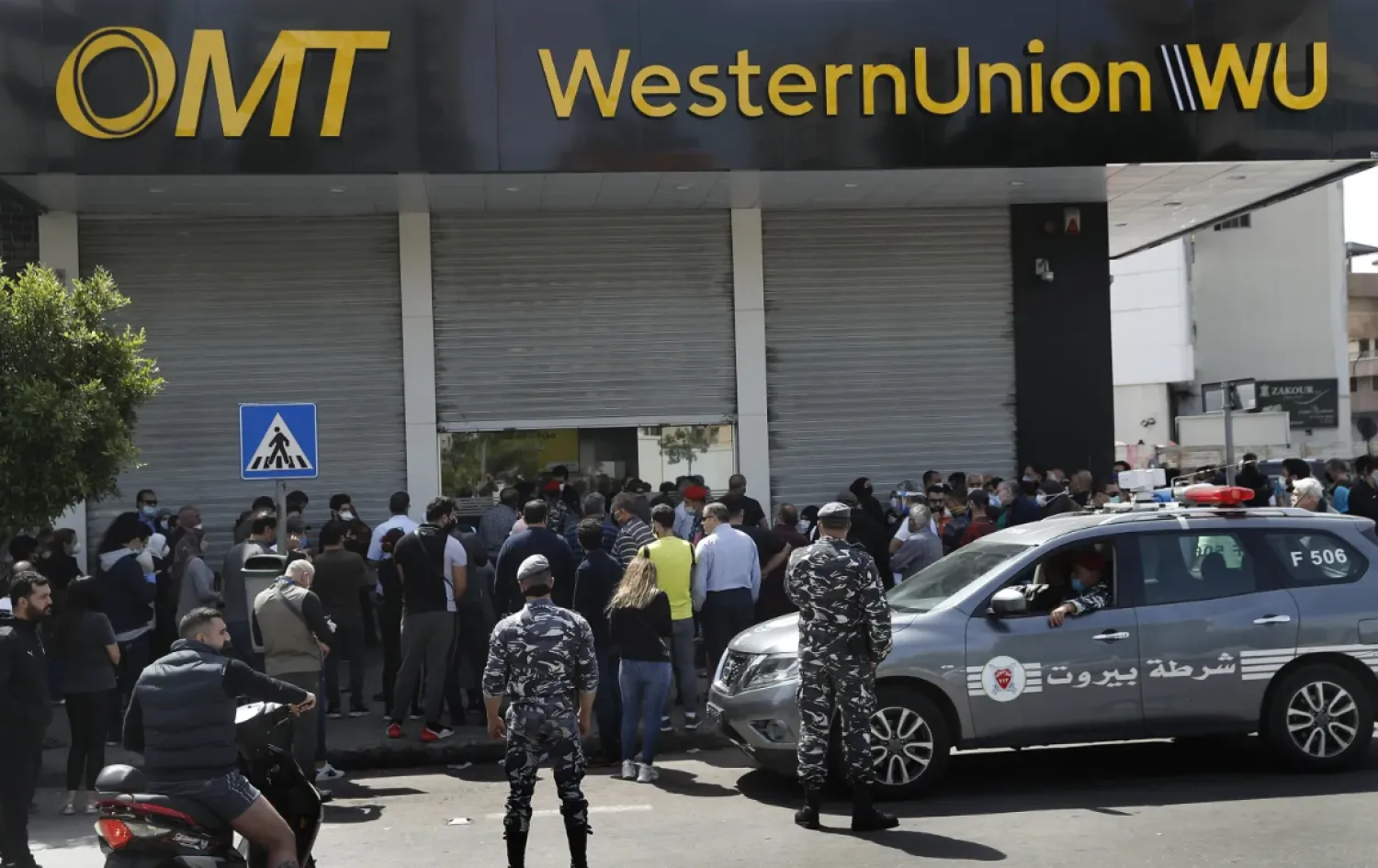
Lebanese citizens queue outside a Western Union shop to receive their money transfers. AP file photo
TT

Under US Pressure, Lebanon Tightens Screws on Money Transfers

Lebanese citizens queue outside a Western Union shop to receive their money transfers. AP file photo

Lebanon announced on Friday that money changers and transfer companies must comply with stricter rules as the country faces heavy US pressure to regulate its cash economy and cut off Hezbollah funding.

The move comes days after a visiting US official said his country was determined to cut off Tehran's funding to the group, and after the US Treasury said Iran's Revolutionary Guards had transferred over $1 billion to Hezbollah this year, mainly via money exchange companies.

Lebanese authorities are seeking to disarm Hezbollah, which was badly weakened in a recent war with Israel, and face heavy US pressure to do so more quickly as well as fears of expanded Israeli military action.

As part of efforts "to remove Lebanon from the Financial Action Task Force (FATF) grey list... the central bank of Lebanon today has taken the first step in a series of precautionary measures aiming to strengthen the compliance environment within the financial sector", a central bank statement said.

The FATF in October last year added Lebanon to its "grey list" of nations that are subject to increased monitoring of financial transactions.

The central bank said it was imposing measures "on all non-bank financial institutions licenced by the central bank of Lebanon, including money transfer companies, exchange bureaus" and other firms handling foreign currency transactions and transfers to and from the country.

According to a central bank circular, from December 1, all non-bank financial institutions must "collect information and data linked to their customers and operations" for transactions of $1,000 or more and report them to the central bank.

Institutions must confirm they have collected the required information before carrying out any transaction, the circular added.

The measures are consistent "with international standards on fighting money laundering and terrorist financing, and preventing the misuse of the authorized financial system for suspicious transactions."

Hezbollah has pushed back against moves to stifle the group.

On Thursday, its parliamentary bloc condemned "US efforts to tighten the financial siege on Lebanon" and rejected what it said was Washington's aim of imposing "financial guardianship" on the country.

Lebanon was once known as the "Switzerland of the Middle East" for its thriving banking sector before a crippling financial crisis in 2019.

Confidence in lenders tanked and the cash economy has since boomed, despite international institutions repeatedly warning of the risk of money laundering and terrorism financing.


UN Says Only 3% of Gaza Cropland Accessible and Undamaged

Salvage workers shovel the scrapped rubble of a building that was destroyed during Israel's war against Hamas in Gaza, to use the recycled remains in the future, in Gaza City on August 16, 2026. (Photo by Omar AL-QATTAA / AFP)
TT

UN Says Only 3% of Gaza Cropland Accessible and Undamaged

Salvage workers shovel the scrapped rubble of a building that was destroyed during Israel's war against Hamas in Gaza, to use the recycled remains in the future, in Gaza City on August 16, 2026. (Photo by Omar AL-QATTAA / AFP)

Just three percent of the cropland in Gaza remains accessible and undamaged, the UN's Food and Agriculture Organization warned Tuesday, citing an analysis of satellite images.

The report found that since October 2025, when a fragile ceasefire between Israel and Hamas took hold, the area of accessible and undamaged cropland had fallen to 448 hectares from 601 hectares, a reduction of 25.5 percent, said AFP.

Another 3,643 hectares of cropland are accessible but too damaged to be farmed without rehabilitation, the FAO said.

"Without urgent action to restore safe access and provide farmers with the support they need, opportunities to restore local food production will continue to diminish," said Rein Paulsen, director of the agency's Office of Emergencies and Resilience.

Restrictions on the import of agricultural goods are also hampering recovery, with livestock farmers struggling to obtain animal feed and veterinary supplies.

Greenhouse availability has also declined, dropping 17.3 percent since October 2025 to 224 hectares that are accessible and undamaged.

The FAO said the reduced access could be explained mainly by the westward expansion of the so-called "Yellow Line" that separates the ceasefire zone from the area controlled by the Israeli military.

The Palestinian militant group Hamas launched an attack on Israel on October 7, 2023, that resulted in the deaths of 1,221 people, according to an AFP tally based on official Israeli figures.

Militants also took 251 hostages to Gaza.

Israel's retaliatory military campaign in Gaza has killed more than 73,000 people, according to the territory's health ministry, which operates under Hamas authority and whose figures are considered reliable by the United Nations.

A ceasefire took hold in October 2025 but progress on permanently ending the war has stalled, and Israeli forces currently control nearly 70 percent of the territory.

Before October 2023 agriculture accounted for about 10 percent of Gaza's economy and supported the livelihoods of more than 560,000 people, according to the FAO.


Syria Says 3 Dead in Hydrogen Tank Blast at Coastal Power Plant

The Banias power plant. (Tartus Governorate on Facebook)
TT

Syria Says 3 Dead in Hydrogen Tank Blast at Coastal Power Plant

The Banias power plant. (Tartus Governorate on Facebook)

A hydrogen tank explosion at a power plant in western Syria killed three people on Tuesday, an electricity company official said.

Alaa Sawda, head of the Syrian Electricity Company's media department told the official SANA news agency that "the explosion at the Banias thermal power plant was caused by maintenance work on the hydrogen tank, and occurred during the replacement of the tank's float valve, resulting in the death of three workers".

"The station continues its operations and was not affected by the explosion," he added.

SANA had initially reported "an explosion in the thermal power plant in Banias" with the cause under investigation.

It cited a regional health official as saying the blast resulted in three deaths.

Banias's thermal plant, located in the western Tartus province, is one of the most important electrical facilities in Syria.

Syria's dilapidated electricity sector suffered heavy blows during the country's civil war with heavy damage to its infrastructure, leading to power cuts that can last up to 20 hours a day.

Since the ousting of longtime ruler Bashar al-Assad in 2024, the new Syrian authorities have repeatedly vowed to increase electricity production.


Hamas Says It Is Committed to Gaza Deal After Kushner’s Israel Visit

 Palestinians walk amid the ruins of buildings destroyed by Israeli airstrikes during the war with Hamas, in Gaza City, Monday, Aug. 17, 2026. (AP)
Palestinians walk amid the ruins of buildings destroyed by Israeli airstrikes during the war with Hamas, in Gaza City, Monday, Aug. 17, 2026. (AP)
TT

Hamas Says It Is Committed to Gaza Deal After Kushner’s Israel Visit

 Palestinians walk amid the ruins of buildings destroyed by Israeli airstrikes during the war with Hamas, in Gaza City, Monday, Aug. 17, 2026. (AP)
Palestinians walk amid the ruins of buildings destroyed by Israeli airstrikes during the war with Hamas, in Gaza City, Monday, Aug. 17, 2026. (AP)

Hamas said on Tuesday it remained committed to the US-backed Gaza peace deal after White House envoy Jared Kushner spoke to Israel about steps towards the group's disarmament.

"Hamas is committed to this agreed-upon process. It is clear that, so far, the Israeli side has not given the mediators clear approval of the roadmap," Hamas spokesman Hazem Qassem told AFP.

"There are timelines and procedural steps that need to be worked out in detail, but there must first be Israeli approval of the roadmap," he said.

Kushner, President Donald Trump's son-in-law, held a rare meeting with Hamas on Sunday in Egypt before meeting the following day in Jerusalem with Israeli Prime Minister Benjamin Netanyahu, who has publicly rejected the latest phase of the deal.

Kushner, in a Fox News interview after the talks, said that Hamas's disarmament could begin in about 30 days and that reconstruction of Gaza would not begin until that happens.

Kushner also said that the United States is "not going to restrict Israel's right to defend itself if there are any imminent threats" in Gaza.

Netanyahu has demanded that Hamas fully disarm. In his talks with Kushner, the two sides agreed that a US general would oversee the surrender of weapons, according to an Israeli official.

Trump's Board of Peace implementing the deal has also told Netanyahu that Israel does not need to start withdrawing from Gaza until full disarmament, walking back an earlier call for Israel to start a phased pullout.

Israel has kept up airstrikes in Gaza despite the peace push.

The Israeli military said Tuesday that a strike two days earlier had killed a commander of the Islamic Jihad group who was responsible for abducting an Israeli during the October 7, 2023, attack that triggered the war.

Israeli operations have killed at least 1,265 Palestinians since a ceasefire came into effect on October 10, according to figures from Gaza's health ministry, which operates under Hamas authority and whose figures are considered reliable by the United Nations.

The Israeli army has reported five deaths in its ranks from Gaza operations over the same period.