‘Saddam Hussein’ Wins Parliament Seat in Iraq after his Disqualification Is Overturned

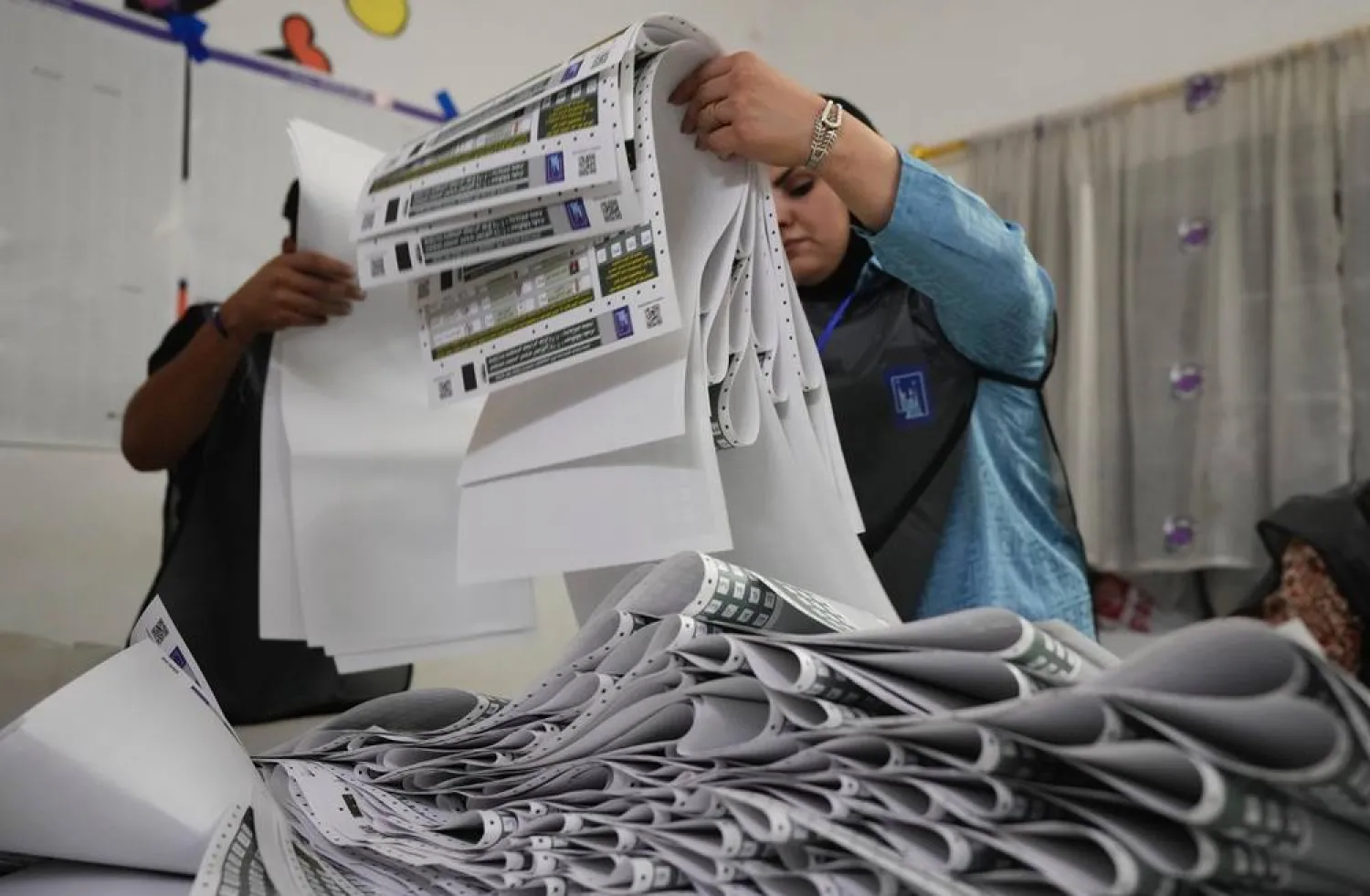
 Election workers count ballots as they close a polling station, during the parliamentary election in Baghdad, Iraq, Tuesday, Nov. 11, 2025. (AP)
Election workers count ballots as they close a polling station, during the parliamentary election in Baghdad, Iraq, Tuesday, Nov. 11, 2025. (AP)
TT

‘Saddam Hussein’ Wins Parliament Seat in Iraq after his Disqualification Is Overturned

 Election workers count ballots as they close a polling station, during the parliamentary election in Baghdad, Iraq, Tuesday, Nov. 11, 2025. (AP)
Election workers count ballots as they close a polling station, during the parliamentary election in Baghdad, Iraq, Tuesday, Nov. 11, 2025. (AP)

Iraq’s Independent High Electoral Commission (IHEC) announced that it has overturned the disqualification of a candidate, called Saddam Hussein al-Naimi, from the parliamentary election that was held this week.

It said the disqualification had no legal justification.

Al-Naimi, who ran on the list of the Sunni al-Azm alliance in the Kirkuk province, was one of 800 candidates excluded from the race.

Al-Naimi shares the name of toppled late longtime ruler Saddam Hussein, but is not related to him. His nomination had sparked widespread debate in political circles and on social media.

After his disqualification was overturned, al-Naimi was allowed to run in the election, ultimately winning a seat in Kirkuk after garnering 12,693 votes, the highest for a Azm candidate in the province.

Incumbent Prime Minister Mohammed Shia al-Sudani came first in the parliamentary election, the Commission said on Wednesday. His coalition received 1.317 million votes in Tuesday's election.

Nine of his ministers also won seats in the legislature.

In Baghdad, 17 MPs out of 71 retained their seats, including Sudani and minister Ahmed al-Asadi and Hiyam Al-Yasiri.

In the southern Basra province, 11 MPs out of 25 were reelected. In the southeastern Dhi Qar province, five out of 19 MPs retained their seats.

In the Al-Muthanna province, only one MP retained his seat. The same scenario played out in the al-Najaf province. In Karbala southwest of Baghdad, four MPs were reelected.

In the Babel province south of Baghdad, five MPs out 17 were reelected, two were reelected in the eastern Waset province, and in al-Anbar, the country’s largest, four won a second term in office.

Following the election, the complex and often lengthy task of choosing the country's next leader is set to begin.

Sudani claimed victory for his coalition, though it still falls short of the majority needed to form a government.

He now faces the tough quest of securing support from other parties, mostly from the Shiite majority, in his bid for a second term.

With no single bloc dominating the next parliament, key parties could spend weeks or even months negotiating alliances to build the largest bloc and nominate the next premier.


Lebanon: Army Says Achieved State Monopoly on Arms in the South in 'Effective’ Way

FILE - Lebanese army soldiers walk through a tunnel dug into a mountain that was used by Hezbollah fighters as a clinic and storage facility near the Lebanese-Israeli border in the Zibqin Valley, southern Lebanon, Nov. 28, 2025. (AP Photo/Bilal Hussein, File)
TT

Lebanon: Army Says Achieved State Monopoly on Arms in the South in 'Effective’ Way

FILE - Lebanese army soldiers walk through a tunnel dug into a mountain that was used by Hezbollah fighters as a clinic and storage facility near the Lebanese-Israeli border in the Zibqin Valley, southern Lebanon, Nov. 28, 2025. (AP Photo/Bilal Hussein, File)

The Lebanese army said on Thursday that it had achieved the goal of a state monopoly on arms in the country’s south in an "effective and tangible way", but said there was more work to be done to clear unexploded ordnance and tunnels in the area.

The army had set a year-end deadline to clear non-state weaponry from southern Lebanon, which ⁠borders Israel, before moving on to other areas of the country.

It said it had extended operational control over the south, except for areas still occupied by Israeli troops.

The statement did not mention Hezbollah, which ⁠fought a year-long war with Israel that ended in a 2024 ceasefire that stipulated that only Lebanon’s state security forces were allowed to carry arms.

A Lebanese security source told Reuters that the statement signaled that no group would be able to launch attacks from southern Lebanon.

Israel and Lebanon agreed to a US-brokered ceasefire in 2024, ending more than a year of fighting between Israel and Hezbollah. That culminated in Israeli strikes that severely weakened the group. Since then, the sides have traded accusations of violations.


Egypt Calls for Safe Shelter, Humanitarian Access to Sudanese

Abdel Fattah el-Sisi during the reception of Abdel Fattah al-Burhan in Cairo last month (Egyptian Presidency)
TT

Egypt Calls for Safe Shelter, Humanitarian Access to Sudanese

Abdel Fattah el-Sisi during the reception of Abdel Fattah al-Burhan in Cairo last month (Egyptian Presidency)

Cairo on Wednesday affirmed the need to provide safe shelter and unimpeded humanitarian access to Sudanese, condemning the massacres and serious violations against civilians in El Fasher and North Kordofan.

Egypt’s position was conveyed by Foreign Minister Badr Abdelatty during a phone call with Tom Fletcher, the United Nations (UN) Under-Secretary-General for Humanitarian Affairs and Emergency Relief Coordinator.

Abdelatty called for urgent measures to protect civilians and affirmed Egypt’s full support for the work of the UN Office for the Coordination of Humanitarian Affairs (OCHA) and its central role in strengthening effective responses to humanitarian crises in the region, whether in the occupied Palestinian territories or Sudan.

Recently, Egypt has intensified contacts to support Sudan's sovereignty, protect its national institutions, and push towards a comprehensive ceasefire within the framework of the “Quad Mechanism.”

Last August, the Mechanism, comprising Saudi Arabia, Egypt, United States, and United Arab Emirates, proposed a roadmap in which it called for a three-month initial humanitarian truce, then an inclusive and transparent transition process within nine months to meet the aspirations of the Sudanese people towards smoothly establishing an independent, civilian-led government with broad-based legitimacy and accountability.

During the phone call on Wednesday, Abdelatty stressed the importance of close coordination with the UN and its specialized agencies to ease civilian suffering and support regional stability.

On Dec. 28, the Egyptian Red Crescent (ERC), in coordination with the Sudanese Red Crescent Society, sent a humanitarian aid convoy to support the Sudanese people, carrying around 70 tons of food, medical supplies, and other relief items.

Last month, the Egyptian presidency issued a statement on the war in Sudan outlining three points it described as “red lines.”

Egypt would not allow any of them to be crossed or compromised, as they directly affect Egypt’s national security, which it said is inseparable from Sudan’s national security.

The reference to activating the joint defense agreement between the two countries was seen as a signal that Egypt could bring its military, political, and diplomatic weight in support of the Sudanese army.

President Abdel Fattah el-Sisi had received last month Lt. Gen. Abdel Fattah al-Burhan, Chairman of Sudan’s Transitional Sovereignty Council in Cairo.

El-Sisi reaffirmed Egypt’s “full support for the Sudanese people in overcoming the current critical phase,” stressing his country’s unwavering commitment to Sudan’s unity, sovereignty, security, and stability.

Meanwhile, Egypt’s Foreign Ministry said Abdelatty discussed with Fletcher the humanitarian situation in Gaza.

The minister urged intensified international action to ensure full and unhindered access for humanitarian, medical, and relief aid into Gaza, calling for the removal of Israeli restrictions that he said were blocking sufficient aid deliveries as winter conditions worsen.

He also stressed the need to protect civilians and speed up the entry of essential supplies, including relief materials and mobile housing units, to mitigate civilian suffering in the Gaza Strip.


Yemen’s Al-Alimi Removes Several Officials from their Positions

Yemen’s Presidential Leadership Council (PLC) Chairman Dr. Rashad Al-Alimi. saba
TT

Yemen’s Al-Alimi Removes Several Officials from their Positions

Yemen’s Presidential Leadership Council (PLC) Chairman Dr. Rashad Al-Alimi. saba

Yemen’s Presidential Leadership Council (PLC) Chairman Dr. Rashad Al-Alimi has issued a series of decisions, including dismissals, referrals for investigation, and new appointments to sensitive military, security, and local positions.

The move reflects a firm approach to reassert control over state institutions.

Al-Alimi issued Decree No. 7 of 2026 concerning the dismissal of the Commander of the Second Military Region and the Commander of the Al-Ghaydah Axis and Military Police Brigade in Al-Mahra Governorate.

Article One of the decree stipulates the dismissal of Major General (Staff) Talib Saeed Abdullah Barjash from his position as Commander of the Second Military Region and his referral for investigation in accordance with legally prescribed procedures and regulations.

Article Two stipulates the dismissal of Major General Mohsen Ali Nasser Marsa from his positions as Commander of the Al-Ghaydah Axis and Commander of the Military Police Brigade in Al-Mahra Governorate. It also stipulates his referral for investigation in accordance with legally prescribed procedures and regulations.

In decree No. 5 he appointed Abdulrahman Sheikh Abdulrahman Al-Yafie as Minister of State and Governor of Aden Governorate.

Al-Alimi relieved Ahmed Hamed Lamlas, Minister of State and Governor of Aden Governorate, of his post and referred him for investigation.

He also dismissed Abdul Salam Saleh Humaid Hadi, Minister of Transport, and Waed Abdullah Badeeb, Minister of Planning and International Cooperation, from their posts and referred them for investigation.

Decree No, 9 stipulated the appointment of Salem Ali Sa’ad Ahmed Makhbal Keddah as Commander of the Al-Ghaydah Military Axis, with promotion to the rank of Brigadier General.

In Decree No. 10, Al-Alimi appointed Brigadier General Khaled Yoslam Ali Al-Qathmi as Commander of the Second Presidential Special Guard Brigade.

Earlier, Head of the Southern Transitional Council (STC) Aidrous Al-Zubaidi was expelled from the PLC for high treason, Al-Alimi announced.

In a decree, Al-Alimi referred Al-Zubaidi to the general prosecutor for committing high treason and harming the unity and security of the state.