
After Assad's Fall, Syrians and EU Officials Hold Rare Meeting in Damascus

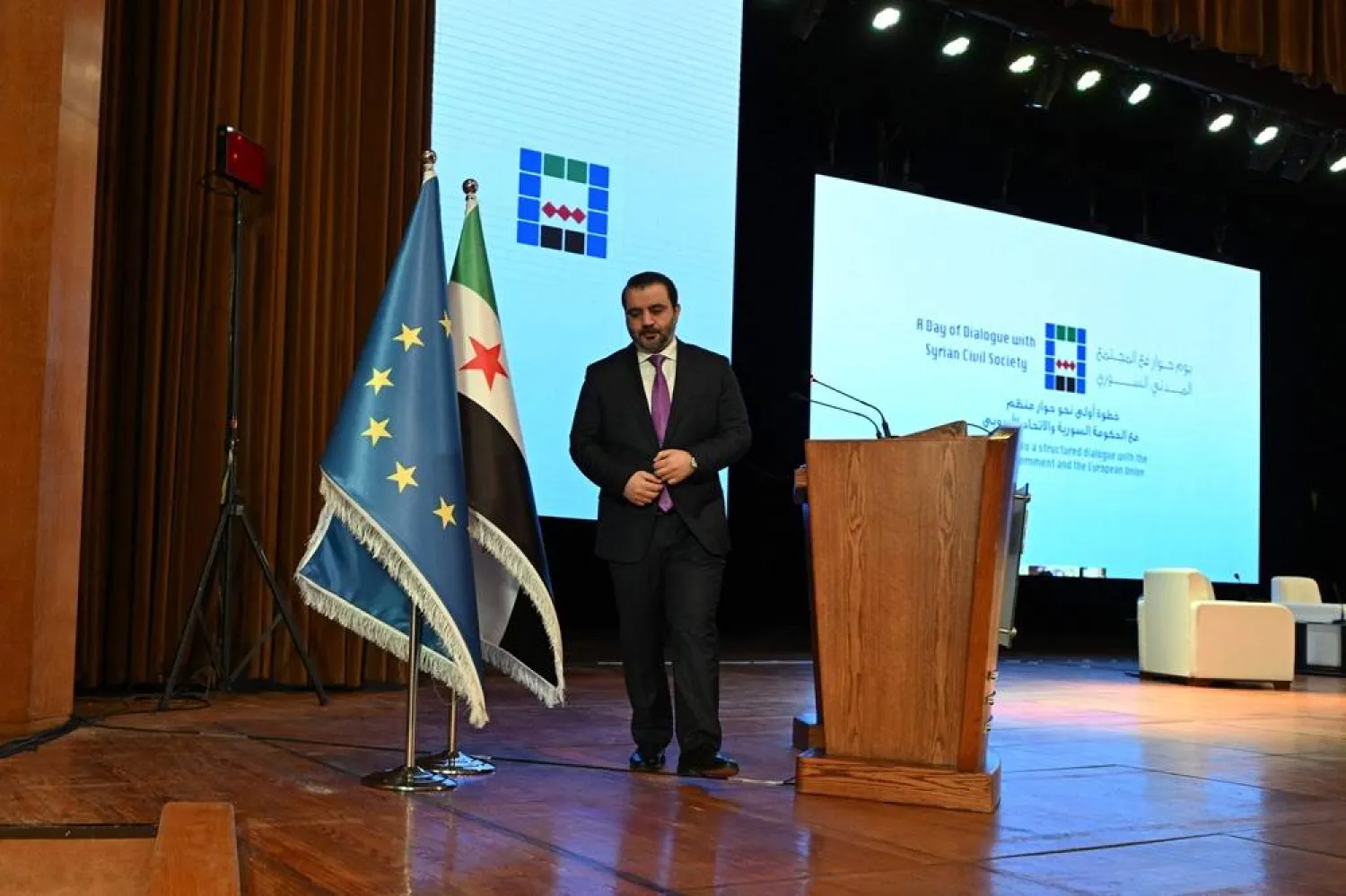
Syrian Minister of Foreign Affairs and Expatriates Asaad al-Shaibani leaves the stage after addressing delegates during a day of dialogue with Syrian civil society, a first step towards structured dialogue with the Syrian government and the European Union, at Conference Palace near Damascus on November 15, 2025. (AFP)
TT

After Assad's Fall, Syrians and EU Officials Hold Rare Meeting in Damascus

Syrian Minister of Foreign Affairs and Expatriates Asaad al-Shaibani leaves the stage after addressing delegates during a day of dialogue with Syrian civil society, a first step towards structured dialogue with the Syrian government and the European Union, at Conference Palace near Damascus on November 15, 2025. (AFP)

Representatives of Syria’s civil society held rare open discussions Saturday in Damascus in the presence of officials from the European Union and the transitional government. They touched on sensitive topics including sectarian tensions, ethnic divisions and people killed by different sides.

The EU-organized meetings known as “The Day of Dialogue” are the first to be held in Damascus after taking place in past years in Brussels. Saturday's meetings came nearly a year after the fall of the 54-year Assad family rule in Syria in a stunning offensive by opposition groups in early December.

The meetings that used to take place within the framework of the Brussels Conferences were mostly boycotted by then-President Bashar al-Assad’s government. The EU said Saturday's meetings were organized in cooperation with Syrian civil society and the Syrian transitional authorities.

“The meeting that used to be held to talk about Syria is now being held in Syria,” Syria’s Foreign Minister Asaad al-Shaibani said in a speech at the opening session held at a conference center in the southern outskirts of Damascus.

Al-Shaibani added that Saturday’s meetings represent “a solid partnership with the civil society and our partners in the European Union.”

Michael Ohnmacht, chargé d’affaires of the EU delegation to Syria, said 500 people from Syria’s different religious and ethnic groups took part in the meetings and “this is something very positive.”

“This is what we hope for Syria’s future, to see this inclusive state which will be a state in the form of all its citizens,” Ohnmacht said.

Despite the changes in Syria over the past year, sectarian violence in the country’s coastal region in March and the southern province of Sweida in July between pro-government gunmen and members of the country’s Druze and Alawite minorities left hundreds of people dead.

Such acts of violence show that Syria still faces major crises in the 14-year conflict that has left half a million people dead.

“Today’s dialogue is the beginning of change and rebuilding Syria only happens through partnership based on respect between the state and civil society,” said Social Affairs Minister Hind Kabawat.

During one of the sessions on transitional justice and the fate of the missing, Syrians demanded answers on issues still pending, such as more than 130,000 people who went missing under Assad's rule while an ethnic Kurd spoke about state discrimination they have faced for decades. Another spoke about violence against some women who belong to minority sects.

Mazen Darwish, a Syrian lawyer and one of the country’s most prominent activists who was repeatedly jailed in Syria before he went into exile years ago, said no one regrets the fall of the Assad family rule adding that this does not mean that “the future of Syria will be rosy and great.”

“Today we have an opportunity in Syria and we have to take advantage of it,” Darwish said.


Lebanon FM Urges Iran to Find ‘New Approach’ on Hezbollah Arms

Iranian Foreign Minister Abbas Araghchi (L) shakes hands with Lebanese Minister of Foreign Affairs and Emigrants Youssef Raggi (R) at the Foreign Ministry in downtown Beirut, Lebanon, 09 January 2026. (EPA)
TT

Lebanon FM Urges Iran to Find ‘New Approach’ on Hezbollah Arms

Iranian Foreign Minister Abbas Araghchi (L) shakes hands with Lebanese Minister of Foreign Affairs and Emigrants Youssef Raggi (R) at the Foreign Ministry in downtown Beirut, Lebanon, 09 January 2026. (EPA)

Lebanese Foreign Minister Youssef Raggi on Friday urged his visiting Iranian counterpart to find a "new approach" to the thorny issue of disarming the Iran-backed Hezbollah group.

Lebanon is under heavy US pressure to disarm Hezbollah, which was heavily weakened in more than a year of hostilities with Israel that largely ended with a November 2024 ceasefire, but Iran and the group have expressed opposition to the move.

Iran has long wielded substantial influence in Lebanon by funding and arming Hezbollah, but as the balance of power shifted since the recent conflict, officials have been more critical towards Tehran.

"The defense of Lebanon is the sole responsibility of the Lebanese state", which must have a monopoly on weapons, Raggi told Iranian Foreign Minister Abbas Araghchi, a Lebanese foreign ministry statement said.

Raggi called on Iran to engage in talks with Lebanon to find "a new approach to the issue of Hezbollah's weapons, drawing on Iran's relationship with the party, so that these weapons do not become a pretext for weakening Lebanon".

He asked Araghchi "whether Tehran would accept the presence of an illegal armed organization on its own territory".

Last month, Raggi declined an invitation to visit Iran and proposed meeting in a neutral third country.

Lebanon's army said Thursday that it had completed the first phase of disarming Hezbollah, doing so in the south Lebanon area near the border with Israel, which called the efforts "far from sufficient".

Araghchi also met President Joseph Aoun on Friday and was set to hold talks with several other senior officials.

After arriving on Thursday, he visited the mausoleum of former Hezbollah leader Hassan Nasrallah, who was killed in a massive Israeli air strike on south Beirut in September 2024.

Last August, Lebanese leaders firmly rejected any efforts at foreign interference during a visit by Iran's security chief Ali Larijani, with the prime minister saying Beirut would "tolerate neither tutelage nor diktat" after Tehran voiced opposition to plans to disarm Hezbollah.


Hamas Says Israeli Strikes on Gaza ‘Cannot Happen without American Cover’

 Palestinians inspect damaged tents at a displacement camp following an Israeli strike in Gaza City, Friday, Jan. 9, 2026. (AP)
Palestinians inspect damaged tents at a displacement camp following an Israeli strike in Gaza City, Friday, Jan. 9, 2026. (AP)
TT

Hamas Says Israeli Strikes on Gaza ‘Cannot Happen without American Cover’

 Palestinians inspect damaged tents at a displacement camp following an Israeli strike in Gaza City, Friday, Jan. 9, 2026. (AP)
Palestinians inspect damaged tents at a displacement camp following an Israeli strike in Gaza City, Friday, Jan. 9, 2026. (AP)

A Hamas official said Friday that Israeli strikes on Gaza "cannot happen without American cover", the day after Israeli attacks killed at least 13 people according to the Palestinian territory's civil defense agency.

Since October 10, a fragile US-sponsored truce in Gaza has largely halted the fighting between Israeli forces and Hamas, but both sides have alleged frequent violations.

Gaza's civil defense agency -- which operates as a rescue force under Hamas authority -- said Israeli attacks across the territory on Thursday killed at least 13 people, including five children.

In a statement on Friday morning, the Israeli military said it "precisely struck Hamas terrorists and terror infrastructure" in response to a "failed projectile" launch.

"Just yesterday, 13 people were killed in different areas of the Strip on fabricated pretexts, in addition to the hundreds of killed and wounded who preceded them after the ceasefire," Hamas political bureau member, Bassem Naim, wrote on Telegram.

"This cannot happen without American cover or a green light."

Israeli forces have killed at least 439 Palestinians in Gaza since the ceasefire took effect, according to the health ministry in the Hamas-run territory.

The Israeli military said gunmen have killed three of its soldiers during the same period.

Media restrictions in Gaza and difficulties in accessing many areas mean AFP is unable to independently verify the tolls and details provided by both sides.

Naim also accused Israeli Prime Minister Benjamin Netanyahu of "evading his commitments and escalating in order to sabotage the agreement and return to war".

He said the Palestinian movement had "complied with all its obligations under the agreement" and was "ready to engage positively and constructively with the next steps of the plan".

Israel has previously said it is awaiting the return of the last hostage body held in Gaza before beginning talks on the second phase of the ceasefire and has insisted that Hamas disarm.

Hamas officials told AFP that search operations for the remains of deceased hostage Ran Gvili resumed on Wednesday after a two-week pause due to bad weather.


Germany Calls on Israel to Halt E1 Settlement Plan

A view of Israeli settlement of Maale Adumim, in the West Bank, Sunday, June 18, 2023. (AP)
TT

Germany Calls on Israel to Halt E1 Settlement Plan

A view of Israeli settlement of Maale Adumim, in the West Bank, Sunday, June 18, 2023. (AP)

Germany calls on Israel to halt its controversial ​E1 settlement project, said a foreign ministry spokesperson in Berlin on Friday, warning that construction carries the risk of ‌creating more ‌instability in the ‌West ⁠Bank ​and ‌the region.

"The plans for the E1 settlement project, it must be said, are part of a comprehensive ⁠intensification of settlement policy in ‌the West Bank, ‍which ‍we have recently ‍observed," said the spokesperson at a regular government press conference.

"It carries the ​risk of creating even more instability, as it ⁠would further restrict the mobility of the Palestinian population in the West Bank," as well as jeopardize the prospects of a two-state solution, the spokesperson added.