

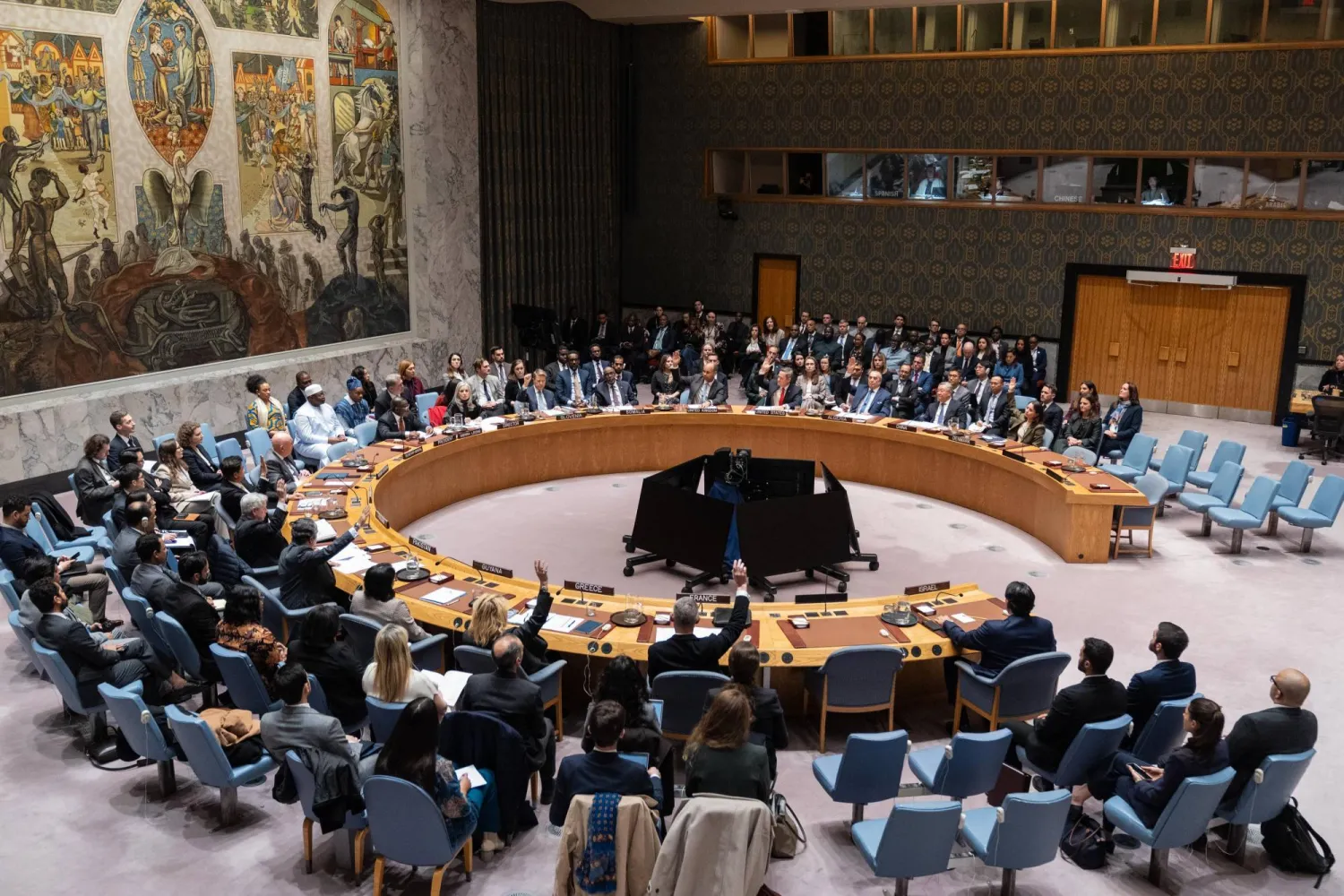

UN Approves the Trump Administration’s Plan for the Future of Gaza 

17 November 2025, US, Bronx: The members of the UN Security Council vote at UN headquarters on a draft resolution introduced by the USA to authorize an international stabilization force in Gaza. (dpa)
TT

UN Approves the Trump Administration’s Plan for the Future of Gaza 

17 November 2025, US, Bronx: The members of the UN Security Council vote at UN headquarters on a draft resolution introduced by the USA to authorize an international stabilization force in Gaza. (dpa)

The Trump administration’s blueprint to secure and govern Gaza won strong approval at the United Nations on Monday, a crucial step that provides international support for US efforts to move the devastated territory toward peace following two years of war.

The US resolution that passed the UN Security Council authorizes an international stabilization force to provide security in Gaza, approves a transitional authority to be overseen by President Donald Trump and envisions a possible future path to an independent Palestinian state.

“This will go down as one of the biggest approvals in the History of the United Nations, will lead to further Peace all over the World, and is a moment of true Historic proportion!” Trump posted on social media.

The vote endorses Trump’s 20-point ceasefire plan and builds on the momentum of the fragile ceasefire he helped broker with allies. It marks a key next step for American efforts to outline Gaza’s future after the Israel-Hamas war destroyed much of the territory and killed tens of thousands of people.

The proposal calls for a yet-to-be-established Board of Peace as a transitional authority that Trump would head. It also provides a wide mandate for the international stabilization force, including overseeing the borders, providing security and demilitarizing the territory. Authorization for the board and force expire at the end of 2027.

Arab and other Muslim countries that expressed interest in providing troops for an international force had signaled that UN authorization was essential for their participation.

Russia, which had circulated a rival resolution, abstained along with China on the 13-0 vote after fears Moscow might use its veto in the Security Council.

However, Hamas opposed the resolution, saying in a statement that it does not meet the “Palestinian people’s political and humanitarian demands and rights.”

Stronger language on Palestinian state

US Ambassador to the UN Mike Waltz said the resolution “represents another significant step towards a stable Gaza that will be able to prosper and an environment that will allow Israel to live in security.”

It came about following nearly two weeks of negotiations, when Arab nations and the Palestinians pressed the United States to strengthen language about Palestinian self-determination.

But the proposal still gives no timeline or guarantee for an independent state, only saying it’s possible after advances in the reconstruction of Gaza and reforms of the Palestinian Authority, which now governs parts of the West Bank.

The US revised the resolution to say that after those steps, “the conditions may finally be in place for a credible pathway to Palestinian self-determination and statehood.”

“The United States will establish a dialogue between Israel and the Palestinians to agree on a political horizon for peaceful and prosperous coexistence,” it adds.

Israeli Prime Minister Benjamin Netanyahu opposes Palestinian statehood and repeated that position Sunday at a time when his hard-line governing partners have expressed concern about the resolution’s endorsement of a “pathway” to Palestinian independence.

Israel’s UN Ambassador Danny Danon told reporters before the vote that Israel was grateful to Trump “for leading peace to the Middle East.”

Algeria’s UN Ambassador Amar Bendjama, the Arab representative on the council, thanked Trump for his instrumental role in bringing about the ceasefire, but said “genuine peace in the Middle East cannot be achieved without justice, justice for the Palestinian people.”

A key to the resolution’s adoption was support from Arab and other Muslim nations that had been critical to the ceasefire and potentially could contribute to the international force. The US mission to the United Nations distributed a joint statement Friday with Qatar, Egypt, United Arab Emirates, Saudi Arabia, Indonesia, Pakistan, Jordan and Türkiye calling for “swift adoption” of the US proposal.

Russia’s UN Ambassador Vassily Nebenzia said Moscow took note of that support but abstained because the resolution did not include a role for the Security Council or emphatically support Palestinian statehood.

The vote shores up hopes that Gaza’s fragile ceasefire will be maintained following a war set off by Hamas’ surprise attack on southern Israel on Oct. 7, 2023, which killed about 1,200 people. Israel’s offensive has killed over 69,000 Palestinians, according to the Gaza health ministry, which doesn’t distinguish between civilians and combatants but says the majority are women and children.

What else the US proposal says

Trump said the members of the Board of Peace will be named in the coming weeks, along with "many more exciting announcements."

The US resolution calls for the stabilization force to ensure “the process of demilitarizing the Gaza Strip” and “the permanent decommissioning of weapons from non-state armed groups.”

A big question has been how to disarm Hamas, which said Monday that giving the force a role inside Gaza that includes disarmament “strips it of its neutrality, and turns it into a party to the conflict in favor of the occupation.”

The resolution authorizes the force “to use all necessary measures to carry out its mandate” in compliance with international law, which is UN language for the use of military force.

It says the stabilization troops will help secure border areas, along with a Palestinian police force that they have trained and vetted, and they will coordinate with other countries to secure the flow of humanitarian assistance. It says the force should closely consult and cooperate with neighboring Egypt and Israel.

As the international force establishes control, the resolution says Israeli forces will withdraw from Gaza “based on standards, milestones, and timeframes linked to demilitarization.” These must be agreed to by the stabilization force, Israeli forces, the US and the guarantors of the ceasefire, it says.



Lebanon: Army Says Achieved State Monopoly on Arms in the South in 'Effective’ Way

FILE - Lebanese army soldiers walk through a tunnel dug into a mountain that was used by Hezbollah fighters as a clinic and storage facility near the Lebanese-Israeli border in the Zibqin Valley, southern Lebanon, Nov. 28, 2025. (AP Photo/Bilal Hussein, File)
TT

Lebanon: Army Says Achieved State Monopoly on Arms in the South in 'Effective’ Way

FILE - Lebanese army soldiers walk through a tunnel dug into a mountain that was used by Hezbollah fighters as a clinic and storage facility near the Lebanese-Israeli border in the Zibqin Valley, southern Lebanon, Nov. 28, 2025. (AP Photo/Bilal Hussein, File)

The Lebanese army said on Thursday that it had achieved the goal of a state monopoly on arms in the country’s south in an "effective and tangible way", but said there was more work to be done to clear unexploded ordnance and tunnels in the area.

The army had set a year-end deadline to clear non-state weaponry from southern Lebanon, which ⁠borders Israel, before moving on to other areas of the country.

It said it had extended operational control over the south, except for areas still occupied by Israeli troops.

The statement did not mention Hezbollah, which ⁠fought a year-long war with Israel that ended in a 2024 ceasefire that stipulated that only Lebanon’s state security forces were allowed to carry arms.

A Lebanese security source told Reuters that the statement signaled that no group would be able to launch attacks from southern Lebanon.

Israel and Lebanon agreed to a US-brokered ceasefire in 2024, ending more than a year of fighting between Israel and Hezbollah. That culminated in Israeli strikes that severely weakened the group. Since then, the sides have traded accusations of violations.


Egypt Calls for Safe Shelter, Humanitarian Access to Sudanese

Abdel Fattah el-Sisi during the reception of Abdel Fattah al-Burhan in Cairo last month (Egyptian Presidency)
TT

Egypt Calls for Safe Shelter, Humanitarian Access to Sudanese

Abdel Fattah el-Sisi during the reception of Abdel Fattah al-Burhan in Cairo last month (Egyptian Presidency)

Cairo on Wednesday affirmed the need to provide safe shelter and unimpeded humanitarian access to Sudanese, condemning the massacres and serious violations against civilians in El Fasher and North Kordofan.

Egypt’s position was conveyed by Foreign Minister Badr Abdelatty during a phone call with Tom Fletcher, the United Nations (UN) Under-Secretary-General for Humanitarian Affairs and Emergency Relief Coordinator.

Abdelatty called for urgent measures to protect civilians and affirmed Egypt’s full support for the work of the UN Office for the Coordination of Humanitarian Affairs (OCHA) and its central role in strengthening effective responses to humanitarian crises in the region, whether in the occupied Palestinian territories or Sudan.

Recently, Egypt has intensified contacts to support Sudan's sovereignty, protect its national institutions, and push towards a comprehensive ceasefire within the framework of the “Quad Mechanism.”

Last August, the Mechanism, comprising Saudi Arabia, Egypt, United States, and United Arab Emirates, proposed a roadmap in which it called for a three-month initial humanitarian truce, then an inclusive and transparent transition process within nine months to meet the aspirations of the Sudanese people towards smoothly establishing an independent, civilian-led government with broad-based legitimacy and accountability.

During the phone call on Wednesday, Abdelatty stressed the importance of close coordination with the UN and its specialized agencies to ease civilian suffering and support regional stability.

On Dec. 28, the Egyptian Red Crescent (ERC), in coordination with the Sudanese Red Crescent Society, sent a humanitarian aid convoy to support the Sudanese people, carrying around 70 tons of food, medical supplies, and other relief items.

Last month, the Egyptian presidency issued a statement on the war in Sudan outlining three points it described as “red lines.”

Egypt would not allow any of them to be crossed or compromised, as they directly affect Egypt’s national security, which it said is inseparable from Sudan’s national security.

The reference to activating the joint defense agreement between the two countries was seen as a signal that Egypt could bring its military, political, and diplomatic weight in support of the Sudanese army.

President Abdel Fattah el-Sisi had received last month Lt. Gen. Abdel Fattah al-Burhan, Chairman of Sudan’s Transitional Sovereignty Council in Cairo.

El-Sisi reaffirmed Egypt’s “full support for the Sudanese people in overcoming the current critical phase,” stressing his country’s unwavering commitment to Sudan’s unity, sovereignty, security, and stability.

Meanwhile, Egypt’s Foreign Ministry said Abdelatty discussed with Fletcher the humanitarian situation in Gaza.

The minister urged intensified international action to ensure full and unhindered access for humanitarian, medical, and relief aid into Gaza, calling for the removal of Israeli restrictions that he said were blocking sufficient aid deliveries as winter conditions worsen.

He also stressed the need to protect civilians and speed up the entry of essential supplies, including relief materials and mobile housing units, to mitigate civilian suffering in the Gaza Strip.


Yemen’s Al-Alimi Removes Several Officials from their Positions

Yemen’s Presidential Leadership Council (PLC) Chairman Dr. Rashad Al-Alimi. saba
TT

Yemen’s Al-Alimi Removes Several Officials from their Positions

Yemen’s Presidential Leadership Council (PLC) Chairman Dr. Rashad Al-Alimi. saba

Yemen’s Presidential Leadership Council (PLC) Chairman Dr. Rashad Al-Alimi has issued a series of decisions, including dismissals, referrals for investigation, and new appointments to sensitive military, security, and local positions.

The move reflects a firm approach to reassert control over state institutions.

Al-Alimi issued Decree No. 7 of 2026 concerning the dismissal of the Commander of the Second Military Region and the Commander of the Al-Ghaydah Axis and Military Police Brigade in Al-Mahra Governorate.

Article One of the decree stipulates the dismissal of Major General (Staff) Talib Saeed Abdullah Barjash from his position as Commander of the Second Military Region and his referral for investigation in accordance with legally prescribed procedures and regulations.

Article Two stipulates the dismissal of Major General Mohsen Ali Nasser Marsa from his positions as Commander of the Al-Ghaydah Axis and Commander of the Military Police Brigade in Al-Mahra Governorate. It also stipulates his referral for investigation in accordance with legally prescribed procedures and regulations.

In decree No. 5 he appointed Abdulrahman Sheikh Abdulrahman Al-Yafie as Minister of State and Governor of Aden Governorate.

Al-Alimi relieved Ahmed Hamed Lamlas, Minister of State and Governor of Aden Governorate, of his post and referred him for investigation.

He also dismissed Abdul Salam Saleh Humaid Hadi, Minister of Transport, and Waed Abdullah Badeeb, Minister of Planning and International Cooperation, from their posts and referred them for investigation.

Decree No, 9 stipulated the appointment of Salem Ali Sa’ad Ahmed Makhbal Keddah as Commander of the Al-Ghaydah Military Axis, with promotion to the rank of Brigadier General.

In Decree No. 10, Al-Alimi appointed Brigadier General Khaled Yoslam Ali Al-Qathmi as Commander of the Second Presidential Special Guard Brigade.

Earlier, Head of the Southern Transitional Council (STC) Aidrous Al-Zubaidi was expelled from the PLC for high treason, Al-Alimi announced.

In a decree, Al-Alimi referred Al-Zubaidi to the general prosecutor for committing high treason and harming the unity and security of the state.