


Iraq’s PM Sudani Joins Majority Bloc in Parliament

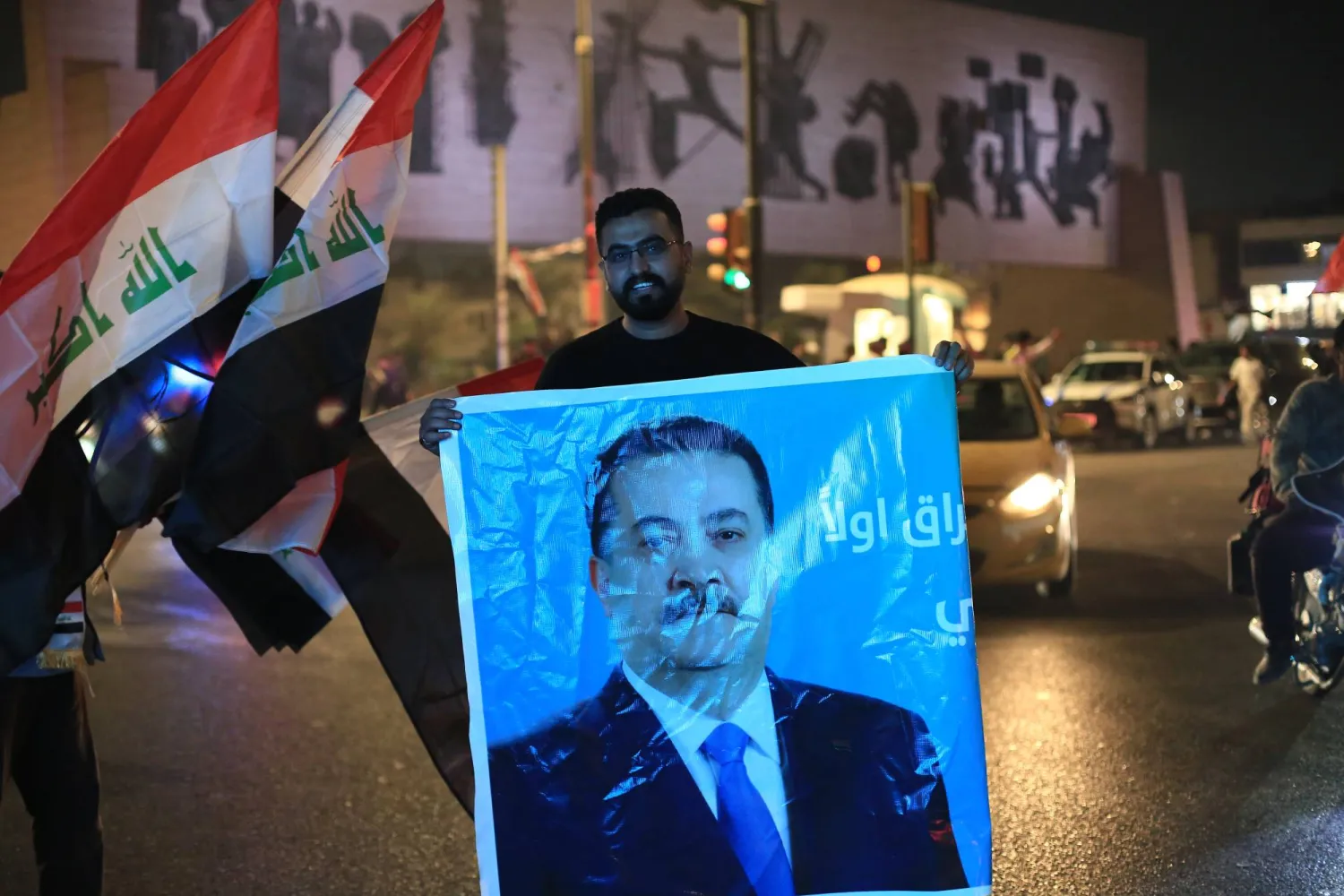
12 November 2025, Iraq, Baghdad: A supporter of Iraqi Prime Minister Mohammed Shia al-Sudani celebrates in Tahrir Square, following the announcement of preliminary election results in Baghdad. (dpa)
TT

Iraq’s PM Sudani Joins Majority Bloc in Parliament

12 November 2025, Iraq, Baghdad: A supporter of Iraqi Prime Minister Mohammed Shia al-Sudani celebrates in Tahrir Square, following the announcement of preliminary election results in Baghdad. (dpa)

Iraq's incumbent Prime Minister Mohammed Shia al-Sudani said Tuesday he had joined the country's main Shiite alliance, the majority bloc that will nominate the next premier.

The move by Sudani, who is seeking a second term as prime minister, gives the Coordination Framework alliance of Shiite factions an outright majority of 175 seats in the 329-seat chamber.

During a conference in the northern city of Duhok, Sudani said his alliance "the Reconstruction and Development coalition is part of the Coordination Framework, which has decided to form the largest bloc".

He added that seeking a second term "is not about personal ambition, but about fulfilling his responsibility to see through the mission".

During his first term Sudani had pursued policies vowing reconstruction and stability in Iraq.

He added that talks will begin among key parties about naming the new premier, speaker and president.

By convention in Iraq, a Shiite holds the post of prime minister, a Sunni is parliament speaker, and the largely ceremonial presidency goes to a Kurd.

On Monday, the Coordination Framework alliance announced that it had formed the majority bloc, which would ultimately nominate the next prime minister.

Brought to power three years ago by the Framework, Sudani's own list secured 46 seats in the chamber.

Joining the Coordination Framework does not guarantee Sudani a second term.

Long-term powerbrokers within the Coordination Framework worry that he has amassed too much power during his first term, making some reluctant to allow him to keep his seat.

Within the Coordination Framework, whose members have varying ties to Iran, some individual groups also scored well, with some winning more seats than in the previous parliament.

Post-election talks between Shiite, Sunni and Kurdish parties in Iraq usually last for months, with constitutional deadlines frequently missed.

But as Iraq has recently regained some stability after decades of war, key parties hope to reach a full package deal -- premier, speaker and president -- before the new parliament convenes in January.



Iraq’s Parliament Delays Presidential Vote

A photograph shows Iraq's parliament building in Baghdad as newly elected lawmakers are due to hold their first session on December 29, 2025. (AFP)
TT

Iraq’s Parliament Delays Presidential Vote

A photograph shows Iraq's parliament building in Baghdad as newly elected lawmakers are due to hold their first session on December 29, 2025. (AFP)

Iraq's parliament postponed the election of the country's president on Tuesday to allow Kurdish rivals time to agree on a candidate.

The parliament delayed the session, the official INA press agency reported, without saying whether a new date had been agreed.

The agency reported earlier that speaker Haibat al-Halbousi received requests from Iraq's two main Kurdish parties, the Kurdistan Democratic Party (KDP) and the Patriotic Union of Kurdistan (PUK), to postpone the vote to "allow both parties more time" to reach a deal.

By convention, a Shiite holds the powerful post of prime minister, the parliament speaker is a Sunni and the largely ceremonial presidency goes to a Kurd.

Under a tacit agreement between the two main Kurdish parties, a PUK member holds the Iraqi presidency, while the president and regional premier of the semi-autonomous Kurdish region is selected from the KDP.

But this time the KDP named its own candidate for Iraq's presidency: Iraqi Foreign Minister Fuad Hussein.

Once elected, the president will then have 15 days to appoint a prime minister, expected to be former premier Nouri al-Maliki.

On Saturday, the Coordination Framework, an alliance of Shiite parties with varying ties to Iran that holds a parliamentary majority, endorsed Maliki.

But his nomination appeared to stoke concern in Washington.

The 75-year-old shrewd politician is Iraq's only two-term premier (2006-2014) since the 2003 US invasion.

Seen as close to Iran, Maliki left power in 2014 following heated pressure from Washington.
US Secretary of State Marco Rubio warned on Sunday against a pro-Iranian government in Iraq.

An Iraqi source close to the Coordination Framework told AFP that Washington had conveyed that it "holds a negative view of previous governments led by former prime minister Maliki."

In a letter, US representatives said that while the selection of the prime minister is an Iraqi decision, "the United States will make its own sovereign decisions regarding the next government in line with American interests."

Another Iraqi source confirmed the letter, adding that the Shiite alliance had still moved forward with its choice, confident that Maliki could allay Washington's concerns.

Iraq has long been a proxy battleground between the US and Iran, with successive governments negotiating a delicate balance between the two foes.

Iraq's new premier will be expected to address Washington's longstanding demand that Baghdad disarm Tehran-backed factions, many of which are designated terrorist groups by the US.


Three French Tourists Killed as Boat Capsizes off Oman

Image published by the Royal Oman Police of the distressed tourist boat (Oman News Agency)
TT

Three French Tourists Killed as Boat Capsizes off Oman

Image published by the Royal Oman Police of the distressed tourist boat (Oman News Agency)

A boat carrying French tourists capsized off the shore of Oman on Tuesday, police said, killing three people and injuring two others.

The boat overturned 2.5 nautical miles (4.6 kilometers) from Sultan Qaboos Port in the capital Muscat "carrying a group of 25 French tourists including the tour guide and boat captain, resulting in the death of three tourists and injuries to two others," Omani police said in a statement on X.

"Investigations are ongoing to determine the circumstances of the incident," they added.

Oman is increasingly attracting attention from international travelers, especially nature lovers drawn to its mountains and coastline.

The country welcomed nearly four million visitors in 2024, with the government aiming to triple that figure by 2040 by focusing on sustainable tourism.


Mazloum Abdi: We Will Take Advantage of Truce to Advance Dec. 18 Agreement

Forces of the Syrian Democratic Forces (SDF) completed their withdrawal to the Hasakah region in northeastern Syria (Reuters). 
TT

Mazloum Abdi: We Will Take Advantage of Truce to Advance Dec. 18 Agreement

Forces of the Syrian Democratic Forces (SDF) completed their withdrawal to the Hasakah region in northeastern Syria (Reuters). 

Mazloum Abdi, commander-in-chief of the Syrian Democratic Forces (SDF), said efforts had been underway for some time to reach a ceasefire, noting that the current truce was implemented “at the request of the US military.”

“We are ready to implement the agreement in the near term, and there is understanding on many issues,” Abdi said in remarks to the Kurdish Ronahi TV channel. “We will use the truce period to make tangible progress on the Dec. 18 agreement.”

He explained that, under the agreement, government forces would not enter Kurdish-majority areas, while SDF institutions would be integrated into state institutions.

He added that Damascus had been asked not to enter the city and had agreed, expressing hope that the commitment would be upheld. Abdi said any solution for Kobani and Qamishli must also include Ras al-Ayn and Afrin.

Abdi said negotiations with Damascus were continuing under international sponsorship, with the involvement of the United States at political and military levels, as well as French President Emmanuel Macron.

He stressed that the talks should not be considered a final agreement, adding that international efforts to de-escalate would succeed as long as Damascus honored its commitments and no “unacceptable” conditions were imposed.

He said the SDF remained ready to implement the Dec. 18 agreement with Damascus within a short period, noting that names had been proposed for the posts of deputy defense minister and governor of Hasakah, though no final list had yet been agreed.

Meanwhile, the SDF said on Monday that heavy clashes had erupted with Syrian government-affiliated factions southeast of Kobani, after attacks launched at dawn.

The fighting continued, particularly in the town of Jalbiya, amid reinforcements including tanks and armored vehicles and intensive Turkish drone activity. Syria’s Defense Ministry accused the SDF of violating the ceasefire and launching more than 25 drone attacks on army positions around Kobani.