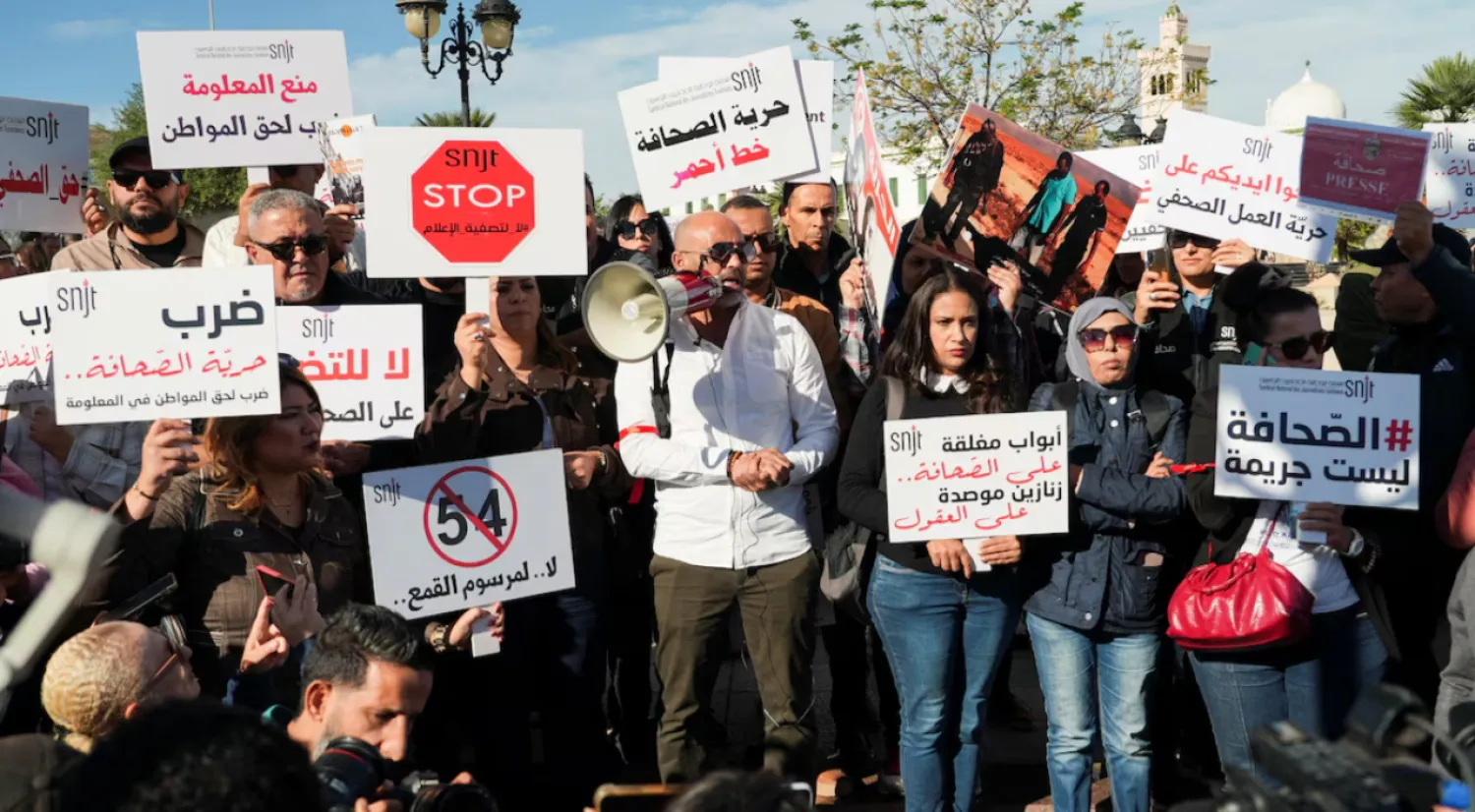
Tunisian Journalists Protest, Demand End to Restrictions on Reporters

Tunisian journalists rally near the government's office, holding signs to protest press restrictions- REUTERS/Jihed Abidellaoui
TT

Tunisian Journalists Protest, Demand End to Restrictions on Reporters

Tunisian journalists rally near the government's office, holding signs to protest press restrictions- REUTERS/Jihed Abidellaoui

Tunisian journalists protested on Thursday near government offices, demanding an end to restrictions on reporters and the release of jailed colleagues, and vowing that the widening crackdown will not silence them.

The protests confirmed growing fears of unprecedented threats to free speech since Kais Saied seized power in 2021.

Hundreds of reporters waved press cards, chanting "Journalism is not a crime" and "Freedom for Tunisian media".

Free speech had flourished following the 2011 uprising that toppled autocrat Zine El Abidine Ben Ali and sparked the “Arab Spring", and President Saied has denied targeting press freedom, Reuters reported.

Critics, however, say his 2021 power grab and subsequent decrees have dismantled democratic safeguards and allowed authorities to pursue journalists for committing offences which are not clearcut.

The Tunisian Journalists’ Syndicate (SNJT) said the escalating pressure was aimed at silencing strong free voices and subjugating the media.

"The situation is sounding the alarm. There is a systematic killing of journalism. We cannot cover government or parliament activities, nor events in the streets," said Nourredine Ahmed, a freelance journalist said.

Amira Mohamed, who works for Mosaique Radio, said the situation was "very bleak", and that dozens of journalists are being prosecuted while others are behind bars.

They have complained about not receiving their 2025 press cards, while foreign journalists said filming permits had been suspended, leaving them vulnerable to police obstruction and long periods of detention.

At least five journalists are in prison, while others face judicial investigations over social media posts or critical reporting.

The Minister of Justice, Laila Jaffal, said this week that there had been no prosecutions over freedom of expression, but rather for defamation.


Katz: Israel Will Keep Troops in Lebanon, Syria, Gaza 'Security Zones'

FILED - 25 June 2024, Israel, Jerusalem: FILE PHOTO - Israeli Defense Minister Israel Katz is pictured in Jerusalem. Photo: Hannes P Albert/dpa
TT

Katz: Israel Will Keep Troops in Lebanon, Syria, Gaza 'Security Zones'

FILED - 25 June 2024, Israel, Jerusalem: FILE PHOTO - Israeli Defense Minister Israel Katz is pictured in Jerusalem. Photo: Hannes P Albert/dpa

Israel's Defense Minister Israel Katz told his US counterpart Pete Hegseth early Thursday that Israel is determined to keep its forces in "security zones" it has carved out inside Lebanon, Syria and the Gaza Strip.

In a statement, Katz's office said the two men spoke overnight and the minister "emphasized Israel's determination to remain in the security zones in Syria, Gaza, and Lebanon in order to protect Israel's borders and the communities near the border from the threats posed by jihadist forces.”

"We have never asked the United States to act in our place along our borders," AFP quoted Katz as saying.

His comments come days after US President Donald Trump asked Israeli Prime Minister Benjamin Netanyahu to pull Israeli forces out of Syria and Lebanon, according to US news outlet Axios.

Citing a US official, Axios reported that Trump told Netanyahu the Israeli deployment was fueling tensions in Syria.

"They don't want you there. You should redeploy," Trump told him, according to Axios.

After the December 2024 overthrow of Syria's longtime ruler Bashar al-Assad, Israel sent troops into a UN-patrolled buffer zone that separated Israeli and Syrian forces on the Golan Heights.

Israel has also carried out repeated incursions into Syrian territory since then, as well as bombings, and has said it wants a demilitarized zone in the country's south.

In Lebanon, Israeli forces remain deployed in what the military describes as a security zone extending roughly 10 kilometers (six miles) into Lebanese territory.

Lebanon and Israel are engaged in talks to end hostilities after Hezbollah drew Lebanon into the broader Middle East war by attacking Israel in March.

The two countries concluded their fifth round of talks in Rome on Wednesday.

The US-brokered negotiations are aimed at having Israeli forces steadily withdraw from Lebanon, starting with two "pilot zones" located outside the "security zone" that Israel has established in the south.

In Gaza, Israel's military controls 60 percent of the territory and is present on the entire outside perimeter along the borders with Israel and Egypt.


Egypt’s New Administrative Capital Gains Official Momentum, but Residential Occupancy Remains Limited

The East Nile Monorail passes alongside high-rise buildings in Egypt’s New Administrative Capital (Egyptian Ministry of Transport) 
TT

Egypt’s New Administrative Capital Gains Official Momentum, but Residential Occupancy Remains Limited

The East Nile Monorail passes alongside high-rise buildings in Egypt’s New Administrative Capital (Egyptian Ministry of Transport) 

Egypt’s New Administrative Capital is steadily gaining political momentum through a growing number of official events that reinforce its standing both officially and publicly, although residential occupancy remains limited.

According to Khaled Abbas, chairman and CEO of the Administrative Capital for Urban Development (ACUD), more than 30,000 people now live in the city, with the number of residents increasing daily. Speaking on television last month, Abbas said the population is expected to reach between 50,000 and 60,000 by the end of the year, based on applications for utility meter installations received by the company.

The project dates back to March 2015, when it was launched to ease pressure on Cairo by building a new city covering about 700 square kilometers (roughly 170,000 feddans) in three phases. The first phase spans 168 square kilometers (about 40,000 feddans), nearly half the size of Cairo, which covers about 90,000 feddans.

The capital was originally scheduled to become operational in 2020, but the COVID-19 pandemic and the geopolitical tensions that followed delayed its official launch until 2024. Ministries then began relocating to the Government District, followed by parliament and other state institutions.

Despite major investments in roads and transportation networks, residential occupancy remains limited compared with the government’s presence, even as authorities continue to hold high-profile events aimed at enhancing the capital’s stature. Most recently, President Abdel Fattah al-Sisi inaugurated the Strategic Command Headquarters, which official statements said is modeled on the world’s most advanced command-and-control centers.

Ahmed Abdel Fattah, head of Partner Business Development at Bold Routes Egypt, told Asharq Al-Awsat that the occupancy rate is “normal despite being limited,” noting that residential populations in new cities typically grow gradually as services expand and more activities are held.

“Years ago, people considered cities such as New Cairo and 6th of October City too far away,” he said. “Today, properties are marketed according to their proximity to the American University in Cairo’s Fifth Settlement, which has effectively become the new downtown.”

Abbas defended the occupancy figures, saying they are “not low.” He noted that the first phase alone is four times the size of either Sheikh Zayed City or El Shorouk City. “The capital is not just a handful of buildings in the middle of the desert, as some imagine,” he stated, adding that infrastructure for the first phase has been completed and about 70 percent of the city’s land has been sold to real estate developers.

Egypt sees the new capital as “a pivotal step” toward reorganizing state institutions within a modern urban environment built on advanced infrastructure and technology, according to official statements.

The city now hosts cabinet meetings, government press conferences, official meetings with senior officials, and major conferences. It recently opened a dedicated “Fan Zone” for World Cup broadcasts and has hosted several official conferences.

To improve access, Egypt recently began operating the East Nile Monorail, linking Cairo with the new capital.

Abdel Fattah said demand for residential units remains lower than demand for comparable units in New Cairo, though interest is increasing. He noted that many projects in the capital are still in the planning and construction stages, with many buyers reserving units on installment plans for future residence.

“The average price per square meter for apartments is about EGP50,000 ($1 equals about EGP50), rising to EGP85,000 for villas,” he said, adding that prices remain lower than in New Cairo because services and projects are not yet fully completed. He described the capital as “the future of housing in Egypt’s real estate market” and predicted demand would continue to grow.

The first phase is designed to accommodate about 500,000 residents. Former senator and strategic analyst Abdel Monem Said, however, expects the population to reach 1 million by 2030. He told Asharq Al-Awsat that the official momentum generated by recent inaugurations and the relocation of ministries and state institutions has strengthened the capital’s profile, while major events and conferences have increased its public appeal.

He continued that the current occupancy level is “natural, especially for a newly built city,” and predicted that both its population and its official and political role would expand gradually over time, following the experience of other countries that have established new capitals.


Pilot Zone Tests Hezbollah’s Commitment to Withdraw South of the Litani

Israeli soldiers aboard an armored vehicle along the Lebanon border (file photo – Reuters) 
TT

Pilot Zone Tests Hezbollah’s Commitment to Withdraw South of the Litani

Israeli soldiers aboard an armored vehicle along the Lebanon border (file photo – Reuters) 

A proposed pilot zone in South Lebanon has been narrowed to six villages as part of the sixth round of Lebanese-Israeli negotiations held Tuesday and Wednesday in Rome. The plan is intended to test implementation of reciprocal withdrawals by Israel and Hezbollah.

The proposed zone includes Western Zawtar (Zawtar al-Gharbiyeh), Froun, Ghandouriyeh, Qalaouiyeh, Burj Qalaouiyeh, and Srifa. Parts of one village remain under Israeli occupation, while the other five are under Israeli fire control. The area is divided into two sectors: Eastern Zawtar (Zawtar al-Sharqiyeh), north of the Litani River, and the remaining villages south of the river.

Srifa lies about five kilometers from the nearest Israeli ground position in Wadi al-Hujayr. Israeli forces never entered the town after withdrawing to the border security zone in South Lebanon in 1985, before their full withdrawal from the country in 2000.

Lebanese sources familiar with the contacts told Asharq Al-Awsat that the pilot zone remains only a proposal. They said the Lebanese Army has not yet been briefed on the outcome of the negotiations because none of its representatives are participating directly in the talks.

Withdrawal for Withdrawal

The proposal effectively divides the area into two sectors: one where Israeli forces are deployed on the outskirts and another where Hezbollah maintains a presence. Under the plan, both sides would withdraw simultaneously, allowing the Lebanese Army to deploy only after Israeli troops and Hezbollah fighters have vacated their respective positions.

The Litani River runs along the outskirts of Eastern Zawtar, Froun, and Srifa. The Israeli military believes the interconnected deep valleys contain Hezbollah rocket-launching sites, citing the intensive strikes it carried out there during the recent war. Israeli ground forces also conducted incursions into the outskirts of Froun last month.

Ghandouriyeh, Qalaouiyeh, and Burj Qalaouiyeh occupy strategic high ground overlooking villages east of Wadi al-Hujayr that are still occupied by the Israeli military. The three villages lie more than 10 kilometers from the Lebanese-Israeli border.

Hezbollah has not commented on the proposal. Last month, Secretary-General Naim Qassem said that “the ceiling of sovereignty can be achieved by remaining within the framework of the November 27, 2024 agreement, on the basis of areas south of the Litani River only.” He also called for an unconditional Israeli withdrawal and for a comprehensive review of Lebanon’s national security strategy after such a withdrawal.

Lebanese Army Measures

Ahead of technical talks between the Lebanese and Israeli armies, expected Friday under US auspices and facilitation to discuss implementation mechanisms — including an Israeli withdrawal and Lebanese Army deployment — the Lebanese military began field measures in one of the proposed pilot-zone villages.

Local media reported that the army set up a large checkpoint at the entrance to Srifa from Deir Kifa and tightened inspections of vehicles and motorcycles entering the town.

Meanwhile, the Israeli military carried out demolition operations in Beit Yahoun, Bint Jbeil, Khiam, and Kounine, bulldozed roads linking Bint Jbeil to the border town of Maroun al-Ras, and opened fire on residents attempting to inspect orchards near Majdal Zoun and Mansouri.