


Egypt’s PM from South Africa: Strengthening Partnership and Coordination on African Issues

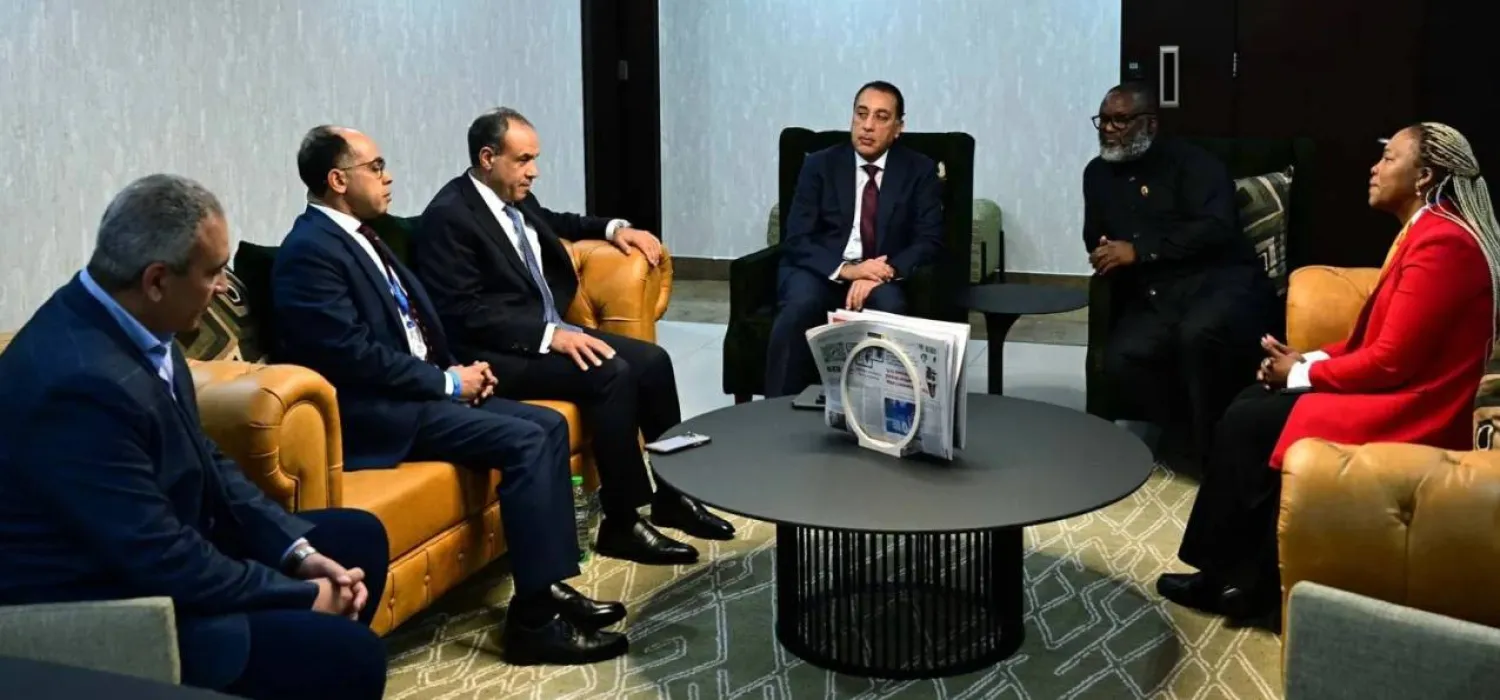
Egyptian Prime Minister Mostafa Madbouly on Friday held talks with senior South African officials on the sidelines of the G20 Summit 2025 (Egyptian cabinet)
TT

Egypt’s PM from South Africa: Strengthening Partnership and Coordination on African Issues

Egyptian Prime Minister Mostafa Madbouly on Friday held talks with senior South African officials on the sidelines of the G20 Summit 2025 (Egyptian cabinet)

Egyptian Prime Minister Mostafa Madbouly held on Friday talks with senior South African officials on the sidelines of the G20 Summit in Johannesburg aimed at “strengthening the partnership between the two countries and coordination on African issues.”

Madbouly is attending the high-profile global event on behalf of President Abdel Fattah El-Sisi. The G20 Summit is scheduled to take place on Saturday and Sunday.

On Friday, the Egyptian PM held talks with representatives from around 40 major companies and leading research centers in South Africa to enhance economic partnership and fostering mutual investment between the two countries.

He said Egypt views cooperation with South Africa and other major countries on the continent, such as Nigeria, as a means to achieve continental integration, adding that his country also seeks cooperation and integration, not competition, with any other countries.

The PM also underlined Cairo’s interest in establishing a joint business council with South Africa and hosting its first meeting in Egypt, asserting the importance of greater connection and cooperation between Egyptian companies and their South African peers.

Egyptian economic expert, Dr. Rashad Abdo, said both Egypt and South Africa possess the necessary elements to forge an economic partnership.

He told Asharq Al-Awsat that such cooperation supports economic development in both countries, and enhances the opportunities for economic integration in African countries.

During his meeting with South African business representatives, the PM emphasized Egypt's desire to bolster economic, trade, and investment partnerships between Cairo and Cape Town.

He also underscored Egypt's readiness to overcome any existing challenges and provide necessary incentives that could contribute to increasing flow of investments from South Africa to Egypt.

Madbouly also reviewed investment opportunities in various sectors in Egypt, including the Suez Canal Economic Zone (SCZONE).

He stressed that the Zone represents one of the most promising opportunities for companies seeking a stable and cost-competitive business environment to enhance their access to regional and international markets.

Positioned at the intersection of three continents (Africa, Asia, and Europe), the Zone provides convenient logistics services, and duty-free access for goods to a number of markets, including the Middle East and Europe, the PM noted.

“Madbouly’s meetings in South Africa are of great political and economic importance,” said Ambassador Rakha Ahmed Hassan, a member of the Egyptian Council for Foreign Affairs.

He told Asharq Al-Awsat that in addition to their economic and trade relations, Egypt and South Africa hold discussions and coordinate on many regional and African issues.

“Egypt has promising investment and trade opportunities, and has good relations with most of the G20 countries,” Ahmed Hassan said. Therefore, he noted, “the development of trade and economic cooperation between Egypt and South Africa will have direct practical benefits through the BRICS and G20.”

On Friday, Egyptian Foreign Minister Badr Abdelatty affirmed Egypt’s keenness to strengthen cooperation, expand joint investments, and advance economic integration with South Africa.

He announced that he will lead a delegation of Egyptian business leaders on an official visit to South Africa next year.



Libya’s Presidential Council Adopts National Reconciliation Charter Amid Rising Divisions

Menfi during the adoption of the National Reconciliation Charter in Tripoli (Presidential Council)
TT

Libya’s Presidential Council Adopts National Reconciliation Charter Amid Rising Divisions

Menfi during the adoption of the National Reconciliation Charter in Tripoli (Presidential Council)

Libya’s Presidential Council Chairman Mohamed al-Menfi on Wednesday adopted the National Reconciliation Charter, describing it as “the beginning of a new phase of serious work toward achieving social peace and justice,” despite escalating political tensions and deepening divisions.

The announcement comes as disputes persist between the House of Representatives and the High Council of State. The latter has urged the United Nations mission to maintain neutrality, defending its unilateral move to reconstitute the board of the High National Elections Commission and warning against any “reproduction of past crises.”

Speaking at a ceremony in Tripoli, Menfi said the charter was the result of national efforts grounded in dialogue and tolerance, and marked the start of translating reconciliation principles into daily practice.

He voiced support for the High Council for Peace and Reconciliation to implement the charter, rebuild trust, and address grievances. Menfi also declared January 7 a National Day for Peace and Reconciliation, calling reconciliation a religious, national, and strategic obligation that ensures the future of coming generations.

Under the 2021 Geneva agreement, the national reconciliation file formally falls under the Presidential Council’s authority. However, little tangible progress has been made over the past five years amid political fragmentation, despite multiple preparatory meetings and conferences sponsored by the African Union.

Renewed talk of reconciliation has coincided with intensified political escalation between the House of Representatives and the High Council of State, following the latter’s unilateral election of a new board for the High National Elections Commission. The move prompted sharp criticism from the UN mission, which expressed serious concern over rising tensions between the two bodies over the commission’s leadership.

In response, the High Council of State expressed surprise at the UN statement. While reaffirming the mission’s role in supporting Libya’s political process, it stressed that the sovereign powers of Libyan institutions, as defined by the constitutional declaration and its amendments, must not be bypassed or handled outside established constitutional and legal frameworks.

The council said reconstituting the elections commission falls within its core competencies and is consistent with constitutional procedures and the 2015 Skhirat Political Agreement, noting that the House of Representatives had taken similar steps in the past without drawing international criticism.

Observers say the dispute reflects an escalating struggle between Libya’s rival institutions over sovereign posts and the electoral track, highlighting growing tensions between national ownership of the political process and international involvement, as elections remain central to the contest for power and legitimacy.


Pay Cuts and Layoffs: UNRWA Faces Sudden Crisis with Palestinian Institutions

Israeli soldiers stand outside UNRWA’s headquarters in the Gaza Strip (AFP)
TT

Pay Cuts and Layoffs: UNRWA Faces Sudden Crisis with Palestinian Institutions

Israeli soldiers stand outside UNRWA’s headquarters in the Gaza Strip (AFP)

A crisis has erupted between the United Nations Relief and Works Agency for Palestine Refugees (UNRWA) and several Palestinian institutions following a decision by the agency to lay off hundreds of employees and cut the salaries of others.

UNRWA informed its local staff from the Gaza Strip who are currently outside the territory that their employment would be terminated immediately and officially, citing the severe monetary crisis facing the agency.

Employees and organizations monitoring UNRWA’s work circulated a decision signed by Sam Rose, acting director of UNRWA affairs in Gaza, announcing the termination of contracts for more than 600 employees under an “exceptional leave” provision in accordance with regulations governing local staff.

The decision stated that UNRWA Commissioner-General Philippe Lazzarini had approved the move as formal notice of termination, while pledging to preserve employees’ financial rights through a mechanism yet to be agreed upon.

The decision cited a crippling financial shortfall that has left UNRWA unable to secure sufficient funds to continue paying salaries and meeting its programmatic obligations.

According to Palestinian sources specializing in refugee and UNRWA affairs, the decision affects 622 employees, the majority of them education staff who were forced to leave Gaza with their families because of the war. Most are currently in Egypt.

The Joint Refugee Committee described the move as “arbitrary and inhumane,” saying it constitutes “a direct assault on employees’ dignity and their right to work and live in safety.” It stressed that staff did not leave Gaza by choice, but fled war, bombardment, starvation, and disease, noting that many are ill or caring for sick relatives.

The committee held Lazzarini fully responsible for the decision, which comes near the end of his term, and called for its immediate reversal and the reinstatement of dismissed staff.

The Refugee Affairs Department of the Palestine Liberation Organization also rejected the decision, describing it as “a dangerous approach that goes beyond a funding crisis to amount to systematic administrative execution.”

Ahmad Abu Houli, a member of the PLO Executive Committee and head of the Refugee Affairs Department, said the 20 percent salary cuts for Gaza and West Bank staff, the termination of contracts for 570 Gaza employees abroad, and the replacement of UNRWA guards in Amman with a private security company amounted to “a stab in the back” of employees who had served as a safety valve for the agency and lost 382 colleagues killed under Israeli bombardment.

Palestinian factions, including Fatah and Hamas, also condemned the decision, calling it an unjustified escalation that violates employees’ rights and deepens their suffering amid war and siege. Palestinian human rights groups likewise denounced the move as illegal under wartime conditions in Gaza.


Lebanese Expat Admits to Working with Israel in Abduction of Former Officer

Retired Lebanese General Security officer Ahmad Shukr, who was abducted in eastern Lebanon (Family file photo / Asharq Al-Awsat)
TT

Lebanese Expat Admits to Working with Israel in Abduction of Former Officer

Retired Lebanese General Security officer Ahmad Shukr, who was abducted in eastern Lebanon (Family file photo / Asharq Al-Awsat)

Lebanese authorities have concluded their investigation into the abduction and disappearance of retired General Security captain Ahmed Shukr, reaching what officials described as a “decisive conclusion” three weeks after he vanished under mysterious circumstances.

A senior judicial source told Asharq Al-Awsat that Shukr was kidnapped in a “highly precise and complex security operation” planned and executed by Israel’s Mossad, which exploited security gaps and relied on the direct cooperation of a Lebanese operative recruited specifically for the mission.

The source stressed that the operation “was not random, but part of an organized intelligence effort,” adding that Shukr was targeted for reasons that remain unknown.

Public Prosecutor Judge Jamal Hajjar ordered the closure of the investigation’s preliminary phase, during which only one suspect was arrested: A Lebanese expatriate residing in Africa, believed to have worked for the Mossad and to have played a central role in luring and abducting Shukr.

According to the judicial source, the suspect initially denied any involvement but soon confessed to cooperating with the Mossad and carrying out multiple assignments, including the task of luring Shukr prior to his abduction.

He admitted to meeting Mossad officers in Africa and receiving payments ranging from $5,000 to $10,000 for each mission.

Investigators said the suspect had prior acquaintance with Shukr, enabling him to build a relationship of trust. After returning to Lebanon roughly ten days ago — apparently in an attempt to dispel suspicion — the suspect rented an apartment owned by Shukr in the town of Choueifat.

Investigators described this detail as crucial in understanding how Shukr was drawn into the trap, alongside other technical and logistical evidence that reinforced the conclusion the operation was carried out with high precision under the supervision of a professional intelligence service.

The suspect’s confessions were corroborated by technical evidence, particularly telecommunications data tracing Shukr’s movements and the timing of his disappearance.

While the initial phase of the investigation has been concluded, authorities say it remains open to the possible involvement of additional suspects believed to be inside Lebanon. Efforts are also ongoing to determine Shukr’s fate, which remains unknown.

The case is expected to be referred to Government Commissioner to the Military Court Judge Claude Ghanem for prosecution of the suspect and anyone else implicated.

Hajjar has also issued search warrants for two individuals—a Swedish national of Syrian origin and a French national of Lebanese origin, suspected of luring Shukr from his hometown of Nabi Sheet to an area near Zahle under the pretext of assisting with a property purchase.

Both men disappeared following Shukr’s abduction. The Swedish suspect is known to have left Lebanon via Beirut’s international airport within hours, while it remains unclear whether the French suspect fled illegally.

Investigators believe the operation may be linked to the long-standing case of Israeli pilot Ron Arad, who went missing in Lebanon in 1986.

Shukr’s family has rejected links to Fuad Shukr, a Hezbollah official killed by Israel in July 2024 in Beirut’s southern suburbs, saying no one in the town even knew him.