


Israeli Settler Violence Rises in West Bank Under Iran War Curbs

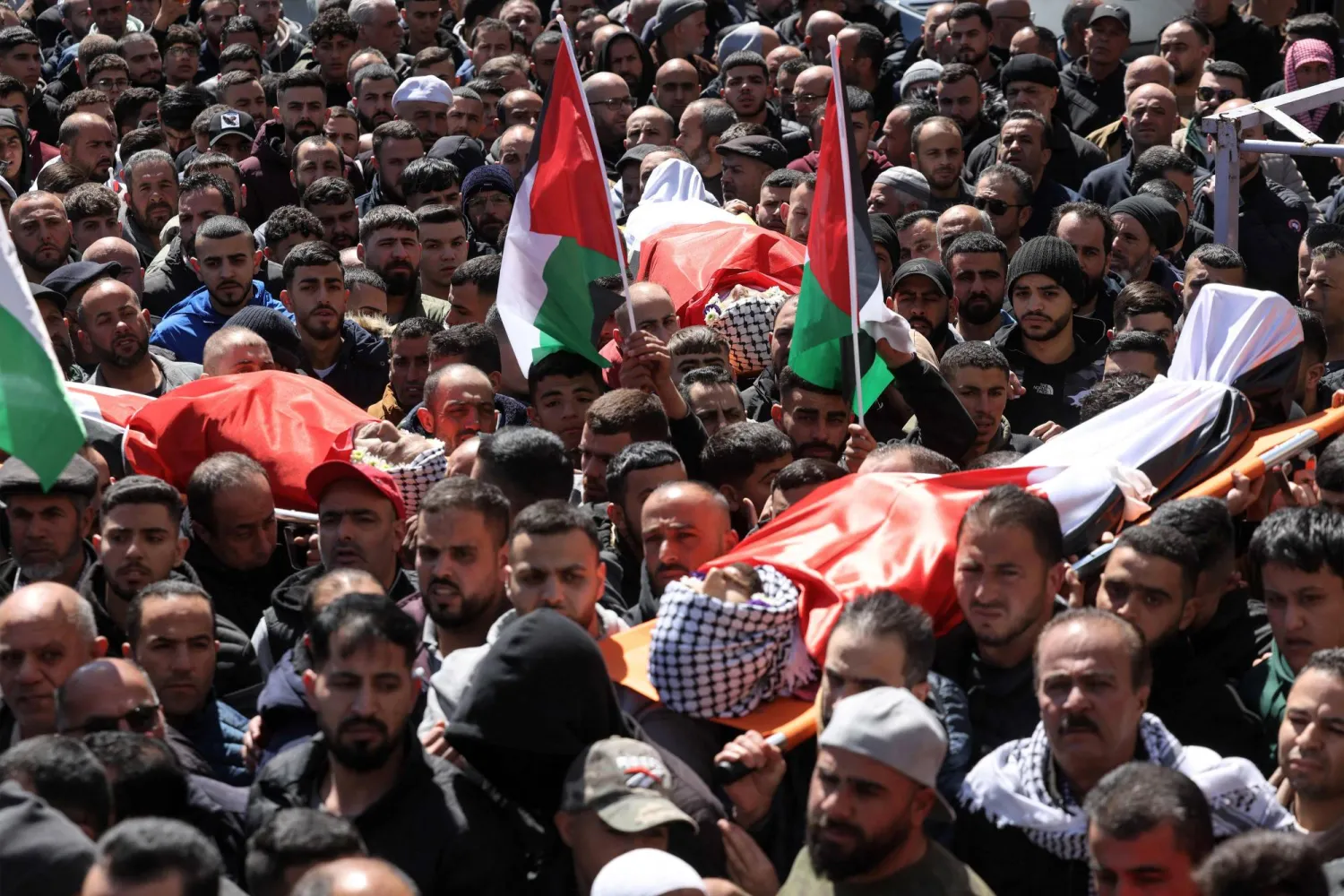
Mourners carry the bodies of three Palestinians killed in a reported attack by Israeli settlers in the town of Abu Falah, northeast of Ramallah in the occupied West Bank, during the funeral on March 8, 2026. (Photo by Zain JAAFAR / AFP)
TT

Israeli Settler Violence Rises in West Bank Under Iran War Curbs

Mourners carry the bodies of three Palestinians killed in a reported attack by Israeli settlers in the town of Abu Falah, northeast of Ramallah in the occupied West Bank, during the funeral on March 8, 2026. (Photo by Zain JAAFAR / AFP)

Israeli settlers in the occupied West Bank are taking advantage of curbs on movement imposed during the war on Iran to attack Palestinians, with military roadblocks preventing ambulances reaching victims quickly, rights groups and medics say.

Settlers have killed at least five Palestinians in the West Bank since the United States and Israel began airstrikes against Iran on February 28, according to the Palestinian health ministry. A sixth man died after inhaling teargas fired during an attack, according to Israeli rights group B'Tselem.

Israel's military blocked many West Bank roads with iron gates and mounds of earth on the first day of the war, and has largely shut crossings with Israel.

The Israeli military says the curbs are preemptive measures while it is carrying out airstrikes on Iran and against Lebanese group Hezbollah, which has fired missiles at Israel in solidarity with Tehran.

Palestinians in remote West Bank villages say the roadblocks have left them increasingly exposed to settler violence.

The Israeli military has also continued to carry out the raids it frequently conducts in Palestinian cities and towns during peacetime to arrest Palestinians, often without charge, they say.

A spokesperson for the Yesha Council, which represents Jewish settlements, did not immediately respond to a Reuters request for comment on the attacks.

Malak ⁠Beirat's husband, Thaer, ⁠was one of two Palestinians who residents and the Palestinian health ministry say were shot dead by settlers before dawn on Sunday in Abu Falah, north of the city of Ramallah.

"Thaer loved life. I never expected he would die," said Beirat, fighting back tears as she sat with her two children.

Witnesses told Reuters that when over 100 settlers gathered on the outskirts of Abu Falah, a local WhatsApp group rallied men to protect the small village. The initial confrontation involved stone throwing, but armed settlers arrived later and began shooting, they said.

Beirat's husband was shot dead while trying to protect a house from attack, a man who helped defend the village said.

Blood could still be seen on Monday in olive groves at the scene of the attack, where villagers have erected ⁠two Palestinian flags at the spots where the two men were killed - one for each victim.

A third Palestinian died after the attack. B'Tselem said his death was probably caused by the effect of teargas fired by Israeli troops deployed to the village during the attack.

The Israeli military says an investigation has been launched into the incident and that it condemns "violence of any kind".

Medics say the new roadblocks have led to delays in reaching injured Palestinians.

"There are obstacles - and even attacks by settlers and the military on the (medical) crews," said Ahmed Jibril, spokesman for the Palestinian Red Crescent ambulance service.

There have been over 109 reports of settler violence against Palestinians in the West Bank since the start of the war with Iran including shootings, physical assaults, property damage, and threats, said Israeli monitoring group Yesh Din.

All the reported killings of Palestinians by settlers this year were in the last week, B'Tselem said.

Settlers shot dead Amir Muhammad Shanaran in a village near the city of Hebron on Saturday, and brothers Muhammad and Fahim ‘Azem were shot dead in Qaryut southeast of the city of Nablus last Monday, the Palestinian health ministry said.

"Taking advantage of the war, armed settler ⁠militias, often operating with support from the ⁠army, continue to attack and harass Palestinian communities across the West Bank in an effort to force them out," B'Tselem said.

In three of the settler shootings, the settlers were wearing Israeli army uniform, Yesh Din said. The Israeli military did not immediately respond to a request for comment.

Palestinians accuse the military of protecting settlers rather than villagers. Israel's military denies this.

Israeli indictments of settler violence are rare. At the end of 2025, Yesh Din said that of the hundreds of cases of settler violence it had documented since the Hamas-led attacks on Israel in October 2023 that led to the Gaza war, only 2% resulted in indictments.

The United Nations says nearly 700 Palestinians were displaced by settler violence from the start of 2025 through early February 2026.

Israel's government has expanded settlements in a construction push that Finance Minister Bezalel Smotrich says is aimed at burying the idea of a Palestinian state.

Right-wing Israeli minister Yossi Dagan announced on Wednesday the establishment of a new settlement in a strategic position in the mountain overlooking Nablus, one of 22 new settlements announced by the Israeli government last May.

Palestinians have long sought an independent state in the West Bank, Gaza and East Jerusalem, territories Israel captured and occupied in the 1967 Middle East war.

Over 700,000 settlers live in East Jerusalem and the West Bank among more than 3 million Palestinians, according to a European Union report in 2024.
Most of the world considers Israel's settlement activity in the West Bank illegal under international law relating to military occupations. Israel disputes this view.



Palestinian Presidency Condemns Continued Israeli Closure of Al-Aqsa Mosque

20 February 2026, Palestinian Territories, Jerusalem: Palestinians perform the Taraweeh prayers in the courtyards of the Al-Aqsa Mosque on the third day of Ramadan. Photo: Department Of Islamic Awqaf In J/APA Images via ZUMA Press Wire/dpa
TT

Palestinian Presidency Condemns Continued Israeli Closure of Al-Aqsa Mosque

20 February 2026, Palestinian Territories, Jerusalem: Palestinians perform the Taraweeh prayers in the courtyards of the Al-Aqsa Mosque on the third day of Ramadan. Photo: Department Of Islamic Awqaf In J/APA Images via ZUMA Press Wire/dpa

The Palestinian Presidency condemned the continued Israeli closure of Al-Aqsa Mosque in Occupied Jerusalem, which has prevented worshippers from performing their religious rites during the holy month of Ramadan.

In a statement, the presidency said the measures constitute a serious violation of the historical and legal status of Al-Aqsa Mosque and other religious sites, SPA reported.

The Palestinian presidency also warned against attempts by the Israeli occupation to exploit the current atmosphere of regional tension and escalation to target religious sites in Jerusalem, reaffirming that Al-Aqsa Mosque, with its entire area of 144 dunams, is an Islamic place of worship exclusively for Muslims.

The statement further stressed the importance of preserving the existing historical and legal status quo at the Al-Haram Al-Sharif.


UN Warns Global Aid at Risk as Middle East War Spreads

A Sudanese refugee girl from al-Fashir rests next to a burnt tree in the middle of the Tine transit camp, amid the conflict between the paramilitary Rapid Support Forces (RSF) and the Sudanese army, in eastern Chad, November 23, 2025. REUTERS/Amr Abdallah Dalsh/File Photo
TT

UN Warns Global Aid at Risk as Middle East War Spreads

A Sudanese refugee girl from al-Fashir rests next to a burnt tree in the middle of the Tine transit camp, amid the conflict between the paramilitary Rapid Support Forces (RSF) and the Sudanese army, in eastern Chad, November 23, 2025. REUTERS/Amr Abdallah Dalsh/File Photo

The United Nations aid chief warned on Wednesday that the conflict in the Middle East is straining humanitarian operations worldwide, disrupting supply chains and slowing the delivery of life-saving assistance to numerous crisis zones.

“We are in a moment of grave peril for the Middle East and, actually I believe, for the wider world,” Tom Fletcher, the UN aid chief, told Reuters.

The US-Israeli war with Iran, which has expanded to Lebanon and dragged in Gulf countries, has convulsed global markets and disrupted supply chains, with airspace closures and the halt of shipping through the critical Strait of Hormuz.

Fletcher said aid supplies to Gaza and sub-Saharan Africa are being affected by the conflict, as humanitarian relief that needs to travel through the Strait of Hormuz or through airspace in the Gulf has been largely blocked or constrained.

Conflict-ridden Somalia, which is facing a major drought, and Sudan are among a number of countries facing dire humanitarian crises.

"These (constraints) will damage our humanitarian supply chains, reduce the humanitarian supplies we can get to people who need them, but they'll also drive up energy costs and food costs across the region," Fletcher said.

"This really is a perfect storm of factors right now, and I'm seriously worried," he stated.

There is particular concern for aid supplies to sub-Saharan Africa, Flether said, which are being impacted by restricted movement through the Strait of Hormuz, with alternative routes slapped with rising freight costs.

Higher oil prices are making the UN's aid deliveries by air more expensive, at a time when UN agencies and NGOs budgets are already facing major donor cuts, Fletcher explained.

"We've just about put some money together to keep more of our UN humanitarian flights in the air, but they've suddenly, almost overnight, become much more expensive," Fletcher said.


States Backing UN Peacekeepers in Lebanon Voice 'Deep Alarm' at Hostilities

Members of the UNIFIL peacekeeping force enter a bus at the site of an Israeli strike at the northern entrance of the southern city of Sidon, on November 7, 2024, amid the ongoing war between Israel and Hezbollah.  (Photo by Mahmoud ZAYAT / AFP)
Members of the UNIFIL peacekeeping force enter a bus at the site of an Israeli strike at the northern entrance of the southern city of Sidon, on November 7, 2024, amid the ongoing war between Israel and Hezbollah. (Photo by Mahmoud ZAYAT / AFP)
TT

States Backing UN Peacekeepers in Lebanon Voice 'Deep Alarm' at Hostilities

Members of the UNIFIL peacekeeping force enter a bus at the site of an Israeli strike at the northern entrance of the southern city of Sidon, on November 7, 2024, amid the ongoing war between Israel and Hezbollah.  (Photo by Mahmoud ZAYAT / AFP)
Members of the UNIFIL peacekeeping force enter a bus at the site of an Israeli strike at the northern entrance of the southern city of Sidon, on November 7, 2024, amid the ongoing war between Israel and Hezbollah. (Photo by Mahmoud ZAYAT / AFP)

Around 30 countries, including those with United Nations peacekeepers in Lebanon, voiced concern Wednesday over renewed fighting after Israel launched strikes in retaliation for attacks by Hezbollah.

"We troop contributing countries to the UN peacekeeping force in Lebanon, joined by several other member states, express our deep alarm at the escalation of hostilities in Lebanon," Jerome Bonnafont, the French ambassador to the United Nations, told reporters in New York, Reuters reported.

"Faced with war, Lebanon must be supported. Its sovereignty and territorial integrity must be preserved. We express our full solidarity with Lebanon and the Lebanese people," he added in the joint statement.

Bonnafont said the countries he represented, including France, Britain, Germany, India and Korea, "condemn in the strongest terms" Hezbollah's attacks.

He spoke as the Security Council was to meet at the UN headquarters to discuss the uptick in fighting in Lebanon, which has left 570 people dead, according to the country's health ministry.

Israel's UN envoy Danny Danon said Wednesday that Israeli forces will continue to operate in Lebanon "as long (as) there will be a threat against us."

"Israel does not want to be operating, but Israel will not accept rockets fired at our people, and we will do whatever is necessary to stop them," Danon told reporters.