


Sudan's Burhan Slams Trump Adviser, Rejects RSF's Return to Power 

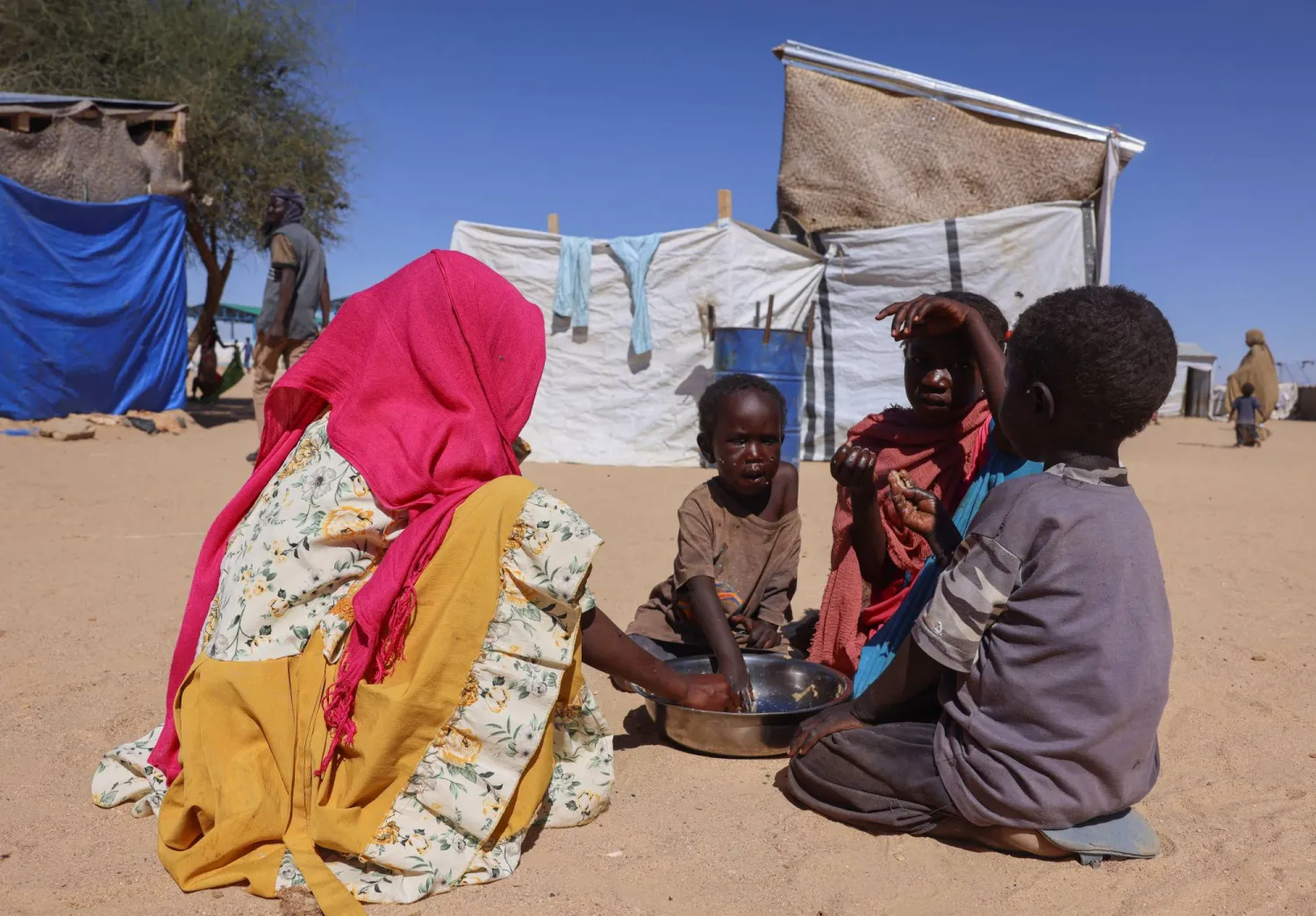
Sudanese refugee children from el-Fasher share a meal from a single plate at the Tine transit refugee camp, amid the conflict between the paramilitary Rapid Support Forces (RSF) and the Sudanese army, in eastern Chad, November 22, 2025. (Reuters)
TT

Sudan's Burhan Slams Trump Adviser, Rejects RSF's Return to Power 

Sudanese refugee children from el-Fasher share a meal from a single plate at the Tine transit refugee camp, amid the conflict between the paramilitary Rapid Support Forces (RSF) and the Sudanese army, in eastern Chad, November 22, 2025. (Reuters)

Sudan’s army commander Gen. Abdel-Fattah Burhan rejected late on Sunday any settlement that keeps the Rapid Support Forces (RSF) in power or allows it to be a partner in rule in the country, whether during a transitional phase or in the future.

He slammed US adviser for African affairs Massad Boulos as being biased to the RSF, while also expressing his doubt over the Quad’s initiative, describing it as the “worst proposal yet” to end the war.

He also slammed the United Arab Emirates’ involvement in the Quad, accusing it of supporting the RSF. He, however, praised the role played by Saudi Arabia and US President Donald Trump in helping end the conflict.

The Quad includes Saudi Arabia, the UAE, US and Egypt. The mediators have been trying for over two years to bring an end to the fighting and reestablish a path to democratic transition which was hampered by a military coup in 2021.

This month, Trump said that he plans to put greater attention on helping find an end to Sudan's war after being urged to take action by Prince Mohammed bin Salman, Saudi Crown Prince and Prime Minister, during his visit to the White House.

Boulos told The Associated Press earlier this month that the latest proposal to end the war calls for a three-month humanitarian truce followed by a nine-month political process.

The RSF said it has agreed to the truce, following global outrage over the paramilitaries’ atrocities in the Darfur city of el-Fasher. In a video speech late Monday, the paramilitary commander Gen. Mohammed Hamdan Dagalo reiterated the group's commitment to a three-month humanitarian truce and called for mediators to pressure the military to accept the proposal.

Burhan, Sudan's top general, said however that the proposal “is considered the worst document yet,” since it “eliminates the Armed Forces, dissolves security agencies and keeps the militia where they are” — referring to the RSF.

“If the mediation continues in this direction, we will consider it to be biased mediation,” he said.

He lashed out at the US adviser and accused him of attempting to “impose some conditions on us.”

“We fear that Massad Boulos will be an obstacle to the peace that all the people of Sudan seek,” Burhan said, without given further details about the plan.

Sudan plunged into chaos in April 2023 when a power struggle between the military and the RSF exploded into open fighting in the capital, Khartoum, and elsewhere in the country.

The devastating war has killed more than 40,000 people, according to UN figures, but aid groups say that is an undercount and the true number could be many times higher. It created the world’s largest humanitarian crisis with over 14 million people forced to flee their homes, fueled disease outbreaks and pushed parts of the country into famine.

On Monday, UN Secretary-General António Guterres called for an immediate ceasefire and for both the military and the RSF to negotiate a settlement.

Writing on social platform X, he also called for a “safe & unimpeded delivery of humanitarian aid," as well as an end to arms and fighters transfer to Sudan.

“We need peace in Sudan,” Guterres said.

In a statement Monday, the UAE's Foreign Ministry said Burhan, through his rejection of the ceasefire proposal, showed “obstructive behavior,” which it said “must be called out.”

Moreover, Burhan denied that the military is controlled by Islamists or that it used chemical weapons in its fighting against the RSF — an accusation leveled by the Trump administration in May.

Burhan said the military will only agree to a truce when the RSF completely withdraws from civilian areas to allow the return of displaced people to their homes, before embarking on talks for a political settlement to the conflict.

“We’re not warmongers, and we don’t reject peace,” he said, “but no one can threaten us or dictate terms to us.”



Barrack Presses Netanyahu to Accept a Turkish Role in Gaza

Photo of the meeting between the US Special Envoy to Syria, Tom Barrack, and Israeli Prime Minister Benjamin Netanyahu on Monday (Israeli Government). 
TT

Barrack Presses Netanyahu to Accept a Turkish Role in Gaza

Photo of the meeting between the US Special Envoy to Syria, Tom Barrack, and Israeli Prime Minister Benjamin Netanyahu on Monday (Israeli Government). 

Hebrew-language media reported that Israeli Prime Minister Benjamin Netanyahu met on Monday in Jerusalem with US envoy Tom Barrack, amid what were described as unusually blunt private messages from the administration of President Donald Trump ahead of a planned US–Israel summit later this month in Florida.

According to the reports, the talks focused on three files: Gaza, Syria and Netanyahu’s expected meeting with Trump.

On Gaza, Israeli daily Yedioth Ahronoth said Barrack sought to allay Netanyahu’s concerns about a Turkish role in any international force deployed to the enclave during a prospective second phase of a fragile ceasefire that began in October. Barrack, the paper reported, argued that Türkiye has the greatest leverage over Hamas and is best placed to persuade the group to disarm.

The newspaper said Barrack reminded Netanyahu that Ankara had endorsed the Trump administration’s ceasefire framework for Gaza and had pledged, on Hamas’s behalf, to provisions related to weapons handover. He reportedly said that Turkish participation would also encourage other hesitant countries to join an international force.

According to Yedioth Ahronoth, Barrack warned that excluding Türkiye would cause those states to step back, adding that Trump would not allow the initiative to fail. Netanyahu’s public statements questioning whether Hamas would ever relinquish its weapons — and his assertion that only Israel could enforce that outcome — were described by Barrack as “unacceptable” and as jeopardizing the plan.

Israel’s Channel 12 also reported that the White House delivered a “private and sharp” message to Netanyahu, asserting that the killing of a senior Hamas military figure, Raed Saad, constituted a breach of the ceasefire brokered with Trump’s mediation.

The channel cited growing tension between the Trump administration and Netanyahu’s government over moving to the deal’s second phase and over Israel’s broader regional policies.

Two US officials were quoted as saying that Secretary of State Marco Rubio, White House envoy Steve Witkoff, and Jared Kushner, the president’s son-in-law, were “deeply frustrated” with Netanyahu’s conduct.

One senior US official was quoted as telling Israeli media that the message to Netanyahu was explicit: if he chose to damage his own credibility, that was his decision, “but we will not allow you to damage President Trump’s reputation after he mediated the Gaza agreement.”

US officials were also cited as expressing rising concern over settler violence against Palestinians in the West Bank and what they termed Israeli “provocations” that undermine Washington’s efforts to expand the Abraham Accords. The United States, one official said, was not asking Israel to compromise its security, but to avoid steps perceived in the Arab world as inflammatory.

On Syria, Israeli assessments quoted in the press said Barrack outlined US “red lines,” stressing Trump’s desire to see stability there and warning that frequent Israeli operations could risk destabilizing the country. Reports added that Washington favors reaching a security understanding and wants to avoid actions it views as undermining the Syrian leadership.

Regarding Lebanon, Trump was said to support continued pressure on Hezbollah through limited operations, while opposing a broader escalation.

Despite recent criticism by Netanyahu of Barrack — including remarks questioning his impartiality — the envoy’s visit went ahead. Columnist Nahum Barnea wrote in Yedioth Ahronoth that US officials increasingly believe Netanyahu is not serious about advancing Trump’s peace plan and is intent on prolonging the war, language he said has sparked intense anger inside the White House.

Israeli analysts suggested Netanyahu is unlikely to reject all US requests outright, instead seeking partial accommodation to ensure a successful meeting with Trump on December 29. Yet, in a show of independence, Israeli forces reportedly carried out an airstrike in Syria shortly before Barrack arrived.

Netanyahu also announced a trilateral summit with Greece and Cyprus, a move widely interpreted in Israel as a political signal directed at Türkiye.

At the close of the meeting, Barrack was quoted as saying the talks were a “constructive dialogue aimed at achieving regional peace and stability.”


Sudan Once again Tops International Rescue Committee Crises Watchlist

FILE PHOTO: Sudanese people, who fled the conflict in Geneina in Sudan's Darfur region, receive rice portions from Red Cross volunteers in Ourang on the outskirts of Adre, Chad July 25, 2023. REUTERS/Zohra Bensemra/File Photo
TT

Sudan Once again Tops International Rescue Committee Crises Watchlist

FILE PHOTO: Sudanese people, who fled the conflict in Geneina in Sudan's Darfur region, receive rice portions from Red Cross volunteers in Ourang on the outskirts of Adre, Chad July 25, 2023. REUTERS/Zohra Bensemra/File Photo

Sudan has once again topped a watchlist of global humanitarian crises released by the International Rescue Committee (IRC) aid organization, as warring sides press on with a conflict that has killed tens of thousands of people.

It is the third time in a row Sudan has headed the list, which was published on Tuesday. It highlights the 20 countries most at risk of new or worsened humanitarian emergencies.

"What the IRC is seeing on the ground is not a tragic accident. The world is not simply failing to respond to crisis; actions and words are producing, prolonging, and rewarding it," IRC CEO David Miliband said in a statement.

"The scale of the crisis in Sudan, ranking first on this year’s Watchlist for the third year in a row and now the largest humanitarian crisis ever recorded, is a signature of this disorder."

War erupted in April 2023 from a power struggle between the Sudanese army and the paramilitary Rapid Support Forces ahead of a planned transition to civilian rule, and triggered the world's largest displacement crisis. More than 12 million people have already been displaced by the ongoing war in Sudan, where humanitarian workers lack resources to help those fleeing, many of whom have been raped, robbed or bereaved by the violence.

Sudan is followed by the Palestinian territories, South Sudan, Ethiopia and Haiti, according to the list.

The IRC said although these countries are home to just 12% of the global population, they account for 89% of those in humanitarian need. It added that the countries are projected to host more than half of the world's extreme poor by 2029.

The remaining countries on the list are Myanmar, Democratic Republic of Congo, Mali, Burkina Faso, Lebanon, Afghanistan, Cameroon, Chad, Colombia, Niger, Nigeria, Somalia, Syria, Ukraine and Yemen.


Torrential Rains and Flash Floods Kill 37 in Moroccan City of Safi

People inspect the damage caused by flash floods in Safi, Morocco, Monday, Dec. 15, 2025. (AP Photo/Abderrazak Gouach)
TT

Torrential Rains and Flash Floods Kill 37 in Moroccan City of Safi

People inspect the damage caused by flash floods in Safi, Morocco, Monday, Dec. 15, 2025. (AP Photo/Abderrazak Gouach)

Floods triggered by torrential rains have killed at least 37 people in the Moroccan coastal city of Safi, the Interior Ministry said Monday.

Authorities said heavy rain and flash floods overnight inundated about 70 homes and businesses and swept away 10 vehicles. The Interior Ministry reported 14 people hospitalized.

Local outlets reported that schools announced three days of closures. Rains also caused flooding and damage elsewhere throughout Morocco, including the northern city of Tetouan and the mountain town of Tinghir.

Safi, a city on Morocco’s Atlantic shore more than 320 kilometers (200 miles) from the capital, Rabat, is a major hub for the country’s critical fishing and mining industries. Both employ thousands to catch, mine and process the commodities for export. The city, with a population of more than 300,000 people, is home to a major phosphate processing plant.

Videos shared on social media showed cars stranded and partially submerged as floodwaters surged through Safi’s streets.

Climate change has made weather patterns more unpredictable in Morocco. North Africa has been plagued by several years of drought, hardening soils and making mountains, deserts and plains more susceptible to flooding. Last year, floods in normally arid mountains and desert areas killed nearly two dozen people in Morocco and Algeria.

This week's floods came after 22 people were killed in a two-building collapse in the Moroccan city of Fez. Morocco has invested in disaster risk initiatives although local governments often do not enforce building codes and drainage systems can be lacking in some cities. Infrastructural inequities were a focus of youth-led protests that swept the country earlier this year.

"This is a disaster, I have never seen anything like this in my lifetime," Khalil Sidki, 67, a Safi resident and member of the local branch of the Moroccan Association of Human Rights, told The Associated Press.

He said the flooding caught people by surprise in a commercial area. In reaction, many shopkeepers locked themselves inside their stores, but as water levels climbed up to 4 meters (13 feet), shops were submerged, killing those trapped inside, he said. Another Safi resident described similar scenes.

Moroccan authorities launched an investigation into the cause of the flooding. Safi received 46 millimeters (less than 2 inches) of rainfall over 24 hours — a level Houcine Youabid from Morocco’s General Directorate of Meteorology described as “normal” for the region. He said infrastructure issues could have combined with the rainfall to contribute to the flooding.

Parts of the North African nation experienced heavy rain and snow over the weekend, and authorities issued alerts for similar conditions throughout the coming days.