

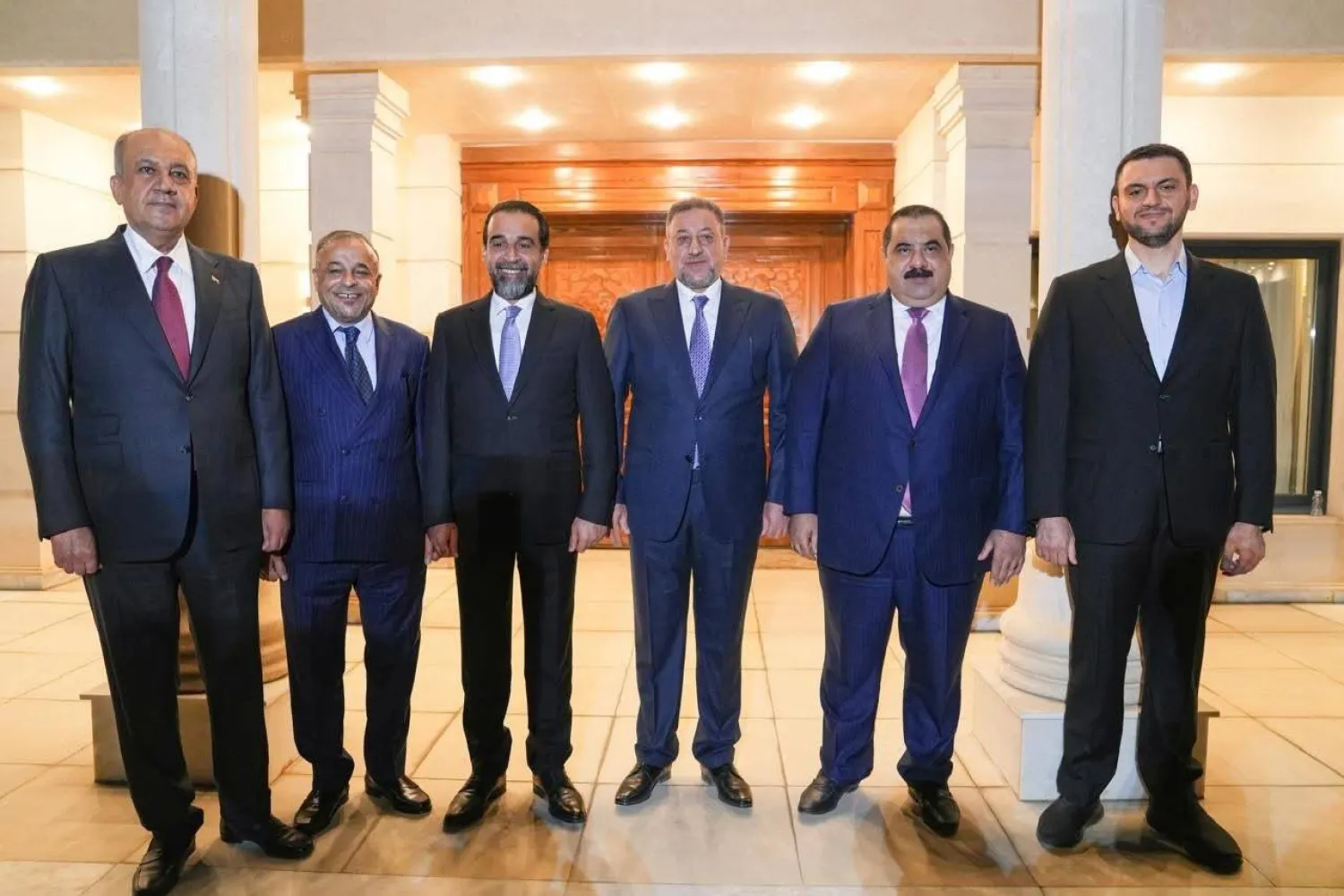

Sunnis of Iraq Form ‘National Political Council’ Similar to Shiite ‘Coordination Framework’

The Sunni leaders after the announcement of the formation of the National Political Council. (Council media)
TT

Sunnis of Iraq Form ‘National Political Council’ Similar to Shiite ‘Coordination Framework’

The Sunni leaders after the announcement of the formation of the National Political Council. (Council media)

Major Sunni powers and parties in Iraq declared the formation of a unified bloc, following the example of the Shiite forces that had formed the Coordination Framework a few years ago.

The new National Political Council brings together the main parties that won over 65 seats in this month’s parliamentary elections. The bloc is formed of the Taqadum party, led by former parliament Speaker Mohammed al-Halbousi, the Azm Alliance, led by MP Muthanna al-Samarrai, the Sovereignty coalition, led by Khamis al-Khanjar, the National Resolution Alliance (al-Hasm al-Watani), headed by Defense Minister Thabet al-Abbasi, and the National Masses Party (al-Jamaheer al-Wataniya), led by former MP Ahmed al-Jubouri.

The council held its first meeting at Khanjar’s Baghdad residence on Sunday. The gatherers stressed that the council will "coordinate stances and unify visions and decisions over major national files," said a statement after the meeting.

They discussed various political developments and the challenges facing Iraq, in their provinces in particular. They stressed the importance of unifying efforts and working on a joint vision to maintain political and social stability, ensure constitutional rights and bolster representation at state institutions.

The members of the council mostly represent Iraq’s northern and western provinces, such as Nineveh, Salaheddine and al-Anbar, as well as the eastern Diyala province.

The gatherers said the council "will be open to all national partners and is committed to the principles that consolidate Iraq’s unity and stability and maintain the rights of its people without exception, based on a national vision that aims to build a strong and just state for all."

A source informed of Sunni disputes predicted that the council will fail given that the Sunnis "are beholden to foreign sponsors."

Speaking to Asharq Al-Awsat on condition of anonymity, he said it was "good for the Sunni party leaders to agree on a framework for understanding and decision-making" given the unity of Shiite forces, "however, achieving it won’t be that easy, unfortunately."

"The main problem with the Sunnis is that several of them are beholden to regional sponsors, such as Türkiye, some Gulf countries, Jordan and Iran," he added.

"The Shiites, meanwhile, are all allied with Tehran," he explained.

Besides the foreign sponsors, the Sunnis have "deep conflicting interests within their own parties, which will hinder their efforts to unite. For example, some leaders are eying the presidency, others the position of parliament speaker, while the Shiites are all holding on to the post of prime minister," continued the source.

He also noted how some powerful Shiite forces are not above intimidation "to sabotage Sunni efforts to unite."

Political analyst and former diplomat Dr. Ghazi Faisal said the Sunni formation of a political council was a "qualitative leap" that may help unify stances on economic, social and legal affairs.

"Should the council remain united, it may stand against unilateral actions by the Shiites in parliament and government," especially if it managed to coordinate its positions with Kurdish parties, he told Asharq Al-Awsat.

Professor of International Relations at the University of Mosul Dr. Firas Elias predicted that the council "will ultimately fail and will not be allowed to succeed for several political reasons, namely because it is not guided by strong political rules like those held by the Coordination Framework."

He told Asharq Al-Awsat that since 2003, the Sunnis have repeatedly failed in uniting because they are driven by their personal interests rather than the interests of a whole bloc.

Moreover, he noted that the formation of the council was a reaction to the parliamentary elections results and what appears to be possible rapprochement between the Shiites and Kurdish powers.



UN Condemns Israel's Moves against Agency for Palestinian Refugees

UNRWA center targeted by Israeli shelling in northern Gaza (DPA)
TT

UN Condemns Israel's Moves against Agency for Palestinian Refugees

UNRWA center targeted by Israeli shelling in northern Gaza (DPA)

The United Nations warned Tuesday that recent actions by Israel against the UN agency for Palestinian refugees risked depriving millions of people of basic services such as education and healthcare.

Israel's parliament passed new legislation on Monday formally stripping the United Nations Relief and Works Agency (UNRWA) of diplomatic immunity, and barring Israeli companies from providing water or electricity to the agency's institutions, AFP reported.

According to UNRWA, the legislation also grants the Israeli government the authority to expropriate the agency's properties in East Jerusalem, including its headquarters and main vocational training center.

UNRWA chief Philippe Lazzarini condemned the legislation as "outrageous", decrying it on social media as "part of an ongoing, systematic campaign to discredit UNRWA and thereby obstruct the core role that the agency plays providing human-development assistance and services to Palestine refugees".

Filippo Grandi, the outgoing head of the UN refugee agency, UNHCR, and a former UNRWA chief, also criticised the move as "very unfortunate".

In an interview with AFP, he highlighted that UNRWA, unlike other UN agencies, provides basic public services such as education and healthcare to the millions of registered Palestinian refugees it serves across Gaza and the West Bank, as well as in Lebanon, Jordan and Syria.

"If you deprive those people of those services... then you had better find a substitute," he said, warning: "I think it would be very difficult."

"At the moment, there is a great risk that millions of people will be deprived of basic services if UNRWA is further deprived of space to work, and resources to work."

Israel has been ratcheting up pressure on UNRWA over the past two years.

It has accused the agency of providing cover for Hamas militants, claiming that some UNRWA employees took part in the militant group's October 7, 2023 assault on Israel, which sparked the war in Gaza.

A series of UN-linked internal and external investigations found some "neutrality-related issues" at UNRWA, but stressed Israel had not provided conclusive evidence for its headline allegation.

Grandi criticised the torrent of accusations that have swirled around the agency.

"UNRWA is a very indispensable organization in the Middle East," he said.

"Contrary to much of the frankly baseless rhetoric that we have heard in the past couple of years, UNRWA is a force for peace and stability," he added.

"In a region in which you need every bit of stability and efforts towards peace, it would be really irresponsible to let such an important organization decline further."


Syria Imposes Night Curfew on Port City of Latakia

People watch as Syrian Security forces are deployed after clashes erupted during a protest in the city of Latakia, Syria, 28 December 2025. EPA/AHMAD FALLAHA
TT

Syria Imposes Night Curfew on Port City of Latakia

People watch as Syrian Security forces are deployed after clashes erupted during a protest in the city of Latakia, Syria, 28 December 2025. EPA/AHMAD FALLAHA

Syrian authorities imposed an overnight curfew in the coastal city of Latakia on Tuesday.

Authorities announced a "curfew in Latakia city, effective from 5:00pm (1400 GMT) on Tuesday, December 30, 2025, until 6:00am (0300 GMT) on Wednesday, December 31, 2025".


Jailed Turkish Kurd Leader Calls on Government to Broker Deal for Syrian Kurds

(FILES) Supporters display a poster depicting jailed leader of the Kurdistan Workers' Party (PKK) Abdullah Ocalan, after he called on the Kurdistan Workers' Party (PKK) to disarm and dissolve itself in Diyarbakir, southeastern Türkiye, on February 27, 2025. (Photo by Yasin AKGUL / AFP)
TT

Jailed Turkish Kurd Leader Calls on Government to Broker Deal for Syrian Kurds

(FILES) Supporters display a poster depicting jailed leader of the Kurdistan Workers' Party (PKK) Abdullah Ocalan, after he called on the Kurdistan Workers' Party (PKK) to disarm and dissolve itself in Diyarbakir, southeastern Türkiye, on February 27, 2025. (Photo by Yasin AKGUL / AFP)

Jailed Turkish Kurd leader Abdullah Ocalan said Tuesday that it was "crucial" for Türkiye’s government to broker a peace deal between the Kurdish-led Syrian Democratic Forces (SDF) and the Damascus government.

Clashes between Syrian forces and the SDF have cast doubt over a deal to integrate the group's fighters into the army, which was due to take effect by the end of the year, reported AFP.

Ocalan, founder of the Kurdistan Workers' Party (PKK) group, called on Türkiye to help ensure implementation of the deal announced in March between the SDF and the Syrian government.

"It is essential for Türkiye to play a role of facilitator, constructively and aimed at dialogue," he said in a message released by Türkiye's pro-Kurdish DEM party.

"This is crucial for both regional peace and to strengthen its own internal peace," Ocalan, who has been jailed for 26 years, added.

"The fundamental demand made in the agreement signed on March 10 between the SDF and the government in Damascus is for a democratic political model permitting (Syria's) peoples to govern together," he added.

"This approach also includes the principle of democratic integration, negotiable with the central authorities. The implementation of the March 10 agreement will facilitate and accelerate that process."

The backbone of the US-backed SDF is the YPG, a Kurdish group seen by Türkiye as an extension of the PKK.

Türkiye and Syria both face long-running unrest in their Kurdish-majority regions, which span their shared border.

In Türkiye, the PKK agreed this year at Ocalan's urging to end its four-decade armed struggle.

In Syria, Sharaa has agreed to merge the Kurds' semi-autonomous administration into the central government, but deadly clashes and a series of differences have held up implementation of the deal.

The SDF is calling for a decentralized government, which Sharaa rejects.

Turkish Foreign Minister Hakan Fidan, whose country sees Kurdish fighters across the border as a threat, urged the SDF last week not to be an "obstacle" to stability.

Syrian Kurdish leader Mazloum Abdi said Thursday that "all efforts" were being made to prevent the collapse of talks.