


Security Forces Confront Armed Group in Latakia, Launch Anti-ISIS Sweep in Aleppohttps://english.aawsat.com/arab-world/5212547-security-forces-confront-armed-group-latakia-launch-anti-isis-sweep-aleppo
Security Forces Confront Armed Group in Latakia, Launch Anti-ISIS Sweep in Aleppo
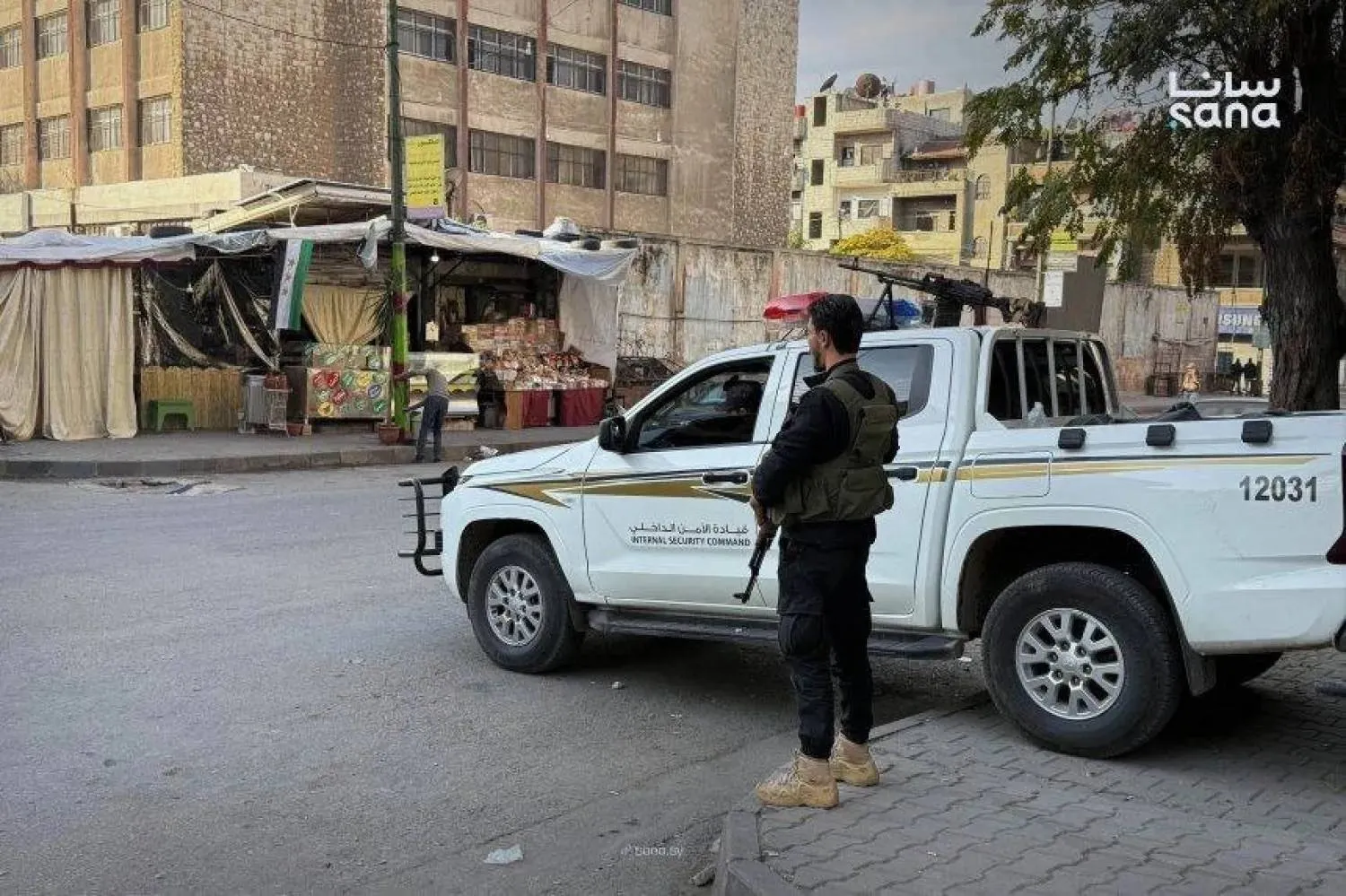
Security deployment and curfew in Homs (SANA)
Several regions in western, northern, and central Syria have recently witnessed simultaneous security incidents.
In Latakia Province, government forces clashed with an armed group described as “outlaws” in the coastal town of Al-Badrousiyah on Monday, while in northern Aleppo, security units launched a targeted campaign in Afrin against suspected cells belonging to ISIS. Meanwhile, the city of Homs remained tense under extended curfew hours following a day of unrest.
Residents in Latakia told Asharq Al-Awsat that security units stormed a seaside hotel where a group of armed men had barricaded themselves after forcibly seizing the property weeks earlier. The authorities were attempting to enforce an evacuation order when the group opened fire, triggering clashes that led to deaths and injuries.
A Syrian security source confirmed to state broadcaster Al-Ikhbariya that internal security units “eliminated several wanted outlaws” during the operation and were pursuing the remaining suspects.
In northern Aleppo, the Interior Ministry announced the launch of a joint operation in Afrin involving internal security forces and the General Intelligence Directorate. The operation targeted “ISIS hideouts and terrorist cells involved in hostile actions threatening public safety and stability,” according to a ministry statement.
In central Syria, authorities extended a curfew in parts of Homs after violence and vandalism swept through several neighborhoods on Sunday. Residents described a “very difficult day” marked by panic and rumors spreading rapidly on social media, raising growing fear among civilians, particularly women and children.
Sources confirmed cases of injury due to random gunfire but denied reports of deaths. Syrian state media reported a return to relative calm, with police and army units allowing limited movement so that residents could secure basic supplies.
In response to public outrage over a recent brutal crime in the nearby town of Zaidal, the victims’ families issued a statement rejecting any attempt to turn the incident into a sectarian conflict.
They emphasized their commitment to legal procedures and warned against fueling discord, urging tribal members, especially from the Bani Khaled clan, not to be swayed by incitement.
The families also distanced themselves from the riots in Homs, saying the violence “does not represent the Bani Khaled tribe.”
Interior Ministry spokesperson Noureddin al-Baba denied that the Zaidal crime had a sectarian motive, saying there was “no material evidence” to support such claims.
He added that preliminary investigations showed sectarian slogans at the scene were meant “to mislead and inflame tensions,” asserting that evidence points to a criminal, not sectarian, motive.
Security forces and army units have since reinforced deployments, set up checkpoints, and increased patrols to restore order and prevent further escalation.

Iran Races against Lebanese Negotiators to Secure Israeli Withdrawal from Southhttps://english.aawsat.com/arab-world/5284935-iran-races-against-lebanese-negotiators-secure-israeli-withdrawal-south
A woman flashes the victory sign next to destroyed buildings following Israeli strikes on the historic old market in the town of Nabatieh, southern Lebanon, 15 June 2026, after the announcement of a US-Iran mediated preliminary framework to end regional military hostilities and lift the naval blockade on the Strait of Hormuz. (EPA)
Iran Races against Lebanese Negotiators to Secure Israeli Withdrawal from South
A woman flashes the victory sign next to destroyed buildings following Israeli strikes on the historic old market in the town of Nabatieh, southern Lebanon, 15 June 2026, after the announcement of a US-Iran mediated preliminary framework to end regional military hostilities and lift the naval blockade on the Strait of Hormuz. (EPA)
Two tracks are moving in parallel to secure Israel’s withdrawal from occupied Lebanese territory. The first is Lebanon’s direct negotiations with Israel, which are scheduled for their fifth session next Monday in Washington.
The second is Iranian pressure to complete the withdrawal before Tehran reaches a nuclear agreement with Washington within a 60-day window.
Iran has told Hezbollah it will not sign the agreement before Israel fully withdraws from Lebanese territory, a source from the “Shiite duo” in Lebanon told Asharq Al-Awsat. The duo is comprised of Hezbollah and its ally the Amal movement headed by parliament Speaker Nabih Berri.
Lebanon has insisted from the start that direct talks with Israel address a package of demands, led by the full withdrawal of Israeli forces from Lebanese territory they occupied during the war.
The declared understanding between Washington and Tehran made no mention of the issue, according to leaks. But Iranian Foreign Minister Abbas Araghchi said on Tuesday that ending the war would not be complete “without the withdrawal of Israeli forces from the territories they occupied in this war.”
“Any military attack by the Zionist entity against Lebanon from now on, and any continued occupation of Lebanese territory from now on, will be considered, from our point of view, a violation of the memorandum of understanding,” he told a meeting with foreign diplomats broadcast by state television.
A displaced woman holds an Iranian flag as she makes her way back to her home in southern Lebanon, on the highway of Sidon, Lebanon, June 16, 2026. (Reuters)
Lebanon’s negotiation track
The Lebanese state, meanwhile, is pressing ahead with a new round of negotiations due to open next Monday in Washington and run until Wednesday, with developments to be discussed in security and diplomatic sessions.
The Lebanese presidency said President Joseph Aoun and Prime Minister Nawaf Salam discussed the preparations on Tuesday.
Aoun and Salam described the US-Iranian understanding as “a positive factor” in easing regional tensions and pushing toward peaceful solutions and an end to the war.
At the same time, they reaffirmed “Lebanon’s firm position in the Washington negotiations” on a final ceasefire, the withdrawal of Israeli forces, the deployment of the Lebanese army up to the international border, the release of Lebanese prisoners and the start of reconstruction.
Gradual withdrawal within 60 days
Iran and Hezbollah are pursuing a parallel track.
A source, who requested anonymity, told Asharq Al-Awsat that the agreement between Iran and the United States “stipulates a ceasefire, a halt to Israeli attacks and a guarantee of Lebanon’s territorial integrity.”
The source said this would require Israeli commitment, “guaranteed by the United States.”
“Hezbollah was informed by the Iranian side that Israel, after the agreement is signed next Friday, must begin a gradual withdrawal from inside occupied Lebanese territory and complete the withdrawal before the date of signing the nuclear agreement with Iran,” the source said, referring to the 60-day deadline.
“The party was informed that Tehran will not sign the nuclear agreement with Washington before Israel’s full withdrawal,” the source added.
Hezbollah Secretary-General Naim Qassem on Tuesday sent a message of thanks to Iranian parliament Speaker Mohammad Baqer Ghalibaf “for obliging the Israeli entity to immediately and permanently halt military operations on all fronts, including Lebanon, in connection with the end of the war on Iran, as the first and fundamental clause of the agreement between Iran and America.”
Lebanese Speaker Nabih Berri and Ghalibaf discussed, in a phone call, field and political developments linked to the deal between the United States and Iran, especially the clause on ending Israel’s war on Lebanon.
A statement from the Lebanese parliament said Ghalibaf and Berri “stressed the need for the United States, the guarantors of the memorandum of understanding and the international community to assume their responsibility to compel Israel to end its war, stop demolishing villages, respect Lebanon’s sovereignty and withdraw immediately from the territories it occupied.”
Vehicles line up on the Rmeileh highway as displaced Lebanese return to their villages in southern Lebanon, 15 June 2026, after the announcement of a US-Iran mediated preliminary framework to end regional military hostilities and lift the naval blockade on the Strait of Hormuz. (EPA)
Hezbollah’s opponents doubtful
Inside Lebanon, Hezbollah’s opponents questioned Iran’s ability to force an Israeli withdrawal from Lebanon.
Members of the Strong Republic parliamentary bloc and the executive body of the Lebanese Forces party said after an extraordinary meeting that any agreement between the United States and Iran “remains a matter concerning the two states involved.”
“The ceasefire mentioned in the agreement is general and concerns the Middle East region. It has no practical repercussions for Lebanon because the party fighting in Lebanon is Israel, not the US,” they said in a statement.
They accused Tehran of “providing verbal services to Hezbollah so that it can continue fighting to achieve Iran’s objectives.”
They said that “what is required after all the suffering endured by the Lebanese people is not merely a ceasefire while keeping the old order in place, with Iran and Hezbollah forming an essential part of that old order, but a complete end to the successive wars that have torn Lebanon apart and impoverished it.”
They said the time had come to achieve that by dissolving illegal military organizations, “foremost among them Hezbollah.”
They also backed the direct negotiation track with Israel, describing it as “the only gateway to ending the wars in Lebanon and reaching an actual state that restores Lebanon’s Arab and international relations.”
The Kataeb Party stressed that Lebanon “is not concerned with any agreement involving Lebanon except one in which the Lebanese state and its legitimate institutions elected by the Lebanese people are involved, through the parties officially authorized to negotiate on their behalf in Washington.”
The party said those representatives were carrying out their role to restore Lebanon’s sovereignty and free decision-making, secure the Israeli withdrawal, halt attacks and complete government decisions to confine arms to the state and restore security decision-making to the official authorities.
At G7, Egypt’s Sisi Urges Israel to Halt Gaza Seizurehttps://english.aawsat.com/arab-world/5284913-g7-egypt%E2%80%99s-sisi-urges-israel-halt-gaza-seizure
President Donald Trump speaks with Egyptian President Abdel Fattah al-Sisi, center, and French President Emmanuel Macron, right, at a working lunch with leaders of G7 and the Middle East in Evian-les-Bains, France, Tuesday, June 16, 2026. (AP)
TT
TT
At G7, Egypt’s Sisi Urges Israel to Halt Gaza Seizure
President Donald Trump speaks with Egyptian President Abdel Fattah al-Sisi, center, and French President Emmanuel Macron, right, at a working lunch with leaders of G7 and the Middle East in Evian-les-Bains, France, Tuesday, June 16, 2026. (AP)
Egyptian President Abdel Fattah al-Sisi on Tuesday urged Israel to abandon its plan to take control of 70 percent of Gaza, as he attended the G7 summit in France.
Last month, Israeli Prime Minister Benjamin Netanyahu ordered the military to take control of more territory in the battered Gaza Strip, flouting the terms of a fragile ceasefire that took effect in October.
He said Israeli forces initially controlled about 50 percent of the enclave under the truce before advancing to around 60 percent and then directing a move towards 70 percent.
Under the ceasefire, Israeli forces were meant to pull back behind a so-called "yellow line," separating areas controlled by Palestinian group Hamas from those held by the Israeli army.
"Only 30 percent of the Strip is effectively left for the Palestinian people," Sisi said, at a G7 summit session on Middle East stability in the French resort of Evian.
This approach "must stop immediately", he added at the session which was also attended by G7 and EU leaders as well as the leaders of the United Arab Emirates and Qatar.
Sisi said there was "no alternative to reaching a just and lasting settlement to the Palestinian cause based on the two-state solution" and urged "the implementation of US President Donald Trump's plan for peace in the Gaza Strip".
Egypt, which shares a border with Gaza, has been a key mediator between Israel and Hamas since the group's October 7, 2023, attacks on Israel triggered the war in the enclave.
The first phase of the Gaza truce saw the release of the remaining hostages seized in the October 7 attacks, in exchange for Palestinians held by Israel.
The transition to the second phase, which was supposed to involve Hamas's disarmament and a gradual withdrawal of the Israeli army, has been stalled for months.
Gaza remains gripped by daily violence, with both the Israeli military and Hamas accusing one another of violating the truce.
Tension in Samarra Tests Iraq Govt's Plan to Impose State Monopoly over Armshttps://english.aawsat.com/arab-world/5284909-tension-samarra-tests-iraq-govts-plan-impose-state-monopoly-over-arms
A man walks past a portrait of the influential cleric Moqtada al-Sadr wearing the military uniform of Saraya al-Salam, in a street in Baghdad, during the provincial council elections in Iraq, on Dec. 18, 2023. (AFP)
TT
TT
Tension in Samarra Tests Iraq Govt's Plan to Impose State Monopoly over Arms
A man walks past a portrait of the influential cleric Moqtada al-Sadr wearing the military uniform of Saraya al-Salam, in a street in Baghdad, during the provincial council elections in Iraq, on Dec. 18, 2023. (AFP)
The Saraya al-Salam faction loyal to influential Iraqi cleric Moqtada al-Sadr said on Tuesday it firmly rejected serving under the command of the pro-Iran Popular Mobilization Forces, a dispute that could pose an early test for Prime Minister Ali al-Zaidi’s plan to bring arms under state control.
The rejection followed reports that a new security commander had been appointed in Samarra, where Sadr’s armed wing is based. The commander is rumored to be close to the Asaib Ahl al-Haq faction.
Asaib Ahl al-Haq, led by Qais al-Khazali, a leading member of the ruling Coordination Framework, has uneasy ties with the Sadrist movement and its leader, Sadr, for reasons observers describe as “political and ideological.”
A Sadrist official told Asharq Al-Awsat that Samarra was witnessing a “state of severe tension” because of “deliberate friction” by some commanders and parties in the PMF with Saraya fighters.
The official said the dispute erupted after PMF chief Falih al-Fayyadh dismissed Ali al-Aqili, the PMF operations commander in Samarra and a member of the Sadrist movement, and replaced him with another commander close to or affiliated with Asaib Ahl al-Haq.
The move angered Saraya fighters.
The official urged the prime minister, who is also commander-in-chief of the armed forces, to “intervene immediately to settle this matter,” saying Saraya was now under his command.
At the start of June, Zaidi issued an administrative order forming a higher committee to oversee Saraya al-Salam’s integration into government security forces and place it directly under the commander-in-chief.
The Joint Operations Command later said it had received the full lists and data for Saraya al-Salam formations, including personnel, weapons and equipment, to complete directives for integrating all Saraya al-Salam formations into security forces tied to the commander-in-chief.
Saraya al-Salam is part of the PMF through brigades 313, 314 and 315. It carries out security duties in several areas, most notably Samarra, where it has been based since June 2007, after the bombing of the Imam al-Askari shrine.
Sadr said on May 27 that he was integrating his armed wing, Saraya al-Salam, into the state and called on PMF factions to hand over their weapons.
Although formally part of the PMF, Saraya al-Salam has long operated semi-independently. It does not take orders from the PMF’s commanders and has poor relations with many factions.
Members of the Saraya al-Salam faction cheer during a ceremony marking the start of the process of handing over their weapons to Iraqi state forces in Samarra, north of Baghdad, Iraq, Thursday, June 4, 2026. (AP)
Test for weapons monopoly
The PMF has not commented on the tension. But Saraya al-Salam appealed to Sadr and Zaidi, stressing that it would not remain under PMF command.
In a statement on Tuesday, Saraya al-Salam pointed to its voluntary disarmament and integration into other security institutions, calling the move “a practical model” for placing weapons exclusively in the state’s hands.
It said the PMF’s recent dismissal of some commanders “contradicts the spirit of the integration process and the monopoly of weapons” through changes in commanders, sectors and responsibilities.
The faction said the appointment of the new security commander “conflicts with the provisions and procedures” of the integration committee formed by the government, calling it “an unjustified targeting” of Saraya personnel.
It stressed its categorical rejection of “working under the command of the Popular Mobilization Forces.”
Tribal sheikhs and clerics in Samarra warned on Saturday against replacing Saraya al-Salam with other factions. They called on the prime minister to visit the city personally and assess conditions on the ground.
They demanded that the security file be handed to the Interior Ministry if there was any intention to replace Saraya with other factions.
Observers see the standoff between Saraya al-Salam and the PMF as a challenge to the weapons control plan and to whether it is truly “serious and not merely symbolic.”
It is also a test of the prime minister’s readiness to use his powers to settle a dispute between armed groups that had already announced their integration into state institutions.
لم تشترك بعد
انشئ حساباً خاصاً بك لتحصل على أخبار مخصصة لك ولتتمتع بخاصية حفظ المقالات وتتلقى نشراتنا البريدية المتنوعة
